Unit 7 · Topic 7.5 · about 30 minutes · 7 parts · 11 scored checks, 1 of them multiple choice, plus 2 from earlier lessons
AP Chemistry 7.5: Magnitude of the Equilibrium Constant
Unit 7: 7 to 9% of the multiple-choice section
What you'll be able to do
- Explain how a very large or a very small value of K relates to the relative concentrations of the reactants and products at equilibrium.
Key vocabulary
| Term | What it means | The exam trap |
|---|---|---|
| Magnitude of K | How large or small the equilibrium constant is, judged by its power of ten. | Judge the size of K from its power of ten, not from the front number alone. |
| Proceeds essentially to completion | Describes an equilibrium so far toward the products that almost no reactant is left. | This phrase describes where the mixture ends up, so keep it separate from how fast the reaction runs. |
| Relative concentration | How the concentration of one species compares with another in the same mixture, such as [B] ÷ [A]. | A ratio depends on which species is on top, so read the order of the two concentrations before you decide which is larger. |
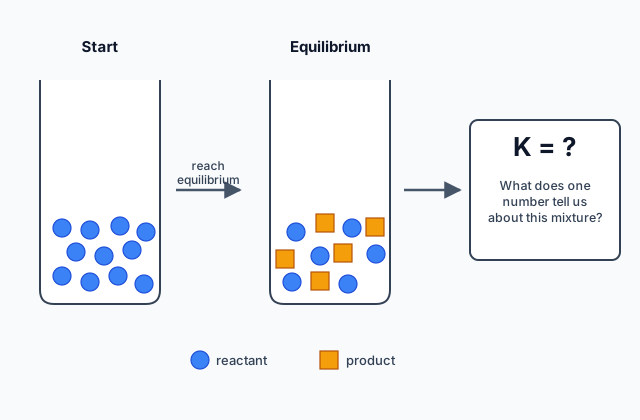 Tap to open the picture full size
Part 1 Think first Two extremes on a data sheet
Commit to a guess first. Being wrong now makes the right idea stick better.
Predict first
A water-treatment chemist keeps two reactions on a data sheet. Each one runs in a closed tank until it settles into equilibrium. Reaction 1 turns nearly all of its reactant into product. Reaction 2 makes almost no product at all. The sheet lists one number for each, its equilibrium constant K, but the ink has smudged. Which description of the two K values is most likely right?
In short. The size of the equilibrium constant tells how far a reaction goes: a very large K means the reaction proceeds essentially to completion, and a very small K means it barely proceeds.
- K puts the products on top and the reactants on the bottom, so a very large K means the product concentrations are far larger than the reactant concentrations at equilibrium.
- A very small K means the opposite: at equilibrium almost no product has formed, and the mixture is nearly all reactant.
- When K is neither very large nor very small, the equilibrium mixture holds significant amounts of both reactants and products.
Part 2 Learn it What the size of K says
2a. A very large K
The equilibrium expression puts the products on top and the reactants on the bottom. For A ⇌ B, that is K = [B] ÷ [A]. So the size of K compares the two sides of the equilibrium mixture.
A very large K means the top is far larger than the bottom: at equilibrium the product concentrations are much larger than the reactant concentrations. So little reactant is left that, for practical purposes, it has all been used. We say the reaction proceeds essentially to completion. The reaction is still reversible, so a trace of reactant remains.
Example (a teaching example): A ⇌ B with K = 2.0 × 10⁹. Then [B] ÷ [A] = 2.0 × 10⁹, so at equilibrium there are about two billion B particles for every A particle.
This reading holds for any reaction, whatever its coefficients: a very large K means the equilibrium mixture is mostly products. To compare concentrations directly, a one-to-one reaction like A ⇌ B is the easiest to picture.
Quick check · Decide and justify
For A(aq) ⇌ B(aq) at a fixed temperature, K = 1 × 10¹² (a teaching example). Which description of the equilibrium mixture is correct?
Which reason supports your decision?
2b. A very small K
A very small K is the opposite: the top of the fraction is far smaller than the bottom. At equilibrium the product concentrations are tiny compared with the reactant concentrations, so the reaction barely proceeds. Almost all of the reactant is still there, and almost none has become product.
Example (a teaching example): C ⇌ D with K = 4.0 × 10⁻¹⁰. Then [D] ÷ [C] = 4.0 × 10⁻¹⁰, so there are about 2.5 billion C particles for every D particle.
Between the extremes, neither side can be ignored. When K is neither very large nor very small, the equilibrium mixture holds significant amounts of both reactants and products. For A ⇌ B with K = 3.0, for example, [B] is three times [A], so the mixture is 25% A and 75% B.
To size up a K, read the power of 10 first. A change of one in the exponent is a factor of ten, so 10⁹ is very large, 10⁻¹⁰ is very small, and a power near 10⁰ is neither.
Quick check · Sort it
Each card gives a one-to-one reaction and its K at a fixed temperature. These are teaching examples. Tap a card, then the bin that describes its equilibrium mixture.
Mostly reactant
Mostly product
Significant amounts of both
2c. From concentrations to K
For A ⇌ B, K = [B] ÷ [A] is how many times larger [B] is than [A] at equilibrium. So from measured equilibrium concentrations you can calculate K and read its size.
Example (a teaching example): at equilibrium [A] = 6.0 × 10⁻⁸ M and [B] = 0.30 M. Then K = 0.30 ÷ (6.0 × 10⁻⁸) = 5.0 × 10⁶. There are five million B particles for every A particle, so the reaction goes essentially to completion.
Two cautions:
- K says where the mixture ends up, not how long it takes to get there. How fast a reaction runs is a separate question.
- "Essentially to completion" and "barely proceeds" describe the equilibrium mixture. Neither one means the reverse reaction has stopped.
Quick check · Calculate
For A ⇌ B at equilibrium, [A] = 4.0 × 10⁻⁷ M and [B] = 0.200 M (teaching example). What is K? Give your answer to two significant figures, typed in e-notation (6.0 × 10⁵ is typed 6.0e5).
Part 3 Watch it done Hydrogen and chlorine
Predict first, then watch each step, then finish the calculation yourself.
H₂(g) + Cl₂(g) ⇌ 2 HCl(g) reaches equilibrium in a closed flask at a fixed temperature. The measured concentrations are [HCl] = 0.800 M and [H₂] = [Cl₂] = 1.6 × 10⁻¹⁷ M. These numbers are a teaching example. What is K, and what does its size say about the mixture?
Predict first
Before you open the first step, predict: at equilibrium in this flask, which species has the larger concentration?
Step 1 · Write the expression and substitute
K = [HCl]² ÷ ([H₂][Cl₂]) = (0.800)² ÷ ((1.6 × 10⁻¹⁷)(1.6 × 10⁻¹⁷)) = 0.640 ÷ (2.56 × 10⁻³⁴) = 2.5 × 10³³. The 1.6 has two significant figures, so the answer keeps two.
Step 2 · Read the size of K
2.5 × 10³³ is far above 1. The product is on top, so the product concentration is far larger than the reactant concentrations: the reaction goes essentially to completion.
Why this step?
Why does such a huge K mean that almost no H₂ or Cl₂ is left?
The product, [HCl], is on top of the fraction and the reactants are on the bottom. A fraction can only be this large if the bottom is tiny next to the top, so [H₂] and [Cl₂] must be tiny next to [HCl].
Step 3 · Compare two concentrations directly
You can see the same thing without K by dividing one measured concentration by another. The question below does that for HCl and H₂.
Your step · Calculate
Finish it. With [HCl] = 0.800 M and [H₂] = 1.6 × 10⁻¹⁷ M, how many times larger is [HCl] than [H₂]? Give your answer to two significant figures, typed in e-notation (6.0 × 10²⁰ is typed 6.0e20).
A K of about 10³³ is far beyond anything you would measure by counting particles. Reading its exponent was enough: far above 1 means products dominate.
Part 4 Try it Reading the exponents
Four reactions, each of the form A ⇌ B, are at equilibrium at the same temperature. Their K values are teaching examples: reaction P, 6.0 × 10⁻⁴; reaction Q, 2.0 × 10⁻⁸; reaction R, 9.0 × 10⁻⁵; reaction S, 1.0 × 10⁻³.
Try it · Rank it
Rank the four reactions by how much product is present compared with reactant at equilibrium.
Most product relative to reactant first
Give each one a place, 1 for first. Give two the same place if they are equal.
Your ranking: none yet
A student then describes the mixture for another reaction, C ⇌ D, with K = 1 × 10⁻²⁰ at a fixed temperature (a teaching example).
Try it · Spot the error
Tap the line with the mistake.
Part 5 Explain it Two reactions, two extremes
On the exam this is handwritten, so answer on paper first. Nothing you type here leaves this page. Then check your answer against the model and each scoring point.
Free response is 50% of the exam score. This one is shaped like a short-answer question, which is worth 4 points.
Free-response practice · Short-answer style
Two reactions of the form A(aq) ⇌ B(aq) are allowed to reach equilibrium in closed containers at the same temperature. For reaction 1, Kc = 4.0 × 10⁵. For reaction 2, Kc = 2.0 × 10⁻⁷. These values are a teaching example.
(a) Identify which reaction proceeds essentially to completion.
(b) Explain what the size of Kc for reaction 1 says about the relative concentrations of A and B at equilibrium.
(c) Calculate [B] in reaction 1 at equilibrium when [A] = 2.5 × 10⁻⁶ M.
(d) Justify the claim that the equilibrium mixture of reaction 2 is mostly A.
Model answer
(a) Reaction 1.
(b) Kc = [B] ÷ [A] = 4.0 × 10⁵, so [B] is 4.0 × 10⁵ times as large as [A]. The product concentration is far larger than the reactant concentration, so almost all of the A has been converted.
(c) [B] = Kc × [A] = (4.0 × 10⁵)(2.5 × 10⁻⁶ M) = 1.0 M.
(d) For reaction 2, [B] ÷ [A] = 2.0 × 10⁻⁷, so [B] is only about two ten-millionths of [A]. Almost no product has formed, so the mixture is mostly A and the reaction barely proceeds.
Score your own answer. This is a self-check, not a grade. Tick each point your answer makes.
Part 6 Check yourself Four reactions at one temperature
All three case questions use the table.
A student measures the equilibrium concentrations for four reactions, each of the form A ⇌ B, at one temperature. These numbers are a teaching example.
| Reaction | [A] (M) | [B] (M) |
|---|---|---|
| 1 | 0.480 | 3.1 × 10⁻⁶ |
| 2 | 2.5 × 10⁻⁸ | 0.350 |
| 3 | 0.210 | 0.250 |
| 4 | 0.350 | 0.0140 |
Case question 1 · Rank it
Using the table: rank the four reactions by the size of K.
Largest K first
Give each one a place, 1 for first. Give two the same place if they are equal.
Your ranking: none yet
Case question 2 · Calculate
Using the table: what is K for reaction 2? Give your answer to two significant figures, typed in e-notation (6.0 × 10⁵ is typed 6.0e5).
Case question 3 · Multiple choice
Using the table: which statement about the equilibrium mixture of reaction 1 do the data support?
The rest stand on their own and do not use the case.
Check yourself · Fill the statement
Complete the description of how K and the extent of a reaction are related.
K compares the concentrations of the on top with the on the bottom. A very large K means the reaction goes essentially to , and a very small K means the reaction proceeds.
Check yourself · Select all
For A ⇌ B at a fixed temperature, K = 6.0 × 10⁻¹⁴ (a teaching example). Which two statements are true of the equilibrium mixture? Select two.
Select 2 answers, then check.
Part 7 Keep it Bring back earlier ideas
This lesson leans on calculating a K from equilibrium data, and on how a mixture's amounts were described in Unit 3. Pulling them back up is what makes them last.
From 7.4 Calculating the Equilibrium Constant · Calculate
In a sealed flask at a fixed temperature, N₂O₄(g) ⇌ 2 NO₂(g) reaches equilibrium with [N₂O₄] = 0.0450 M and [NO₂] = 0.0300 M. These numbers are a teaching example. What is Kc? Give your answer to three significant figures.
From 3.7 Solutions and Mixtures · Calculate
A student dissolves 29.2 g of sodium chloride, NaCl (molar mass 58.44 g/mol), in water and adds water to make 250.0 mL of solution. What is the molarity of the solution? Give your answer to three significant figures.
In three lines
- K has the products on top and the reactants on the bottom, so a very large K means the mixture is mostly products and the reaction proceeds essentially to completion.
- A very small K means almost no product has formed at equilibrium and the reaction barely proceeds; a K that is neither very large nor very small leaves significant amounts of both.
- K describes the equilibrium mixture, not the speed, and you read its size from the power of ten first.
Exam strategy for this topic
- Section I, Multiple Choice: 60 questions in 90 minutes.
- Section II, Free Response: 7 questions in 105 minutes.
- A scientific or graphing calculator is recommended for use on both sections of the exam.
Read the size of K from its power of ten before anything else, then say which side of the fraction is larger: products over reactants. When a question asks you to justify a claim about the mixture, quote the equilibrium expression and say what its size means for the concentrations.
Questions students ask
What does a large equilibrium constant mean?
A very large K means the product concentrations are much larger than the reactant concentrations at equilibrium, so the reaction proceeds essentially to completion.
What does a small equilibrium constant mean?
A very small K means almost no product has formed at equilibrium, so the reaction barely proceeds and the mixture is mostly reactants.
Does a large K mean the reaction is fast?
No. K describes the equilibrium mixture, not how quickly it forms.
What if K is close to 1?
Then neither side can be ignored: the equilibrium mixture holds significant amounts of both reactants and products.
Does essentially to completion mean no reactant is left?
Almost none. The reaction is still reversible, so a trace of the reactant remains at equilibrium.
Course alignment, for teachers
AP Chemistry topic 7.5, Unit 7: Equilibrium.
- Skill 6.D: Provide reasoning to justify a claim using chemical principles or laws, or using mathematical justification.
This lesson maps the one essential knowledge statement of the topic to the part that teaches each one: 1 is checked by a scored question. The map is in the lesson file.