Unit 7 · Topic 7.6 · about 30 minutes · 7 parts · 11 scored checks, 1 of them multiple choice, plus 2 from earlier lessons
AP Chemistry 7.6: Properties of the Equilibrium Constant
Unit 7: 7 to 9% of the multiple-choice section
What you'll be able to do
- Represent a multistep process with an overall equilibrium expression, using the equilibrium expressions of the individual reactions.
Key vocabulary
| Term | What it means | The exam trap |
|---|---|---|
| Overall reaction | The single reaction that results from adding the steps of a multistep process, with species that appear on both sides canceled. | Check that your steps really add to the target before you combine their K values. |
| Multistep process | A change that happens in two or more steps, each with its own equation and its own equilibrium constant. | Each step's K belongs to its equation as written, so note which direction and which coefficients each one uses. |
| Reaction quotient (Qc) | The value of the equilibrium expression for any mixture at any moment, written like Kc but not limited to equilibrium. | Q is calculated from the same kind of expression as K, so read the equation exactly as it is written before you substitute. |
 Tap to open the picture full size
Part 1 Think first Running a reaction backward
Commit to a guess first. Being wrong now makes the right idea stick better.
Predict first
A process chemist has a reference table with the equilibrium constant K for 2 SO₂ + O₂ ⇌ 2 SO₃ at one temperature. Her plant needs the sulfur trioxide to break back down, 2 SO₃ ⇌ 2 SO₂ + O₂. The table has no entry for that direction, and there is no time to run an experiment. What should she do with the tabulated K?
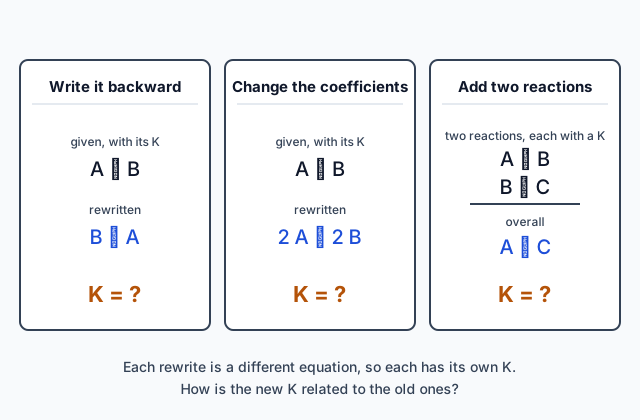
In short. When a reaction is rewritten, its equilibrium constant changes in a fixed way: reversing the reaction inverts K, multiplying every coefficient by c raises K to the power c, and adding reactions multiplies their K values.
- The overall equilibrium expression for a multistep process is the product of the expressions for the steps, and any species that is made in one step and used in another cancels.
- Q has the same mathematical form as K, so every one of these manipulations applies to Q in the same way.
- Check every change to the equation before you change K, because a different coefficient or a different direction is a different K.
Part 2 Learn it Rewriting reactions, rewriting K
2a. Reverse the reaction
An equilibrium constant belongs to a reaction exactly as it is written, at one temperature. Change how the reaction is written and you change K, in a way you can predict.
When a reaction is reversed, K is inverted. The old products become the reactants, so the old top of the fraction goes to the bottom:
- N₂O₄ ⇌ 2 NO₂ has Kc = [NO₂]² ÷ [N₂O₄].
- 2 NO₂ ⇌ N₂O₄ has Kc = [N₂O₄] ÷ [NO₂]², which is 1 ÷ the first Kc.
Example (a teaching example): if Kc = 0.0150 for N₂O₄ ⇌ 2 NO₂, then Kc for 2 NO₂ ⇌ N₂O₄ is 1 ÷ 0.0150 = 66.7.
The new K is a reciprocal, not the old K with a minus sign, and not 1 minus the old K. A very small K becomes a very large one, which matches the idea that a reaction that barely goes forward goes almost to completion backward.
Quick check · Calculate
At one temperature, PCl₅(g) ⇌ PCl₃(g) + Cl₂(g) has Kc = 0.0250 (a teaching example). What is Kc for PCl₃(g) + Cl₂(g) ⇌ PCl₅(g) at the same temperature? Give your answer to three significant figures.
2b. Multiply the coefficients
Suppose every coefficient in a reaction is multiplied by the same factor c. Each concentration in the expression is then raised to c times its old exponent, so the whole expression is raised to the power c. K is raised to the power c.
Example (a teaching example): N₂O₄ ⇌ 2 NO₂ has Kc = [NO₂]² ÷ [N₂O₄] = 0.0150.
- Doubling it (c = 2) gives 2 N₂O₄ ⇌ 4 NO₂, with Kc = [NO₂]⁴ ÷ [N₂O₄]² = ([NO₂]² ÷ [N₂O₄])² = (0.0150)² = 2.25 × 10⁻⁴.
- Halving it (c = ½) gives ½ N₂O₄ ⇌ NO₂, with Kc equal to the square root of 0.0150, which is 0.122.
So doubling the coefficients squares K, tripling cubes it, and halving takes the square root. It does not double or halve K.
A reaction can be reversed and scaled together. Reversing is c = −1, so you can do both in either order: invert, then raise to the power.
Quick check · Calculate
At one temperature, 2 SO₂(g) + O₂(g) ⇌ 2 SO₃(g) has Kc = 6.00 × 10² (a teaching example). What is Kc for SO₂(g) + ½ O₂(g) ⇌ SO₃(g) at the same temperature? Give your answer to three significant figures.
2c. Add the reactions
A multistep process has an overall reaction that is the sum of its steps. When reactions are added together, the K of the overall reaction is the product of the K values of the reactions that were summed.
Example (a teaching example):
- Step 1: N₂(g) + O₂(g) ⇌ 2 NO(g), K₁ = [NO]² ÷ ([N₂][O₂]) = 4.0 × 10⁻⁴
- Step 2: 2 NO(g) + O₂(g) ⇌ 2 NO₂(g), K₂ = [NO₂]² ÷ ([NO]²[O₂]) = 5.0 × 10³
- Overall: N₂(g) + 2 O₂(g) ⇌ 2 NO₂(g)
NO is made in step 1 and used in step 2, so it cancels in the overall reaction. Multiply the two expressions and [NO]² cancels too:
K₁ × K₂ = [NO₂]² ÷ ([N₂][O₂]²), the expression for the overall reaction.
K = K₁ × K₂ = (4.0 × 10⁻⁴)(5.0 × 10³) = 2.0.
Adding two reactions multiplies their K values; it does not add them. To use a reaction that is not quite in the form you need, reverse it or scale it first, as in the last two sections, and then add.
Quick check · Multiple choice
Reaction 1 is A + B ⇌ C, with equilibrium constant K₁. Reaction 2 is C + B ⇌ D, with equilibrium constant K₂. Which expression gives the equilibrium constant for the overall reaction A + 2 B ⇌ D?
2d. Q follows the same rules
The reaction quotient Q has the same mathematical form as K: products over reactants, each raised to its coefficient. The only difference is the mixture it is calculated for. Q describes any mixture, at any moment, and K is the special value Q takes at equilibrium.
Because the two expressions have identical forms, every valid algebraic manipulation of K also applies to Q. Reverse the reaction and Q is inverted. Multiply the coefficients by c and Q is raised to the power c. Add two reactions and their Q values multiply.
Example (a teaching example): a mixture of N₂O₄ and NO₂ has Qc = 0.40 when the reaction is written N₂O₄ ⇌ 2 NO₂. The same mixture, with the reaction written 2 NO₂ ⇌ N₂O₄, has Qc = 1 ÷ 0.40 = 2.5. The mixture has not changed. Only the way the reaction is written has changed, and with it the form of the expression.
Quick check · Decide and justify
For N₂O₄ ⇌ 2 NO₂, a mixture of the two gases has Qc = 0.50 at one moment (a teaching example). What is Qc for the same mixture when the reaction is written 2 NO₂ ⇌ N₂O₄?
Which reason supports your decision?
Part 3 Watch it done Methane and steam in two steps
Predict first, then watch each step, then finish the calculation yourself.
Hydrogen can be made from methane and steam in two steps at one temperature. Step 1: CH₄(g) + H₂O(g) ⇌ CO(g) + 3 H₂(g), K₁ = 2.60 × 10⁻². Step 2: CO(g) + H₂O(g) ⇌ CO₂(g) + H₂(g), K₂ = 8.40. These K values are teaching examples. What is K for the overall reaction?
Predict first
Before you open the first step, predict: which species will cancel and appear in neither the overall reaction nor the overall expression?
Step 1 · Add the reactions and cancel
Adding the left sides and the right sides gives CH₄ + H₂O + CO + H₂O ⇌ CO + 3 H₂ + CO₂ + H₂. CO is on both sides and cancels. Combining the rest: CH₄(g) + 2 H₂O(g) ⇌ CO₂(g) + 4 H₂(g).
Step 2 · Write the expression for each step
K₁ = [CO][H₂]³ ÷ ([CH₄][H₂O]) and K₂ = [CO₂][H₂] ÷ ([CO][H₂O]).
Step 3 · Multiply the expressions
K₁ × K₂ = [CO][H₂]³[CO₂][H₂] ÷ ([CH₄][H₂O][CO][H₂O]) = [CO₂][H₂]⁴ ÷ ([CH₄][H₂O]²). That is the expression for the overall reaction.
Why this step?
Why does [CO] not appear in the overall expression?
CO is a product of step 1 and a reactant of step 2, so it is on top in K₁ and on the bottom in K₂. It cancels when the two expressions are multiplied, just as it cancels when the two reactions are added.
Your step · Calculate
Finish it. With K₁ = 2.60 × 10⁻² and K₂ = 8.40, what is K for CH₄(g) + 2 H₂O(g) ⇌ CO₂(g) + 4 H₂(g)? Give your answer to three significant figures.
The order was add the reactions, cancel, then multiply the K values. Writing the overall expression from the steps is how you know the product is right.
Part 4 Try it Backward and doubled
Use the same two steps and K values at the same temperature: CH₄(g) + 2 H₂O(g) ⇌ CO₂(g) + 4 H₂(g) has K = (2.60 × 10⁻²)(8.40) = 0.2184 when its two steps are added. A plant operator needs to run it backward, as CO₂(g) + 4 H₂(g) ⇌ CH₄(g) + 2 H₂O(g).
Try it · Calculate
What is K for CO₂(g) + 4 H₂(g) ⇌ CH₄(g) + 2 H₂O(g)? Give your answer to three significant figures.
In step 2, CO(g) + H₂O(g) ⇌ CO₂(g) + H₂(g) has K₂ = 8.40. A student writes the same step with every coefficient doubled.
Try it · Decide and justify
The student says that for 2 CO(g) + 2 H₂O(g) ⇌ 2 CO₂(g) + 2 H₂(g), K = 2 × 8.40 = 16.8. Is the student correct?
Which reason supports your decision?
Part 5 Explain it Ammonia on the way to nitrogen monoxide
On the exam this is handwritten, so answer on paper first. Nothing you type here leaves this page. Then check your answer against the model and each scoring point.
Free response is 50% of the exam score. This one is shaped like a short-answer question, which is worth 4 points.
Free-response practice · Short-answer style
At one temperature, reaction 1 is N₂(g) + 3 H₂(g) ⇌ 2 NH₃(g), with K₁ = 2.5 × 10². Reaction 2 is 4 NH₃(g) + 5 O₂(g) ⇌ 4 NO(g) + 6 H₂O(g), with K₂ = 4.0 × 10³. These K values are teaching examples. A chemist adds reaction 2 to two times reaction 1.
(a) Represent the overall reaction, with NH₃ canceled.
(b) Represent the equilibrium constant K for the overall reaction in terms of K₁ and K₂.
(c) Calculate K for the overall reaction.
(d) Calculate K for the overall reaction written in the reverse direction.
Model answer
(a) Two times reaction 1 is 2 N₂ + 6 H₂ ⇌ 4 NH₃. Adding reaction 2 and canceling 4 NH₃ gives 2 N₂(g) + 6 H₂(g) + 5 O₂(g) ⇌ 4 NO(g) + 6 H₂O(g).
(b) Doubling reaction 1 squares K₁, and adding reaction 2 multiplies by K₂, so K = (K₁)² × K₂.
(c) K = (2.5 × 10²)² × (4.0 × 10³) = (6.25 × 10⁴)(4.0 × 10³) = 2.5 × 10⁸.
(d) Reversing the reaction inverts K: 1 ÷ (2.5 × 10⁸) = 4.0 × 10⁻⁹.
Score your own answer. This is a self-check, not a grade. Tick each point your answer makes.
Part 6 Check yourself Two reactions of nitrogen monoxide
Both case questions use the table.
The table gives the equilibrium constants for two reactions of nitrogen monoxide at one temperature. These values are a teaching example.
| Reaction | Equation | Kc |
|---|---|---|
| I | 2 NO(g) + Cl₂(g) ⇌ 2 NOCl(g) | 5.0 × 10² |
| II | 2 NO(g) + O₂(g) ⇌ 2 NO₂(g) | 2.0 × 10³ |
Case question 1 · Calculate
Using the table: what is Kc for 2 NOCl(g) + O₂(g) ⇌ Cl₂(g) + 2 NO₂(g) at the same temperature? Give your answer to two significant figures.
Case question 2 · Rank it
Using the table: each reaction below is reaction I rewritten. Rank them by Kc.
Largest Kc first
Give each one a place, 1 for first. Give two the same place if they are equal.
Your ranking: none yet
The rest stand on their own and do not use the case.
Check yourself · Match
Match each change to a reaction with its effect on K.
Check yourself · Spot the error
At one temperature, N₂O₄ ⇌ 2 NO₂ has Kc = 0.0150 (a teaching example). A student finds Kc for 4 NO₂ ⇌ 2 N₂O₄. Tap the line with the mistake.
Part 7 Keep it Bring back earlier ideas
This lesson leans on judging what the size of K says about a mixture, and on calculating a Kc from equilibrium data. Pulling them back up is what makes them last.
From 7.5 Magnitude of the Equilibrium Constant · Decide and justify
For A(aq) ⇌ B(aq) at a fixed temperature, K = 1 × 10¹² (a teaching example). Which description of the equilibrium mixture is correct?
Which reason supports your decision?
From 7.4 Calculating the Equilibrium Constant · Calculate
In a sealed flask at a fixed temperature, N₂O₄(g) ⇌ 2 NO₂(g) reaches equilibrium with [N₂O₄] = 0.0450 M and [NO₂] = 0.0300 M. These numbers are a teaching example. What is Kc? Give your answer to three significant figures.
In three lines
- Reversing a reaction inverts K, and multiplying every coefficient by c raises K to the power c.
- Adding reactions multiplies their K values, and a species made in one step and used in another cancels in the overall reaction.
- Q has the same form as K, so reversing, scaling and adding change Q in exactly the same ways.
Exam strategy for this topic
- Section I, Multiple Choice: 60 questions in 90 minutes.
- Section II, Free Response: 7 questions in 105 minutes.
- A scientific or graphing calculator is recommended for use on both sections of the exam.
Before you touch a K, write down how each reaction you were given must be changed to reach the one you need: reversed, scaled, or added. Then apply one rule per change: invert, raise to a power, multiply. Show the overall expression from the steps if you can, since the canceling species make the result easy to check.
Questions students ask
What happens to K when a reaction is reversed?
K is inverted. The reversed reaction has the reciprocal of the original K.
What happens to K when the coefficients are multiplied?
If every coefficient is multiplied by c, K is raised to the power c. Doubling the coefficients squares K, and halving them takes the square root.
How do you find K for an overall reaction made of several steps?
Add the reactions, cancel the species that appear on both sides, and multiply the K values of the steps.
Do these rules work for Q too?
Yes. Q has the same mathematical form as K, so reversing, scaling and adding change Q in the same ways.
Why is the new K not just the old K with a sign change?
K is a ratio of concentrations, so reversing the reaction swaps the top and bottom of the ratio, which gives a reciprocal.
Course alignment, for teachers
AP Chemistry topic 7.6, Unit 7: Equilibrium.
- Skill 5.A: Identify quantities needed to solve a problem from given information (e.g., text, mathematical expressions, graphs, or tables).
This lesson maps all 4 essential knowledge statements of the topic to the part that teaches each one: 4 are checked by a scored question. The map is in the lesson file.