Unit 7 · Topic 7.7 · about 30 minutes · 7 parts · 11 scored checks, 1 of them multiple choice, plus 2 from earlier lessons
AP Chemistry 7.7: Calculating Equilibrium Concentrations
Unit 7: 7 to 9% of the multiple-choice section
What you'll be able to do
- Identify the concentrations or partial pressures of chemical species at equilibrium based on the initial conditions and the equilibrium constant.
Key vocabulary
| Term | What it means | The exam trap |
|---|---|---|
| Reaction quotient (Q) | The ratio, in the same form as K, calculated from the concentrations or partial pressures a mixture has at a given moment. | Q can be calculated for any mixture, so use the amounts you are given rather than amounts you assume. |
| Equilibrium constant (K) | The value of Q when a system is at equilibrium; it depends on the reaction and on the temperature. | A K belongs to one reaction as written at one temperature, so check that the equation and temperature match the question. |
| ICE table | A table of Initial, Change and Equilibrium amounts for each species in a reaction. | Fill the table one row at a time and keep unrounded values between steps, rounding only once at the end. |
| Dynamic equilibrium | The state in which the forward and reverse reactions continue at the same rate, so the proportions of reactants and products stay constant. | Constant does not mean equal, so do not expect reactants and products to have matching amounts. |
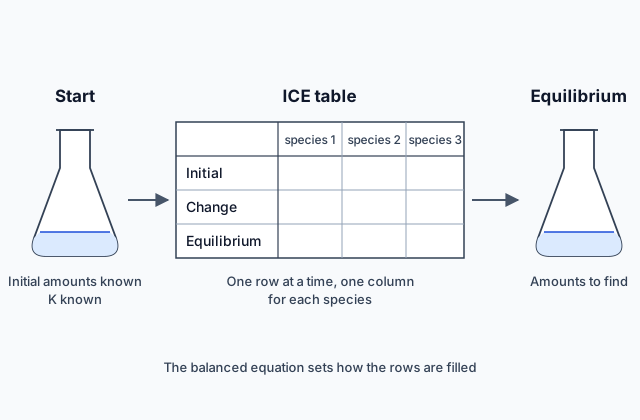 Tap to open the picture full size
Part 1 Think first Two flasks, one reaction
Commit to a guess first. Being wrong now makes the right idea stick better.
Predict first
Two flasks hold hydrogen, iodine and hydrogen iodide gas at the same temperature, and the same reaction can happen in both. In flask 1 the purple color of the iodine slowly fades. In flask 2 the purple slowly deepens. What decides which way each flask changes?
In short. Comparing the reaction quotient Q with the equilibrium constant K tells which way a mixture will change, and an ICE table with K gives the amounts at equilibrium.
- Q has the same form as K but uses the amounts present now; Q = K means the system is at equilibrium.
- An ICE table tracks Initial, Change and Equilibrium amounts, with the change in each species set by the balanced equation.
- When K is very small, x is tiny next to the starting amount, which shortens the algebra if you test the assumption.
Part 2 Learn it From a starting mixture to the amounts at equilibrium
2a. Which way will it go? Compare Q with K
A mixture that is not at equilibrium keeps changing until it is. To say which way, compare two numbers.
The equilibrium constant K is fixed for a reaction at one temperature. The reaction quotient Q has the same form as K, but you put in the concentrations (or partial pressures) the mixture has right now. For H₂(g) + I₂(g) ⇌ 2HI(g):
Qc = [HI]² / ([H₂][I₂])
In this lesson Kc = 49.0 for this reaction at one temperature, a teaching example. K is written without units.
- Q < K: there is relatively too little product. The reaction proceeds with net consumption of reactants and generation of products.
- Q > K: there is relatively too much product. The reaction proceeds with net consumption of products and generation of reactants.
- Q = K: the system is at dynamic equilibrium. Both reactions continue at the same rate, and the proportions of reactants and products stay constant.
Example: a mixture with [H₂] = 0.20 M, [I₂] = 0.20 M and [HI] = 0.10 M has Qc = (0.10)² / ((0.20)(0.20)) = 0.25. That is less than 49.0, so the net change makes more HI.
Quick check · Decide and justify
For H₂(g) + I₂(g) ⇌ 2HI(g), Kc = 49.0. A flask at that temperature holds [H₂] = 0.010 M, [I₂] = 0.010 M and [HI] = 0.20 M. Which way does the mixture change?
Which reason supports your decision?
2b. An ICE table finds the amounts at equilibrium
To find how much of each species there is at equilibrium, track the change with an ICE table: Initial, Change, Equilibrium. Let x be the concentration of H₂ that reacts. The balanced equation sets every other change: for each H₂ that reacts, one I₂ reacts and two HI form.
Start with [H₂] = [I₂] = 0.400 M and no HI, in concentrations (M):
| Row | [H₂] | [I₂] | [HI] |
|---|---|---|---|
| Initial | 0.400 | 0.400 | 0 |
| Change | −x | −x | +2x |
| Equilibrium | 0.400 − x | 0.400 − x | 2x |
Put the Equilibrium row into the Kc expression:
Kc = (2x)² / ((0.400 − x)(0.400 − x)) = 49.0
Both sides are perfect squares, so take the square root: 2x / (0.400 − x) = 7.00. Then 2x = 2.80 − 7.00x, so x = 2.80 / 9.00 = 0.3111 M. Keep the extra figures until the end.
At equilibrium, [H₂] = [I₂] = 0.400 − 0.3111 = 0.0889 M and [HI] = 2(0.3111) = 0.622 M. Check by putting them back: (0.6222)² / (0.08889)² = 49.0, so Qc = Kc.
Quick check · Calculate
A second flask, at the same temperature where Kc = 49.0 for H₂(g) + I₂(g) ⇌ 2HI(g), starts with [H₂] = 0.800 M, [I₂] = 0.800 M and no HI. What is [HI] at equilibrium, in M? Give your answer to three significant figures.
2c. When K is small, x is small
The perfect square will not always be there. When K is very small, almost none of the reactant reacts, so x is tiny next to the starting concentration. Then 'initial − x' is nearly just 'initial', and the algebra is short.
Example: N₂O₄(g) ⇌ 2NO₂(g) with Kc = 4.0 × 10⁻⁴, a teaching example. The flask starts with [N₂O₄] = 0.800 M and no NO₂. N₂O₄ changes by −x and NO₂ by +2x, so
Kc = (2x)² / (0.800 − x) = 4.0 × 10⁻⁴
Assume 0.800 − x ≈ 0.800. Then 4x² / 0.800 = 4.0 × 10⁻⁴, so x² = 8.0 × 10⁻⁵ and x = 0.0089 M.
Always test the assumption. x / 0.800 = 1.1%, which is under 5%, a common rule of thumb, so ignoring x was fair. Then [NO₂] = 2x = 0.018 M, and [N₂O₄] is still 0.79 M.
If x turns out to be more than about 5% of the starting concentration, the shortcut cannot be trusted, and this lesson does not use another method.
Quick check · Calculate
PCl₅(g) ⇌ PCl₃(g) + Cl₂(g) has Kc = 1.6 × 10⁻⁵ at one temperature, a teaching example. A flask starts with [PCl₅] = 0.400 M and no PCl₃ or Cl₂. Assume x is small next to 0.400 M. What is [Cl₂] at equilibrium, in millimolar (mM, where 1 mM = 0.001 M)? Give your answer to two significant figures.
Part 3 Watch it done Starting from the other side
Predict first, then watch each step, then finish the calculation yourself.
A flask at the temperature where Kc = 49.0 for H₂(g) + I₂(g) ⇌ 2HI(g) starts with only hydrogen iodide: [HI] = 0.900 M and no H₂ or I₂. Written as 2HI(g) ⇌ H₂(g) + I₂(g), the reaction has Kc = 1/49.0 = 0.0204 at this temperature. Find the concentrations at equilibrium.
Predict first
Before you open the first step, predict: this flask has no H₂ or I₂ at all. What does the mixture do?
Step 1 · Compare Q with K
With no H₂ or I₂, Qc = [H₂][I₂] / [HI]² = 0, which is less than Kc = 0.0204. So the reaction proceeds with net generation of H₂ and I₂, and HI is consumed.
Step 2 · Fill in the ICE table
Let x be the H₂ that forms.
- [HI]: starts at 0.900, changes by −2x, ends at 0.900 − 2x
- [H₂]: starts at 0, changes by +x, ends at x
- [I₂]: starts at 0, changes by +x, ends at x
Why this step?
Why is the change in [HI] −2x and not −x?
The balanced equation shows 2 HI consumed for each H₂ and each I₂ formed. The coefficients set the ratios of the changes, so when x of H₂ forms, 2x of HI is used up.
Step 3 · Substitute, take the square root and solve
Kc = (x)(x) / (0.900 − 2x)² = 0.0204. Both sides are perfect squares, so x / (0.900 − 2x) = √0.0204 = 0.14283. Then x = 0.14283(0.900 − 2x) = 0.12855 − 0.28566x, so 1.28566x = 0.12855 and x = 0.099984 M. Keep the unrounded x for the next step.
Your step · Calculate
Finish it. With x = 0.099984 M, what is [HI] at equilibrium, in M? Give your answer to three significant figures.
M
So [H₂] = [I₂] = 0.100 M and [HI] = 0.700 M. Check with the forward constant: (0.700)² / ((0.100)(0.100)) = 49, the Kc of the original equation. The same K governs the balance point, and it does not matter which side the mixture started from.
Part 4 Try it A reactor in partial pressures
A reactor holds gases, so the amounts are partial pressures in atm and the constant is Kp. For CO(g) + H₂O(g) ⇌ CO₂(g) + H₂(g), take Kp = 9.0 at the reactor's temperature. These numbers are a teaching example. Qp is built from partial pressures the same way Qc is built from concentrations, and the ICE table works the same way.
Try it · Calculate
The reactor starts with P(CO) = 0.80 atm, P(H₂O) = 0.80 atm and no CO₂ or H₂. What is P(CO) at equilibrium, in atm? Give your answer to two significant figures.
Try it · Sort it
The reactor runs CO(g) + H₂O(g) ⇌ CO₂(g) + H₂(g) at the temperature where Kp = 9.0. Each card gives the partial pressures in one mixture, in atm. Tap a card, then the bin for what that mixture does next.
Net forward
At equilibrium
Net reverse
Part 5 Explain it From a starting mixture to the equilibrium amounts
On the exam this is handwritten, so answer on paper first. Nothing you type here leaves this page. Then check your answer against the model and each scoring point.
Free response is 50% of the exam score. This one is shaped like a short-answer question, which is worth 4 points.
Free-response practice · Short-answer style
A rigid 1.00 L flask holds 0.200 mol of H₂(g), 0.200 mol of I₂(g) and 0.800 mol of HI(g) at a temperature where Kc = 49.0 for H₂(g) + I₂(g) ⇌ 2HI(g). These numbers are a teaching example.
(a) Calculate Qc for the mixture.
(b) Make a claim about which way the mixture changes, and justify it by comparing Qc with Kc.
(c) Represent the mixture with an ICE table in terms of x, the concentration of H₂ that reacts. Draw the table on paper.
(d) Determine [HI] at equilibrium.
Model answer
(a) The flask is 1.00 L, so [H₂] = [I₂] = 0.200 M and [HI] = 0.800 M. Qc = [HI]² / ([H₂][I₂]) = (0.800)² / ((0.200)(0.200)) = 16.0.
(b) Qc = 16.0 is less than Kc = 49.0, so the mixture has relatively too little product. The reaction proceeds with net consumption of H₂ and I₂ and generation of HI.
(c) The table is shown below the model.
(d) Kc = (0.800 + 2x)² / (0.200 − x)² = 49.0, so (0.800 + 2x) / (0.200 − x) = 7.00. Then 0.800 + 2x = 1.400 − 7.00x, so 9.00x = 0.600 and x = 0.06667 M. [HI] = 0.800 + 2(0.06667) = 0.933 M. Check: [H₂] = 0.200 − 0.06667 = 0.1333 M, and (0.9333)² / (0.1333)² = 49.0.
| Row | [H₂] | [I₂] | [HI] |
|---|---|---|---|
| Initial | 0.200 | 0.200 | 0.800 |
| Change | −x | −x | +2x |
| Equilibrium | 0.200 − x | 0.200 − x | 0.800 + 2x |
Score your own answer. This is a self-check, not a grade. Tick each point your answer makes.
Part 6 Check yourself Four mixtures, one reaction
All three case questions use the table.
Fe³⁺(aq) + SCN⁻(aq) ⇌ FeSCN²⁺(aq) has Kc = 1.0 × 10² at the temperature of the experiment. This is a teaching example, not a measured value. A student prepares four mixtures and records the concentrations before anything has time to change.
| Mixture | [Fe³⁺] | [SCN⁻] | [FeSCN²⁺] |
|---|---|---|---|
| 1 | 0.0020 | 0.0020 | 0.0010 |
| 2 | 0.0050 | 0.0010 | 0.00050 |
| 3 | 0.0100 | 0.0010 | 0.00040 |
| 4 | 0.0010 | 0.0050 | 0.00080 |
Case question 1 · Calculate
Using the table: what is Qc for mixture 1? Give your answer to two significant figures.
Case question 2 · Multiple choice
Using the table: which mixture is at equilibrium?
Case question 3 · Select all
Using the table: select the two mixtures in which the net change makes more Fe³⁺ and SCN⁻. Select two.
Select 2 answers, then check.
The rest stand on their own and do not use the case.
Check yourself · Spot the error
A student finds the equilibrium concentrations for H₂(g) + I₂(g) ⇌ 2HI(g), where Kc = 49.0, starting from [H₂] = [I₂] = 0.500 M and no HI. Tap the line with the mistake.
Check yourself · Put it in order
A student finds the equilibrium concentrations from starting amounts and K. Put the steps in order.
Part 7 Keep it Bring back earlier ideas
This lesson leans on comparing Q with K, and on working in concentrations, which an ICE table starts from. Pulling them back up is what makes them last.
From 7.6 Properties of the Equilibrium Constant · Decide and justify
For N₂O₄ ⇌ 2 NO₂, a mixture of the two gases has Qc = 0.50 at one moment (a teaching example). What is Qc for the same mixture when the reaction is written 2 NO₂ ⇌ N₂O₄?
Which reason supports your decision?
From 3.8 Representations of Solutions · Rank it
A student draws four glucose solutions at the same scale, so every glucose molecule drawn stands for the same amount of glucose. Box A holds 8 molecules in a volume of 2V. Box B holds 6 molecules in a volume of V. Box C holds 9 molecules in a volume of 3V. Box D holds 10 molecules in a volume of 2V. Rank the solutions by concentration.
Most concentrated first
Give each one a place, 1 for first. Give two the same place if they are equal.
Your ranking: none yet
In three lines
- Q has the same form as K but uses the amounts present now: Q < K makes products, Q > K makes reactants, and Q = K is dynamic equilibrium.
- An ICE table tracks Initial, Change and Equilibrium amounts, with the change in each species set by the coefficients; substitute the Equilibrium row into K and solve for x.
- When K is very small, x is tiny next to the starting amount, so initial − x ≈ initial, but test that x is under about 5% of it.
Exam strategy for this topic
- Section I, Multiple Choice: 60 questions in 90 minutes.
- Section II, Free Response: 7 questions in 105 minutes.
- A scientific or graphing calculator is recommended for use on both sections of the exam.
Write the Q or K expression first, then the ICE table, and show each substitution. Keep unrounded values between steps, give your final answer to the figures the data allow, and state in words which way the mixture changes and why, since the claim needs its justification.
Questions students ask
How do you tell which way a reaction will go?
Calculate Q from the amounts present and compare it with K. If Q < K the net change makes products, if Q > K it makes reactants, and if Q = K the system is at equilibrium.
What does ICE stand for in an ICE table?
Initial, Change and Equilibrium. The Change row is written in terms of x using the coefficients of the balanced equation, and the Equilibrium row is Initial plus Change.
When can you ignore x next to the initial concentration?
When K is very small, so almost none of the reactant reacts. Test it: if x is under about 5% of the starting concentration, treating initial − x as initial was fair.
Can you use partial pressures instead of concentrations?
Yes. For gases, use Qp and Kp with partial pressures and build the ICE table the same way.
Does the starting mixture change K?
No. K depends on the reaction and the temperature. Different starting mixtures end at different amounts, but all of them end with Q equal to the same K.
Course alignment, for teachers
AP Chemistry topic 7.7, Unit 7: Equilibrium.
- Skill 3.A: Represent chemical phenomena using appropriate graphing techniques, including correct scale and units.
This lesson maps all 2 essential knowledge statements of the topic to the part that teaches each one: 2 are checked by a scored question. The map is in the lesson file.