Unit 7 · Topic 7.8 · about 30 minutes · 7 parts · 12 scored checks, 2 of them multiple choice, plus 2 from earlier lessons
AP Chemistry 7.8: Representations of Equilibrium
Unit 7: 7 to 9% of the multiple-choice section
What you'll be able to do
- Represent a system undergoing a reversible reaction with a particulate model.
Key vocabulary
| Term | What it means | The exam trap |
|---|---|---|
| Particulate representation | A drawing that shows individual atoms, molecules or ions to stand for a larger sample. | Check what each drawn particle stands for and that the boxes are the same size before you compare two drawings. |
| Dynamic equilibrium | The state in which the forward and reverse reactions continue at the same rate, so the amounts of reactants and products stay constant. | Equal rates are not the same as equal numbers of each kind of particle, so do not look for matching counts. |
| Equilibrium constant (K) | The value of the reaction quotient when a system is at equilibrium; it depends on the reaction and the temperature. | K describes the whole mixture at equilibrium, so read it from a box that is at equilibrium and use every count. |
| Conservation of atoms | In a closed flask the atoms of each element stay the same in number while the particles change. | Counting particles is not the same as counting atoms, so count atoms when you want to know if two boxes could be the same flask. |
 Tap to open the picture full size
Part 1 Think first Same flask, two snapshots
Commit to a guess first. Being wrong now makes the right idea stick better.
Predict first
A sealed flask of purple iodine vapor and hydrogen is heated, and after a while its color stops changing. In a thought experiment, a chemist photographs the particles at 10 minutes and again at 20 minutes. What would the two photographs show?
In short. A particulate representation uses counts of reactant and product particles to show the relative amounts before and at equilibrium and to find the value of K.
- In boxes of the same size at one scale, particle counts compare amounts, and atoms must balance in every box of one closed flask.
- Before equilibrium the counts change from box to box; at equilibrium they stay the same, although individual particles keep reacting.
- For a reaction with equal numbers of particles on each side, K can be calculated from the counts in a box at equilibrium.
Part 2 Learn it Reading and building particle drawings
2a. Reading a particle box
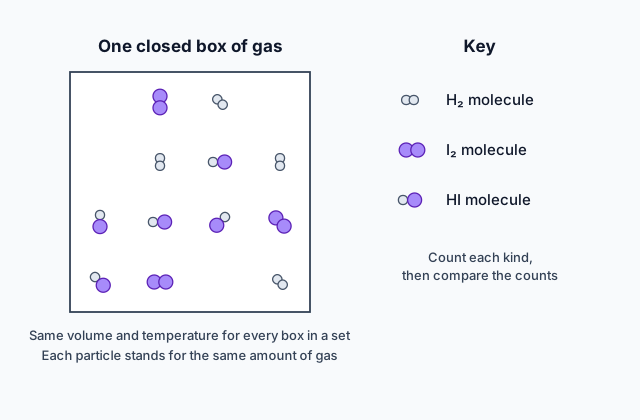
A particulate representation is a drawing of a sealed flask at the level of particles. Every box in a set is drawn at the same size, and each particle stands for the same amount of gas. Then counts compare amounts directly: twice as many HI particles means twice the concentration of HI.
For H₂(g) + I₂(g) ⇌ 2HI(g), H₂ is two small spheres, I₂ is two large spheres and HI is one of each, as in the key in the diagram.
Two rules make a drawing of a reaction mixture trustworthy:
- Atoms are conserved. Count the H atoms (2 in each H₂, 1 in each HI) and the I atoms (2 in each I₂, 1 in each HI). Each total must be the same in every box of one closed flask.
- A reaction changes the counts in fixed steps. Each time H₂ and I₂ react, one H₂ and one I₂ disappear and two HI appear.
Example: a box starts with 5 H₂, 5 I₂ and no HI. After three reactions it shows 2 H₂, 2 I₂ and 6 HI. H atoms: 5 × 2 = 10 at the start and 2 × 2 + 6 = 10 after. The I atoms balance the same way.
Quick check · Multiple choice
A closed flask starts as a box with 6 H₂, 6 I₂ and no HI. Which box could show the same flask later, for H₂(g) + I₂(g) ⇌ 2HI(g)?
2b. Before equilibrium and at equilibrium
One box cannot tell you whether a mixture is at equilibrium. A series of boxes can.
Before equilibrium, the counts change from box to box, because one direction of the reaction is going faster than the other. At equilibrium, the counts stop changing: boxes drawn at later times show the same number of each kind of particle.
The particles do not stop. H₂ and I₂ keep reacting to make HI, and HI keeps breaking apart, at the same rate, so the counts hold steady. This is dynamic equilibrium. A particle in a later box may be a different particle in a different place; the counts match, not the particles.
Example: a flask starts with 5 H₂ and 5 I₂, and boxes are drawn each minute.
| Time | H₂ | I₂ | HI |
|---|---|---|---|
| 0 min | 5 | 5 | 0 |
| 1 min | 3 | 3 | 4 |
| 2 min | 2 | 2 | 6 |
| 3 min | 2 | 2 | 6 |
The counts changed from 0 min to 1 min and from 1 min to 2 min, so those boxes are not at equilibrium. The 2 min and 3 min boxes match, so by 2 min the flask is at equilibrium. Notice that H₂ and I₂ are still there: equilibrium does not mean the reactants are used up.
Quick check · Decide and justify
A flask of H₂ and I₂ gas is drawn at 1 min, 2 min and 3 min. The 1 min box has 4 H₂, 4 I₂ and 4 HI. The 2 min box and the 3 min box each have 3 H₂, 3 I₂ and 6 HI. Is the flask at equilibrium at 2 min?
Which reason supports your decision?
2c. Reading K from a box
A particle count is proportional to a concentration when every box has the same volume. For H₂(g) + I₂(g) ⇌ 2HI(g) there are two particles on each side of the equation, so the volume cancels and the counts can stand in for the concentrations in Kc = [HI]² / ([H₂][I₂]):
Kc = (number of HI)² / ((number of H₂)(number of I₂))
Use a box that is at equilibrium. Example: the last box of the series in the table, with 2 H₂, 2 I₂ and 6 HI, gives Kc = (6)² / ((2)(2)) = 9.0.
You can also estimate without calculating:
- If HI outnumbers both H₂ and I₂, then K is greater than 1 and the mixture favors the products.
- If HI is outnumbered by both H₂ and I₂, then K is less than 1 and the mixture favors the reactants.
- If the counts are mixed, calculate it.
K describes the whole mixture, so use all three counts, not one.
Quick check · Calculate
A box at equilibrium for H₂(g) + I₂(g) ⇌ 2HI(g) shows 2 H₂, 5 I₂ and 8 HI. What is Kc? Give your answer to two significant figures.
Part 3 Watch it done Drawing the equilibrium box
Predict first, then watch each step, then finish the calculation yourself.
A closed flask starts as a box with 6 H₂ and 6 I₂ and no HI. At equilibrium the box shows 3 H₂ and 3 I₂. Find how many HI particles it shows, draw it as counts, and find Kc for H₂(g) + I₂(g) ⇌ 2HI(g).
Predict first
Before you open the first step, predict: how many particles will the equilibrium box show in all, compared with the 12 at the start?
Step 1 · Count what reacted
H₂ fell from 6 to 3, so 3 H₂ reacted, and I₂ fell from 6 to 3, so 3 I₂ reacted. That is 3 reactions, each using one H₂ and one I₂.
Why this step?
Why does the box show 6 HI and not 3?
Each reaction of one H₂ with one I₂ makes two HI, the coefficient in 2HI. Three reactions make 6 HI. The atoms agree: 3 × 2 + 6 = 12 H atoms, the same as 6 × 2 = 12 at the start.
Step 2 · Write the box as counts
The equilibrium box has 3 H₂, 3 I₂ and 6 HI, which is 12 particles. The total is the same as at the start because each reaction turns two particles, H₂ and I₂, into two particles, 2HI.
Step 3 · Write K in particles
There are two particles on each side of the equation, so the volume cancels and Kc = (number of HI)² / ((number of H₂)(number of I₂)).
Your step · Calculate
Finish it. The equilibrium box shows 3 H₂, 3 I₂ and 6 HI. What is Kc? Give your answer to two significant figures.
K = 4.0 is greater than 1, and in the box HI outnumbers both H₂ and I₂, so the drawing and the number agree: at this temperature the mixture favors the products. And the total stayed at 12 because two particles went in and two came out.
Part 4 Try it Building a box from K
Now go the other way, from K to a box. At another temperature, K for H₂(g) + I₂(g) ⇌ 2HI(g) is 16. These numbers are a teaching example. The counts work like concentrations, so the ICE table from the last topic works on counts too.
Try it · Calculate
A closed flask starts as a box with 6 H₂ and 6 I₂ and no HI. At the temperature where Kc = 16, how many HI particles does the equilibrium box show? Give a whole number.
Try it · Sort it
At the temperature where Kc = 16, each card describes one box of H₂, I₂ and HI, drawn at the same size and scale. Tap a card, then the bin for what that mixture does next.
Net forward
At equilibrium
Net reverse
Part 5 Explain it Two temperatures, two boxes
On the exam this is handwritten and a drawing is made on paper. Answer on paper first, with your drawing. Nothing you type here leaves this page. Then check your answer against the model and each scoring point.
Free response is 50% of the exam score. This one is shaped like a short-answer question, which is worth 4 points.
Free-response practice · Short-answer style
A closed flask starts with 8 H₂ and 8 I₂ particles and no HI. Each particle drawn stands for the same amount of gas. At temperature T1 the reaction H₂(g) + I₂(g) ⇌ 2HI(g) has Kc = 36. These numbers are a teaching example.
(a) Represent the flask at equilibrium at T1 by drawing a particulate model on paper, and state how many particles of each kind it shows.
(b) Calculate Kc from your drawing to show that it agrees with Kc = 36.
(c) At temperature T2 the same starting mixture reaches equilibrium with 4 H₂, 4 I₂ and 8 HI. Determine which temperature has the larger Kc.
(d) Explain why a box drawn one minute after the flask reaches equilibrium at T1 shows the same numbers of particles, even though the reactions have not stopped.
Model answer
(a) Let x be the number of H₂ that react. Then 2x / (8 − x) = √36 = 6, so 2x = 48 − 6x and x = 6. The box shows 2 H₂, 2 I₂ and 12 HI, which is 16 H atoms and 16 I atoms, as at the start. Draw two small two-sphere H₂, two large two-sphere I₂ and twelve HI.
(b) Kc = (12)² / ((2)(2)) = 144 / 4 = 36, which agrees.
(c) At T2, Kc = (8)² / ((4)(4)) = 64 / 16 = 4.0. Kc at T1 (36) is larger than Kc at T2 (4.0), so T1 has the larger Kc.
(d) At equilibrium the forward and reverse reactions continue at the same rate. Each time H₂ and I₂ react to make HI, another HI breaks apart to make H₂ and I₂, so the number of each kind of particle stays the same, although individual particles keep changing.
| Particle | Start | Equilibrium at T1 | Equilibrium at T2 |
|---|---|---|---|
| H₂ | 8 | 2 | 4 |
| I₂ | 8 | 2 | 4 |
| HI | 0 | 12 | 8 |
Score your own answer. This is a self-check, not a grade. Tick each point your answer makes.
Part 6 Check yourself Five snapshots of one flask
All three case questions use the figure.
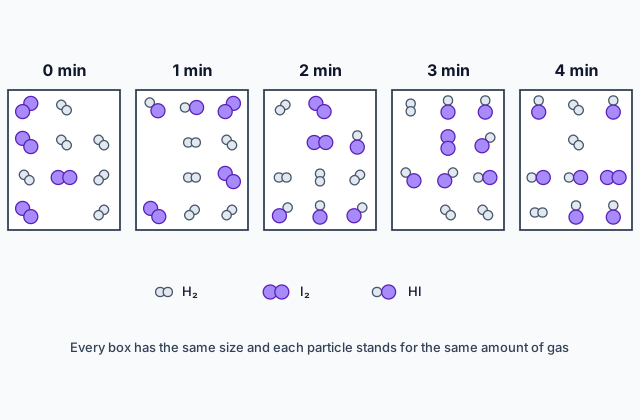
A student drew one closed flask of H₂, I₂ and HI gas every minute, all at one temperature, for the reaction H₂(g) + I₂(g) ⇌ 2HI(g). Each box has the same size and each particle stands for the same amount of gas. These drawings are a teaching example.
 Tap to open the picture full size
Case question 1 · Calculate
Using the figure: the flask is at equilibrium at 4 min. What is Kc? Give your answer to two significant figures.
Case question 2 · Multiple choice
Using the figure: which is the first box that shows the flask at equilibrium?
Case question 3 · Select all
Using the figure: compare the 3 min box with the 4 min box. Select the two true statements.
Select 2 answers, then check.
The rest stand on their own and do not use the case.
Check yourself · Rank it
Four boxes each show the same reaction, H₂(g) + I₂(g) ⇌ 2HI(g), at equilibrium at four different temperatures, with 12 particles in each box. Box A: 4 H₂, 4 I₂ and 4 HI. Box B: 3 H₂, 3 I₂ and 6 HI. Box C: 1 H₂, 1 I₂ and 10 HI. Box D: 5 H₂, 5 I₂ and 2 HI. Rank the boxes by the value of Kc.
Largest Kc first
Give each one a place, 1 for first. Give two the same place if they are equal.
Your ranking: none yet
Check yourself · Fill the statement
Complete the reading of a drawing of H₂(g) + I₂(g) ⇌ 2HI(g) at equilibrium.
In boxes drawn at later times, the number of each kind of particle is , even though the particles keep reacting. If HI outnumbers both H₂ and I₂ in the box, then Kc is than 1 and the mixture favors the .
Check yourself · Spot the error
A student compares two boxes of the same flask, drawn at 5 min and at 10 min. Both boxes show 3 H₂, 3 I₂ and 6 HI. The student explains what this means. Tap the line with the mistake.
Part 7 Keep it Bring back earlier ideas
This lesson reads amounts from drawings at one scale, as you did for solutions, and uses an ICE table on counts. Pulling back how a count stands for a concentration and how an ICE table is solved is what makes them last.
From 7.7 Calculating Equilibrium Concentrations · Calculate
A second flask, at the same temperature where Kc = 49.0 for H₂(g) + I₂(g) ⇌ 2HI(g), starts with [H₂] = 0.800 M, [I₂] = 0.800 M and no HI. What is [HI] at equilibrium, in M? Give your answer to three significant figures.
From 3.8 Representations of Solutions · Rank it
Four sodium solutions are drawn in boxes of the same size, all at one scale. Rank the boxes by the number of Na⁺ ions each one shows.
Most Na⁺ ions first; equal numbers share a place
Give each one a place, 1 for first. Give two the same place if they are equal.
Your ranking: none yet
In three lines
- In boxes of the same size at one scale, particle counts compare amounts, and atoms must balance in every box of one closed flask.
- Before equilibrium the counts change from box to box; at equilibrium they stop changing, although the particles keep reacting at equal rates.
- K can be calculated from the counts in an equilibrium box when both sides have the same number of particles, and K > 1 means products outnumber reactants.
Exam strategy for this topic
- Section I, Multiple Choice: 60 questions in 90 minutes.
- Section II, Free Response: 7 questions in 105 minutes.
- A scientific or graphing calculator is recommended for use on both sections of the exam.
When a question gives a drawing, count every kind of particle first and write the counts down. State the scale, check that atoms balance, and then reason with the counts, using all three counts if you calculate K. If you must draw, say how many of each kind you drew.
Questions students ask
How do you tell from drawings whether a mixture is at equilibrium?
Compare boxes drawn at different times. Before equilibrium the counts of each kind of particle change from box to box; at equilibrium they stay the same.
Do the particles stop reacting at equilibrium?
No. Forward and reverse reactions continue at the same rate, so the counts stay constant while individual particles keep changing.
Can you find K from a particle drawing?
Yes, from a drawing at equilibrium. For H₂(g) + I₂(g) ⇌ 2HI(g), Kc = (number of HI)² / ((number of H₂)(number of I₂)). Each particle must stand for the same amount in a box of fixed volume.
How can you tell whether K is greater or less than 1 without calculating?
If the product particles outnumber each reactant in an equilibrium box, K is greater than 1. If each reactant outnumbers the product, K is less than 1.
Why must atoms balance in every box?
A closed flask neither gains nor loses atoms, so every box drawn of it must contain the same number of atoms of each element.
Course alignment, for teachers
AP Chemistry topic 7.8, Unit 7: Equilibrium.
- Skill 3.C: Represent visually the relationship between the structures and interactions across multiple levels or scales (e.g., particulate to macroscopic).
This lesson maps the one essential knowledge statement of the topic to the part that teaches each one: 1 is checked by a scored question. The map is in the lesson file.