Unit 9 · Topic 9.2 · about 30 minutes · 7 parts · 11 scored checks, 1 of them multiple choice, plus 2 from earlier lessons
AP Chemistry 9.2: Absolute Entropy and Entropy Change
Unit 9: 7 to 9% of the multiple-choice section
What you'll be able to do
- Calculate the standard entropy change for a chemical or physical process based on the absolute entropies (standard molar entropies) of the species involved in the process.
Key vocabulary
| Term | What it means | The exam trap |
|---|---|---|
| Absolute entropy | The entropy of a substance measured from the natural zero of entropy, a perfect crystal at 0 K, so it is positive for any substance above that temperature. | Look the value up for every species in the equation, element or compound, and use the table rather than a rule of thumb about which ones are zero. |
| Standard molar entropy (S°) | The absolute entropy of 1 mole of a substance in its standard state, in J/(mol·K). | The value is per mole, so multiply it by the coefficient before you add it to a total. |
| Standard entropy change (ΔS°) | The entropy change when a process occurs with every species in its standard state, equal to ΣS°(products) − ΣS°(reactants). | Order matters in a difference, so read which total is subtracted from which before you calculate. |
| Σ (sum) | The symbol for adding up a set of terms, here the S° of every product or every reactant, each times its coefficient. | The sum covers every species on that side of the equation, so count them all. |
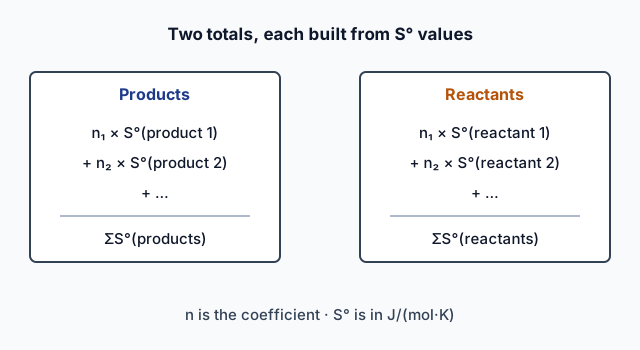 Tap to open the picture full size
Part 1 Think first Putting a number on it
Commit to a guess first. Being wrong now makes the right idea stick better.
Predict first
A table lists the standard molar entropy of liquid water as 70.0 J/(mol·K) and of water vapor as 188.8 J/(mol·K). A student uses the table to find the entropy change when 1.00 mol of liquid water at 298 K becomes water vapor at 298 K. What should the student do?
In short. The standard entropy change of a reaction is ΔS° = ΣS°(products) − ΣS°(reactants), where each S° is a standard molar entropy multiplied by its coefficient.
- Every pure element and compound has a positive standard molar entropy, S°, in J/(mol·K), and gases have much larger values than liquids or solids; no element has S° equal to zero.
- Multiply each S° by its coefficient, add the products and the reactants separately, and subtract the reactants from the products, never the other way around.
- ΔS° is for the reaction as written, so doubling every coefficient doubles it, and its sign should agree with the change in moles of gas when that change is not zero.
Part 2 Learn it Adding up standard molar entropies
2a. Absolute entropy, S°
Entropy has a natural zero: a perfect crystal at 0 K. Measured from that zero, every pure element and compound has an absolute entropy, which is always positive at any temperature above 0 K. The tabulated value for 1 mole at standard conditions is the standard molar entropy, written S°, in joules per mole per kelvin, J/(mol·K).
Two patterns in S° values follow from the last topic:
- A gas has a much higher S° than the same substance as a liquid, and a liquid higher than a solid. For water, S°(l) = 70.0 and S°(g) = 188.8 J/(mol·K).
- No element is assigned S° = 0. O₂(g) is 205.2 J/(mol·K) and N₂(g) is 191.6 J/(mol·K).
The values on this page are teaching-example values of the kind printed in thermodynamic tables.
Quick check · Decide and justify
A student reads a table and says: "The standard molar entropy of O₂(g) must be 0 J/(mol·K), because O₂ is an element in its standard state." Is the student correct?
Which reason supports your decision?
2b. ΔS° from a table
The entropy change for a process is final minus initial, found from the absolute entropies of what is present before and after:
ΔS° = ΣS°(products) − ΣS°(reactants)
Σ means "add up". Each S° is multiplied by its coefficient, because the equation describes that many moles of each species. The answer is for the reaction as written, in J/(mol·K), meaning per mole of reaction.
Example: 2H₂(g) + O₂(g) → 2H₂O(l), with S° of 130.7, 205.2 and 70.0 J/(mol·K).
- Products: 2(70.0) = 140.0.
- Reactants: 2(130.7) + 205.2 = 466.6.
- ΔS° = 140.0 − 466.6 = −326.6 J/(mol·K).
The values are given to one decimal place, so the answer is too.
Quick check · Calculate
Calculate ΔS° for N₂(g) + 3H₂(g) → 2NH₃(g), in J/(mol·K), with its sign. The standard molar entropies are N₂(g) 191.6, H₂(g) 130.7 and NH₃(g) 192.8 J/(mol·K). Give your answer to one decimal place.
2c. The method, and a sign check
Follow the same steps every time, and finish by checking your answer against what the last topic predicts:
- Write the balanced equation with a state on every species, and look up each S°.
- Multiply each S° by its coefficient.
- Add the terms for the products, and separately the terms for the reactants.
- Subtract: products minus reactants.
- Check that the sign agrees with the change in the moles of gas.
The sign check catches slips such as a reversed subtraction. It works when the moles of gas change by a clear amount. If the moles of gas are the same on both sides, the prediction is weak, and the table values decide the sign.
Quick check · Put it in order
Put the steps for finding ΔS° of a reaction in order.
Part 3 Watch it done Heating limestone
Predict first, then watch each step, then finish the calculation yourself.
Limestone decomposes when heated: CaCO₃(s) → CaO(s) + CO₂(g). The standard molar entropies are CaCO₃(s) 92.9, CaO(s) 39.8 and CO₂(g) 213.8 J/(mol·K). Find ΔS° for the reaction.
Predict first
Before you open the first step, predict the sign of ΔS° for this reaction.
Step 1 · Total the products
The products are 1 mol of CaO(s) and 1 mol of CO₂(g): 1(39.8) + 1(213.8) = 253.6 J/(mol·K). Keep the unrounded sum for the next step.
Why this step?
Why is each S° multiplied by a coefficient?
The equation stands for that many moles of each species, and each mole carries its own standard molar entropy. Here every coefficient is 1, so nothing changes, but with another reaction a missing coefficient would give the wrong total.
Step 2 · Total the reactants
The only reactant is 1 mol of CaCO₃(s): 1(92.9) = 92.9 J/(mol·K).
Your step · Calculate
Finish it. With 253.6 J/(mol·K) for the products and 92.9 J/(mol·K) for the reactants, what is ΔS° for the reaction? Give your answer to one decimal place.
J/(mol·K)
The result is positive, and the sign check agrees: the reaction makes 1 mol of gas from a solid. The size matters too. A 160.7 J/(mol·K) increase is large, because a solid and a gas are the two ends of the scale for matter dispersal.
Part 4 Try it The gas stove
A gas stove burns methane: CH₄(g) + 2O₂(g) → CO₂(g) + 2H₂O. Use these standard molar entropies in J/(mol·K), teaching-example values: CH₄(g) 186.3, O₂(g) 205.2, CO₂(g) 213.8, H₂O(l) 70.0, H₂O(g) 188.8.
Try it · Calculate
Calculate ΔS° when the water forms as a liquid, H₂O(l), in J/(mol·K), with its sign. Give your answer to one decimal place.
Now suppose the burner runs hot enough that the water leaves as a gas: CH₄(g) + 2O₂(g) → CO₂(g) + 2H₂O(g). The moles of gas are 3 on each side.
Try it · Decide and justify
Is ΔS° for the reaction that makes water vapor, with H₂O(g) at 188.8 J/(mol·K), positive, negative or exactly zero?
Which reason supports your decision?
Part 5 Explain it Sulfur trioxide
On the exam this is handwritten, so answer on paper first. Nothing you type here leaves this page. Then check your answer against the model and each scoring point.
Free response is 50% of the exam score. This one is shaped like a short-answer question, which is worth 4 points.
Free-response practice · Short-answer style
Sulfur trioxide is made in the manufacture of sulfuric acid: 2SO₂(g) + O₂(g) → 2SO₃(g). The standard molar entropies are SO₂(g) 248.2, O₂(g) 205.2 and SO₃(g) 256.8 J/(mol·K). These values are a teaching example.
(a) Calculate ΔS° for the reaction as written, in J/(mol·K).
(b) Explain why the sign of your answer to (a) is consistent with the moles of gas in the equation.
(c) A student writes the equation as SO₂(g) + ½O₂(g) → SO₃(g). Calculate ΔS° for this equation.
(d) Explain the relationship between your answers to (a) and (c).
Model answer
(a) ΔS° = 2(256.8) − [2(248.2) + 205.2] = 513.6 − 701.6 = −188.0 J/(mol·K).
(b) The reaction goes from 3 mol of gas to 2 mol of gas, so the matter becomes less dispersed, and a negative ΔS° is expected.
(c) ΔS° = 256.8 − [248.2 + ½(205.2)] = 256.8 − 350.8 = −94.0 J/(mol·K).
(d) The second equation has every coefficient halved, so it describes half as many moles of each species, and its ΔS° is half of the first: −94.0 is half of −188.0.
Score your own answer. This is a self-check, not a grade. Tick each point your answer makes.
Part 6 Check yourself Making nitric oxide
All three case questions use the table.
In the first step of making nitric acid, ammonia burns in oxygen: 4NH₃(g) + 5O₂(g) → 4NO(g) + 6H₂O(g). The table lists teaching-example standard molar entropies.
| Species | S° (J/(mol·K)) |
|---|---|
| NH₃(g) | 192.8 |
| O₂(g) | 205.2 |
| NO(g) | 210.8 |
| H₂O(g) | 188.8 |
Case question 1 · Calculate
Using the table: what is ΔS° for the reaction as written, in J/(mol·K)? Give your answer to one decimal place.
Case question 2 · Multiple choice
Using the table: the reaction goes from 9 mol of gas to 10 mol of gas. Which statement about the sign of ΔS° is correct?
Case question 3 · Calculate
Using the table: what is ΔS° for 2NH₃(g) + (5/2)O₂(g) → 2NO(g) + 3H₂O(g), in J/(mol·K)? Give your answer to one decimal place.
The rest stand on their own and do not use the case.
Check yourself · Spot the error
A student calculates ΔS° for 2H₂(g) + O₂(g) → 2H₂O(g), using H₂(g) 130.7, O₂(g) 205.2 and H₂O(g) 188.8 J/(mol·K). Tap the line with the mistake.
Check yourself · Select all
Which two statements about standard molar entropies are true? Select two.
Select 2 answers, then check.
Part 7 Keep it Bring back earlier ideas
The calculation leans on two earlier ideas: how to predict the sign of an entropy change, and how a change in one quantity is found as final minus initial. Pulling them back up is what makes them last.
From 9.1 Introduction to Entropy · Sort it
Each card is a reaction at constant temperature. Tap a card, then the bin for the sign of its ΔS.
ΔS > 0
ΔS < 0
Back to the cold pack, now in a lab. A student dissolves 20.0 g of ammonium nitrate, NH₄NO₃, in 100.0 g of water in a coffee-cup calorimeter. The temperature falls from 23.0 °C to 10.2 °C. Treat the solution as 120.0 g with a specific heat capacity of 4.18 J/(g·°C). These numbers are a teaching example.
From 6.4 Heat Capacity and Calorimetry · Calculate
What is q for the solution, in joules, as the ammonium nitrate dissolves? Include its sign, and give your answer to three significant figures.
In three lines
- Standard molar entropies, S°, of pure elements and compounds are positive absolute values in J/(mol·K); gases are much larger than liquids or solids.
- ΔS° = ΣS°(products) − ΣS°(reactants), with every S° multiplied by its coefficient and the answer given for the reaction as written.
- Check the sign against the change in moles of gas; when that change is zero, the totals from the table decide.
Exam strategy for this topic
- Section I, Multiple Choice: 60 questions in 90 minutes.
- Section II, Free Response: 7 questions in 105 minutes.
- A scientific or graphing calculator is recommended for use on both sections of the exam.
Write ΔS° = ΣS°(products) − ΣS°(reactants) first, show each S° multiplied by its coefficient, give the answer with its sign and the unit J/(mol·K), and then say in a few words whether the sign fits the change in the moles of gas. Keep unrounded totals until the last subtraction.
Questions students ask
How do you calculate ΔS° for a reaction?
Add the standard molar entropies of the products, each multiplied by its coefficient, and subtract the same sum for the reactants: ΔS° = ΣS°(products) − ΣS°(reactants).
What are the units of ΔS°?
Joules per mole per kelvin, J/(mol·K). The value is for the reaction as written, so it is per mole of reaction.
Can the standard molar entropy of a substance be zero or negative?
Not for a pure element or compound at 298 K. Entropy is measured from a true zero at 0 K, so the absolute entropy of any pure element or compound above that temperature is positive. Aqueous ions are the exception: S° of H⁺(aq) is set to zero by convention, and many ions have negative values.
What does a negative ΔS° mean?
It means the system becomes less dispersed in the reaction, as when the number of moles of gas falls, so the products have a lower total S° than the reactants.
What happens to ΔS° if you double the equation?
It doubles. ΔS° is for the reaction as written, so every coefficient counts.
Course alignment, for teachers
AP Chemistry topic 9.2, Unit 9: Thermodynamics and Electrochemistry.
- Skill 5.F: Calculate, estimate, or predict an unknown quantity from known quantities by selecting and following a logical computational pathway and attending to precision (e.g., performing dimensional analysis and attending to significant figures).
This lesson maps the one essential knowledge statement of the topic to the part that teaches each one: 1 is checked by a scored question. The map is in the lesson file.