Unit 9 · Topic 9.9 · about 30 minutes · 7 parts · 12 scored checks, 0 of them multiple choice, plus 2 from earlier lessons
AP Chemistry 9.9: Cell Potential and Free Energy
Unit 9: 7 to 9% of the multiple-choice section
What you'll be able to do
- Explain whether an electrochemical cell is thermodynamically favored, using the standard reduction potentials of its two half-reactions to find its standard cell potential and its ΔG°.
Key vocabulary
| Term | What it means | The exam trap |
|---|---|---|
| Cell potential | The voltage of an electrochemical cell, in volts. | Read the sign before the size when a cell potential is given. |
| Standard reduction potential (E°red) | The potential of a reduction half-reaction under standard conditions, listed in tables for the reduction direction. | A table lists reductions only, so check which half-reaction in your cell is the oxidation before you use a value. |
| Standard cell potential (E°cell) | The cell potential when all solutions are 1.0 M and all gases are at 1.0 atm, found as E°cathode − E°anode. | Say which half-cell is the cathode before you subtract, because the order of subtraction matters. |
| Thermodynamically favored | A reaction that can proceed on its own, which at standard conditions has a positive E°cell and a negative ΔG°. | Favored describes the energy, not the speed, so a favored reaction can still be slow. |
| Standard Gibbs free energy change (ΔG°) | The free energy change of a reaction with every species in its standard state, linked to the cell potential by ΔG° = −nFE°. | Check the units: with E° in volts and F in C/mol, ΔG° starts out in joules. |
| Faraday constant (F) | The charge carried by one mole of electrons, 96,485 C/mol. | F belongs to a mole of electrons, so it is paired with n, the moles of electrons in the balanced equation. |
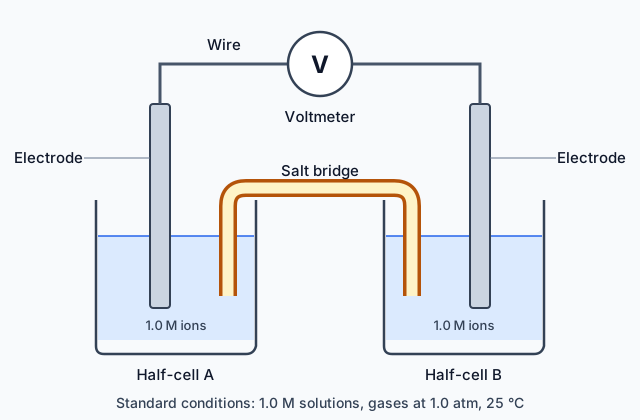 Tap to open the picture full size
Part 1 Think first Two batteries, two voltages
Commit to a guess first. Being wrong now makes the right idea stick better.
Predict first
A store sells a small cell stamped 1.5 V and a coin cell stamped 3 V. The voltage is printed on the case because a voltmeter reads it directly across the cell. Both cells run on a chemical reaction. What does the higher voltage say about the reaction inside the 3 V cell?
In short. A cell reaction is thermodynamically favored when its standard cell potential E° is positive, and E° from reduction potentials gives ΔG° through ΔG° = −nFE°.
- Find E° by identifying the reduction and the oxidation half-reactions and subtracting: E°cell = E°cathode − E°anode, with each potential taken from the reduction table and never multiplied by a coefficient.
- A positive E° means a negative ΔG° and a favored reaction; a negative E° means a positive ΔG° and a reaction that needs an externally applied potential.
- In ΔG° = −nFE°, n is the moles of electrons transferred in the balanced equation as written, F is 96,485 C per mole of electrons, and ΔG° comes out in joules per mole of reaction.
Part 2 Learn it From half-reactions to favorability
2a. Voltage as favorability
The voltage of an electrochemical cell is its cell potential, E, in volts (V). When every species is in its standard state (solutions at 1.0 M, gases at 1.0 atm), it is the standard cell potential, E°.
The sign of E° tells you whether the cell reaction, written in the direction you are considering, is thermodynamically favored:
- E° > 0: the reaction is thermodynamically favored. In a galvanic cell it runs on its own and produces a positive voltage.
- E° < 0: the reaction is thermodynamically unfavored. It does not run on its own. It needs an externally applied potential, as in an electrolytic cell.
Writing a reaction in reverse changes the sign of its E°. If a reaction has E° = +0.80 V, its reverse has E° = −0.80 V. So one direction of a redox reaction is favored and the other is not, and the cell that runs the favored one is the galvanic cell.
Quick check · Sort it
Each card describes a cell reaction as written. Tap a card, then the bin for what its standard cell potential says.
Thermodynamically favored
Unfavored, needs an applied potential
2b. Finding E° from a table
To calculate E° for a cell, identify the oxidation and the reduction half-reactions, then use their standard reduction potentials, E°red, from a table. Every table value is for the reduction direction.
E°cell = E°cathode − E°anode
The cathode is where reduction occurs and the anode is where oxidation occurs, and both potentials are the reduction values from the table. In a galvanic cell the half-reaction with the more positive E°red is the one reduced.
Example, the zinc-copper cell: Cu²⁺ is reduced (E° = +0.34 V) and Zn is oxidized (the table row is Zn²⁺ + 2e⁻ → Zn, E° = −0.76 V), so E°cell = 0.34 − (−0.76) = +1.10 V.
Two cautions. A reduction potential does not change with the number of electrons in the half-reaction, so never multiply it by a coefficient. And subtract the anode's value: do not add it.
| Reduction half-reaction | E°red (V) |
|---|---|
| Cl₂(g) + 2e⁻ → 2Cl⁻(aq) | +1.36 |
| Ag⁺(aq) + e⁻ → Ag(s) | +0.80 |
| Cu²⁺(aq) + 2e⁻ → Cu(s) | +0.34 |
| Pb²⁺(aq) + 2e⁻ → Pb(s) | −0.13 |
| Fe²⁺(aq) + 2e⁻ → Fe(s) | −0.44 |
| Zn²⁺(aq) + 2e⁻ → Zn(s) | −0.76 |
| Mg²⁺(aq) + 2e⁻ → Mg(s) | −2.37 |
Quick check · Calculate
A galvanic cell is built from Ag⁺/Ag and Pb²⁺/Pb half-cells at standard conditions. Pb is oxidized and Ag⁺ is reduced, so the cell reaction is Pb(s) + 2Ag⁺(aq) → Pb²⁺(aq) + 2Ag(s). Use E°red = +0.80 V for Ag⁺/Ag and E°red = −0.13 V for Pb²⁺/Pb to calculate E°cell, in volts. Give your answer to two decimal places.
2c. From voltage to free energy
A cell's voltage and its Gibbs free energy change are two measures of the same favorability, linked by
ΔG° = −nFE°
- n is the moles of electrons transferred in the balanced equation as written.
- F is the Faraday constant, 96,485 C per mole of electrons.
- E° is in volts, and one volt is one joule per coulomb, so ΔG° comes out in joules per mole of reaction as written. Divide by 1000 for kJ/mol.
The minus sign matters. A positive E° gives a negative ΔG°, so a cell with a positive E° involves a thermodynamically favored reaction. A negative E° gives a positive ΔG°.
Example, the zinc-copper cell: Zn + Cu²⁺ → Zn²⁺ + Cu transfers n = 2 mol of electrons, and E° = 1.10 V. ΔG° = −(2)(96,485 C/mol)(1.10 V) = −212,267 J/mol, which is −212 kJ/mol.
Unlike E°, n does change with the equation. If the equation is doubled, n doubles and so does ΔG°, but E° stays the same.
Quick check · Calculate
Use E°red = +1.36 V for Cl₂/Cl⁻ and E°red = −0.44 V for Fe²⁺/Fe: for Fe(s) + Cl₂(g) → Fe²⁺(aq) + 2Cl⁻(aq) at standard conditions, what is ΔG° in kJ/mol? Use F = 96,485 C/mol e⁻ and give your answer to three significant figures.
2d. Favored or unfavored
Put the two signs together. For a reaction as written under standard conditions:
- A positive E° goes with a negative ΔG°: the reaction is thermodynamically favored.
- A negative E° goes with a positive ΔG°: the reaction is thermodynamically unfavored.
To decide, calculate E°cell from the half-reactions the reaction contains and read its sign. The size of E° is not the answer to a favored-or-not question: a large negative E° is strongly unfavored.
An unfavored reaction is not impossible. An externally applied potential can make it run, which is what an electrolytic cell does. The reverse of an unfavored reaction has the opposite E°, so it is favored and can run in a galvanic cell.
Quick check · Decide and justify
Use E°red = +0.34 V for Cu²⁺/Cu and E°red = −0.76 V for Zn²⁺/Zn: at standard conditions, is Cu(s) + Zn²⁺(aq) → Cu²⁺(aq) + Zn(s) thermodynamically favored?
Which reason supports your decision?
Part 3 Watch it done An iron-silver cell
Predict first, then watch each step, then finish the calculation yourself.
A galvanic cell is built from an iron electrode in 1.0 M Fe²⁺(aq) and a silver electrode in 1.0 M Ag⁺(aq) at 25 °C. The overall reaction is Fe(s) + 2Ag⁺(aq) → Fe²⁺(aq) + 2Ag(s). Use the table of reduction potentials to find ΔG° for this reaction.
Predict first
Before you open the first step, predict: will ΔG° for this cell reaction be positive or negative?
Step 1 · Identify the half-reactions
Ag⁺ gains electrons, so it is reduced at the cathode: Ag⁺ + e⁻ → Ag, with E°red = +0.80 V. Fe loses electrons, so it is oxidized at the anode. The table row is Fe²⁺ + 2e⁻ → Fe, with E°red = −0.44 V.
Step 2 · Subtract to get E°cell
E°cell = E°cathode − E°anode = 0.80 V − (−0.44 V) = 1.24 V. The silver potential is not doubled for the two Ag⁺ ions. The cell potential is positive, so the reaction is favored.
Why this step?
Why is n equal to 2 even though the silver half-reaction uses one electron?
n counts the electrons transferred in the balanced equation as written. One Fe atom loses 2 electrons, and those 2 electrons are taken by 2 Ag⁺ ions, so 2 mol of electrons are transferred per mole of reaction. The potential stays 0.80 V however many Ag⁺ ions react.
Step 3 · Choose n and F
n = 2 mol of electrons, F = 96,485 C/mol, and E° = 1.24 V. Those are the three numbers ΔG° = −nFE° needs. Keep the unrounded product until the last step.
Your step · Calculate
Finish it. With E°cell = 1.24 V and n = 2, what is ΔG° in kJ/mol? Give your answer to three significant figures.
kJ/mol
The same table value, 0.80 V, would be used whether the equation showed one Ag⁺ or two. Only n changes with the equation, and it changes ΔG° with it: ΔG° for Fe + 2Ag⁺ is twice the ΔG° of the half-sized equation, while E° stays at 1.24 V.
Part 4 Try it Choosing a partner for copper
A student has a copper electrode in 1.0 M Cu²⁺(aq) and can pair it with magnesium, zinc or lead, each in 1.0 M of its own ions, using the table above. In each cell Cu²⁺ is reduced and the other metal is oxidized.
Try it · Rank it
Rank the three cells by how strongly favored the cell reaction is, most favored first. Each cell uses 1.0 M solutions. E°red values: Cu²⁺/Cu +0.34 V, Pb²⁺/Pb −0.13 V, Zn²⁺/Zn −0.76 V, Mg²⁺/Mg −2.37 V.
Most favored first
Give each one a place, 1 for first. Give two the same place if they are equal.
Your ranking: none yet
Try it · Spot the error
A student finds E°cell for Mg(s) + Cu²⁺(aq) → Mg²⁺(aq) + Cu(s) using the table. Tap the line with the mistake.
Part 5 Explain it Is the zinc-silver cell favored?
On the exam this is handwritten, so answer on paper first. Nothing you type here leaves this page. Then check your answer against the model and each scoring point.
Free response is 50% of the exam score. This one is shaped like a short-answer question, which is worth 4 points.
Free-response practice · Short-answer style
A galvanic cell is built from a zinc electrode in 1.0 M Zn²⁺(aq) and a silver electrode in 1.0 M Ag⁺(aq) at 25 °C. The overall reaction is Zn(s) + 2Ag⁺(aq) → Zn²⁺(aq) + 2Ag(s). The standard reduction potentials are Ag⁺/Ag +0.80 V and Zn²⁺/Zn −0.76 V, and F = 96,485 C/mol.
(a) Identify the species that is reduced.
(b) Calculate E°cell.
(c) Calculate ΔG° for the reaction as written, in kJ/mol.
(d) Make a claim about whether the reaction is thermodynamically favored, and justify it using the signs of E°cell and ΔG°.
Model answer
(a) Ag⁺ is reduced to Ag(s), because it gains electrons. Zn is oxidized.
(b) E°cell = E°cathode − E°anode = 0.80 V − (−0.76 V) = 1.56 V.
(c) Two electrons are transferred (n = 2), so ΔG° = −nFE° = −(2)(96,485 C/mol)(1.56 V) = −301,033 J/mol, which is −301 kJ/mol.
(d) The reaction is thermodynamically favored. E°cell is positive (+1.56 V) and ΔG° is negative (−301 kJ/mol), and a positive E° with a negative ΔG° means a favored reaction.
Score your own answer. This is a self-check, not a grade. Tick each point your answer makes.
Part 6 Check yourself Four half-cells
All three case questions use the table.
A student has the four standard half-cells in the table. Each is at standard conditions. In every cell the student builds, the half-reaction with the more positive potential is the one reduced.
| Reduction half-reaction | E°red (V) |
|---|---|
| Ag⁺(aq) + e⁻ → Ag(s) | +0.80 |
| Cu²⁺(aq) + 2e⁻ → Cu(s) | +0.34 |
| Fe²⁺(aq) + 2e⁻ → Fe(s) | −0.44 |
| Mg²⁺(aq) + 2e⁻ → Mg(s) | −2.37 |
Case question 1 · Calculate
Using the table: what is E°cell, in volts, for the cell reaction Mg(s) + 2Ag⁺(aq) → Mg²⁺(aq) + 2Ag(s)? Give your answer to two decimal places.
Case question 2 · Calculate
Using the table: for Mg(s) + 2Ag⁺(aq) → Mg²⁺(aq) + 2Ag(s), what is ΔG° in kJ/mol? Give your answer to three significant figures.
Case question 3 · Select all
Using the table: select the three true statements about the reaction Fe(s) + Mg²⁺(aq) → Fe²⁺(aq) + Mg(s) at standard conditions.
Select 3 answers, then check.
The rest stand on their own and do not use the case.
Check yourself · Fill the statement
Complete the statement about a cell reaction at standard conditions.
A reaction with a E°cell has a ΔG°, so it is thermodynamically and can run in a cell without help.
Check yourself · Match
Match each expression to what it says.
Part 7 Keep it Bring back earlier ideas
This lesson leans on two earlier ideas: how to tell which electrode is the anode, and what the sign of ΔG° says about equilibrium. Pulling them back up is what makes them last.
A student builds a cell from a lead electrode in 1.0 M Pb(NO₃)₂(aq) and a silver electrode in 1.0 M AgNO₃(aq). A wire with a voltmeter joins the electrodes, and a salt bridge of KNO₃(aq) joins the solutions. The voltmeter shows a steady reading while the cell runs for 30 minutes. The student weighs each electrode before and after. These numbers are a teaching example.
| Electrode | Mass before (g) | Mass after (g) | Change (g) |
|---|---|---|---|
| Lead | 12.450 | 11.820 | −0.630 |
| Silver | 9.800 | 10.456 | +0.656 |
From 9.8 Galvanic (Voltaic) and Electrolytic Cells · Multiple choice
Using the table: which electrode is the anode?
From 9.5 Free Energy and Equilibrium · Decide and justify
A reaction A ⇌ B has ΔG° = −8.0 kJ/mol at 298 K. Under standard conditions, which side is favored at equilibrium?
Which reason supports your decision?
In three lines
- A positive E°cell means a thermodynamically favored reaction and a negative one means an unfavored reaction that needs an externally applied potential.
- E°cell = E°cathode − E°anode, using each half-reaction's standard reduction potential from the table, which is never multiplied by a coefficient.
- ΔG° = −nFE°, with n the moles of electrons transferred and F = 96,485 C/mol, so a positive E° gives a negative ΔG°.
Exam strategy for this topic
- Section I, Multiple Choice: 60 questions in 90 minutes.
- Section II, Free Response: 7 questions in 105 minutes.
- A scientific or graphing calculator is recommended for use on both sections of the exam.
Write the two half-reactions, label the cathode and the anode, and write E°cathode − E°anode with every sign before you calculate. Use the reduction table's values unchanged. Then give ΔG° with its sign and unit, and say in words what the sign means for favorability.
Questions students ask
How do you calculate the standard cell potential?
Identify the reduction and oxidation half-reactions, look up each standard reduction potential, and subtract: E°cell = E°cathode − E°anode. Do not multiply a potential by a coefficient.
What does a positive cell potential mean?
The cell reaction is thermodynamically favored, with a negative ΔG°. A negative cell potential means the reaction as written is unfavored and needs an externally applied potential.
What is the relationship between ΔG° and cell potential?
ΔG° = −nFE°, where n is the moles of electrons transferred in the balanced equation as written, F is 96,485 C/mol, and E° is in volts. A positive E° gives a negative ΔG°.
Why is a standard reduction potential not multiplied by the coefficients?
A potential measures the energy available per electron, which does not depend on how many electrons the equation shows. The number of electrons goes into n for ΔG°, not into E°.
What units does ΔG° have when calculated from E°?
With E° in volts and F in C/mol, ΔG° comes out in joules per mole of reaction as written. Divide by 1000 for kJ/mol.
Course alignment, for teachers
AP Chemistry topic 9.9, Unit 9: Thermodynamics and Electrochemistry.
- Skill 5.F: Calculate, estimate, or predict an unknown quantity from known quantities by selecting and following a logical computational pathway and attending to precision (e.g., performing dimensional analysis and attending to significant figures).
This lesson maps all 3 essential knowledge statements of the topic to the part that teaches each one: 3 are checked by a scored question. The map is in the lesson file.