Unit 9 · Topic 9.3 · about 30 minutes · 7 parts · 12 scored checks, 1 of them multiple choice, plus 2 from earlier lessons
AP Chemistry 9.3: Gibbs Free Energy and Thermodynamic Favorability
Unit 9: 7 to 9% of the multiple-choice section
What you'll be able to do
- Explain whether a physical or chemical process is thermodynamically favored based on an evaluation of ΔG°.
Key vocabulary
| Term | What it means | The exam trap |
|---|---|---|
| Gibbs free energy change (ΔG°) | The standard free energy change for a process; a negative value means the process is thermodynamically favored. | Look at the sign of ΔG° and not at the size of the number alone when you decide on favorability. |
| Standard state | A pure substance, a solution at 1.0 M, or a gas at 1.0 atm (or 1.0 bar), the conditions for which ΔG° is defined. | ΔG° is defined only for these conditions, so check that every species in a problem is in its standard state. |
| Thermodynamically favored | Describes a process with ΔG° < 0; it replaces the older word "spontaneous". | The phrase is about comparing products with reactants, so be careful what extra meaning you give it. |
| Standard Gibbs free energy of formation (ΔGf°) | The ΔG° for forming 1 mole of a substance from its elements in their standard states. | Elements in their standard states have a formation value of zero, which is not true of absolute entropies. |
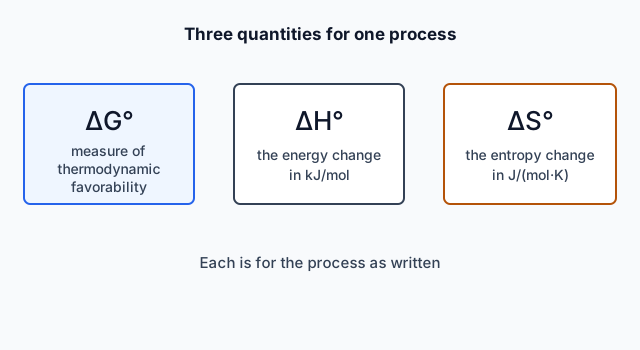 Tap to open the picture full size
Part 1 Think first Ice in winter and in summer
Commit to a guess first. Being wrong now makes the right idea stick better.
Predict first
On a winter night a puddle freezes. The next summer afternoon the same ice-free puddle never freezes, and an ice cube left outside melts. The substance is the same water, and the change is the same, just in opposite directions. Why does the direction depend on the temperature?
In short. A process is thermodynamically favored when its standard Gibbs free energy change, ΔG°, is less than zero, and ΔG° = ΔH° − TΔS° combines the energy change with the entropy change.
- ΔG° < 0 means thermodynamically favored; it replaces the older word "spontaneous", which wrongly suggests a change that happens suddenly or without a cause.
- ΔG° can be found from standard Gibbs free energies of formation, ΣΔGf°(products) − ΣΔGf°(reactants), or from ΔH° − TΔS° with T in kelvins and ΔS° converted to kJ/(mol·K).
- The signs of ΔH° and ΔS° show at which temperatures a process is favored: all, none, only high, or only low.
Part 2 Learn it One number for favorability
2a. ΔG° and thermodynamic favorability
The Gibbs free energy change, ΔG°, is the standard Gibbs free energy change for a process in which every reactant and product is in its standard state: a pure substance, a solution at 1.0 M, or a gas at 1.0 atm (or 1.0 bar).
ΔG° measures thermodynamic favorability:
- If ΔG° < 0, the process is thermodynamically favored.
- If ΔG° > 0, it is not favored as written, and the reverse process is.
Historically, chemists called a process with ΔG° < 0 "spontaneous". That word invites two misunderstandings, that the process happens suddenly and that it happens without a cause, so "thermodynamically favored" is the preferred phrase. A favored process has been compared with its alternative; it has not been given a speed or a trigger.
Quick check · Select all
A process has ΔG° = −20 kJ/mol with every species in its standard state. Which two statements are correct? Select two.
Select 2 answers, then check.
2b. ΔG° from formation values
ΔG° can be found from tabulated standard Gibbs free energies of formation, ΔGf°, the ΔG° for making 1 mole of a substance from its elements in their standard states. By that definition an element in its standard state has ΔGf° = 0.
ΔG° = ΣΔGf°(products) − ΣΔGf°(reactants)
As in the last topic, multiply each value by its coefficient, total each side, and subtract the reactants from the products. The unit is kJ/mol.
Example: for CO(g) + ½O₂(g) → CO₂(g), with ΔGf° values of −137.2 for CO(g) and −394.4 kJ/mol for CO₂(g), and 0 for O₂(g): ΔG° = −394.4 − (−137.2 + 0) = −257.2 kJ/mol, so the process is favored. The values in this lesson are teaching examples of tabulated values.
Quick check · Calculate
Calculate ΔG° for CH₄(g) + 2O₂(g) → CO₂(g) + 2H₂O(l), in kJ/mol, with its sign. The ΔGf° values are CH₄(g) −50.8, CO₂(g) −394.4 and H₂O(l) −237.1 kJ/mol. Give your answer to one decimal place.
2c. ΔG° = ΔH° − TΔS°
When ΔH° and ΔS° are known at a temperature, ΔG° follows directly:
ΔG° = ΔH° − TΔS°
Two cautions. T is in kelvins. And ΔH° is usually in kJ/mol while ΔS° is in J/(mol·K), so divide ΔS° by 1000 before you multiply.
The equation shows why you sometimes need both terms. Dissolving sodium nitrate, NaNO₃, absorbs energy (ΔH° = +20.5 kJ/mol), which works against it, but it greatly disperses the ions (ΔS° = +89 J/(mol·K)). At 298 K:
ΔG° = 20.5 − (298)(0.089) = 20.5 − 26.5 = −6.0 kJ/mol
The entropy term wins, so dissolving is favored even though it absorbs energy. The freezing of water is the mirror image: it releases energy but gathers the molecules, so the temperature decides. These values are teaching examples.
Quick check · Calculate
For N₂(g) + 3H₂(g) → 2NH₃(g) at 298 K, ΔH° = −92.2 kJ/mol and ΔS° = −198.1 J/(mol·K). What is ΔG°, in kJ/mol? Give your answer to one decimal place.
2d. Which temperatures favor a process?
In ΔG° = ΔH° − TΔS°, T is positive, so the signs of ΔH° and ΔS° settle many cases without a calculation:
| ΔH° | ΔS° | Thermodynamically favored at |
|---|---|---|
| − | + | all temperatures |
| + | − | no temperature |
| + | + | high temperatures |
| − | − | low temperatures |
When ΔH° < 0 and ΔS° > 0, both terms push ΔG° below zero, so no calculation is needed. When ΔH° > 0 and ΔS° < 0, both push it above zero, so the process is never favored. When the signs match, the temperature is the tie-breaker: a high T makes the entropy term −TΔS° large, so the entropy change wins, and a low T lets the energy change win.
Quick check · Sort it
Each card describes a process. Tap a card, then the bin that says when it is thermodynamically favored.
At all temperatures
At no temperature
Only at high temperatures
Only at low temperatures
Part 3 Watch it done Heating limestone
Predict first, then watch each step, then finish the calculation yourself.
Limestone decomposes: CaCO₃(s) → CaO(s) + CO₂(g), with ΔH° = +178.3 kJ/mol and ΔS° = +160.7 J/(mol·K). These are teaching-example values. Is the decomposition thermodynamically favored at 1175 K?
Predict first
Before you open the first step, predict: would heating the limestone make the decomposition more favored, less favored or no different?
Step 1 · Read the signs
ΔH° > 0 and ΔS° > 0. The energy change works against the process and the entropy change works for it, so it is favored only at high temperatures.
Step 2 · Convert ΔS° to kJ
160.7 J/(mol·K) is 0.1607 kJ/(mol·K).
Why this step?
Why convert the entropy change to kilojoules?
ΔH° is in kilojoules and ΔS° is in joules, so without the conversion the entropy term would be 1000 times too big and ΔG° would come out wrong in size and sign.
Step 3 · Check a low temperature
At 298 K: ΔG° = 178.3 − (298)(0.1607) = 178.3 − 47.89 = +130.4 kJ/mol. It is positive, so the process is not favored at room temperature.
Your step · Calculate
Finish it. What is ΔG° at 1175 K, in kJ/mol? Give your answer to one decimal place.
kJ/mol
At 298 K the entropy term was only 47.9 kJ against 178.3 kJ of enthalpy, so the process was not favored. Heating to 1175 K raised the entropy term to 188.8 kJ, and the sign of ΔG° flipped. The same reasoning is why limestone is heated in a kiln to make lime.
Part 4 Try it The cold pack
An instant cold pack gets cold when ammonium nitrate dissolves in water: NH₄NO₃(s) → NH₄⁺(aq) + NO₃⁻(aq). For this process, ΔH° = +25.7 kJ/mol and ΔS° = +108.7 J/(mol·K). These numbers are a teaching example.
Try it · Calculate
What is ΔG° for dissolving ammonium nitrate at 298 K, in kJ/mol? Give your answer to one decimal place.
Try it · Decide and justify
The cold pack gets colder as the ammonium nitrate dissolves, so dissolving absorbs energy. Is dissolving ammonium nitrate thermodynamically favored at 298 K?
Which reason supports your decision?
Part 5 Explain it Nitrogen dioxide and its dimer
On the exam this is handwritten, so answer on paper first. Nothing you type here leaves this page. Then check your answer against the model and each scoring point.
Free response is 50% of the exam score. This one is shaped like a short-answer question, which is worth 4 points.
Free-response practice · Short-answer style
Brown nitrogen dioxide gas forms colorless dinitrogen tetroxide gas: 2NO₂(g) → N₂O₄(g). At 298 K, ΔH° = −57.2 kJ/mol and ΔS° = −175.8 J/(mol·K). These values are a teaching example.
(a) Calculate ΔG° at 298 K, in kJ/mol.
(b) Justify whether the reaction is thermodynamically favored at 298 K.
(c) Predict whether the reaction is thermodynamically favored at 500 K, and explain your prediction using the signs of ΔH° and ΔS°.
(d) Explain why the sign of the entropy change is negative for this reaction.
Model answer
(a) ΔG° = ΔH° − TΔS° = −57.2 kJ/mol − (298 K)(−0.1758 kJ/(mol·K)) = −57.2 + 52.4 = −4.8 kJ/mol.
(b) ΔG° < 0, so the reaction is thermodynamically favored at 298 K.
(c) It is not favored at 500 K. ΔH° < 0 and ΔS° < 0, so the reaction is favored only at low temperatures, below the crossover where ΔG° = 0, T = ΔH°/ΔS° = −57.2/−0.1758 = 325 K. At 500 K, which is above that, ΔG° = −57.2 − (500)(−0.1758) = −57.2 + 87.9 = +30.7 kJ/mol, so the reaction is not favored.
(d) Two moles of gas become one mole of gas, so the matter is less dispersed and ΔS° is negative.
Score your own answer. This is a self-check, not a grade. Tick each point your answer makes.
Part 6 Check yourself Four reactions, two quantities
All three case questions use the table.
A student collects ΔH° and ΔS° for four reactions, A to D, at 298 K. Every species is in its standard state. These numbers are a teaching example.
| Reaction | ΔH° (kJ/mol) | ΔS° (J/(mol·K)) |
|---|---|---|
| A | −112.0 | +145.0 |
| B | +85.0 | −30.0 |
| C | +60.0 | +180.0 |
| D | −75.0 | −160.0 |
Case question 1 · Calculate
Using the table: what is ΔG° for reaction C at 298 K, in kJ/mol? Give your answer to one decimal place.
Case question 2 · Multiple choice
Using the table: which reaction is thermodynamically favored at every temperature?
Case question 3 · Decide and justify
Using the table: reaction D is favored at 298 K. Is it still favored at 1000 K?
Which reason supports your decision?
The rest stand on their own and do not use the case.
Check yourself · Spot the error
A student explains why dissolving ammonium nitrate, ΔH° = +25.7 kJ/mol, cannot be thermodynamically favored. Tap the line with the mistake.
Check yourself · Fill the statement
Complete the statement about ΔG° and its standard state.
ΔG° is defined with every species in its standard state: a pure substance, a solution at a concentration of , or a gas at a pressure of . A process with ΔG° zero is thermodynamically favored.
Part 7 Keep it Bring back earlier ideas
Favorability combines two earlier ideas: whether a process absorbs or releases energy, and how to compute a change in entropy. Pulling them back up is what makes them last.
From 6.4 Heat Capacity and Calorimetry · Decide and justify
A student dissolves a few grams of calcium chloride in 50.0 g of water in a coffee-cup calorimeter. The thermometer reads 21.0 °C before and 30.5 °C after the solid dissolves. Is dissolving calcium chloride exothermic or endothermic?
Which reason supports your decision?
From 9.2 Absolute Entropy and Entropy Change · Calculate
Calculate ΔS° for N₂(g) + 3H₂(g) → 2NH₃(g), in J/(mol·K), with its sign. The standard molar entropies are N₂(g) 191.6, H₂(g) 130.7 and NH₃(g) 192.8 J/(mol·K). Give your answer to one decimal place.
In three lines
- A process is thermodynamically favored when ΔG° < 0; "spontaneous" is the older word and wrongly suggests suddenly.
- ΔG° = ΣΔGf°(products) − ΣΔGf°(reactants), or ΔG° = ΔH° − TΔS° with T in kelvins and ΔS° in kJ/(mol·K).
- If ΔH° < 0 and ΔS° > 0 the process is favored at all T, if ΔH° > 0 and ΔS° < 0 at no T; with matching signs, high T favors + + and low T favors − −.
Exam strategy for this topic
- Section I, Multiple Choice: 60 questions in 90 minutes.
- Section II, Free Response: 7 questions in 105 minutes.
- A scientific or graphing calculator is recommended for use on both sections of the exam.
When a question asks whether a process is favored, state the sign of ΔG° and what it means, in words: "ΔG° < 0, so the process is thermodynamically favored". In a calculation, convert ΔS° to kJ/(mol·K), use T in kelvins, and keep the signs. When only the signs of ΔH° and ΔS° are given, answer with the temperature condition and name both terms.
Questions students ask
What does ΔG° tell you?
ΔG° tells you whether a process is thermodynamically favored under standard conditions. If ΔG° < 0 the process is favored, and if ΔG° > 0 it is not favored as written.
Is thermodynamically favored the same as spontaneous?
"Thermodynamically favored" replaces "spontaneous" for ΔG° < 0. It avoids the misreading that a favored process happens suddenly or without a cause.
How do you calculate ΔG°?
Use ΔG° = ΔH° − TΔS°, with T in kelvins and ΔS° converted to kJ/(mol·K). Or use ΔG° = ΣΔGf°(products) − ΣΔGf°(reactants).
When is a process favored at all temperatures?
When ΔH° < 0 and ΔS° > 0. Both terms then make ΔG° negative, so no calculation is needed.
Why can an endothermic process be thermodynamically favored?
If its entropy increase is large enough, the term TΔS° outweighs a positive ΔH°, so ΔG° is negative. Dissolving sodium nitrate is an example.
Course alignment, for teachers
AP Chemistry topic 9.3, Unit 9: Thermodynamics and Electrochemistry.
- Skill 6.E: Provide reasoning to justify a claim using connections between particulate and macroscopic scales or levels.
This lesson maps all 6 essential knowledge statements of the topic to the part that teaches each one: 6 are checked by a scored question. The map is in the lesson file.