Unit 9 · Topic 9.4 · about 25 minutes · 7 parts · 11 scored checks, 2 of them multiple choice, plus 2 from earlier lessons
AP Chemistry 9.4: Thermodynamic and Kinetic Control
Unit 9: 7 to 9% of the multiple-choice section
What you'll be able to do
- Explain, in terms of kinetics, why a thermodynamically favored reaction might not occur at a measurable rate.
Key vocabulary
| Term | What it means | The exam trap |
|---|---|---|
| Kinetic control | The condition of a process that is thermodynamically favored but does not proceed at a measurable rate. | The idea combines two pieces of evidence, so check that both the favorability and the rate have been established. |
| Activation energy | The energy that colliding particles must have to change into products; a high activation energy is a common reason for a slow rate. | Activation energy belongs to the rate question, so be careful which question a statement is answering. |
| Thermodynamically favored | Describes a process with ΔG° < 0; it is a statement about the products compared with the reactants. | The word says nothing about speed, so watch for answers that give it a time. |
| Rate of a process | How fast reactants are converted to products, which may be too slow to measure. | A rate that cannot be measured is not the same as a system with no tendency to change. |
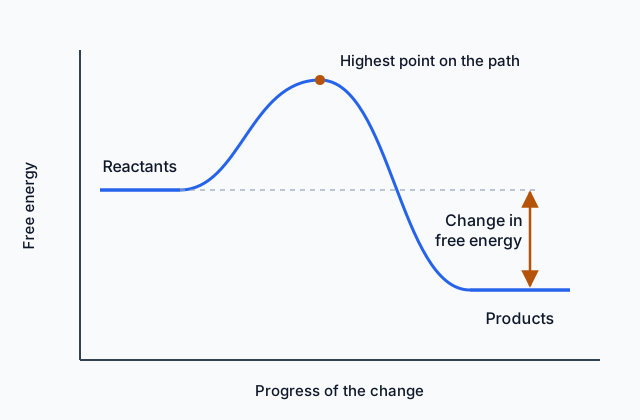 Tap to open the picture full size
Part 1 Think first A diamond ring
Commit to a guess first. Being wrong now makes the right idea stick better.
Predict first
At 25 °C and 1 atm, turning diamond into graphite is thermodynamically favored: ΔG° = −2.9 kJ/mol. Yet no diamond ring has ever turned into pencil lead. How can that be?
In short. A thermodynamically favored process can still occur too slowly to see, and such a process is said to be under kinetic control.
- ΔG° < 0 says that a process is favored; it says nothing about how fast the process occurs.
- High activation energy is a common reason for a favored process to occur at no measurable rate.
- A favored process that is not occurring is under kinetic control, and that does not mean the system is at equilibrium.
Part 2 Learn it Favored is not the same as fast
2a. Favored, but not occurring
Many processes that are thermodynamically favored do not occur to any measurable extent, or occur at extremely slow rates. A sheet of paper in air, a bowl of sugar and a diamond ring each sit unchanged for years, although burning the paper or the sugar in oxygen, or turning the diamond into graphite, has ΔG° < 0.
So ΔG° answers one question, whether a process is favored, and not another, how fast it occurs. When you are asked why a favored process is not seen, the answer is not in the sign of ΔG°. It is in the kinetics of the process, which is the study of how fast it goes.
Quick check · Multiple choice
A student reads that the combustion of table sugar in oxygen has ΔG° < 0. A bowl of sugar has sat in air for a year with no change. Which statement best resolves this?
2b. Kinetic control and activation energy
A process that is thermodynamically favored but does not proceed at a measurable rate is said to be under kinetic control. A common reason is a high activation energy: the energy that colliding particles must have before they can change into products. If few collisions have that much energy at the temperature of the system, the process goes extremely slowly.
Think of a ball in a hollow on a hillside that sits above a valley. The valley is lower, so rolling there is favored, but the ball stays in the hollow until something gives it enough energy to climb the rim. That is why a spark or a flame can start a combustion that sat unchanged for months: it gives some particles the energy to get over the barrier.
So there are two separate questions, and each has its own evidence. ΔG° (from ΔH°, ΔS° and T) says whether the process is favored. The activation energy says whether it occurs at a measurable rate.
Quick check · Sort it
Each card is a piece of information about a process. Tap a card, then the bin for the question it helps answer.
Is the process thermodynamically favored?
Does it occur at a measurable rate?
2c. Kinetic control is not equilibrium
It is tempting to say a system that shows no change must have stopped changing because it is at equilibrium. That does not follow. The fact that a process does not proceed at a noticeable rate does not mean that the system is at equilibrium.
Here is the reasoning to use in an explanation:
- If a process is known to be thermodynamically favored (ΔG° < 0), and yet it does not occur at a measurable rate, it is reasonable to conclude that the process is under kinetic control.
- The cause is not shown by ΔG°. A high activation energy is a common reason.
- "No change" is evidence about the rate, so it cannot be used as evidence that the system is at equilibrium.
A written answer should name the pieces: favored from ΔG°, slow from the lack of change, and kinetic control from the two together.
Quick check · Decide and justify
A mixture of two gases at 25 °C shows no sign of reacting. For the reaction that would occur, ΔG° = −300 kJ/mol. A student says: "Nothing is changing, so the mixture is at equilibrium." Is the student's conclusion reasonable?
Which reason supports your decision?
Part 3 Watch it done A diamond ring, with numbers
Predict first, then watch each step, then finish the conclusion yourself.
At 298 K, the standard Gibbs free energy of formation of graphite is 0 kJ/mol and that of diamond is +2.9 kJ/mol, teaching-example values. A diamond ring is observed for years and shows no change into graphite. What can you conclude?
Predict first
Before you open the first step, predict: is turning diamond into graphite at 298 K thermodynamically favored?
Step 1 · Calculate ΔG°
For C(diamond) → C(graphite), ΔG° = ΔGf°(graphite) − ΔGf°(diamond) = 0 − 2.9 = −2.9 kJ/mol. Graphite, not diamond, is carbon's standard state, which is why its ΔGf° is 0 while diamond's is +2.9 kJ/mol.
Step 2 · Say what the sign means
ΔG° < 0, so the change from diamond to graphite is thermodynamically favored at 298 K.
Why this step?
Why can the ring still show no change at all?
ΔG° says only that graphite is the favored form. It does not say how fast the change happens. Rearranging the strongly bonded carbon atoms of diamond into graphite takes a very large activation energy, so almost no collisions have enough energy and the rate is not measurable.
Your step · Fill the statement
Finish it. Complete the conclusion about the diamond ring.
ΔG° is , so the change is . No change is observed, so the process is under control, for which a common reason is a high .
The conclusion has three links: ΔG° < 0 for favorability, no observed change for the rate, and together they point to kinetic control. Nothing here says the diamond and graphite are at equilibrium. A system at equilibrium has no net tendency to change, but this one does: it is favored to change and is held back only by its rate.
Part 4 Try it Four situations
A chemist sorts what she sees in four situations at 25 °C. In each, ΔG° tells whether the process is favored, and the observation tells whether it occurs at a measurable rate.
Try it · Sort it
Tap each situation, then the bin that describes it.
Favored and occurring
Favored but under kinetic control
Not favored
One of the favored changes is a mixture of hydrogen and oxygen in a sealed flask at 25 °C, where 2H₂(g) + O₂(g) → 2H₂O(l) has ΔG° = −474.2 kJ/mol. The flask shows no change over a year.
Try it · Match
Match each piece of evidence about the flask to what it shows.
Part 5 Explain it Propane and air
On the exam this is handwritten, so answer on paper first. Nothing you type here leaves this page. Then check your answer against the model and each scoring point.
Free response is 50% of the exam score. This one is shaped like a short-answer question, which is worth 4 points.
Free-response practice · Short-answer style
A cylinder holds a mixture of propane gas and air at 25 °C. The combustion C₃H₈(g) + 5O₂(g) → 3CO₂(g) + 4H₂O(l) has ΔG° = −2108.2 kJ/mol. The mixture shows no change for months. When a spark passes through it, it burns rapidly. These values are a teaching example.
(a) Identify whether the combustion is thermodynamically favored at 25 °C, and justify your answer with the sign of ΔG°.
(b) Explain, in terms of kinetics, why no reaction is observed before the spark.
(c) Justify whether the lack of change before the spark shows that the mixture is at equilibrium.
(d) Explain how the spark allows the combustion to start.
Model answer
(a) The combustion is thermodynamically favored, because ΔG° = −2108.2 kJ/mol is less than zero.
(b) The combustion has a high activation energy. At 25 °C very few collisions between propane and oxygen molecules have enough energy to react, so the rate is too slow to measure, even though the process is favored.
(c) No. A process that is favored but does not occur at a measurable rate is under kinetic control. A lack of change shows only that the rate is not measurable, so it does not show that the system is at equilibrium.
(d) The spark supplies energy to some of the molecules, giving them enough energy to overcome the activation energy, so the combustion can begin.
Score your own answer. This is a self-check, not a grade. Tick each point your answer makes.
Part 6 Check yourself Four processes at 25 °C
All three case questions use the table.
A student records ΔG° and what is observed for four processes at 25 °C. These values are a teaching example.
| Process | Equation | ΔG° (kJ/mol) | Observation |
|---|---|---|---|
| A | CH₄(g) + 2O₂(g) → CO₂(g) + 2H₂O(l) | −817.8 | No change in a sealed flask for a month |
| B | N₂(g) + O₂(g) → 2NO(g) | +173.2 | No NO detected in a sealed flask for a month |
| C | Zn(s) + 2H⁺(aq) → Zn²⁺(aq) + H₂(g) | −147.1 | Bubbles of H₂ appear within seconds |
| D | C(diamond) → C(graphite) | −2.9 | No change in a sample for years |
Case question 1 · Select all
Using the table: which two processes are under kinetic control? Select two.
Select 2 answers, then check.
Case question 2 · Decide and justify
Using the table: a student says process B is under kinetic control because no NO is detected. Is the student correct?
Which reason supports your decision?
Case question 3 · Multiple choice
Using the table: a student claims process A has reached equilibrium because nothing has changed in a month. Which response is best supported?
The rest stand on their own and do not use the case.
Check yourself · Spot the error
A student explains why a mixture of two gases does not react, even though ΔG° = −150 kJ/mol. Tap the line with the mistake.
Check yourself · Fill the statement
Complete the statement about a process that is favored but not seen.
A process with ΔG° zero is thermodynamically favored. If it still occurs at no measurable rate, it is under control, and a common reason is a high . That does not mean the system is at equilibrium.
Part 7 Keep it Bring back earlier ideas
Kinetic control leans on two earlier ideas: what ΔG° < 0 does and does not say, and how a process that absorbs energy can still be favored. Pulling them back up is what makes them last.
From 9.3 Gibbs Free Energy and Thermodynamic Favorability · Select all
A process has ΔG° = −20 kJ/mol with every species in its standard state. Which two statements are correct? Select two.
Select 2 answers, then check.
An instant cold pack gets cold when ammonium nitrate dissolves in water: NH₄NO₃(s) → NH₄⁺(aq) + NO₃⁻(aq). For this process, ΔH° = +25.7 kJ/mol and ΔS° = +108.7 J/(mol·K). These numbers are a teaching example.
From 9.3 Gibbs Free Energy and Thermodynamic Favorability · Decide and justify
The cold pack gets colder as the ammonium nitrate dissolves, so dissolving absorbs energy. Is dissolving ammonium nitrate thermodynamically favored at 298 K?
Which reason supports your decision?
In three lines
- ΔG° < 0 shows a process is thermodynamically favored; it does not show that the process occurs at a measurable rate.
- A favored process that is not occurring is under kinetic control, and a high activation energy is a common reason.
- A lack of observed change is evidence about the rate, so it does not show that the system is at equilibrium.
Exam strategy for this topic
- Section I, Multiple Choice: 60 questions in 90 minutes.
- Section II, Free Response: 7 questions in 105 minutes.
- A scientific or graphing calculator is recommended for use on both sections of the exam.
When a favored process is not observed, write a three-part answer: it is favored because ΔG° < 0; it is not observed because its rate is not measurable; so it is under kinetic control, most likely due to a high activation energy. Do not call it equilibrium, and do not use ΔG° to explain the slow rate.
Questions students ask
Can a process be thermodynamically favored and not happen?
Yes. ΔG° < 0 shows a process is favored but says nothing about its rate. Many favored processes occur at extremely slow rates.
What is kinetic control?
A process that is thermodynamically favored but does not proceed at a measurable rate is under kinetic control. A high activation energy is a common reason.
What is activation energy?
It is the energy that colliding particles must have to change into products. A high activation energy means few collisions are energetic enough, so the rate is slow.
Does a reaction that shows no change have to be at equilibrium?
No. A favored process that does not proceed at a noticeable rate may be under kinetic control, and that does not mean the system is at equilibrium.
Why did the diamond not turn into graphite?
The change is thermodynamically favored, but it has a very high activation energy, so it does not occur at a measurable rate at room temperature.
Course alignment, for teachers
AP Chemistry topic 9.4, Unit 9: Thermodynamics and Electrochemistry.
- Skill 6.E: Provide reasoning to justify a claim using connections between particulate and macroscopic scales or levels.
This lesson maps all 2 essential knowledge statements of the topic to the part that teaches each one: 2 are checked by a scored question. The map is in the lesson file.