Unit 9 · Topic 9.5 · about 30 minutes · 7 parts · 11 scored checks, 1 of them multiple choice, plus 2 from earlier lessons
AP Chemistry 9.5: Free Energy and Equilibrium
Unit 9: 7 to 9% of the multiple-choice section
What you'll be able to do
- Use the relationships between ΔG°, the equilibrium constant K and temperature to explain whether a process is thermodynamically favored.
Key vocabulary
| Term | What it means | The exam trap |
|---|---|---|
| Standard free energy change (ΔG°) | The change in free energy when a process runs with every reactant and product in its standard state, usually in kJ/mol. | Check the unit it is given in before it goes into an equation, because kilojoules and joules differ by a factor of one thousand. |
| Thermodynamically favored | A process with ΔG° < 0, one whose products are favored at equilibrium under standard conditions. | Read the exact wording of a claim, since "favored" describes which side wins at equilibrium and says nothing more than that. |
| Equilibrium constant (K) | The number that compares the amounts of products and reactants in a mixture that has stopped changing. | A K can be written as a decimal or as a power of ten, so decide whether it is above or below 1 before using it. |
| Standard conditions | Pure substances, 1.0 M solutions and 1.0 atm (or 1.0 bar) gases, at a stated temperature. | An equation with T in it needs the temperature in kelvin, so convert any Celsius reading first. |
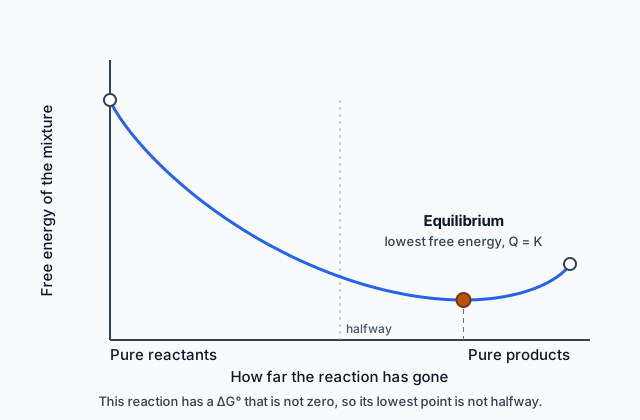 Tap to open the picture full size
Part 1 Think first Two flasks, opposite signs
Commit to a guess first. Being wrong now makes the right idea stick better.
Predict first
Two reactions of the form A ⇌ B are run in water at 298 K, each starting with only A at a concentration of 1.0 M. Reaction 1 has ΔG° = −20 kJ/mol. Reaction 2 has ΔG° = +20 kJ/mol. When each mixture stops changing, what does each flask hold?
In short. The standard free energy change and the equilibrium constant describe the same thing from two sides: ΔG° = −RT ln K, so a negative ΔG° goes with K > 1 and a positive ΔG° goes with K < 1.
- A process is thermodynamically favored when ΔG° < 0, which means the products are favored at equilibrium (K > 1) under standard conditions.
- K = e^(−ΔG°/RT) and ΔG° = −RT ln K, with T in kelvin and ΔG° in joules per mole when R is 8.314 J/(mol·K).
- When ΔG° is near zero, K is close to 1. When ΔG° is much larger or much smaller than RT, K is far from 1.
Part 2 Learn it From the sign of ΔG° to the size of K
2a. ΔG° and which side is favored
The standard free energy change, ΔG°, is the change in free energy when every reactant and product is in its standard state. A process with ΔG° < 0 is thermodynamically favored. The equilibrium constant, K, says the same thing in terms of amounts: it compares products with reactants once the mixture stops changing.
The two always agree:
- ΔG° < 0 means K > 1. The products are favored at equilibrium under standard conditions.
- ΔG° > 0 means K < 1. The reactants are favored.
Be careful about what "favored" means. A K above 1 means the products outweigh the reactants at equilibrium. It does not mean the reactants are all used up. A K below 1 does not mean nothing happens either: some product still forms, but the reactants are favored at equilibrium.
This lesson is about thermodynamic favorability only. How quickly a mixture gets to equilibrium is a different question.
Quick check · Decide and justify
A reaction A ⇌ B has ΔG° = −8.0 kJ/mol at 298 K. Under standard conditions, which side is favored at equilibrium?
Which reason supports your decision?
2b. ΔG° = −RT ln K
The size of ΔG° and the size of K are tied together by two forms of one equation:
ΔG° = −RT ln K, or K = e^(−ΔG°/RT)
- R is the gas constant, 8.314 J/(mol·K).
- T is the temperature in kelvin, never in °C.
- ΔG° must be in joules per mole to match R. A value given in kJ/mol is multiplied by 1000.
Example: a reaction has ΔG° = −15.0 kJ/mol at 298 K. Then −ΔG°/RT = (15 000 J/mol)/((8.314 J/(mol·K))(298 K)) = 6.054, and K = e^6.054 = 426. The negative ΔG° gives K > 1, as it should.
The equation works both ways. If you are given K, take its natural logarithm (ln, not log) and multiply by −RT to get ΔG°. A K below 1 has a negative ln K, so ΔG° comes out positive.
Quick check · Calculate
A reaction has ΔG° = −12.5 kJ/mol at 298 K. What is its equilibrium constant K? Use R = 8.314 J/(mol·K) and give your answer to three significant figures.
2c. Estimating K without a calculator
You can judge K from ΔG° without finishing the calculation, by comparing ΔG° with RT. At 298 K, RT = (8.314 J/(mol·K))(298 K) = 2478 J/mol, about 2.5 kJ/mol.
- When ΔG° is near zero, the exponent −ΔG°/RT is near zero, so K is close to 1. At ΔG° = 0, K is exactly 1.
- When ΔG° is much larger or much smaller than RT (more than a few times 2.5 kJ/mol away from zero), the exponent is large and K is far from 1: much greater than 1 if ΔG° is very negative, much less than 1 if it is very positive.
A few values at 298 K: ΔG° = −1.0 kJ/mol gives K = 1.5. ΔG° = +1.0 kJ/mol gives K = 0.67. ΔG° = −30 kJ/mol gives K = 1.8 × 10⁵.
Because K depends on ΔG° through an exponential, a change of about 6 kJ/mol changes K by roughly a factor of ten.
Quick check · Rank it
Four reactions are run at 298 K. Reaction P has ΔG° = +1 kJ/mol, reaction Q has −35 kJ/mol, reaction R has +25 kJ/mol and reaction S has −2 kJ/mol. Rank them by the size of their equilibrium constants K.
Largest K first
Give each one a place, 1 for first. Give two the same place if they are equal.
Your ranking: none yet
Part 3 Watch it done From K to ΔG° for acetic acid
Predict first, then watch each step, then finish the calculation yourself.
Acetic acid, the acid in vinegar, ionizes in water: CH₃COOH(aq) ⇌ CH₃COO⁻(aq) + H⁺(aq). At 298 K the equilibrium constant is K = 1.8 × 10⁻⁵. What is ΔG° for the ionization, in kJ/mol? Use R = 8.314 J/(mol·K).
Predict first
Before you open the first step, predict: will ΔG° for this ionization be positive or negative?
Step 1 · Choose the equation and the temperature
K is given and ΔG° is wanted, so use ΔG° = −RT ln K with T = 298 K.
Step 2 · Find RT
RT = (8.314 J/(mol·K))(298 K) = 2477.572 J/mol. Keep the unrounded value for the last step.
Step 3 · Take the natural logarithm of K
ln(1.8 × 10⁻⁵) = −10.9251. It is negative because K is less than 1.
Why this step?
Why should the answer come out positive before you finish the calculation?
A K below 1 means the reactants are favored at equilibrium, and that goes with ΔG° > 0. In the equation a negative ln K is multiplied by −RT, so the two minus signs give a positive ΔG°.
Your step · Calculate
Finish it. With RT = 2477.572 J/mol and ln K = −10.9251, what is ΔG° for the ionization of acetic acid, in kJ/mol? Give your answer to three significant figures.
kJ/mol
A ΔG° of +27 kJ/mol is not a ban on the reaction. K = 1.8 × 10⁻⁵ is small, but it is not zero, so acetic acid does ionize a little. A positive ΔG° means the reactants win at equilibrium, and the larger the ΔG°, the more completely they win.
Part 4 Try it A step inside the body
Reactions in the body run at about 310 K, not 298 K. One step in a metabolic pathway has ΔG° = +7.50 kJ/mol at 310 K. These numbers are a teaching example.
Try it · Calculate
What is the equilibrium constant K for the step at 310 K? Use R = 8.314 J/(mol·K) and give your answer to three significant figures.
Try it · Sort it
Each card gives ΔG° for a reaction at 298 K, where RT is about 2.5 kJ/mol. Tap a card, then the bin that describes K.
K is much less than 1
K is close to 1
K is much greater than 1
Part 5 Explain it An isomerization at equilibrium
On the exam this is handwritten, so answer on paper first. Nothing you type here leaves this page. Then check your answer against the model and each scoring point.
Free response is 50% of the exam score. This one is shaped like a short-answer question, which is worth 4 points.
Free-response practice · Short-answer style
A compound X changes into its isomer Y in solution: X(aq) ⇌ Y(aq). At 298 K, ΔG° for the reaction is −0.60 kJ/mol. These numbers are a teaching example. Use R = 8.314 J/(mol·K).
(a) Identify whether the conversion of X to Y is thermodynamically favored under standard conditions.
(b) Calculate the equilibrium constant K at 298 K.
(c) Explain, by comparing ΔG° with RT, why K is close to 1.
(d) A classmate says, "ΔG° is negative, so all of X will turn into Y." Justify whether this claim is correct, using your value of K.
Model answer
(a) Yes. ΔG° is negative, so the conversion is thermodynamically favored.
(b) K = e^(−ΔG°/RT) = e^((600 J/mol)/((8.314 J/(mol·K))(298 K))) = e^0.2422 = 1.274, which is 1.27 to three significant figures.
(c) RT is about 2.48 kJ/mol, and |ΔG°| = 0.60 kJ/mol is much smaller than that. The exponent −ΔG°/RT is therefore near zero, and e raised to a number near zero is near 1.
(d) The claim is not correct. K = [Y]/[X] = 1.27, so at equilibrium there is only about 1.27 times as much Y as X: roughly 56% Y and 44% X. Some X is always left, because K is finite.
Score your own answer. This is a self-check, not a grade. Tick each point your answer makes.
Part 6 Check yourself Four reactions at 298 K
All three case questions use the table.
A student looks up four reactions at 298 K. Reactions A, B and C list ΔG°, and reaction D lists only K. These numbers are a teaching example. Use R = 8.314 J/(mol·K).
| Reaction | Given at 298 K |
|---|---|
| A | ΔG° = −40.0 kJ/mol |
| B | ΔG° = −0.50 kJ/mol |
| C | ΔG° = +9.00 kJ/mol |
| D | K = 2.50 × 10⁻³ |
Case question 1 · Calculate
Using the table: what is the equilibrium constant K of reaction C? Give your answer to three significant figures.
Case question 2 · Multiple choice
Using the table: which statement about the four reactions is supported by the data?
Case question 3 · Calculate
Using the table: what is ΔG° of reaction D, in kJ/mol? Give your answer to three significant figures.
The rest stand on their own and do not use the case.
Check yourself · Spot the error
A student works out what a ΔG° of +12 kJ/mol at 298 K says about a reaction. Tap the line with the mistake.
Check yourself · Put it in order
Put the steps for finding K from a ΔG° given in kJ/mol at a temperature in °C in order.
Part 7 Keep it Bring back earlier ideas
K and ΔG° say which side is favored at equilibrium, not how fast the mixture gets there, and ΔG° contains an entropy term. Pulling those back up is what makes them last.
From 9.4 Thermodynamic and Kinetic Control · Decide and justify
A mixture of two gases at 25 °C shows no sign of reacting. For the reaction that would occur, ΔG° = −300 kJ/mol. A student says: "Nothing is changing, so the mixture is at equilibrium." Is the student's conclusion reasonable?
Which reason supports your decision?
From 9.2 Absolute Entropy and Entropy Change · Calculate
Calculate ΔS° for N₂(g) + 3H₂(g) → 2NH₃(g), in J/(mol·K), with its sign. The standard molar entropies are N₂(g) 191.6, H₂(g) 130.7 and NH₃(g) 192.8 J/(mol·K). Give your answer to one decimal place.
In three lines
- ΔG° < 0 means thermodynamically favored and K > 1; ΔG° > 0 means K < 1. Neither means all or nothing.
- ΔG° = −RT ln K and K = e^(−ΔG°/RT), with T in kelvin and ΔG° in joules per mole.
- When ΔG° is near zero, K is close to 1; when ΔG° is far from zero compared with RT, K is far from 1.
Exam strategy for this topic
- Section I, Multiple Choice: 60 questions in 90 minutes.
- Section II, Free Response: 7 questions in 105 minutes.
- A scientific or graphing calculator is recommended for use on both sections of the exam.
In a calculation with ΔG° and K, write the relationship, convert T to kelvin and ΔG° to joules, and show the exponent before the answer. Then check the answer against the sign: ΔG° < 0 should give K > 1. In a written answer, state which side is favored in words, and name the comparison of ΔG° with RT when you are asked whether K is near 1.
Questions students ask
What is the relationship between ΔG° and K?
ΔG° = −RT ln K, or equivalently K = e^(−ΔG°/RT). A negative ΔG° goes with K > 1 and a positive ΔG° goes with K < 1.
What does thermodynamically favored mean?
It means ΔG° < 0, so the products are favored at equilibrium (K > 1) under standard conditions. It does not mean the reaction is fast or that it goes to completion.
Why must T be in kelvin and ΔG° in joules?
R is 8.314 J/(mol·K), so the units only cancel when T is in kelvin and ΔG° is in joules per mole. A ΔG° in kJ/mol is multiplied by 1000 first.
When is K close to 1?
When ΔG° is near zero, because the exponent −ΔG°/RT is near zero and e to a number near zero is near 1. When ΔG° is much larger or much smaller than RT, K is far from 1.
If ΔG° is positive, does the reaction not happen?
A positive ΔG° means K < 1, so reactants are favored at equilibrium. Some product still forms, because K is not zero.
Course alignment, for teachers
AP Chemistry topic 9.5, Unit 9: Thermodynamics and Electrochemistry.
- Skill 6.D: Provide reasoning to justify a claim using chemical principles or laws, or using mathematical justification.
This lesson maps all 4 essential knowledge statements of the topic to the part that teaches each one: 4 are checked by a scored question. The map is in the lesson file.