Unit 9 · Topic 9.6 · about 30 minutes · 7 parts · 11 scored checks, 1 of them multiple choice, plus 2 from earlier lessons
AP Chemistry 9.6: Free Energy of Dissolution
Unit 9: 7 to 9% of the multiple-choice section
What you'll be able to do
- Explain how the enthalpy and entropy changes of dissolving a salt are related to how soluble the salt is.
Key vocabulary
| Term | What it means | The exam trap |
|---|---|---|
| Enthalpy of dissolution (ΔH°) | The energy absorbed (positive) or released (negative) when a substance dissolves. | Read the sign of ΔH° as the direction of energy flow only, and ask what else a claim about favorability would need. |
| Entropy of dissolution (ΔS°) | The change in disorder when a substance dissolves, counting both the dissolved particles and the solvent around them. | The entropy term is multiplied by temperature, so check its units against the enthalpy before you combine them. |
| Ion-dipole attraction | The attraction between an ion and the partial charge on a polar molecule, such as water. | Ask how large an attraction is, and what else changes when it forms, before you use it to explain a difference between two salts. |
| Solubility | How much of a substance dissolves in a given solvent at a given temperature. | Words like soluble and insoluble are the ends of a scale, so a salt that barely dissolves still dissolves a little. |
| Solubility product (Ksp) | The equilibrium constant for a salt dissolving, which is tied to ΔG° of dissolution by ΔG° = −RT ln Ksp. | Ksp compares equilibrium amounts, and the way it is written depends on the formula of the salt, so write the dissolution equation first. |
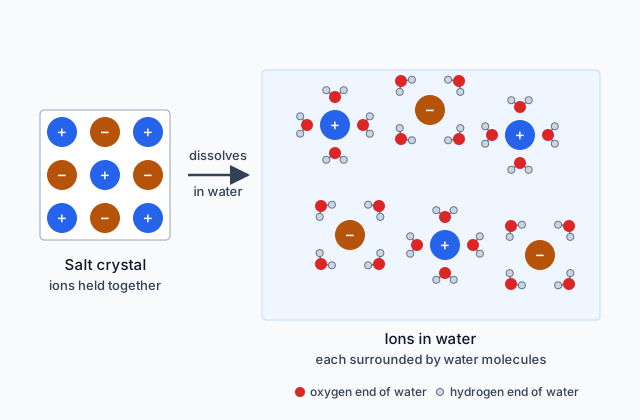 Tap to open the picture full size
Part 1 Think first Salt and silver chloride
Commit to a guess first. Being wrong now makes the right idea stick better.
Predict first
Stir 36 g of table salt, NaCl, into 100 g of water at 25 °C and it dissolves, even though the water cools by a few degrees. Silver chloride, AgCl, is also made of a metal cation and a chloride ion, but only a tiny amount of it dissolves. Which explanation fits both?
In short. A salt dissolves to the extent its free energy of dissolution allows, and that ΔG° adds up three contributions, each with an enthalpy part and an entropy part, which often nearly cancel.
- Dissolving a salt breaks the attractions in the solid, rearranges the solvent around the dissolved particles, and forms attractions between the dissolved particles and the solvent.
- ΔG° = ΔH° − TΔS° for dissolution, and ΔG° = −RT ln K ties it to K, so a more positive ΔG° means a lower solubility for similar salts.
- The contributions are large and opposite in sign, so the total is hard to predict from the three factors alone.
Part 2 Learn it What decides how much of a salt dissolves
2a. Three things happen when a salt dissolves
When an ionic solid dissolves in water, three things happen. Each has an enthalpy part (energy absorbed or released) and an entropy part (change in disorder), and together they decide the free energy change, ΔG°, of dissolution.
- The attractions that hold the solid together are broken. The ions are pulled out of the crystal. This takes in energy, so the enthalpy goes up (ΔH > 0). It also frees the ions to move, so the entropy goes up (ΔS > 0).
- The solvent reorganizes around the dissolved particles. Water molecules have to pull away from one another, giving up some of their own attractions, to make room and to turn so their partial charges face the ions. That takes in energy, so the enthalpy goes up (ΔH > 0). Water held in place around an ion is more ordered, so the entropy goes down (ΔS < 0).
- The dissolved particles interact with the solvent. Ion-dipole attractions between the ions and the water form. This releases energy, so the enthalpy goes down (ΔH < 0). Each ion is now tied to the water molecules around it and moves less freely, so the entropy goes down (ΔS < 0).
The signs are only a rough estimate. How big each contribution is depends on the ions and on the solvent.
Quick check · Match
Match each part of the dissolving process to its effect.
2b. Adding them up
Add the three enthalpy parts to get ΔH° for dissolving, and the three entropy parts to get ΔS°. Then use ΔG° = ΔH° − TΔS°, with ΔS° converted from J/(mol·K) to kJ/(mol·K) so both terms are in kJ/mol.
For NaCl at 298 K: ΔG° = +3.9 kJ/mol − (298 K)(0.0434 kJ/(mol·K)) = 3.9 − 12.9 = −9.0 kJ/mol. Dissolving absorbs a little energy, but the entropy gain more than pays for it, so ΔG° is negative.
The table shows why this is hard to predict. AgCl has the same two signs as NaCl, but its ΔH° is about 17 times as large. The energy to pull apart a crystal and the energy returned by water are each hundreds of kJ/mol and nearly cancel, so the total is a small difference between large numbers. A small change in either one can change the sign of ΔG°. Measured values decide; the three factors alone do not.
| Salt | ΔH° (kJ/mol) | ΔS° (J/(mol·K)) |
|---|---|---|
| NaCl | +3.9 | +43.4 |
| AgCl | +65.4 | +32.5 |
Quick check · Calculate
Dissolving AgCl has ΔH° = +65.4 kJ/mol and ΔS° = +32.5 J/(mol·K). What is ΔG° for dissolving AgCl at 298 K, in kJ/mol? Give your answer to the nearest 0.1 kJ/mol.
2c. From ΔG° to solubility
Dissolving a salt is an equilibrium, and its K is the solubility product, Ksp. The link from the last topic applies directly: ΔG° = −RT ln Ksp.
- A negative ΔG° of dissolving means K > 1: a lot of salt dissolves. For NaCl, K is about 38.
- A positive ΔG° means K < 1: only a little dissolves. For AgCl, ΔG° = +55.7 kJ/mol gives K of about 1.7 × 10⁻¹⁰, tiny but not zero.
For salts with the same kind of formula, such as one cation and one anion each, the more positive ΔG° of dissolving, the smaller K and the less soluble the salt. The enthalpy and entropy changes matter only through ΔG°, so a salt can be quite soluble even when dissolving absorbs energy, as NaCl shows.
Quick check · Rank it
Four salts, each made of one cation and one anion, have these free energy changes of dissolution at 298 K: salt P, +31.0 kJ/mol; salt Q, −4.0 kJ/mol; salt R, +12.5 kJ/mol; salt S, −17.0 kJ/mol. Rank them by solubility.
Most soluble first
Give each one a place, 1 for first. Give two the same place if they are equal.
Your ranking: none yet
Part 3 Watch it done Silver bromide against table salt
Predict first, then watch each step, then finish the calculation yourself.
At 298 K, dissolving silver bromide, AgBr, has ΔH° = +84.4 kJ/mol and ΔS° = +47.7 J/(mol·K). These numbers are a teaching example. Find ΔG° for dissolving AgBr and say whether AgBr is more or less soluble than NaCl, whose ΔG° is −9.0 kJ/mol.
Predict first
Before you open the first step, predict: will dissolving AgBr be thermodynamically favored at 298 K?
Step 1 · Put the entropy in kJ
ΔS° = +47.7 J/(mol·K) = +0.0477 kJ/(mol·K), so that both terms are in kJ/mol.
Step 2 · Find the entropy term
TΔS° = (298 K)(0.0477 kJ/(mol·K)) = 14.2146 kJ/mol. Keep the unrounded value for the last step.
Why this step?
Why do both ΔH° and ΔS° being positive not settle the sign of ΔG°?
ΔH° adds to ΔG° and −TΔS° subtracts from it, so the two terms work against each other. Which one is larger decides the sign, and that depends on the numbers.
Your step · Calculate
Finish it. With ΔH° = +84.4 kJ/mol and TΔS° = 14.2146 kJ/mol, what is ΔG° for dissolving AgBr, in kJ/mol? Give your answer to the nearest 0.1 kJ/mol.
kJ/mol
A ΔG° of +70.2 kJ/mol gives K = e^(−ΔG°/RT) = 5.0 × 10⁻¹³. That is far smaller than NaCl's K of about 38, so AgBr is much less soluble. Both salts have ΔH° > 0 and ΔS° > 0. What differs is the size of ΔH°, which is why the signs alone cannot answer the question.
Part 4 Try it A cold pack, in numbers
An instant cold pack gets cold because the salt inside, ammonium nitrate, NH₄NO₃, absorbs energy as it dissolves. At 298 K, take ΔH° = +25.7 kJ/mol and ΔS° = +109 J/(mol·K) for dissolving it. These numbers are a teaching example.
Try it · Calculate
What is ΔG° for dissolving ammonium nitrate at 298 K, in kJ/mol? Give your answer to the nearest 0.1 kJ/mol.
Try it · Decide and justify
A student says, "Dissolving ammonium nitrate absorbs energy, so it cannot be thermodynamically favored." Is the conclusion correct?
Which reason supports your decision?
Part 5 Explain it Why KCl dissolves
On the exam this is handwritten, so answer on paper first. Nothing you type here leaves this page. Then check your answer against the model and each scoring point.
Free response is 50% of the exam score. This one is shaped like a short-answer question, which is worth 4 points.
Free-response practice · Short-answer style
At 298 K, dissolving potassium chloride, KCl, has ΔH° = +17.2 kJ/mol and ΔS° = +81.2 J/(mol·K). Dissolving silver iodide, AgI, has ΔH° = +110.6 kJ/mol and ΔS° = +68.5 J/(mol·K). These numbers are a teaching example. Use R = 8.314 J/(mol·K).
(a) Calculate ΔG° for dissolving KCl, to the nearest 0.1 kJ/mol.
(b) Calculate the equilibrium constant K for dissolving KCl, to two significant figures.
(c) Describe the three contributions to ΔH° when a salt dissolves, and say what must be true of them for ΔH° to be positive, as it is for KCl.
(d) Justify the statement that the signs of ΔH° and ΔS° alone cannot predict how soluble a salt is, using ΔG° for AgI.
Model answer
(a) ΔG° = ΔH° − TΔS° = 17.2 kJ/mol − (298 K)(0.0812 kJ/(mol·K)) = 17.2 − 24.2 = −7.0 kJ/mol.
(b) K = e^(−ΔG°/RT) = e^(6998 J/mol ÷ ((8.314 J/(mol·K))(298 K))) = e^2.82 = 17.
(c) Pulling the ions out of the solid absorbs energy (ΔH > 0). The water has to give up some of its own attractions to rearrange around the ions, which also absorbs energy (ΔH > 0). The attractions between the ions and the water molecules release energy (ΔH < 0). ΔH° is the sum of the three, so it is positive when the energy absorbed by the first two is greater than the energy released by the ion-water attractions, as for KCl.
(d) KCl and AgI both have ΔH° > 0 and ΔS° > 0. For AgI, ΔG° = 110.6 − (298)(0.0685) = 110.6 − 20.4 = +90.2 kJ/mol, while ΔG° for KCl is −7.0 kJ/mol. The signs are the same but ΔG° has opposite signs, because the sizes of ΔH° and TΔS° decide the sign of ΔG°.
Score your own answer. This is a self-check, not a grade. Tick each point your answer makes.
Part 6 Check yourself Three salts at 298 K
All three case questions use the table.
A student compares three salts, each made of one cation and one anion, at 298 K. Salt Z is a made-up salt. These numbers are a teaching example. Use R = 8.314 J/(mol·K).
| Salt | ΔH° (kJ/mol) | ΔS° (J/(mol·K)) |
|---|---|---|
| NaCl | +3.9 | +43.4 |
| AgBr | +84.4 | +47.7 |
| Salt Z | −12.0 | −30.0 |
Case question 1 · Calculate
Using the table: what is ΔG° for dissolving salt Z at 298 K, in kJ/mol? Give your answer to the nearest 0.1 kJ/mol, with its sign.
Case question 2 · Multiple choice
Using the table: which statement about the three salts is supported by the data?
Case question 3 · Rank it
Using the table: rank the three salts by solubility, treating each as one cation and one anion per formula unit.
Most soluble first
Give each one a place, 1 for first. Give two the same place if they are equal.
Your ranking: none yet
The rest stand on their own and do not use the case.
Check yourself · Spot the error
A student explains how dissolving works. Tap the line with the mistake.
Check yourself · Fill the statement
Complete the explanation of why the free energy of dissolving is hard to predict.
Pulling the ions out of the crystal energy. The attraction of the ions to water energy. These two large changes are opposite, so they partly , and with the reorganization of the water as a third term, the sign of the total is hard to predict.
Part 7 Keep it Bring back earlier ideas
The free energy of dissolving uses ΔG° = ΔH° − TΔS° from earlier in the unit, and reads a K from ΔG° the way the last topic did. Pulling those back up is what makes them last.
From 9.5 Free Energy and Equilibrium · Spot the error
A student works out what a ΔG° of +12 kJ/mol at 298 K says about a reaction. Tap the line with the mistake.
From 9.3 Gibbs Free Energy and Thermodynamic Favorability · Calculate
For N₂(g) + 3H₂(g) → 2NH₃(g) at 298 K, ΔH° = −92.2 kJ/mol and ΔS° = −198.1 J/(mol·K). What is ΔG°, in kJ/mol? Give your answer to one decimal place.
In three lines
- Dissolving a salt breaks the solid's attractions, reorganizes the solvent, and forms ion-solvent attractions, each with enthalpy and entropy parts.
- ΔG° = ΔH° − TΔS° and ΔG° = −RT ln K: a more positive ΔG° of dissolving means a smaller K and a less soluble salt.
- The contributions are large and opposite in sign, so the sign of ΔG° cannot be predicted from the three factors alone.
Exam strategy for this topic
- Section I, Multiple Choice: 60 questions in 90 minutes.
- Section II, Free Response: 7 questions in 105 minutes.
- A scientific or graphing calculator is recommended for use on both sections of the exam.
When asked why a salt dissolves or does not, name the three contributions (breaking the solid, reorganizing the solvent, ion-solvent attractions) and say which of them is larger in this case. State that the terms are large and opposite, so the total is hard to predict, and use ΔG° = ΔH° − TΔS° with the units matched to back up your claim.
Questions students ask
What happens when a salt dissolves in water?
The attractions holding the solid together are broken, the water reorganizes around the dissolved particles, and the ions form attractions with the water. Each step has an enthalpy part and an entropy part.
How are ΔG°, ΔH° and ΔS° related for dissolution?
ΔG° = ΔH° − TΔS°. Convert ΔS° to kJ/(mol·K) so both terms are in kJ/mol. A negative ΔG° means the dissolution is thermodynamically favored.
Can a salt dissolve if dissolving absorbs energy?
Yes. If the entropy gain, TΔS°, is larger than ΔH°, then ΔG° is negative. NaCl is an example, and it is also how an instant cold pack works.
Why is it hard to predict the free energy of dissolving?
The energy to break the solid and the energy released by ion-solvent attractions are large and opposite, so their total is a small difference between big numbers.
How does ΔG° of dissolving relate to solubility?
ΔG° = −RT ln K, where K is the solubility product. For similar salts, a more positive ΔG° means a smaller K and a lower solubility.
Course alignment, for teachers
AP Chemistry topic 9.6, Unit 9: Thermodynamics and Electrochemistry.
- Skill 4.D: Explain the degree to which a model or representation describes the connection between particulate-level properties and macroscopic properties.
This lesson maps the one essential knowledge statement of the topic to the part that teaches each one: 1 is checked by a scored question. The map is in the lesson file.