Unit 9 · Topic 9.7 · about 30 minutes · 7 parts · 10 scored checks, 1 of them multiple choice, plus 2 from earlier lessons
AP Chemistry 9.7: Coupled Reactions
Unit 9: 7 to 9% of the multiple-choice section
What you'll be able to do
- Explain how outside energy sources and coupled reactions make thermodynamically unfavorable processes happen.
Key vocabulary
| Term | What it means | The exam trap |
|---|---|---|
| Thermodynamically unfavorable | A process with ΔG° > 0, which does not go on its own under standard conditions. | Read what a question asks about the process, since unfavorable describes the free energy change and nothing else. |
| External energy source | Energy supplied from outside a system, such as electricity or light, that makes an unfavored process occur. | Name the form of energy, because electrical and light are not interchangeable in a description of a particular example. |
| Coupled reactions | Two reactions that share a common intermediate and whose sum is the overall reaction. | The overall reaction is a sum, so count each reaction as many times as it is used before you add. |
| Common intermediate | A species that one reaction produces and the other uses, so it cancels when the two are added. | Look for the species on opposite sides of the two equations before you decide that two reactions can be coupled. |
| ATP | Adenosine triphosphate, the molecule whose hydrolysis to ADP and phosphate is the favorable reaction cells most often couple to others. | Notice how many ATP are used for each product, since the free energy change is counted once for each one. |
 Tap to open the picture full size
Part 1 Think first A battery on a charger
Commit to a guess first. Being wrong now makes the right idea stick better.
Predict first
A phone battery powers the phone while a reaction inside it goes forward by itself. Plug it into a charger and the battery recharges, which means the reverse reaction is made to run. That reverse reaction does not happen on its own. What makes it happen?
In short. A reaction with ΔG° > 0 does not go by itself, but it can be driven by energy from outside or by coupling it to a favorable reaction with which it shares an intermediate, so that the overall ΔG° < 0.
- An outside source of energy, such as electricity in an electrolytic cell or a charger, or light in photosynthesis, can make an unfavorable process occur.
- Coupled reactions share one or more common intermediates, and the overall reaction is the sum of the two, with the free energy changes added.
- The coupling works only when the overall ΔG° is below zero; the unfavorable reaction's own ΔG° does not change.
Part 2 Learn it Making an unfavorable process happen
2a. Energy from outside
A reaction with ΔG° > 0 is not thermodynamically favored, so it does not go by itself. It can still be made to happen by supplying energy from an outside source. Two examples:
- Electrical energy. Splitting water, 2H₂O(l) → 2H₂(g) + O₂(g), has ΔG° = +474 kJ for the reaction as written. An electrolytic cell connected to a power supply drives it. A charger does the same for a rechargeable battery: it supplies the energy that pushes the battery's reaction backward.
- Light. In photosynthesis, a plant turns carbon dioxide and water into glucose and oxygen, 6CO₂ + 6H₂O → C₆H₁₂O₆ + 6O₂, which has ΔG° of about +2880 kJ per mole of glucose. Light supplies the energy.
The outside source does the work. The reaction's own ΔG° has not changed, and the process keeps going only while the energy keeps coming. The favored reverse reaction returns the energy when the battery runs the phone or when glucose is burned.
Quick check · Sort it
Each card names a process. Tap a card, then the bin for the energy that makes it happen.
Electrical energy from outside
Light from outside
No outside energy is needed
2b. Coupling two reactions
Cells have no chargers, so they drive an unfavorable reaction by coupling it to a favorable one. The two reactions share a common intermediate: a species that is a product of one and a reactant of the other.
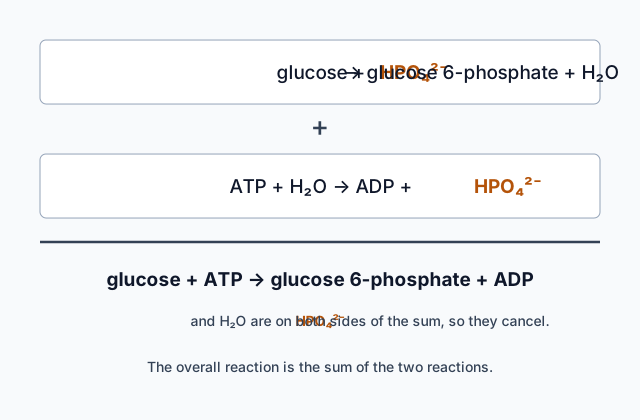
First, glucose picks up a phosphate group:
glucose + HPO₄²⁻ → glucose 6-phosphate + H₂O, ΔG° = +13.8 kJ/mol
On its own that does not go. The cell's favorable reaction is the breakdown of ATP:
ATP + H₂O → ADP + HPO₄²⁻, ΔG° = −30.5 kJ/mol
HPO₄²⁻ is made by the second reaction and used by the first. Writing free HPO₄²⁻ as the species they share is how the sum is accounted for. It is bookkeeping, not a claim about exactly how the phosphate group moves. When the reactions are added, it cancels, and so does the water:
glucose + ATP → glucose 6-phosphate + ADP
The overall ΔG° is the sum: (+13.8) + (−30.5) = −16.7 kJ/mol. The total is below zero, so the coupled process is thermodynamically favored and glucose 6-phosphate is made. These are teaching values.
Quick check · Calculate
A biosynthesis step has ΔG° = +50.0 kJ/mol. It is coupled, through a shared intermediate, to the hydrolysis of two ATP, each with ΔG° = −30.5 kJ/mol. What is ΔG° for the overall coupled process, in kJ/mol? Give your answer to the nearest 0.1 kJ/mol, with its sign.
2c. When coupling works
A coupled process has to meet two conditions.
- The reactions share an intermediate. That is what links them. A very favorable reaction that shares no species with the unfavorable one cannot drive it, however negative its ΔG° is.
- The overall ΔG° is negative. Add the free energy changes of the two reactions, counting each as many times as it is used. If the sum is below zero, the coupled reaction is thermodynamically favored. If it is not, coupling has not helped.
For example, a step with ΔG° = +20.0 kJ/mol coupled to a reaction of −12.0 kJ/mol gives +8.0 kJ/mol, which is still positive. That coupling fails.
The unfavorable reaction is not changed. Its own ΔG° is still positive. What is favored is the overall reaction, the sum, which is what the system actually does.
Quick check · Decide and justify
An unfavorable reaction with ΔG° = +35.0 kJ/mol shares an intermediate with the hydrolysis of ATP (ΔG° = −30.5 kJ/mol). One ATP is hydrolyzed for each product molecule. Is the overall coupled process thermodynamically favored?
Which reason supports your decision?
Part 3 Watch it done Making glycerol 3-phosphate
Predict first, then watch each step, then finish the calculation yourself.
A cell makes glycerol 3-phosphate: glycerol + HPO₄²⁻ → glycerol 3-phosphate + H₂O, with ΔG° = +9.2 kJ/mol. It couples this to ATP + H₂O → ADP + HPO₄²⁻, with ΔG° = −30.5 kJ/mol. These numbers are a teaching example. What is ΔG° for the coupled process, and is it favored?
Predict first
Before you open the first step, predict: will the coupled process be thermodynamically favored?
Step 1 · Find the shared intermediate
HPO₄²⁻ is a reactant in the glycerol reaction and a product of the ATP reaction. It is the common intermediate, so the reactions can be coupled.
Step 2 · Add the reactions
Adding the two reactions, HPO₄²⁻ and H₂O appear on both sides and cancel. The overall reaction is glycerol + ATP → glycerol 3-phosphate + ADP.
Why this step?
Why does the overall ΔG° come from adding the two ΔG° values?
The overall reaction is the sum of the two reactions, so its free energy change is the sum of theirs. The shared intermediate is made in one reaction and used up in the other, so it contributes nothing extra. Writing it as a free species is how the sum is accounted for, not a claim about the mechanism.
Your step · Calculate
Finish it. The two reactions have ΔG° = +9.2 kJ/mol and ΔG° = −30.5 kJ/mol. What is ΔG° for the overall coupled reaction, in kJ/mol? Give your answer to the nearest 0.1 kJ/mol, with its sign.
kJ/mol
The glycerol reaction still has ΔG° = +9.2 kJ/mol by itself. Nothing changed that. What changed is the reaction the cell actually carries out, the sum, which has ΔG° = −21.3 kJ/mol.
Part 4 Try it How much ATP is enough?
A cell needs a reaction that has ΔG° = +31.0 kJ/mol to go. It has a shared intermediate with ATP hydrolysis, ΔG° = −30.5 kJ/mol per ATP. Cells hydrolyze a whole number of ATP for each product molecule. These numbers are a teaching example.
Try it · Calculate
What is the smallest whole number of ATP, hydrolyzed for each product molecule, that makes the overall ΔG° negative?
Try it · Fill the statement
A cell makes a phosphate compound X-P from X and HPO₄²⁻, a reaction that is not favored on its own. Complete the explanation of how ATP hydrolysis drives it.
On its own, making X-P has a ΔG° that is . ATP hydrolysis releases HPO₄²⁻, which the first reaction uses, so HPO₄²⁻ is the shared . Adding the two reactions gives an overall ΔG° that is .
Part 5 Explain it Splitting water and building a phosphate
On the exam this is handwritten, so answer on paper first. Nothing you type here leaves this page. Then check your answer against the model and each scoring point.
Free response is 50% of the exam score. This one is shaped like a short-answer question, which is worth 4 points.
Free-response practice · Short-answer style
Water can be split into hydrogen and oxygen: 2H₂O(l) → 2H₂(g) + O₂(g), with ΔG° = +474 kJ for the reaction as written. In a cell, a compound Q picks up a phosphate group: Q + HPO₄²⁻ → Q-P + H₂O, with ΔG° = +18.5 kJ/mol. The cell couples this to ATP + H₂O → ADP + HPO₄²⁻, with ΔG° = −30.5 kJ/mol. These numbers are a teaching example.
(a) Identify whether the splitting of water is thermodynamically favored.
(b) Describe how an electrolytic cell makes the splitting of water occur.
(c) Calculate ΔG° for the coupled reaction Q + ATP → Q-P + ADP.
(d) Explain why Q-P forms when the reaction is coupled to ATP hydrolysis, even though it does not form on its own.
Model answer
(a) No. ΔG° is positive, so splitting water is not thermodynamically favored.
(b) An external source of electrical energy, such as a power supply connected to the cell, drives the reaction that would not go by itself.
(c) ΔG° = (+18.5 kJ/mol) + (−30.5 kJ/mol) = −12.0 kJ/mol.
(d) The two reactions share a common intermediate, HPO₄²⁻, which the ATP reaction makes and the Q reaction uses. Added together, the reactions give an overall reaction whose ΔG° is negative (−12.0 kJ/mol), so the coupled process is thermodynamically favored.
Score your own answer. This is a self-check, not a grade. Tick each point your answer makes.
Part 6 Check yourself A model cell
Both case questions use the table.
A student studies three reactions in a model cell. Reaction 3 shares no species with the other two. These numbers are a teaching example.
| Reaction | Equation | ΔG° (kJ/mol) |
|---|---|---|
| 1 | Y + HPO₄²⁻ → Y-P + H₂O | +22.0 |
| 2 | ATP + H₂O → ADP + HPO₄²⁻ | −30.5 |
| 3 | S → T + U | −45.0 |
Case question 1 · Calculate
Using the table: reactions 1 and 2 are coupled. What is ΔG° for the overall reaction, in kJ/mol? Give your answer to the nearest 0.1 kJ/mol, with its sign.
Case question 2 · Multiple choice
Using the table: which statement about the reactions is supported?
The rest stand on their own and do not use the case.
Check yourself · Spot the error
A student works out a coupled process. Tap the line with the mistake.
Check yourself · Select all
Which two of these processes need an outside source of energy to happen? Select two.
Select 2 answers, then check.
Part 7 Keep it Bring back earlier ideas
Coupling adds the ΔG° values of two reactions and asks whether the total is below zero, so it leans on how a ΔG° is found and on what a negative one does and does not mean. Pulling those back up is what makes them last.
From 9.6 Free Energy of Dissolution · Calculate
Dissolving AgCl has ΔH° = +65.4 kJ/mol and ΔS° = +32.5 J/(mol·K). What is ΔG° for dissolving AgCl at 298 K, in kJ/mol? Give your answer to the nearest 0.1 kJ/mol.
From 9.5 Free Energy and Equilibrium · Decide and justify
A reaction A ⇌ B has ΔG° = −8.0 kJ/mol at 298 K. Under standard conditions, which side is favored at equilibrium?
Which reason supports your decision?
In three lines
- An outside source of energy, such as electricity or light, can drive a process with ΔG° > 0; the process's own ΔG° does not change.
- Coupled reactions share a common intermediate, and the overall ΔG° is the sum of their ΔG° values, counting each reaction as many times as it is used.
- A coupling works only when the sum is below zero, as with ATP hydrolysis driving a phosphate-transfer reaction.
Exam strategy for this topic
- Section I, Multiple Choice: 60 questions in 90 minutes.
- Section II, Free Response: 7 questions in 105 minutes.
- A scientific or graphing calculator is recommended for use on both sections of the exam.
In a coupling problem, write both reactions, circle the species that appears on opposite sides, add the reactions so it cancels, and add the ΔG° values with their signs, counting each reaction as many times as it is used. State the sign of the total and say what it means: favored if below zero. If a question gives an outside source of energy, name its form.
Questions students ask
How can an unfavorable reaction happen at all?
An outside source of energy can drive it, as electricity drives an electrolytic cell or light drives photosynthesis, or it can be coupled to a favorable reaction with which it shares an intermediate.
What are coupled reactions?
Two reactions that share a common intermediate. Their sum is the overall reaction, and the overall ΔG° is the sum of the two ΔG° values.
Why does ATP hydrolysis drive other reactions?
Its ΔG° is negative, about −30.5 kJ/mol here. When a reaction that shares an intermediate with it is added to it, the total can be negative, so the overall process is favored.
Does coupling change the unfavorable reaction's own ΔG°?
No. The unfavorable reaction still has ΔG° > 0 by itself. The coupled process, the sum of the two, is what has ΔG° < 0.
Is any favorable reaction able to drive any unfavorable one?
No. The reactions must share a common intermediate, and the overall ΔG° must be below zero.
Course alignment, for teachers
AP Chemistry topic 9.7, Unit 9: Thermodynamics and Electrochemistry.
- Skill 4.D: Explain the degree to which a model or representation describes the connection between particulate-level properties and macroscopic properties.
This lesson maps all 2 essential knowledge statements of the topic to the part that teaches each one: 2 are checked by a scored question. The map is in the lesson file.