Unit 9 · Topic 9.8 · about 30 minutes · 7 parts · 13 scored checks, 4 of them multiple choice, plus 1 from earlier lessons
AP Chemistry 9.8: Galvanic (Voltaic) and Electrolytic Cells
Unit 9: 7 to 9% of the multiple-choice section
What you'll be able to do
- Explain how the parts of an electrochemical cell work together, and use the type of cell and the half-reaction at each electrode to describe what happens in it.
Key vocabulary
| Term | What it means | The exam trap |
|---|---|---|
| Electrochemical cell | A device that uses a redox reaction to move electrons through a circuit, or uses an electric current to drive a redox reaction. | Name the type of cell before describing anything else in it, because the same parts can serve either type. |
| Galvanic (voltaic) cell | A cell that runs a thermodynamically favored redox reaction and produces a current. | Look for an outside power source in a drawing before you decide which type of cell it shows. |
| Electrolytic cell | A cell in which an outside source of electrical energy drives a thermodynamically unfavored reaction. | Read the reaction as written; the direction of an electrolytic reaction is chosen by what the power supply forces. |
| Anode | The electrode where oxidation occurs. | Decide the anode from the half-reaction at each electrode every time, and do not carry it over from a cell you saw earlier. |
| Cathode | The electrode where reduction occurs. | Work out what happens to the electrode's mass from its half-reaction rather than from memory. |
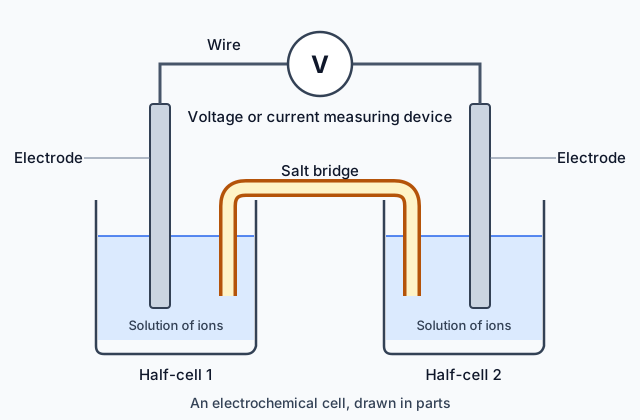
| Salt bridge | A path for ions between two half-cells that completes the circuit and keeps each solution neutral without letting the solutions mix. | Name which particles move through a part of a cell, electrons or ions, before you say which way they go. |
 Tap to open the picture full size
Part 1 Think first Two strips and a bulb
Commit to a guess first. Being wrong now makes the right idea stick better.
Predict first
A student puts a copper strip in a copper(II) nitrate solution and a silver strip in a silver nitrate solution. A wire with a small bulb joins the strips, and a salt bridge joins the solutions. The bulb lights and stays lit for an hour. After the hour, which strip has lost mass, and where did the electrons it released go?
In short. An electrochemical cell uses a redox reaction to move electrons through a circuit: a galvanic cell runs a favored reaction on its own, and an electrolytic cell uses an outside source of energy to force an unfavored one.
- In every cell, oxidation occurs at the anode and reduction occurs at the cathode, and electrons travel through the wire from the anode to the cathode.
- The salt bridge carries ions, not electrons: anions move toward the anode half-cell and cations toward the cathode half-cell.
- An electrode loses mass if its metal is oxidized and gains mass if metal is deposited on it, and a gas can form where an ion is oxidized or reduced.
Part 2 Learn it How a cell works
2a. Two kinds of cell, one rule
An electrochemical cell uses a redox reaction to move electrons through a circuit. There are two kinds.
- A galvanic cell, also called a voltaic cell, runs a thermodynamically favored reaction. The reaction happens on its own and produces an electric current. A flashlight battery powering its bulb is a galvanic cell.
- An electrolytic cell runs a thermodynamically unfavored reaction. It happens only because an outside source of electrical energy, such as a power supply, drives it. Splitting molten sodium chloride into sodium and chlorine is done in an electrolytic cell, and so is plating silver onto a spoon, where the power supply drives the electrode reactions.
One rule holds for both kinds: oxidation occurs at the anode, and reduction occurs at the cathode. A memory aid is an ox and red cat: anode, oxidation; reduction, cathode.
An electrode is the anode because of the half-reaction that happens at it, not because of the metal it is made of or the kind of cell it is in. A drawing of a cell is a tool for finding where each half-reaction occurs and which way the current flows.
Quick check · Sort it
Each card describes a cell. Tap a card, then the bin for the kind of cell it describes.
Galvanic cell
Electrolytic cell
2b. The parts of a cell
Every cell is built from the same parts, and each has a job. Take a galvanic cell with a zinc electrode in zinc sulfate solution, a copper electrode in copper(II) sulfate solution, and the favored reaction Zn(s) + Cu²⁺(aq) → Zn²⁺(aq) + Cu(s).
- Electrodes are the solid conductors where the half-reactions happen. Electrons leave or enter the cell at them.
- Half-cell solutions hold the ions that react or carry charge. Each electrode sits in its own solution, so each half-cell is the place for one half-reaction.
- The wire, with a voltage or current measuring device in it, is the path for electrons between the electrodes.
- The salt bridge is a path for ions between the two solutions. It completes the circuit and keeps each solution electrically neutral without letting the solutions mix.
The cell can be described at two levels. At the particulate level, zinc atoms at the surface of one electrode give up electrons and enter the solution as Zn²⁺ ions. At the macroscopic level, that electrode gets lighter and the measuring device shows a current.
Quick check · Match
Match each part of an electrochemical cell to its job.
2c. Following the electrons and the ions
Now run the zinc-copper galvanic cell and follow what moves.
- At the anode, zinc is oxidized: Zn(s) → Zn²⁺(aq) + 2e⁻. The zinc electrode loses mass as atoms become ions.
- At the cathode, copper(II) ions are reduced: Cu²⁺(aq) + 2e⁻ → Cu(s). The copper electrode gains mass as copper is deposited.
- Electrons travel through the wire from the anode to the cathode. They never travel through the solutions or the salt bridge.
- Ions travel through the salt bridge. The anode half-cell is gaining positive Zn²⁺ ions, so negative ions (anions) move toward it. The cathode half-cell is losing positive Cu²⁺ ions, so positive ions (cations) move toward it.
The direction of the ion flow follows from keeping each solution neutral. Negative ions go toward the half-cell that is gaining positive charge, and positive ions go toward the half-cell that is losing it.
Quick check · Fill the statement
Complete the description of the zinc-copper galvanic cell.
Zinc atoms are , so the zinc electrode is the . Electrons travel through the wire toward the strip of . Negative ions in the salt bridge move toward the half-cell that is positive ions.
2d. Running a cell backward
An electrolytic cell uses a power supply to push electrons the opposite way. Connect one to the zinc-copper cell so that it forces the unfavored reaction Cu(s) + Zn²⁺(aq) → Cu²⁺(aq) + Zn(s).
- Oxidation still occurs at the anode, but now the anode is the copper electrode: Cu(s) → Cu²⁺(aq) + 2e⁻. It loses mass.
- Reduction still occurs at the cathode, which is now the zinc electrode: Zn²⁺(aq) + 2e⁻ → Zn(s). It gains mass, as in plating.
- Electrons still travel through the wire from the anode to the cathode, and anions still move through the salt bridge toward the anode.
The rule did not change; the reaction did, and the electrodes took the roles the reaction gave them.
Electrolysis can also form a gas. In molten sodium chloride, chloride ions are oxidized at the anode: 2Cl⁻ → Cl₂(g) + 2e⁻, so chlorine gas bubbles off there. Sodium ions are reduced at the cathode: Na⁺ + e⁻ → Na(l).
Quick check · Multiple choice
A power supply forces the unfavored reaction Cu(s) + Zn²⁺(aq) → Cu²⁺(aq) + Zn(s) in a zinc-copper cell. Which statement is true?
Part 3 Watch it done Describing a nickel-silver cell
Predict first, then watch each step, then finish the description yourself.
A student builds a cell with a nickel electrode in 1.0 M Ni(NO₃)₂(aq) and a silver electrode in 1.0 M AgNO₃(aq). A wire with a voltmeter joins the electrodes, and a salt bridge of KNO₃(aq) joins the solutions. The overall reaction, Ni(s) + 2Ag⁺(aq) → Ni²⁺(aq) + 2Ag(s), is thermodynamically favored. Describe what happens in the cell.
Predict first
Before you open the first step, predict: which electrode will lose mass as the cell runs?
Step 1 · Name the kind of cell
The reaction is thermodynamically favored and the cell has no power supply, so this is a galvanic cell. It will produce a current on its own.
Step 2 · Split the reaction into half-reactions
Nickel goes from Ni(s) to Ni²⁺, which is a loss of electrons: Ni(s) → Ni²⁺(aq) + 2e⁻. Silver goes from Ag⁺ to Ag(s), which is a gain of electrons: Ag⁺(aq) + e⁻ → Ag(s).
Why this step?
Why is the nickel electrode the anode and not the silver one?
The anode is the electrode where oxidation occurs. Nickel atoms lose electrons there, so nickel is oxidized and its electrode is the anode. Silver ions gain electrons, so reduction occurs at the silver electrode, the cathode.
Step 3 · Follow the electrons and the mass
Electrons leave the nickel anode, travel through the wire, and reach the silver cathode. The nickel electrode loses mass as Ni atoms become Ni²⁺ ions, and the silver electrode gains mass as silver is deposited on it.
Your step · Decide and justify
Finish it. In the salt bridge, which way do the nitrate ions (NO₃⁻) move?
Which reason supports your decision?
The whole description follows from one decision, which half-reaction is oxidation. Nickel is oxidized, so nickel is the anode, loses mass, and sends electrons toward the silver cathode, where silver is deposited. The salt bridge then moves anions toward the nickel half-cell and cations toward the silver half-cell.
Part 4 Try it The same cell, forced backward
Now connect a power supply to the nickel-silver cell. It forces the reverse reaction, 2Ag(s) + Ni²⁺(aq) → 2Ag⁺(aq) + Ni(s), which is thermodynamically unfavored. Then try one more electrolytic cell, with a gas.
Try it · Select all
The power supply forces 2Ag(s) + Ni²⁺(aq) → 2Ag⁺(aq) + Ni(s) in the nickel-silver cell. Select all the true statements.
Select 3 answers, then check.
Try it · Multiple choice
A student electrolyzes molten magnesium chloride, MgCl₂(l), in a cell with two inert electrodes. Which statement describes what happens?
Part 5 Explain it Describe a magnesium-iron cell
On the exam this is handwritten, so answer on paper first. Nothing you type here leaves this page. Then check your answer against the model and each scoring point.
Free response is 50% of the exam score. This one is shaped like a short-answer question, which is worth 4 points.
Free-response practice · Short-answer style
A student builds a galvanic cell with a magnesium electrode in 1.0 M MgSO₄(aq) and an iron electrode in 1.0 M FeSO₄(aq). A wire with a voltmeter joins the electrodes, and a salt bridge containing KNO₃(aq) joins the solutions. The overall reaction is Mg(s) + Fe²⁺(aq) → Mg²⁺(aq) + Fe(s).
(a) Identify the electrode that is the anode, and write the half-reaction that occurs there.
(b) Describe the direction of electron flow in the wire and the direction in which nitrate ions, NO₃⁻, move through the salt bridge.
(c) Predict how the mass of each electrode changes as the cell runs.
(d) The student removes the salt bridge. Explain why the cell stops producing a steady current.
Model answer
(a) The magnesium electrode is the anode, because magnesium is oxidized there: Mg(s) → Mg²⁺(aq) + 2e⁻.
(b) Electrons travel through the wire from the magnesium electrode (the anode) to the iron electrode (the cathode). Nitrate ions move through the salt bridge toward the magnesium half-cell, which is gaining Mg²⁺ ions.
(c) The magnesium electrode loses mass as Mg atoms become Mg²⁺ ions. The iron electrode gains mass as Fe²⁺ ions are reduced to Fe(s) and deposited on it.
(d) Without the salt bridge, ions cannot move between the half-cells. Positive charge builds up in the magnesium half-cell and negative charge builds up in the iron half-cell, which stops electrons from flowing and so stops the reactions.
Score your own answer. This is a self-check, not a grade. Tick each point your answer makes.
Part 6 Check yourself A lead-silver cell
All three case questions use the table.
A student builds a cell from a lead electrode in 1.0 M Pb(NO₃)₂(aq) and a silver electrode in 1.0 M AgNO₃(aq). A wire with a voltmeter joins the electrodes, and a salt bridge of KNO₃(aq) joins the solutions. The voltmeter shows a steady reading while the cell runs for 30 minutes. The student weighs each electrode before and after. These numbers are a teaching example.
| Electrode | Mass before (g) | Mass after (g) | Change (g) |
|---|---|---|---|
| Lead | 12.450 | 11.820 | −0.630 |
| Silver | 9.800 | 10.456 | +0.656 |
Case question 1 · Multiple choice
Using the table: which electrode is the anode?
Case question 2 · Decide and justify
Using the table: in the wire, which way do the electrons travel?
Which reason supports your decision?
Case question 3 · Select all
Using the table: select the two true statements about the salt bridge.
Select 2 answers, then check.
The rest stand on their own and do not use the case.
Check yourself · Spot the error
A student explains how a power supply plates copper onto a key in a copper(II) sulfate solution, using a copper electrode and the key as the two electrodes. Tap the line with the mistake.
Check yourself · Fill the statement
A student removes the salt bridge from a working zinc-copper galvanic cell and leaves the wire and voltmeter in place. Complete the explanation of what happens.
Without the salt bridge, cannot move between the half-cells, so builds up in each half-cell and the soon stops.
Part 7 Keep it Bring back earlier ideas
This lesson leans on two earlier ideas: writing a balanced redox equation from half-reactions, and what the sign of ΔG° says about favorability. Pulling them back up is what makes them last.
Bring it back · Multiple choice
Two half-reactions are Al(s) → Al³⁺(aq) + 3e⁻ and Cu²⁺(aq) + 2e⁻ → Cu(s). Which balanced equation do they give when they are added so that the electrons cancel?
From 9.3 Gibbs Free Energy and Thermodynamic Favorability · Select all
A process has ΔG° = −20 kJ/mol with every species in its standard state. Which two statements are correct? Select two.
Select 2 answers, then check.
In three lines
- A galvanic cell runs a thermodynamically favored reaction on its own; an electrolytic cell uses an outside source of energy to force an unfavored one.
- In every cell, oxidation occurs at the anode and reduction at the cathode; electrons go through the wire from anode to cathode, and ions move through the salt bridge.
- The anode loses mass if its metal is oxidized and the cathode gains mass if metal is deposited; electrolysis can also release a gas at an electrode.
Exam strategy for this topic
- Section I, Multiple Choice: 60 questions in 90 minutes.
- Section II, Free Response: 7 questions in 105 minutes.
- A scientific or graphing calculator is recommended for use on both sections of the exam.
Start every cell question by writing the half-reaction at each electrode and naming the one where electrons are lost. The anode, the direction of electron flow, the ion flow in the salt bridge and the mass change all follow from that. Draw or describe electrons in the wire and ions in the bridge separately.
Questions students ask
What is the difference between a galvanic cell and an electrolytic cell?
A galvanic cell runs a thermodynamically favored reaction on its own and produces a current. An electrolytic cell uses an outside source of electrical energy to drive a thermodynamically unfavored reaction.
Which electrode is the anode?
The anode is the electrode where oxidation occurs, in every kind of electrochemical cell. The cathode is where reduction occurs.
Which way do electrons flow in an electrochemical cell?
Through the external wire from the anode, where oxidation puts electrons into the circuit, to the cathode, where reduction uses them.
What does a salt bridge do?
It lets ions move between the two half-cells, which completes the circuit and keeps each solution electrically neutral. Anions move toward the anode half-cell and cations toward the cathode half-cell.
How can you tell which electrode gains mass?
An electrode gains mass where a metal is deposited, which is reduction at the cathode. It loses mass where its metal is oxidized and dissolves, at the anode.
Beyond the AP Exam
College Board sets this limit on what the AP Exam asks about this topic. Anything past it is not on the exam.
Labeling an electrode as positive or negative will not be assessed on the AP Exam.
Course alignment, for teachers
AP Chemistry topic 9.8, Unit 9: Thermodynamics and Electrochemistry.
- Skill 2.F: Explain how modifications to an experimental procedure will alter results.
This lesson maps all 3 essential knowledge statements of the topic to the part that teaches each one: 3 are checked by a scored question. The map is in the lesson file.