Unit 5 · Topic 5.1 · about 30 minutes · 7 parts · 10 scored checks, 2 of them multiple choice, plus 2 from earlier lessons
AP Macroeconomics 5.1: Fiscal and Monetary Policy Actions in the Short Run
Unit 5: 20 to 30% of the multiple-choice section
What you'll be able to do
- Explain, with graphs where they help, what happens when fiscal and monetary policy are used together.
Key vocabulary
| Term | What it means | The exam trap |
|---|---|---|
| Fiscal policy | A government's changes to its spending and its taxes or transfers, used to reach goals such as full employment. | Only the government's purchases, taxes and transfer payments count as fiscal policy, so a change in the interest rate on reserves belongs to the central bank even when one question describes both moves. |
| Monetary policy | A central bank's actions, such as changing its administered interest rates or conducting open-market operations, used to reach goals such as price stability. | Unlike a change in purchases, a monetary action gets no multiplier in this model, so its share of closing a gap is described as a chain of effects and never calculated in dollars. |
| Negative (recessionary) output gap | The amount by which real output falls short of full-employment output. | Real output sits left of LRAS, so both policies must push AD right, and a gap given in dollars is divided by the spending multiplier to find the purchases needed, not multiplied by it. |
| Positive (inflationary) output gap | The amount by which real output exceeds full-employment output. | With output above full employment, both policies have to be contractionary, and as AD shifts left the unemployment rate rises back to the natural rate while the price level falls. |
| Administered interest rates | Interest rates the central bank sets directly, such as the rate it pays on reserves; with ample reserves, changing them is how it moves the policy rate. | The policy rate is the target, not the action: with ample reserves the central bank changes an administered rate, such as interest on reserves or the discount rate, and the policy rate follows. |
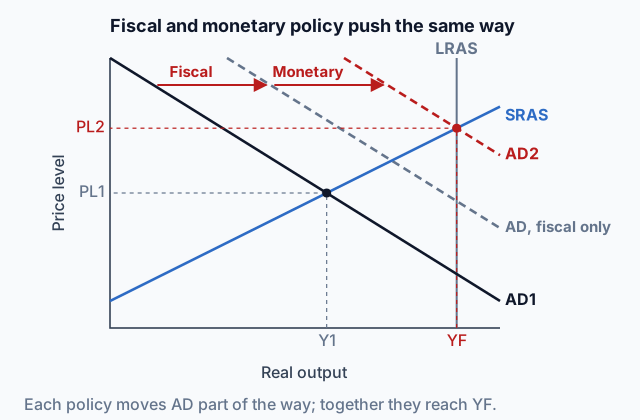 Tap to open the picture full size
Part 1 Think first Two moves in one week
Guess before you learn. A wrong guess still makes the answer stick.
Predict first
A country slides into a recession. In the same week, its legislature passes a large road-building plan paid for with borrowed money, and its central bank, whose banking system has ample reserves, cuts the interest rate it pays banks on their reserves. A news anchor says borrowing costs are now certain to fall. What do you think?
In short. Fiscal and monetary policy can be used together to close an output gap, and the pair's effect on aggregate demand, real output, the price level and interest rates is certain only where both policies push the same way.
- Expansionary fiscal and monetary policy together shift aggregate demand right to close a recessionary gap; contractionary policies together close an inflationary gap.
- Any result both policies push in the same direction moves that way for certain.
- Any result the two policies push in opposite directions depends on the sizes of the actions.
Part 2 Learn it Three short ideas, each checked as you go
2a. Two tools on one gap
You have met both tools on their own. Fiscal policy is the government changing its purchases, taxes or transfers. Monetary policy belongs to the central bank, and its action depends on the banking system:
- With ample reserves, as in the United States, the central bank changes its administered rates, such as the interest rate it pays on reserves. The policy rate follows. The policy rate is the target, not the action.
- With limited reserves, it buys or sells government bonds in open-market operations, which changes the money supply.
When real output is below full employment, a negative (recessionary) gap, the two can act together. The government raises purchases, cuts taxes or raises transfers, and the central bank lowers its administered rate (ample) or buys bonds (limited). Both shift aggregate demand right. With a positive (inflationary) gap, both turn contractionary and shift AD left.
Neither tool then has to close the whole gap alone. Together they move AD until it crosses SRAS on LRAS, at full-employment output. If one is expansionary and the other contractionary, they pull AD against each other.
Quick check · Sort it
Each plan is for an economy with a negative (recessionary) output gap. Tap a plan, then tap what it does to that gap.
Both tools help close the gap
Both tools widen the gap
The tools pull against each other
2b. What is certain, and what depends on sizes
A combination moves four things you can track: aggregate demand, real output, the price level and interest rates.
Start with AD. If both policies push it the same way, it moves that way for certain, and real output and the price level follow it along SRAS. If they push it opposite ways, AD could end up right or left, so the changes in output and the price level cannot be determined without the sizes.
Interest rates need their own look, because the two tools pull on them differently. Expansionary monetary policy lowers interest rates; that is how it raises spending. Expansionary fiscal policy usually means the government borrows more, which raises interest rates, because government borrowing adds to the demand for loanable funds. (The central bank's move works through the policy rate and the rates that follow it; the extra borrowing works through the real interest rate in the loanable funds market, which topic 5.5 draws. Both reach the rates households and firms pay on loans.) Contractionary policies reverse both pulls.
So two expansionary policies make AD certain and interest rates uncertain. An expansionary fiscal policy with a contractionary monetary policy flips that: both push interest rates up, while AD is pulled two ways.
Whatever both policies push the same way is certain. Whatever they push in opposite directions depends on which push is bigger.
Quick check · Decide and justify
Marisca has a negative (recessionary) output gap, and its banking system has ample reserves. Its government raises spending on ports, paying for it by borrowing, and its central bank lowers the interest rate it pays on reserves. Real output will rise. What happens to interest rates in Marisca?
Which reason supports your choice?
2c. Sizing each half
A question can give the gap in dollars and ask how big a fiscal change would close it alone. Use the multipliers from 3.2 Multipliers:
- spending multiplier = 1 / (1 - MPC), for government purchases
- tax multiplier = MPC / (1 - MPC), for taxes and transfers
- fiscal change needed = gap / multiplier
Say real GDP is $820 billion, full-employment real GDP is $840 billion, and the MPC is 0.8. The gap is $20 billion below full employment and the spending multiplier is 5, so purchases must rise by $20 billion / 5 = $4 billion. You divide, because each dollar of purchases becomes five dollars of AD.
The monetary half is answered in words, not dollars. Name the action for the regime the question states, then trace it. With ample reserves, a lower interest rate on reserves pulls down the policy rate and then other interest rates, so interest-sensitive investment and consumption rise and AD shifts right. This model gives monetary policy no multiplier, so its share of the gap is described, never calculated.
When both act, each can be smaller than it would need to be alone.
Quick check · Calculate
Dravona's real GDP is $475 billion, its full-employment real GDP is $500 billion and its MPC is 0.9. If a change in government purchases alone were used to close the gap, what is the minimum change in purchases, in billions of dollars? Give a positive number for an increase and a negative number for a decrease.
Part 3 Watch it done Cooling an overheated economy with both tools
Watch each step, then do the last one yourself.
Oskaria is producing real output of $1,000 billion, above its full-employment output of $900 billion, and inflation is climbing. Its banking system has limited reserves. The government cuts its purchases and the central bank acts at the same time, and together they close the gap. Trace both policies and decide what is certain.
Step 1 · Read the gap
Real output is $100 billion above full employment, a positive (inflationary) gap. Closing it means shifting aggregate demand left, so both policies should be contractionary.
Step 2 · The monetary half
With limited reserves, the central bank sells government bonds in open-market operations. Bank reserves and the money supply fall, the nominal interest rate rises, and interest-sensitive investment and consumption fall. AD is pushed left.
Step 3 · The fiscal half
Lower government purchases cut spending on output directly, so AD is pushed left again.
Why this step?
Why is the direction of AD settled here?
Both policies push AD left, so nothing pulls it back to the right. Once the direction of AD is settled, real output and the price level follow it along SRAS.
Your step · Fill the statement
Finish the analysis of Oskaria, where a cut in government purchases and an open-market bond sale together close a positive (inflationary) output gap. Tap a blank, then tap a phrase.
As AD shifts left to full employment, the unemployment rate , the price level , and the change in interest rates .
Both policies on the graph
AD shifts left from AD1 to AD2. Output falls from Y1 to Y2, full-employment output on LRAS (label it YF on your own graph), and the price level falls from PL1 to PL2.
Part 4 Try it New plans, same rule
Classify each policy first, as expansionary or contractionary, using the regime the plan names. Then ask which results both policies push the same way. Those are the only certain ones.
Try it · Match
In each plan, any rise in the government's budget deficit is paid for by borrowing. Tap a plan, then tap what you can say for certain about its short-run effects.
Try it · Multiple choice
Vantoria has a negative (recessionary) output gap, and its banking system has ample reserves. Its government is raising spending on rail lines. Which central bank action pushes in the same direction to help close the gap?
Part 5 Explain it Write it the way the exam asks
Nothing you type leaves this page.
Free response is 33.35% of the exam score. This one is shaped like Question 3, Short.
Free-response practice · Question 3 style
Assume the banking system of Ternovia has ample reserves. Ternovia's real GDP is $564 billion, its full-employment real GDP is $600 billion, and its marginal propensity to consume is 0.75. (a) Draw a correctly labeled graph of aggregate demand and aggregate supply showing the current equilibrium price level, labeled PL1, real output, labeled Y1, and full-employment output, labeled YF. (b) Identify an action Ternovia's central bank could take to close the output gap. (c) Calculate the minimum change in government purchases that would close the gap if fiscal policy were used alone. Show your work. (d) Suppose instead that the central bank's action from part (b) and a smaller increase in government purchases, paid for by borrowing, are used together and exactly close the gap. On your graph in part (a), show the combined effect, labeling the new price level PL2. (e) Will interest rates in Ternovia increase, decrease, or is the change indeterminate as a result of the combined policies in part (d)? Explain.
Model answer
(a) Price level on the vertical axis and real output on the horizontal. AD1 slopes down and SRAS slopes up, crossing at PL1 and Y1, both marked on the axes. LRAS is vertical at YF, to the right of Y1, because real GDP of $564 billion is below full-employment real GDP of $600 billion. (b) Lower the interest rate it pays on reserves. Lowering another administered rate, such as the discount rate, is also correct. (c) The gap is $600 billion - $564 billion = $36 billion. The spending multiplier is 1 / (1 - 0.75) = 4, so purchases must increase by $36 billion / 4 = $9 billion. (d) AD shifts right from AD1 to AD2, shown by an arrow, until AD2 crosses SRAS on LRAS at YF. PL2 is above PL1. (e) The change is indeterminate. The lower interest rate on reserves pulls interest rates down, while the government's extra borrowing pushes them up, so the net change depends on the sizes of the two actions.
Score your own answer. This is a self-check, not a grade. Tick each point your answer makes.
Part 6 Check yourself Read a policy plan
Read the table and the plan first, then answer from them.
Selvenna, a fictional economy, has a banking system with ample reserves. Next month its legislature will raise military spending, paid for by borrowing, and its central bank will raise the interest rate it pays on reserves. Its statistics agency reported:
| Measure | Value |
|---|---|
| Real GDP (billions of dollars) | 1,248 |
| Full-employment real GDP (billions of dollars) | 1,200 |
| Inflation rate | 6.5% |
| Marginal propensity to consume | 0.8 |
Case question 1 · Multiple choice
Selvenna, whose banking system has ample reserves, raises military spending paid for by borrowing while its central bank raises the interest rate it pays on reserves. Compared with making neither change, what can be said for certain about the short run?
Case question 2 · Calculate
Selvenna's real GDP is $1,248 billion, its full-employment real GDP is $1,200 billion and its MPC is 0.8. If a change in taxes alone were used to close the gap, what is the minimum change in taxes, in billions of dollars? Give a positive number for an increase and a negative number for a decrease.
The rest stand on their own and do not use the case.
Check yourself · Put it in order
A central bank in an economy with ample reserves acts against a positive (inflationary) output gap. Tap the steps in the order they happen.
Check yourself · Spot the error
Kalmora has a positive (inflationary) output gap and a banking system with ample reserves. Its government cuts purchases while its central bank lowers the interest rate it pays on reserves. A student wrote this analysis. Tap the first line with a mistake.
Part 7 Keep it Keep it
From 4.4 Banking and the Expansion of the Money Supply · Sort it
Count the money supply as currency held by the public plus checking deposits. Tap each event, then tap its effect on the money supply at the moment it happens.
Creates new money
Leaves the money supply unchanged
From 3.2 Multipliers · Calculate
In Penwick the MPC is 0.75. Policymakers want aggregate demand to fall by $60 billion, using a change in government purchases alone. By how much should government purchases change, in billions of dollars? Give a negative number for a decrease.
In three lines
- Fiscal and monetary policy can work together: both expansionary for a recessionary gap, both contractionary for an inflationary one.
- Whatever both policies push the same way is certain; whatever they push opposite ways depends on sizes.
- Name the monetary action for the regime: an administered rate with ample reserves, open-market operations with limited reserves.
Exam strategy for this topic
- Section I, Multiple Choice: 60 questions in 70 minutes.
- Section II, Free Response: 3 questions in 60 minutes.
- This lesson's Explain it is shaped like free-response question 3, Short.
- A four-function calculator is allowed on both sections of the exam.
Before you draw, label each policy expansionary or contractionary, then track AD and interest rates separately: whatever both policies push the same way gets a direction, and whatever they push apart gets indeterminate, with the reason. On the AD-AS graph, show the shift with an arrow and land AD2 where SRAS meets LRAS.
Questions students ask
Why would a government use fiscal and monetary policy together instead of just one?
Neither tool then has to close the whole gap alone, so each can be smaller. A rate cut does part of the work, a smaller rise in purchases does the rest, and AD ends where it crosses SRAS on LRAS.
If both policies are expansionary, why don't interest rates fall for sure?
The central bank's cut pulls interest rates down. But a deficit paid for by borrowing adds to the demand for loanable funds and pushes them up, and which pull wins depends on the sizes of the two actions.
How do I find the change in government purchases that would close a gap on its own?
Find the gap, then divide it by the spending multiplier, 1 / (1 - MPC). With real GDP of $820 billion, full-employment real GDP of $840 billion and an MPC of 0.8, the gap is $20 billion and the multiplier is 5, so purchases must rise by $4 billion.
What does the central bank actually do when reserves are ample?
It changes an administered rate, such as the interest rate it pays on reserves or the discount rate. The policy rate moves after that, which is why it counts as the target and not the action.
Can I calculate how much of the gap monetary policy closes?
No. This model gives monetary policy no multiplier, so you describe its effect in words: the rate change moves interest-sensitive investment and consumption, and that shifts AD.
With limited reserves, what is certain if taxes are cut while the central bank sells bonds?
The tax cut pushes AD right and the bond sale pushes it left, so real output and the price level cannot be signed without sizes. Interest rates are different. If the larger deficit is borrowed, both moves push rates up, so interest rates rise for certain.
Course alignment, for teachers
AP Macroeconomics topic 5.1, Unit 5: Long-Run Consequences of Stabilization Policies.
- Skill 2.B: Using economic concepts, principles, or models, explain how a specific economic outcome occurs when there are multiple contributing variables or what multiple actions should be taken in order to achieve a specific economic outcome.
This lesson maps all 2 essential knowledge statements of the topic to the part that teaches each one: 2 are checked by a scored question. The map is in the lesson file.