Unit 4 · Topic 4.6 · about 30 minutes · 7 parts · 13 scored checks, 3 of them multiple choice, plus 2 from earlier lessons
AP Macroeconomics 4.6: Monetary Policy
Unit 4: 18 to 23% of the multiple-choice section
What you'll be able to do
- Define monetary policy and its related terms, explain with a graph the short-run effects of a monetary policy action, and calculate those effects using data and balance sheets.
- Describe why monetary policy works only after lags.
Key vocabulary
| Term | What it means | The exam trap |
|---|---|---|
| Monetary policy | A central bank's use of its tools to change interest rates and the money supply in pursuit of goals such as price stability. | Fiscal policy is the usual wrong answer beside it: tax cuts and government purchases are set by the government, so only the central bank's rate and reserve actions count as monetary policy. |
| Price stability | A low and steady rate of inflation. | Raising interest rates to bring inflation back to its goal is aimed at price stability, not at more jobs, because contractionary policy slows hiring in the short run. |
| Administered interest rates | Rates a central bank sets by announcement, such as the discount rate and interest on reserves, rather than rates set by trading in a market. | Only the flat parts of DR are administered rates, so changing them moves the flat parts and leaves the sloped middle of DR where it was. |
| Discount rate | The interest rate a central bank charges banks that borrow reserves from it. | The discount rate sets the top flat part of DR, so with ample reserves it is interest on reserves, the floor, that the policy rate sits on and follows. |
| Interest on reserves | The interest a central bank pays banks on the reserves they hold with it; with ample reserves, the floor under the policy rate. | With ample reserves this is the lever to name: lowering it is expansionary, while buying bonds would leave the policy rate where it was. |
| Open-market operations | A central bank's purchases or sales of government bonds, which add reserves to the banking system or take them out. | A bond sale still lowers the monetary base when reserves are ample; what it fails to do is move the policy rate. |
| Limited reserves | A banking system whose banks hold barely more reserves than they need, so a change in reserves moves interest rates. | Bond purchases, a lower reserve requirement and a lower discount rate move the money supply and interest rates in this regime, so read which regime the stem names before choosing a tool. |
| Ample reserves | A banking system whose banks hold so many reserves that a small change in their quantity does not move the policy rate. | Adding or removing reserves only slides SR along the flat floor of DR, so a bond purchase or sale leaves the policy rate where it was. |
| Policy rate | The overnight interbank lending rate a central bank aims at with a target range; in the United States, the federal funds rate. | Naming the federal funds rate as the action is wrong, because it is the target; the action is a change in a rate the central bank sets itself. |
| Expansionary and contractionary monetary policy | Policy that lowers interest rates to close a negative (recessionary) output gap, or raises them to close a positive (inflationary) one. | Match the policy to the gap: a negative (recessionary) output gap calls for expansionary policy and lower rates, a positive (inflationary) gap for contractionary policy and higher rates. |
| Required reserve ratio | The share of its deposits that a bank must hold as reserves, set by the central bank. | Cutting the requirement frees reserves to lend only when reserves are limited; banks with ample reserves already hold more than they need, so it changes nothing there. |
| Reserve market | The market for the reserves banks hold at the central bank, graphed with the policy rate against the quantity of reserves. | Label the curves DR and SR, never MD and MS, and put the policy rate and the quantity of reserves on the axes rather than the nominal interest rate and the quantity of money. |
 Tap to open the picture full size
Part 1 Think first Selling bonds when reserves are plentiful
Guess before you learn. A wrong guess still makes the answer stick.
Predict first
In August 2026, U.S. banks held about $2.9 trillion of reserves at the Federal Reserve (FRED series TOTRESNS, read October 15, 2026). Suppose the Fed sold $20 billion of government bonds to banks, taking $20 billion of reserves out of the banking system, and changed nothing else. What would most likely happen to the federal funds rate, the rate banks charge each other for overnight loans of reserves?
In short. Monetary policy is a central bank moving interest rates, and through them spending, real output and the price level, with tools that depend on whether its banks hold ample or limited reserves.
- With ample reserves, the central bank changes its administered rates, chiefly interest on reserves, and the policy rate follows.
- With limited reserves, open-market operations, the discount rate and the reserve requirement change the money supply.
- Lower rates raise interest-sensitive spending and shift aggregate demand right; higher rates do the reverse, with lags.
Part 2 Learn it Four short ideas, each checked as you go
2a. What monetary policy is for, and its tools
A central bank, such as the Federal Reserve in the United States, runs monetary policy: it moves interest rates to steer the economy toward its goals, such as price stability. For the Fed, Congress set two: maximum employment and stable prices, which the Fed calls its dual mandate (Federal Reserve, monetary policy goals FAQ, read October 15, 2026).
When real output is below full employment, a negative (recessionary) gap, it uses expansionary policy and pushes interest rates down. When output is above full employment, a positive (inflationary) gap, it uses contractionary policy and pushes them up.
Its tools are the discount rate and other administered interest rates (rates the central bank simply announces, such as interest on reserves), open-market operations (buying or selling government bonds), and the required reserve ratio.
Which tool does the work depends on the banks. With limited reserves, banks hold barely more than they need, so adding or removing reserves moves interest rates. With ample reserves, they hold so much that a little more or less changes nothing, so the central bank moves rates by changing its administered rates. U.S. banks have ample reserves, and the Fed's key tool is interest on reserves. The Fed's cut of the reserve requirement to zero, announced on March 15, 2020, took effect on March 26, 2020 (Federal Reserve, Reserve Requirements page, read October 15, 2026).
Quick check · Decide and justify
The banking system in Velstrand has ample reserves. Real output is well below full employment, and the central bank wants interest rates to fall. Which action should it take?
Which reason supports your choice?
2b. Ample reserves: the reserve market
Many central banks aim at a target range for the policy rate, the rate banks charge each other for overnight loans of reserves. In the United States it is the federal funds rate. It is the target; the action is a change in a rate the central bank sets.
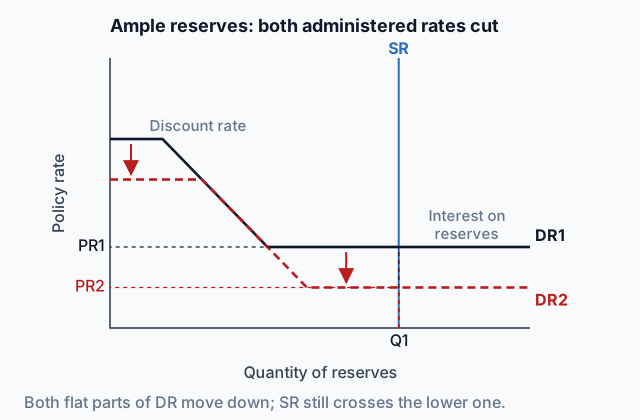
The reserve market graph shows how, with Policy rate on the vertical axis and Quantity of reserves on the horizontal. The demand for reserves, DR, is flat at the top, at the discount rate, where a bank short of reserves can borrow from the central bank. It is flat at the bottom, at interest on reserves, because no bank lends reserves for less than the central bank pays to hold them. That bottom is the floor, though the federal funds rate sits slightly under it, because a few lenders in that market are not banks and cannot earn interest on reserves. In between, DR slopes down. The supply of reserves, SR, is vertical: the central bank decides how many reserves exist.
With ample reserves, SR crosses the lower flat part, and the policy rate, PR1, sits there. Raise interest on reserves and that part moves up, taking the policy rate with it; raise all the administered rates and both flat parts move up. The sloped middle stays put, since only the flat parts are rates the central bank sets. Add reserves and SR slides along the floor, so the policy rate does not move.
Quick check · Fill the statement
Tap a blank, then tap a phrase.
The United States has ample reserves in its banking system. Its policy rate is the , the rate banks charge each other for overnight loans of reserves. The Federal Reserve announces a for that rate and moves the rate by changing .
2c. Limited reserves: open-market operations
In an open-market purchase the central bank buys government bonds and pays with new reserves, so reserves and the monetary base rise. An open-market sale does the reverse. That much is true in any banking system.
What happens next depends on the regime. With ample reserves, the extra reserves still count in the monetary base, but they land on the flat part of DR and the policy rate stays put. With limited reserves, banks lend the new excess reserves, the loans become deposits, and the money supply grows by more than the monetary base did, because of the money multiplier from 4.4 Banking and the Expansion of the Money Supply. On the money market graph from 4.5 The Money Market, money supply shifts right and the nominal interest rate falls. A sale shifts money supply left and the rate rises.
With limited reserves the other two tools work through the money supply as well. A lower required reserve ratio frees reserves to lend, and a lower discount rate makes borrowing reserves cheaper, so both raise the money supply. Raising either does the reverse.
Quick check · Calculate
Ismara is an invented economy whose banking system has limited reserves and a required reserve ratio of 12.5 percent. Its central bank buys $40 million of government bonds from commercial banks. Banks lend all their excess reserves, every loan is redeposited, and the public holds no extra currency. What is the maximum increase in Ismara's money supply, in millions of dollars?
2d. From the policy rate to aggregate demand
In either regime, the path to the economy is the same. Say the central bank lowers interest on reserves. The policy rate falls, and other interest rates follow it down: car loans, mortgages, business loans. Cheaper borrowing raises interest-sensitive spending, mainly investment by firms and consumption of things bought on credit. That spending shifts AD to the right, so in the short run real output rises, unemployment falls and the price level rises. Contractionary policy runs every link the other way.
Bond prices move too. A bond already issued pays a fixed amount each year, so when interest rates fall its price rises, and when rates rise its price falls, as in 4.1 Financial Assets.
Write every link. "Lower rates raise AD" skips the reason, which is the spending in between.
None of this happens at once. It takes time to recognize a problem, because figures on output and jobs arrive weeks or months after the fact. Then it takes time for the economy to adjust: firms plan and order equipment over months, and families buy homes and cars long after a rate cut.
Quick check · Put it in order
The banking system in Kerrow has ample reserves, and its real output is below full employment. Its central bank lowers the interest rate it pays on reserves. Tap the effects in the order they happen.
Part 3 Watch it done Cooling an overheated economy with ample reserves
Watch each step, then do the last one yourself.
Saldova's banking system has ample reserves. Its real GDP is $840 billion and its full-employment real GDP is $800 billion. The central bank will use monetary policy to close the gap. Name its action and show it on the reserve market.
Step 1 · Read the gap
Real GDP is $40 billion above full employment, a positive (inflationary) gap. The central bank wants less spending, so it runs contractionary policy.
Step 2 · Pick the tool for the regime
Saldova's banks hold ample reserves, so the central bank raises the interest rate it pays on reserves, or raises all its administered rates together. The policy rate is what it aims at, not what it changes.
Why this step?
Why not sell government bonds, the way a central bank with limited reserves would?
With ample reserves, taking some reserves away slides SR to the left along the flat bottom of DR. SR still crosses DR on that flat part, so the policy rate does not move.
Step 3 · Draw the starting graph
Policy rate on the vertical axis, Quantity of reserves on the horizontal. DR is flat at the discount rate, slopes down, then is flat at interest on reserves. SR is vertical and crosses DR on its lower flat part. Mark PR1 on the vertical axis at that crossing and Q1 under SR.
Your step · Decide and justify
Finish it. Saldova's banking system has ample reserves, and its central bank raises the interest rate it pays on reserves and changes nothing else. On the reserve market graph, what happens to the policy rate?
Which reason supports your choice?
From PR2 the chain runs as in 2d, in reverse: other interest rates rise, interest-sensitive spending falls, AD shifts left, and real output and the price level fall toward full employment.
Part 4 Try it Draw it, then pick the tool
Try it · Multiple choice
Castavia's banking system has limited reserves, and Ruskara's has ample reserves. Both economies are producing below full employment. Which pair of actions would close each economy's gap?
Try it · Calculate
Hesper's banking system has ample reserves. Its central bank sells $12 billion of government bonds to commercial banks, and reserves stay ample. By how many billions of dollars does Hesper's monetary base change? Give a negative number for a decrease.
Try it · Decide and justify
Brenmoor's banking system has ample reserves. To cool an overheated economy, its central bank raises the interest rate it pays on reserves, and interest rates across the economy rise. What happens to the price of previously issued bonds, such as a Brenmoor government bond issued two years ago that pays a fixed $30 a year?
Which reason supports your choice?
Part 5 Explain it Write it the way the exam asks
Nothing you type leaves this page.
Free response is 33.35% of the exam score. This one is shaped like Question 2, Short.
Free-response practice · Question 2 style
Amberlund's banking system has ample reserves. Its real GDP is $1,140 billion, and its full-employment real GDP is $1,200 billion. (a) Identify an action Amberlund's central bank could take to close the output gap. (b) Draw a correctly labeled graph that shows how the action you identified in part (a) changes Amberlund's policy rate. Label the original policy rate PR1 and the new policy rate PR2. (c) Will the price level in Amberlund increase, decrease, or stay the same in the short run? Explain.
Model answer
(a) Lower the interest rate it pays on reserves. Real GDP is $60 billion below full employment, so the central bank needs lower interest rates, and with ample reserves its tool is an administered rate. (b) Reserves are ample, so the graph is the reserve market: Policy rate on the vertical axis and Quantity of reserves on the horizontal. DR1 is flat at the top, slopes down, and is flat at the bottom; SR is vertical and crosses the lower flat part at PR1, with Q1 below it. An arrow moves the lower flat part (or both flat parts) down to DR2, and SR crosses it at PR2, below PR1, still at Q1. (c) The price level increases. Lower interest rates make borrowing cheaper, so investment and consumption bought on credit rise, and aggregate demand shifts right.
Score your own answer. This is a self-check, not a grade. Tick each point your answer makes.
Part 6 Check yourself Read the Fed's September 2026 decision
Read the statement and the table first, then answer from them.
On September 16, 2026, the Federal Open Market Committee raised its target range for the federal funds rate by a quarter point, "in support of the Federal Reserve's dual mandate" of maximum employment and stable prices. Its statement said inflation was still above the Committee's 2 percent goal and that the increase would help bring it back sooner. It also said the Committee was keeping reserves in the banking system ample. The table shows U.S. rates on September 16, the day of the decision, and on September 17, the day the change took effect.
| Rate | Sept. 16 | Sept. 17 |
|---|---|---|
| Interest on reserves | 3.65% | 3.90% |
| Primary credit (discount) | 3.75% | 4.00% |
| Target range (fed funds) | 3.50% to 3.75% | 3.75% to 4.00% |
| Effective fed funds | 3.63% | 3.88% |
Case question 1 · Multiple choice
Using the Federal Reserve's statement of September 16, 2026, which describes that decision? U.S. banks hold ample reserves.
Case question 2 · Multiple choice
U.S. banks hold ample reserves. Which conclusion does the table of U.S. interest rates for September 16 and 17, 2026 support?
The rest stand on their own and do not use the case.
Check yourself · Sort it
Each card is an action a government or central bank might take. Tap a card, then tap where it belongs.
Policy action with ample reserves
Policy action with limited reserves
Not monetary policy
Check yourself · Spot the error
Graymarsh's banking system has ample reserves, and its central bank lowers the interest rate it pays on reserves. A student described the reserve market graph they drew. Tap the first line with a mistake.
Check yourself · Decide and justify
Jorvan's banking system has ample reserves. In January its central bank lowered the interest rate it pays on reserves to fight a recession, and the policy rate fell within days. By April, business investment and unemployment have barely changed. Should the central bank conclude that the cut did not work?
Which reason supports your choice?
Part 7 Keep it Keep it
From 4.5 The Money Market · Decide and justify
A classmate drawing the money market slopes the money supply curve upward, saying a higher nominal interest rate brings more money into the economy. In the model, the central bank determines the monetary base. Is the classmate's curve right?
Which reason supports your choice?
The National Bureau of Economic Research (NBER) dates U.S. recessions from a peak month, when a recession begins, to a trough month, when it ends, and announces each date after the fact. The two timelines set those dates beside three of the federal fiscal laws approved during the recessions. The Economic Stimulus Act of 2008 sent tax rebates. The American Recovery and Reinvestment Act of 2009 (the Recovery Act) paid for highway work, schools and aid to the unemployed. The CARES Act of 2020 sent payments to households and added to unemployment benefits.
A law's money still goes out after it is approved. The 2008 act told the Treasury to pay its rebates as rapidly as possible and no later than December 31, 2008. Much of the Recovery Act paid for projects that had to be planned and contracted before any of the money was spent.
| Date | Event |
|---|---|
| December 2007 | Recession begins (peak month) |
| February 13, 2008 | Economic Stimulus Act approved |
| December 1, 2008 | NBER announces the December 2007 peak |
| February 17, 2009 | Recovery Act approved |
| June 2009 | Recession ends (trough month) |
| September 20, 2010 | NBER announces the June 2009 trough |
| Date | Event |
|---|---|
| February 2020 | Recession begins (peak month) |
| March 27, 2020 | CARES Act approved |
| April 2020 | Recession ends (trough month) |
| June 8, 2020 | NBER announces the February 2020 peak |
| July 19, 2021 | NBER announces the April 2020 trough |
Sources: NBER business cycle dating committee announcements (nber.org); govinfo.gov, Public Laws 110-185, 111-5 and 116-136; all read October 14, 2026.
From 3.8 Fiscal Policy · Multiple choice
Using the timelines of the 2007 to 2009 and 2020 U.S. recessions, which statement about deciding on fiscal policy do they support?
In three lines
- Ample reserves: change interest on reserves or the administered rates, and the policy rate follows.
- Limited reserves: open-market operations, the discount rate and the reserve requirement move the money supply.
- Lower rates raise interest-sensitive spending and shift AD right; higher rates do the reverse, with lags.
Exam strategy for this topic
- Section I, Multiple Choice: 60 questions in 70 minutes.
- Section II, Free Response: 3 questions in 60 minutes.
- This lesson's Explain it is shaped like free-response question 2, Short.
- A four-function calculator is allowed on both sections of the exam.
Read the stem for limited or ample reserves before you name a tool or draw a graph, because that word picks both. Then write every link from the rate change to spending to AD, and state the direction of real output and the price level.
Questions students ask
Why doesn't selling bonds raise interest rates in the U.S.?
U.S. banks hold ample reserves, so taking some away leaves SR crossing DR on its flat floor. In August 2026 banks held about $2.9 trillion of reserves, and a $20 billion sale is less than 1 percent of that.
Does the Fed set the federal funds rate?
Not directly. It announces a target range and sets interest on reserves, and the federal funds rate, a rate banks charge each other overnight, settles just under that floor.
How does a lower interest rate on reserves increase aggregate demand?
The policy rate falls with it, and rates on car loans, mortgages and business loans follow. Cheaper borrowing raises investment and consumption bought on credit, and that spending shifts AD to the right.
With limited reserves, how much can a bond purchase add to the money supply?
Multiply the new reserves by the maximum money multiplier. A $40 million purchase from banks at a 12.5 percent requirement can add up to $40 million × (1 ÷ 0.125) = $320 million, because the banks' deposits did not change and all the new reserves are excess.
If the central bank cut rates three months ago and nothing has happened, did it fail?
Not necessarily. Monetary policy works with lags: data on output and jobs arrive late, and firms plan and order equipment over months, so spending responds slowly even after the policy rate has moved.
Why are there two different graphs for monetary policy?
The regime decides it. With limited reserves, the money market shows the money supply shifting and the nominal interest rate changing; with ample reserves, the reserve market shows the administered rates moving the policy rate.
Course alignment, for teachers
AP Macroeconomics topic 4.6, Unit 4: Financial Sector.
- Skill 2.A: Using economic concepts, principles, or models, explain how a specific economic outcome occurs or what action should be taken in order to achieve a specific economic outcome.
This lesson maps all 10 essential knowledge statements of the topic to the part that teaches each one: 10 are checked by a scored question. The map is in the lesson file.