Unit 3 · Topic 3.10 · about 30 minutes · 7 parts · 15 scored checks, 2 of them multiple choice
AP Precalculus 3.10: Trigonometric Equations and Inequalities
 Tap to open the picture full size
Part 1 Think first How often is the reflector that high?
Guess before you learn. A wrong guess still makes the answer stick.
Predict first
A reflector is clipped to a bicycle wheel 30 cm from the hub. You lift the back of the bike and spin the wheel slowly, starting with the reflector level with the hub, out in front of it. Its height above the hub is cm after the wheel turns through radians. Your calculator says , so a friend says there is exactly one moment in the turn when the reflector is 20 cm above the hub. During one full turn, how many moments is it exactly 20 cm above the hub?
In short. To solve a trigonometric equation, use an inverse trigonometric function for one solution, find the others its restricted range leaves out, and keep the ones the interval or the context allows.
- The inverse gives one angle, . For sine the other angle in the same cycle is ; for cosine it is . Move any answer that falls outside the interval by .
- Trigonometric functions are periodic, so adding whole periods gives infinitely many solutions. A context usually restricts the domain to a few of them.
- Factor out a trigonometric expression instead of dividing by it. For an inequality, solve the equation first, then test one value in each piece of the interval.
Part 2 Learn it Four short ideas, each checked as you go
2a. The inverse gives one answer. Find the other.
Solve for . The inverse sine undoes sine, so a first answer is
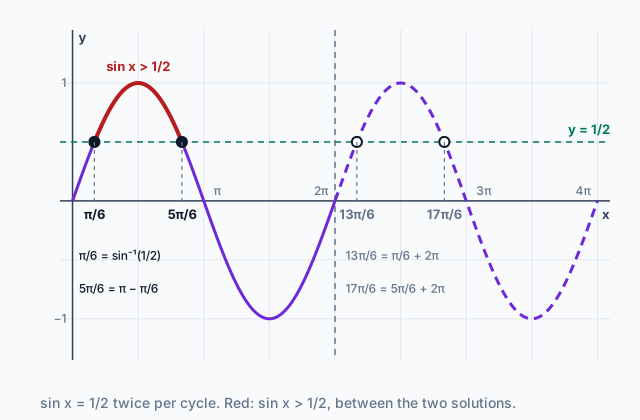
That is only half the job. The inverse sine always answers with an angle from to , because that is the restricted domain sine needed to have an inverse. Sine also equals in Quadrant II, at the angle just as far back from : . The diagram shows both crossings.
So modify the inverse's answer. Call it .
- For , the other angle in the same cycle is .
- For , the inverse cosine gives from to , and the other angle is .
Then shift any answer outside the interval by . With a calculator in radian mode, . That is not in , so add to get about . The other solution is , already inside.
Quick check · Calculate
Graphing calculator required. The equation has two solutions with , in radians. Give the one greater than , to three decimal places.
2b. Every solution, and the ones a situation allows
Sine repeats every . Once you have the two solutions in one cycle, add any whole number of periods to either one. Every solution of is
for an integer . That is infinitely many: , and are three more. Cosine also has period . Tangent has period and takes each value once per cycle, so gives .
A situation usually cuts the list down. Go back to the bike wheel, and say it turns once every 2 seconds. After seconds the reflector is cm above the hub, so it is 15 cm up when :
If you watch for the first 4 seconds, only , , and count. Negative times and times after 4 seconds solve the equation, but not the problem.
Quick check · Fill the statement
No calculator. Tap a blank, then tap an angle. The equation is , in radians.
With , the solutions are and , smaller first. Every other solution is one of those two plus a whole-number multiple of .
2c. Factor. Do not divide.
Solve for . It is tempting to divide both sides by and get . That step quietly assumes . But wherever , both sides are 0, so every one of those is a solution, and dividing just threw them away.
Move everything to one side and factor instead:
A product is 0 when either factor is 0.
- gives and .
- gives , so and .
That is four solutions, and dividing would have found two. The same goes for , or any expression that can be 0: factor it out rather than divide by it.
Quick check · Decide and justify
No calculator. To solve for , a student divides both sides by , gets , and answers only. Did the student miss a solution?
Which reason supports your answer?
2d. Inequalities: solve the equation, then read the graph
To solve for , start with the equation . Its solutions, and , are the only places in the interval where the graph meets the line , so they cut the interval into pieces. On each piece, stays on one side of .
Now decide which pieces you want. In the diagram, the red part of the curve, between and , is above the line. Without a graph, test one value in each piece: , which is less than ; , which is more; and , which is less. So
The endpoints are left out because there equals . With they would be in.
The other pieces, and , solve . Handing those in when the question asked for the red part is an easy slip, and one test value catches it.
Quick check · Multiple choice
No calculator. Which set is the solution of for , in radians?
Part 3 Watch it done Factor, then solve each piece
Watch each step, then do the last one yourself.
Solve for .
Step 1 · Factor
Both terms share , so pull it out: The product is 0 when either factor is 0, so there are two smaller equations to solve.
Why this step?
Why not divide both sides by at the start?
Dividing assumes . Wherever , the left side is 0 whatever is, so those values are solutions, and dividing would throw them away.
Step 2 · First factor
at and . Sine is also 0 at , but is not in .
Step 3 · Second factor
gives , and the inverse cosine gives .
Your step · Calculate
No calculator. Finish it. The equation factors as . How many solutions does it have with ?
Part 4 Try it When do the greenhouse fans run?
Here the answers are not special angles, so you need a calculator in radian mode. A greenhouse warms up through the day. Its temperature, in degrees Celsius, is modeled by
where is hours after midnight, for one day, . It is coolest at midnight, 18 degrees, and warmest at noon, 30 degrees. Fans switch on when the temperature rises above 28 degrees and off when it drops back to 28. Set up , isolate the cosine, and solve for the angle before you solve for .
Try it · Calculate
Graphing calculator required. A greenhouse's temperature, in degrees Celsius, is , where is hours after midnight and . Its fans run whenever the temperature is above 28 degrees. At what time do the fans first switch on? Give to three decimal places.
Try it · Calculate
Graphing calculator required. A greenhouse's temperature, in degrees Celsius, is , where is hours after midnight and . Its fans run whenever the temperature is above 28 degrees. For how many hours in that day do the fans run? Give the answer to three decimal places.
Part 5 Explain it Write it the way the exam asks
Nothing you type leaves this page. Check your answer against the model and each scoring point.
Free response is 37.5% of the exam score. This one is shaped like Question 3, Modeling a Periodic Context.
Free-response practice · Question 3 style
No calculator. The tip of one blade of a wind turbine is meters above the ground, seconds after a timer starts. The model is used only for the first 10 seconds, . (A) Find all values of in for which . Show the work that leads to your answer. (B) Find all intervals of in on which the tip is higher than 70 meters. (C) If could be any real number, the equation would have infinitely many solutions. Explain why, and why only finitely many of them answer part (A).
Model answer
(A) gives . The inverse cosine gives , and the other angle in the cycle is . Adding periods, or , so or . In : . (B) when . At , , so the tip is above 70 between each pair of solutions: and . After the next solution would be , past 10, and , so also . (C) Cosine is periodic, so h repeats every 4 seconds, and the tip passes 70 meters twice in every turn, forever. The context restricts to the first 10 seconds, two and a half turns, so only five of those times count.
Score your own answer. This is a self-check, not a grade. Tick each point your answer makes.
Part 6 Check yourself A tide chart and three solving questions
The three case questions use the same dock model D.
The depth of the water at a dock, in meters, is modeled by , where is hours after midnight. The model is used for one day, . The chart plots at every whole hour, with the horizontal line at a depth of 5 meters.
Water depth at the dock,
Each dot is (t, D(t)) at a whole hour, rounded to two decimal places. The line is a depth of 5 meters.
Case question 1 · Multiple choice
No calculator. A boat can tie up at the dock only when the water is at least 5 meters deep. For which values of in the day can it tie up?
Case question 2 · Calculate
No calculator. For how many hours in total, during the day , is the water at the dock at least 5 meters deep?
Case question 3 · Decide and justify
No calculator. The harbor office lists every time during the day when the water at the dock is exactly 5 meters deep. Should be on that list?
Which reason supports your answer?
The rest stand on their own and do not use the case.
Check yourself · Spot the error
No calculator. A student solves for . Tap the first line that goes wrong.
Check yourself · Put it in order
No calculator. Tap the steps for solving for in order.
Check yourself · Sort it
No calculator. Each card is a value offered as a solution of on the interval , in radians. Tap a card, then where it belongs.
Solves it, in the interval
Solves it, outside the interval
Does not solve it
Part 7 Keep it Bring back earlier ideas
Pulling an older idea back up is what makes it last.
From 3.4 Sine and Cosine Function Graphs · Put it in order
No calculator. Tap the angles, in radians, in order of the value of , from least to greatest.
From 2.13 Exponential and Logarithmic Equations and Inequalities · Sort it
No calculator. Each card gives an equation and a value a student found while solving it. Tap a card, then whether that value solves the original equation.
Solution
Extraneous
In three lines
- The inverse gives one angle . The other in the cycle is for sine and for cosine; shift anything outside the interval by .
- Periodic means infinitely many solutions, and so on. A context restricts the domain to the few that count.
- Factor out a trig expression rather than dividing by it. For an inequality, find the boundary points, then test a value in each piece.
Vocabulary
- Inverse trigonometric function
- Arcsine, arccosine or arctangent, written , and ; its output is an angle measure, which makes it useful for solving trigonometric equations and inequalities.
- Domain restriction
- A limit on the inputs: sine restricted to and cosine to so they have inverses, which is why an inverse gives only one solution, or a limit implied by a context, such as one day of a tide model.
- Periodic
- Repeating its values every period, which is why a trigonometric equation often has infinitely many solutions.
Course alignment, for teachers
AP Precalculus topic 3.10, Unit 3: Trigonometric and Polar Functions.
- Skill 1.A: Solve equations and inequalities represented analytically, with and without technology.
- Skill 2.A: Identify information from graphical, numerical, analytical, and verbal representations to answer a question or construct a model, with and without technology.
- Skill 3.B: Apply numerical results in a given mathematical or applied context.
This lesson maps all 3 essential knowledge statements of the topic to the part that teaches each one: 3 are checked by a scored question. The map is in the lesson file.