Unit 3 · Topic 3.9 · about 30 minutes · 7 parts · 12 scored checks, 3 of them multiple choice
AP Precalculus 3.9: Inverse Trigonometric Functions
 Tap to open the picture full size
Part 1 Think first How far has the wheel turned?
Guess before you learn. A wrong guess still makes the answer stick.
Predict first
Your seat on a Ferris wheel started level with the hub, on the right, and the wheel turns counterclockwise. A friend who looked away tells you only one thing: right now your seat is half a radius above the hub. You want to tell them how far the wheel has turned since the start. What can the height alone tell you?
In short. An inverse trigonometric function runs sine, cosine or tangent backward: it takes a value of the function as its input and gives back the one angle in a fixed interval that produces it.
- Sine, cosine and tangent are periodic, so each output comes from many angles. Each has an inverse only on a restricted domain: for sine, for cosine and for tangent.
- The inverses are arcsine, arccosine and arctangent, also written , and . The means inverse, not reciprocal.
- Inputs and outputs switch, so the output is an angle, and it always lies in the restricted domain. An angle outside it never comes back out: .
Part 2 Learn it Running the trig functions backward
3a. Too many angles, so restrict the domain
In 2.8 you saw that a function has an inverse only where each output comes from exactly one input. Sine fails that badly. , and so does , and so does the sine of every angle a whole number of turns away from either. Sine is periodic, so every value it takes comes back again and again. Cosine and tangent are periodic too.
So none of the three has an inverse on its full domain. Each one is invertible only on a restricted domain: a stretch of angles on which the function takes each of its values exactly once. On that stretch it is one-to-one, and running it backward gives back one angle.
The three inverse functions are called arcsine, arccosine and arctangent. You will also see them written , and . That means inverse, exactly as it does in . It is not an exponent. The reciprocal of sine is written or , and it is a different function altogether.
Quick check · Multiple choice
No calculator. The function has domain all real numbers. Which statement explains why has no inverse function on that domain?
3b. Where each function is fenced in
These three restricted domains are the standard ones, so arcsine, arccosine and arctangent each give one agreed value for every input they accept.
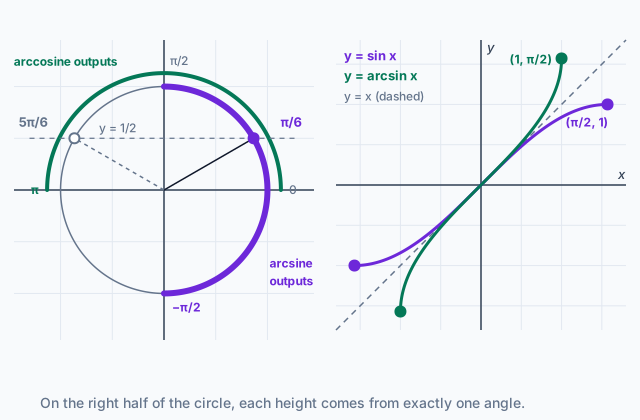
- Sine is restricted to , the right half of the unit circle. As P climbs that half from the bottom to the top, its height goes from to and passes every height once.
- Cosine is restricted to , the top half. As P goes over the top from to , its -coordinate goes from to , each value once.
- Tangent is restricted to , the right half with its two ends left open. At the terminal ray is vertical, so tangent is not defined there. In between, the slope of the ray takes every real value once.
An inverse switches inputs and outputs, so each restricted domain becomes the set of outputs of the inverse. Arcsine and arctangent give angles on the right half of the circle. A negative input gives a negative angle, such as , never . Arccosine gives angles from to , so a negative input gives an angle in Quadrant II.
Switching inputs and outputs also reflects each graph across the line : the point becomes . So rises from to , as the diagram shows, and stops there. Arctangent's graph never reaches ; those are its horizontal asymptotes.
Quick check · Sort it
No calculator. Each card is an angle in radians. Tap a card, then tap which of arcsine and arccosine can give that angle as an output.
Both can
Only arcsine
Only arccosine
Neither
3c. Reading an inverse value
Sine takes an angle and gives a number from to . Arcsine runs the other way: it takes that number and gives back the angle. So becomes . The input of an inverse trig function is a value of sine, cosine or tangent, and the output is an angle.
That also tells you which inputs make sense. Sine and cosine only produce values from to , so and do not exist. Tangent produces every real number, so arctangent accepts any input at all.
To find a value without a calculator, ask the question, then check the fence. For , ask which angle has cosine . Several do, such as and . Only lies in , so .
Quick check · Fill the statement
No calculator. Each value is an angle in radians. Tap a blank, then tap an answer.
, and .
Part 3 Watch it done An inverse wrapped around its own function
Watch each step, then do the last one yourself.
Find without a calculator.
Step 1 · Work the inside first
is in Quadrant III, past the negative -axis. There P is , so . The problem is now .
Why this step?
Why is the answer not simply ? Arcsine undoes sine, after all.
Arcsine only ever outputs an angle in , and is outside that interval. An inverse undoes its function only on the restricted domain, so holds only when is already between and .
Step 2 · Look on the right half of the circle
The answer is an angle on the right half of the unit circle whose sine is . A negative sine puts P below the -axis, so the angle is between and : a clockwise turn from the positive -axis. Find the point on that quarter of the circle at height .
Your step · Calculate
No calculator. Finish it. The value of , in radians, is . What is ? Give the exact value; a fraction such as 7/4 is fine.
Part 4 Try it Many angles, one answer
The lab draws P on the unit circle with the sine graph underneath. Set to and read . Now hunt for other angles with the same sine: move the slider, or type angles, until P sits at exactly the same height again. Find at least three more between and , and watch where each one lands on the graph.
Every one of those angles has sine , yet is a single number. Which of your angles lies in ? That one is the answer, and it is the only one. Then close the lab and answer the two questions on paper.
Try it · Calculate
Graphing calculator required. The terminal ray of an angle , with , passes through the point . Use arctangent to find in radians. Give a decimal to three places.
Try it · Decide and justify
No calculator. A student writes , because arccosine undoes cosine. Is the student right?
Which reason supports your answer?
Part 5 Explain it Write it the way the exam asks
Nothing you type leaves this page.
Free response is 37.5% of the exam score. This one is shaped like Question 4, Symbolic Manipulations.
Free-response practice · Question 4 style
No calculator. Let . (i) Give the range of . Explain why tangent has to be restricted before it has an inverse, and why the range leaves out and . (ii) Explain why accepts every real number as an input, while does not. (iii) A classmate writes . Explain the error and find the correct value.
Model answer
(i) The range of is . Tangent is periodic, so each of its values comes from infinitely many angles, and it has an inverse only on a domain where each value comes from one angle. That domain is . Its ends are left out because the terminal ray is vertical at , so tangent is not defined there. (ii) The inputs of are outputs of tangent. As goes from to , the slope of the ray takes every real value, so accepts any real number. Sine only gives values from to , so needs . (iii) is not in , so arctangent can never output it. , and the angle in with tangent is . So .
Score your own answer. This is a self-check, not a grade. Tick each point your answer makes.
Part 6 Check yourself One table, run backward
The two case questions use the same table of . Answer them from it and the unit circle.
A function is defined by for only, with in radians. On that domain is decreasing, so each output comes from exactly one input and has an inverse function, . The table lists some values of .
Case question 1 · Calculate
No calculator. The function is defined for . The value of , in radians, is . What is ? Give a fraction or a decimal.
Case question 2 · Multiple choice
No calculator. The function is defined for . Reading from left to right, which describes the graph of ?
The rest stand on their own and do not use the case.
Check yourself · Spot the error
No calculator. A student evaluates . Tap the first line that goes wrong.
Check yourself · Match
No calculator. Tap each expression, then its value. Angles are in radians.
Part 7 Keep it Bring back earlier ideas
Pulling an older idea back up is what makes it last.
From 3.3 Sine and Cosine Function Values · Multiple choice
No calculator. For which angle , in radians, is and ?
From 2.8 Inverse Functions · Fill the statement
No calculator. A function has , , , and . Tap a blank, then tap an answer.
= and = . The inputs of are the of .
In three lines
- Sine, cosine and tangent are periodic, so each has an inverse only on a restricted domain: , and .
- Arcsine, arccosine and arctangent, written , and , take a trig value and give back an angle in that interval.
- Always check the interval: , , and an angle outside it never comes back out.
Vocabulary
- Inverse trigonometric function
- A function that switches the inputs and outputs of sine, cosine or tangent, so its input is a value of that function and its output is an angle.
- Arcsine
- The inverse of sine on , also written ; it takes a value from to and gives an angle in that interval.
- Arccosine
- The inverse of cosine on , also written ; it takes a value from to and gives an angle in that interval.
- Arctangent
- The inverse of tangent on , also written ; it takes any real number and gives an angle in that interval.
- Restricted domain
- A part of a function's domain on which each output comes from exactly one input, so the function is invertible there.
Course alignment, for teachers
AP Precalculus topic 3.9, Unit 3: Trigonometric and Polar Functions.
- Skill 1.C: Construct new functions, using transformations, compositions, inverses, or regressions, that may be useful in modeling contexts, criteria, or data, with and without technology.
- Skill 2.B: Construct equivalent graphical, numerical, analytical, and verbal representations of functions that are useful in a given mathematical or applied context, with and without technology.
This lesson maps all 3 essential knowledge statements of the topic to the part that teaches each one: 3 are checked by a scored question. The map is in the lesson file.