Unit 3 · Topic 3.15 · about 30 minutes · 7 parts · 14 scored checks, 2 of them multiple choice
AP Precalculus 3.15: Rates of Change in Polar Functions
 Tap to open the picture full size
Part 1 Think first A bead on a spinning rod
Guess before you learn. A wrong guess still makes the answer stick.
Predict first
A science museum has a long rod that spins around a hub at its middle, with a bead that slides along the rod. A screen shows where the bead is as a signed number of feet from the hub: positive on the painted half of the rod, negative on the plain half. Over two seconds the screen reads , then , then . Is the bead getting closer to the hub or farther from it?
In short. The output of a polar function is a signed radius, so how changes as increases, together with the sign of , tells you whether the point is moving toward the origin or away from it.
- The distance from the origin is . It increases when is positive and increasing or negative and decreasing, and it decreases when is positive and decreasing or negative and increasing.
- Where changes from increasing to decreasing or back, has a relative extremum, and the point is relatively closest to or farthest from the origin. Read there to tell which.
- The average rate of change of with respect to is the change in the signed radius divided by the change in , a rate per radian, and it can be used to estimate inside the interval.
Part 2 Learn it Four short ideas, each checked as you go
2a. Toward the origin or away from it
In the output is a signed radius. When is positive, the point sits on the terminal ray of . When is negative, it sits on the opposite ray. Either way, its distance from the origin is .
So to tell whether the point is moving toward the origin or away from it as increases, watch , not . That gives four cases.
- positive and increasing: grows, so the point moves away from the origin.
- positive and decreasing: shrinks, so it moves toward the origin.
- negative and decreasing: goes from to to , so grows and the point moves away.
- negative and increasing: shrinks, so it moves toward the origin.
The third case is the one students get wrong. Decreasing sounds like shrinking, but a negative number that decreases gets bigger in size.
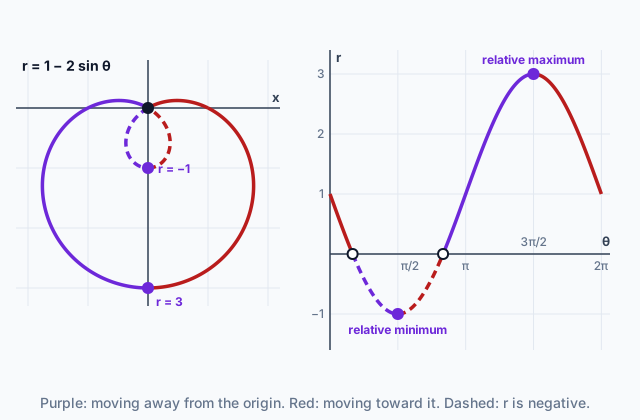
Look at in the diagram. From to , falls from 0 to . It is negative and decreasing there, and the point swings out from the origin to the far end of the small inner loop.
Quick check · Sort it
No calculator. On each card, the value of a polar function changes steadily from the first number to the second as increases. Tap a card, then tap what the point does.
Moves away from the origin
Moves toward the origin
2b. Closest and farthest points
Where changes from increasing to decreasing, or from decreasing to increasing, it has a relative extremum. At that angle the point is relatively closest to the origin or relatively farthest from it. Which one depends on the sign of there, because the distance is .
Take again. It has a relative maximum of 3 at . That value is positive and larger than the values beside it, so the point is relatively farthest from the origin: the bottom of the big loop.
The same function has a relative minimum of at . A minimum sounds like the closest point, but there, and is smaller on either side, down to 0 at and . So that point is also relatively farthest from the origin: the far end of the small loop.
Closest points come from extrema too. For , has a relative minimum of 1 at , and is positive there, so that point is relatively closest to the origin.
So find where turns, then read to tell closest from farthest.
Quick check · Multiple choice
No calculator. A polar function is negative for . It decreases on , increases on , and . Which describes the point with polar coordinates ?
2c. The average rate of change of r
The average rate of change of with respect to over an interval from to is the change in the signed radius divided by the change in :
It tells you how fast the signed radius is changing per radian, on average. On the graph of against , it is the slope of the secant line between the two points.
For from to :
On average, the signed radius drops about 1.27 for each radian turns.
Use the signed values, signs and all. The point is 1 unit from the origin at both ends of this interval, so a calculation with distances would give 0, as if nothing happened. Something did: went from 1 to and passed through the origin on the way. Keep in radians, since the rate is per radian.
Quick check · Calculate
No calculator. A polar function has and , with in radians. What is the average rate of change of with respect to from to ?
2d. Estimating with the average rate
The average rate of change gives you a line to estimate with. Start at a value you know and move along the secant line:
for an angle inside the interval from to .
With and the rate from 0 to , estimate :
The actual value is . The estimate is off by a third, because the graph of bends away from the secant line. It is still the best you can do when all you have is two values, as in a table, and a shorter interval around the angle usually gives a closer estimate.
Two slips to avoid. Multiply the rate by how far is from your starting angle, not by itself. And keep the sign of the rate: a negative rate lowers the estimate as moves forward.
Quick check · Calculate
No calculator. A polar function has and , with in radians. Use the average rate of change of over to estimate .
Part 3 Watch it done Piece by piece
Watch each step, then do the last one yourself.
Let for . Describe how the distance between the point and the origin changes as increases.
Step 1 · Find how r changes
As goes from 0 to , goes from 0 to . Cosine decreases from 0 to and increases from to , so decreases from to , then increases to . It is also 0 where , at .
Step 2 · Split at the zero and the turn
That gives three pieces: , and . On the first, is positive and decreasing. For example, , between 4 and 0. The distance shrinks from 4 to 0, so the point moves toward the origin and reaches it at .
Why this step?
Why split at , where keeps decreasing, as well as at , where it turns?
Whether a changing means toward or away depends on the sign of as well as on whether is increasing or decreasing. The sign changes at and the direction changes at , so one description cannot cover two pieces.
Step 3 · Look at the second piece
On , keeps decreasing, from 0 down to . For example, . Every value of is negative and decreasing, so grows from 0 to 4 and the point moves away from the origin, along the ray opposite each .
Your step · Fill the statement
No calculator. Finish it. For , and , and increases between them. Tap a blank, then tap an answer.
On , the distance , so the point moves the origin.
Part 4 Try it A circle that is drawn twice
The polar function draws a circle of diameter 3 that passes through the origin. As goes from 0 to , is positive and falls from 3 to 0, so the point comes in to the origin. Then keeps going, and turns negative. The lab shows this circle so you can see what the point does next. The two questions after the lab are about a different function, : a circle of the same size, turned a quarter turn.
Try it · Decide and justify
No calculator. For , as increases from to , decreases steadily from 0 to . Does the point move toward the origin or away from it?
Which reason supports your answer?
Try it · Calculate
No calculator. For with , at what value of is the point farthest from the origin? That value is . What is ? Give a fraction or a decimal.
Part 5 Explain it Write it the way the exam asks
Nothing you type leaves this page. Check your answer against the model and each scoring point.
Free response is 37.5% of the exam score. This one is shaped like Question 4, Symbolic Manipulations.
Free-response practice · Question 4 style
No calculator. The polar function is given by for . (A) Find the average rate of change of over . Show the work that leads to your answer, and interpret the value. (B) On the interval , is the distance between the point and the origin increasing or decreasing? Give a reason for your answer. (C) The function has a relative minimum at . Is the point relatively closest to or relatively farthest from the origin? Explain your reasoning. (D) Use the average rate of change of over to estimate . Show the work that leads to your answer.
Model answer
(A) and . The average rate of change is . Over this interval the signed radius increases by , about 2.86, per radian on average. (B) and , and decreases on this interval, so increases. is positive and increasing, so the distance is increasing. (C) , and for near 0, is between and 0, so . The point is 2 units from the origin and the points beside it are closer, so it is relatively farthest from the origin. (D) and , so the rate is . Then .
Score your own answer. This is a self-check, not a grade. Tick each point your answer makes.
Part 6 Check yourself One table, one polar function
The three case questions use the same table. Answer them from it.
The polar function is decreasing for , with in radians. The table gives selected values of .
| (radians) | |
|---|---|
| 0 | 3.0 |
| 0.5 | 2.4 |
| 1 | 1.0 |
| 1.5 | |
| 2 | |
| 2.5 |
Case question 1 · Calculate
No calculator. What is the average rate of change of with respect to from to ?
Case question 2 · Calculate
No calculator. Use the average rate of change of over to estimate .
Case question 3 · Multiple choice
No calculator. As increases from 1.5 to 2.5, what happens to the distance between the point and the origin?
The rest stand on their own and do not use the case.
Check yourself · Spot the error
No calculator. A polar function has and . A student finds the average rate of change of with respect to from to . Tap the first line that goes wrong.
Check yourself · Select all
No calculator. Let , which is 0 at and at . On which two intervals does the point move away from the origin as increases? Pick two.
Select 2 answers, then check.
Part 7 Keep it Bring back earlier ideas
Pulling an older idea back up is what makes it last.
From 3.14 Polar Function Graphs · Spot the error
No calculator. A student locates the point on the graph of the polar function for . Tap the first line that goes wrong.
From 1.3 Rates of Change in Linear and Quadratic Functions · Calculate
No calculator. Let . What is the slope of the secant line through and ?
In three lines
- Distance from the origin is : positive and increasing or negative and decreasing moves the point away; the other two cases move it toward the origin.
- Where turns from increasing to decreasing or back, the point is relatively closest or farthest; read to tell which.
- Average rate of change of is the change in signed radius over the change in , per radian, and it estimates inside the interval.
Vocabulary
- Polar function
- A function whose inputs are angle measures and whose outputs are radii, graphed as the points with polar coordinates .
- Polar coordinates
- An ordered pair that locates a point by an angle and a radial displacement from the origin, along the terminal ray of when is positive and the opposite ray when is negative.
- Signed radius
- The value of in : its sign says which ray the point is on, and is the distance between the point and the origin.
- Relative extremum
- A value of where changes from increasing to decreasing or from decreasing to increasing; the point there is relatively closest to or farthest from the origin.
- Average rate of change
- For with respect to over an interval, the change in the signed radius values divided by the change in : the rate at which the signed radius changes per radian.
Course alignment, for teachers
AP Precalculus topic 3.15, Unit 3: Trigonometric and Polar Functions.
- Skill 3.A: Describe the characteristics of a function with varying levels of precision, depending on the function representation and available mathematical tools.
- Skill 3.C: Support conclusions or choices with a logical rationale or appropriate data.
This lesson maps all 5 essential knowledge statements of the topic to the part that teaches each one: 5 are checked by a scored question. The map is in the lesson file.