Unit 4 · Topic 4.2 · about 30 minutes · 7 parts · 12 scored checks, 1 of them multiple choice
AP Precalculus 4.2: Parametric Functions Modeling Planar Motion
Not assessed on the AP Exam. Unit 4 is part of the course, but nothing in it is on the exam.
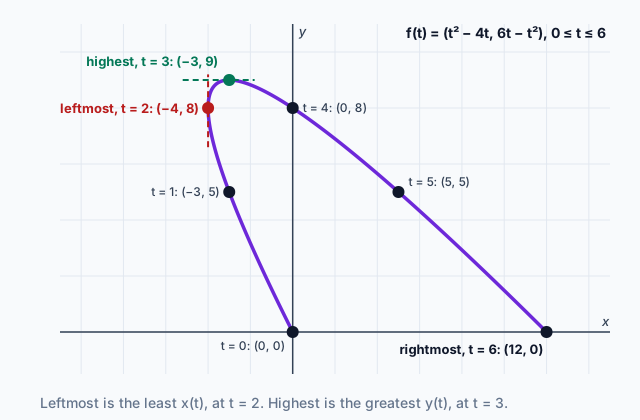 Tap to open the picture full size
Part 1 Think first Farthest west, highest up
Commit to a guess first. Being wrong now still helps the answer stick.
Predict first
A survey drone lifts off from a dock. It climbs while drifting west, swings back east, and lands 16 meters east of where it took off. At the moment it is farthest west of its takeoff spot, is it also at its highest?
In short. A parametric function can model a particle moving in the plane, and its graph shows where the particle is at each time .
- The least and greatest values of give the leftmost and rightmost points of the motion, and the least and greatest values of give the lowest and highest points.
- The real zeros of give the -intercepts of the path, and the real zeros of give the -intercepts.
- When the domain is restricted, check the start and the end of the path as well, because an extreme can sit at either end.
Part 2 Learn it Three ideas, each checked before the next
2a. The graph shows where the particle is
Put the drone on a grid with the pad at the origin. At time seconds its position is , where is how many meters east of the pad it is (negative means west) and is its height in meters. For this flight, and , for .
Written as one function, . Put in a time and you get a point. At , : one second in, the drone is 3 meters west of the pad and 5 meters up. Any particle moving in the plane can be modeled the same way, and the graph of , the path in the diagram, is every position it takes.
| (seconds) | (meters) | (meters) |
|---|---|---|
The graph leaves one thing out: time. A point on the path says where the drone was, not when. To know when, you go back to , which is why the dots in the diagram carry labels.
Quick check · Match
A particle's position at time is . Tap a time, then the particle's position at that time.
2b. Farthest left, right, down and up
How far west does the drone get? Only measures east and west, so the answer comes from alone. The least value of gives the leftmost point of the path and the greatest value gives the rightmost. In the same way, the least and greatest values of give the lowest and highest points.
Here is a quadratic with zeros at 0 and 4, and a quadratic turns halfway between its zeros, at . Since and , the leftmost point is . The height turns halfway between 0 and 6, at , where and . The highest point is .
Each extreme comes from its own function, so they can happen at different moments, and here they do.
Check the ends too. Because falls until and rises after, its greatest value is at an end: or . The rightmost point, , is where the flight ends. The lowest points are the two ends, and , where the height is 0.
Quick check · Calculate
A particle's position at time is for . What is the least -coordinate the particle reaches, the farthest left its path goes?
2c. Crossing the axes
Every point on the -axis has -coordinate 0. So the path meets the -axis exactly when , and the real zeros of give the -intercepts. In the same way, the real zeros of give the -intercepts. The letters cross over, and that is the part people get backward.
For the drone, is 0 at and . Put those times into : and . The -intercepts are and . Four seconds in, the drone is right over the pad, 8 meters up.
The height is 0 at and , which gives the -intercepts and : takeoff and landing.
A zero of is a time, not a point. To get the intercept you still need the other coordinate at that time. Only zeros inside the domain count, too. If had a zero at , that would be a moment before the drone took off, and the path has no point there.
Quick check · Fill the statement
A particle moves along the path for . Tap a blank, then tap an answer.
The path meets the -axis where = 0, and it does so at . It meets the -axis where = 0, and it does so at .
Part 3 Watch it done A drone over a soccer field
Read each step, then do the last one yourself.
A camera drone films a soccer practice. Its position seconds after takeoff is , with meters east of a corner flag (negative values are west) and meters above the ground, for . Find its highest point, the points where it is directly above the flag, and how far west of the flag it gets.
Step 1 · Highest point
Height is , a quadratic with zeros 0 and 10. It turns halfway between them, at , where . Then , so the highest point is .
Step 2 · Directly above the flag
Directly above the flag means on the -axis, where . Solve : or . Then and , so the -intercepts are and . The drone is over the flag at takeoff and again at the top of its climb.
Why this step?
Why do the zeros of , and not the zeros of , give the points on the -axis?
Every point on the -axis has -coordinate 0, so the drone is on that axis exactly when . The zeros of are the times it is at ground level, which puts it on the -axis.
Step 3 · Farthest west
Farthest west means the least value of . Since has zeros 0 and 5, it turns halfway between them, at . It opens upward, so that turning point is its least value, and the ends, and , cannot go lower.
Your step · Calculate
Finish it. A drone's distance east of a flag, in meters, is for , with negative values west of the flag. What is the least value of ?
So the drone gets 6.25 meters west of the flag at , when it is meters up. Its farthest west point, , is not its highest point, which comes later, right over the flag.
Part 4 Try it A train on an oval track
A toy train runs on an oval track on a classroom floor. Two taped lines cross at the origin: the -axis runs east, the -axis runs north, and distances are in feet. The train's position at time is for , which is one lap.
Warm up in the lab first. It shows a different oval, , not the train's track, with the graphs of and against under it and the readouts off. Move the Parameter t slider slowly through one lap. Each time the point is farthest left or right, look at what the graph is doing. Each time the point crosses the vertical axis, look at where the graph crosses 0.
Then work the two questions on paper, for the train's track, and .
Try it · Calculate
A toy train's position on a floor, in feet, is for , with measured east and measured north. What is the least value of , the -coordinate of the train's farthest point west?
Try it · Calculate
A toy train's position on a floor, in feet, is for , with in radians. Its path crosses the -axis at two points. What is the -coordinate of the crossing with the greater -coordinate? Give a decimal to three places.
Part 5 Explain it Write it out
Nothing you type leaves this page. Check your answer against the model and each point on the list.
Unit 4 is not on the AP Exam, so this is written practice for the course.
Written practice
A drone's position seconds after takeoff is , with meters east of a fence post (negative values are west) and meters above the ground, for . (i) Identify the leftmost point of the drone's path, and explain how you found it. (ii) Identify the highest point of the path. (iii) Identify every point where the path meets the -axis, and explain why one zero of gives no point of the path. (iv) Describe what the -intercepts of the path mean for the drone.
Model answer
(i) The leftmost point comes from the least value of . is a quadratic that opens upward with its vertex at , where . The ends give and , both larger. Since , the leftmost point is . (ii) The highest point comes from the greatest value of , which turns halfway between its zeros 0 and 4, at . and , so the highest point is . (iii) The path meets the -axis where : , so or . The time is before takeoff, outside , so it gives no point. , so the only -intercept is : at the drone is directly above the post, 6 meters up. (iv) The -intercepts come from the zeros of , at and . They are , where the drone takes off 3 meters west of the post, and , where it lands 5 meters east of it.
Score your own answer. This is a self-check, not a grade. Tick each point your answer makes.
Part 6 Check yourself A seabird's dive
The two case questions use the same seabird dive. Answer them from it.
A seabird dives for a fish next to a buoy. Its position seconds into the dive is in meters, with measured horizontally from the buoy and measured up from the water's surface, for . A negative means the bird is under water.
| (seconds) | (meters) | (meters) |
|---|---|---|
Case question 1 · Multiple choice
What is the lowest point of the seabird's path?
Case question 2 · Calculate
How far from the buoy, measured horizontally in meters, is the seabird when it comes back up through the surface of the water?
The rest stand on their own and do not use the case.
Check yourself · Spot the error
A particle moves along the path for . A student finds the -intercepts of the path. Tap the first line that goes wrong.
Check yourself · Sort it
A particle's position is for . Each card names a point where its path meets an axis. Tap a card, then the function whose zero gives the time the particle is at that point.
Use
Use
Part 7 Keep it From earlier lessons
Pulling an older idea back up is what makes it last.
From 4.1 Parametric Functions · Put it in order
The parametric function has domain , and its graph passes through each of these five points once. Tap them in the order a sketch joins them.
From 3.5 Sinusoidal Functions · Calculate
The graph of a sinusoidal function k has a maximum at , then its next minimum at , then its next maximum at . What is the period of k?
In three lines
- A parametric function gives a particle's position at time , and its graph is the path.
- The least and greatest values of give the leftmost and rightmost points; those of give the lowest and highest, ends included.
- The real zeros of give the -intercepts and the real zeros of give the -intercepts.
Vocabulary
- Parametric function
- A function that gives a point in the plane for each value of ; in planar motion, its graph shows the position of a particle at time .
- Planar motion
- The motion of a particle in the plane, modeled by a parametric function .
- Horizontal extrema
- The leftmost and rightmost positions of a particle's motion, found from the minimum and maximum values of .
- Vertical extrema
- The lowest and highest positions of a particle's motion, found from the minimum and maximum values of .
- Real zeros
- The values of where or is 0; the real zeros of correspond to -intercepts and those of to -intercepts.
Course alignment, for teachers
AP Precalculus topic 4.2, Unit 4: Functions Involving Parameters, Vectors, and Matrices.
- Skill 3.A: Describe the characteristics of a function with varying levels of precision, depending on the function representation and available mathematical tools.
- Skill 3.B: Apply numerical results in a given mathematical or applied context.
This lesson maps all 3 essential knowledge statements of the topic to the part that teaches each one: 3 are checked by a scored question. The map is in the lesson file.