Unit 4 · Topic 4.4 · about 30 minutes · 7 parts · 13 scored checks, 2 of them multiple choice
AP Precalculus 4.4: Parametrically Defined Circles and Lines
Not assessed on the AP Exam. Unit 4 is part of the course, but nothing in it is on the exam.
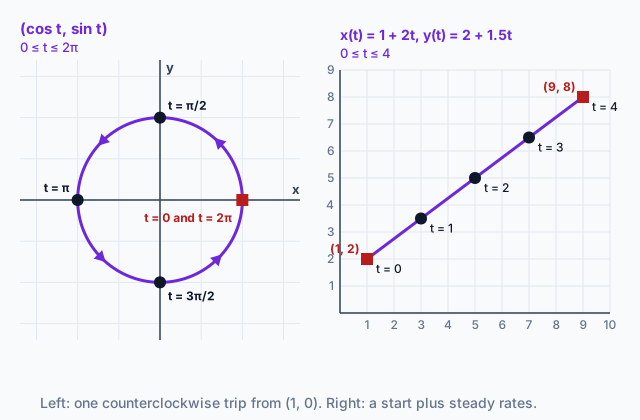 Tap to open the picture full size
Part 1 Think first Swap the coin's coordinates
Make a guess before the lesson starts. A wrong guess still helps the right answer stick.
Predict first
A game designer makes a coin fly in a circle. She sets its position to and and lets the time run from 0 to . The coin starts at and goes once around counterclockwise. Then she swaps the two, so and . What does the coin do now?
In short. A parametric function can move a point around a circle, built from on the unit circle, or along a line segment, built from an initial position and constant rates of change.
- with domain makes one complete counterclockwise revolution around the unit circle, starting and ending at .
- Transformations of it model any circular path: has center and radius , and changing the inside sets the start, the direction and the number of trips.
- From to in time : and , for .
Part 2 Learn it Circles, then segments
2a. One trip around the unit circle
You already know the point at angle on the unit circle: . Now let be time, and let the point move.
At the point is at . At it is at the top, . Then at , at , and back to at . The angle keeps growing, so the point turns counterclockwise, the way angles open in standard position.
With domain , that is one complete counterclockwise revolution around the unit circle, centered at the origin, starting and ending at . To find where the point is at any time, use the unit circle values you already have. At it is at .
The domain matters as much as the formula. Stop at and the point covers only the top half. Let run to and it goes round twice.
Quick check · Match
A point moves along for . Tap a time, then where the point is at that time.
2b. Any circle, from the unit circle
Multiply both coordinates by and the point stays from the origin, so it goes around the circle of radius . Add and to move the center to :
That is still one counterclockwise trip. It starts at , the rightmost point, because and .
Say a robot mower circles a tree at on a yard map in meters, always 2 meters from the trunk. Its path is , and it starts at .
You can check that against the circle's equation, . Substitute: . Every point of the path is on the circle.
Two things trip people up. The equation shows , but the parametric function multiplies by . And the center keeps its own signs: a tree at gives .
Quick check · Multiple choice
A point goes once counterclockwise around the circle , starting at its rightmost point, for . Which parametric function models this motion?
2c. Where it starts, which way it goes, how many trips
Changing the inside cosine and sine changes the trip, not the circle.
- Replace with : . Same start, , but the point now turns clockwise.
- Replace with : the point starts at angle instead of 0. starts at and still turns counterclockwise.
- Replace with , for : the angle grows times as fast. goes around three times for , and once for . The number of trips is times the length of the interval, divided by .
When a formula fits none of these, test it. Find the point at , then at a small such as 0.1, and see which way it moved. Picture a clock: moving right across the top, or down the right side, is clockwise.
Try . At it is at , the leftmost point. At , is just above 0, so the point moved up the left side. On a clock that is clockwise.
Quick check · Sort it
Each card is a parametric function for , and each one traces a circle. Tap a card, then the way the point goes round.
Counterclockwise
Clockwise
2d. Along a line segment
Straight-line motion needs no trigonometry. You need the initial position and how fast each coordinate changes.
A skateboarder rolls in a straight line at a steady speed from to , in meters, in 4 seconds. Over those 4 seconds changes by , so the rate of change of with respect to is meters per second. changes by , so its rate is . Start at the initial position and add rate times :
At that gives , as it should. The domain does the stopping. The same formulas for past 4 carry on along the line.
In general, from to in time , the rates are and . One segment has many parametrizations. for covers it in 1 second. for covers it backward, from to .
Quick check · Fill the statement
A ball rolls in a straight line at a steady speed from to , in meters, in 4 seconds, with in seconds. Tap a blank, then tap a number.
In the ball's parametric function, the initial position has -coordinate . Each second, changes by meters and changes by meters, and the domain is .
Part 3 Watch it done The tip of a minute hand
Read each step, then do the last one yourself.
A clock is drawn on a grid in centimeters with its center at . The tip of its minute hand is 5 cm from the center. Write a parametric function for the tip over one hour, with , starting at the top of the clock and moving clockwise.
Step 1 · Start from the unit circle
for goes once around, counterclockwise, from . The minute hand needs two changes: start at the top, and go the other way.
Step 2 · Fix the start and the direction
Replace with : . At the angle is , so the point is , the top. At the angle is , which shares a terminal ray with , so the hour ends at the top too.
Why this step?
Why does replacing with make the point go clockwise?
In , a growing angle turns the point counterclockwise. Here , which shrinks as grows, so the point turns the opposite way.
Step 3 · Stretch and move the circle
Multiply by the radius 5 and add the center's coordinate. For that gives , for . Check : , the center's , so the tip starts straight above the center. The -coordinate is built the same way, from the sine and the center's .
Your step · Calculate
Finish it. The tip of a minute hand goes once clockwise around a circle with center and radius 5 cm, starting at the top, and its -coordinate is for . Write the same way. What is ? Give a decimal.
By the difference identities, and , so the tip is also . That is the coin from the start of the lesson: swapping sine and cosine starts at the top and turns clockwise.
Part 4 Try it A drone's straight flight
Warm up on the grapher first. It shows a segment from to , traced for , with the path on top and and against underneath. Drag Parameter t from 0 to 1 and watch grow by 5 and by 3, each at a steady rate. Then move Interval of t ends at up to 2. The path runs on past along the same line: the formulas do not stop, the domain does. Set Interval of t starts at to and the line runs back past as well.
Now take paper. A delivery drone flies in a straight line at a steady speed from a depot at to a house at , with distances in kilometers on a map. The flight takes 3 minutes, and is the time in minutes since takeoff.
Try it · Calculate
A delivery drone flies in a straight line at a steady speed from a depot at to a house at , in kilometers, in 3 minutes, with in minutes. What is the rate of change of with respect to , in kilometers per minute?
Try it · Decide and justify
A delivery drone flies in a straight line at a steady speed from a depot at to a house at , in kilometers, in 3 minutes, with in minutes since takeoff. Does for model this flight?
Which reason supports your answer?
Part 5 Explain it Put it in writing
Nothing you type leaves this page. Write your answer, then check it against the model and each line of the list.
Unit 4 is not on the AP Exam, so this is written practice for the course.
Written practice
On a park map in meters, with east as the positive direction and north as the positive direction, a round pond has its center at and a radius of 10. (i) Write a parametric function that models a duck swimming once counterclockwise around the edge of the pond, starting and ending at the easternmost point, , for . (ii) Describe how to change your function so the duck makes the same trip clockwise, and explain how you know it now goes clockwise. (iii) A footpath runs straight from the gate at to . A jogger covers it at a steady speed in 100 seconds. Write a parametric function for the jogger's position, with its domain, and identify the rates of change of and with respect to .
Model answer
(i) for . At it gives , and it turns counterclockwise like . (ii) Replace with , which gives . It still starts at , but a moment after its is below 30, so the duck moves south from the easternmost point. On a map with north up, that is clockwise. (iii) changes by 50 meters and by 30 meters in 100 seconds, so the rates are 0.5 and 0.3 meters per second. The function is for , which reaches at .
Score your own answer. This is a self-check, not a grade. Tick each point your answer makes.
Part 6 Check yourself Moving platforms
The two case questions use the same platform table. Answer them from it.
A designer scripts two moving platforms for a video game level. Positions are in meters on the level map, and is the time in seconds. Each platform follows the parametric function in the table over the domain given.
| Platform | Position (x(t), y(t)) | Domain |
|---|---|---|
Case question 1 · Multiple choice
Platform moves along for , in meters. Which describes its motion?
Case question 2 · Calculate
Platform moves along for , in meters, with in seconds. At what time is platform at its lowest point? Give a decimal to two places.
The rest stand on their own and do not use the case.
Check yourself · Spot the error
A student writes a parametric function for a point that moves in a straight line at a steady speed from to in 2 seconds. Tap the first line that goes wrong.
Check yourself · Put it in order
A point moves along for . Tap the four points in the order the point first reaches them.
Part 7 Keep it From earlier lessons
Ideas you have not used in a while fade. One finds a point on a circle, where this lesson started; the other reads a slope from the rates of change of and , as a line segment does.
A groundskeeper maps a soccer field with the origin at the center spot. East is the polar axis, so the positive -axis points east and the positive -axis points north. Distances are in meters and angles in radians. Three markers were recorded in different ways.
| Marker | Recorded as | Coordinate system |
|---|---|---|
| P | Polar | |
| Q | Polar | |
| R | Rectangular |
From 3.13 Trigonometry and Polar Coordinates · Calculate
A field map has the origin at the center spot and east as the polar axis, in meters. Marker P has polar coordinates . How many meters north of the center spot is marker P? That is its -coordinate.
From 4.3 Parametric Functions and Rates of Change · Calculate
A particle moves along . Use the average rates of change of and over to find the slope of the graph between the points where and .
In three lines
- for goes once counterclockwise around the unit circle, from back to .
- moves the circle to center and radius ; reverses it, moves the start, and makes times as many trips.
- A segment from to in time starts at and changes at the rates and .
Vocabulary
- Parametric function
- A function that gives a point in the plane for each value of the parameter in its domain.
- Unit circle
- The circle of radius 1 centered at the origin, traced once by for .
- Counterclockwise revolution
- One full trip around a circle in the direction angles open in standard position, ending where it started.
- Line segment
- The part of a line between two points, such as and ; a parametric function stays on it when its domain stops it at both ends.
- Initial position
- Where the moving point is when starts, such as for motion from to .
- Rate of change of x with respect to t
- How much changes per unit of ; along a segment covered at a steady speed in time it is .
- Rate of change of y with respect to t
- How much changes per unit of ; along a segment covered at a steady speed in time it is .
Course alignment, for teachers
AP Precalculus topic 4.4, Unit 4: Functions Involving Parameters, Vectors, and Matrices.
- Skill 1.B: Express functions, equations, or expressions in analytically equivalent forms that are useful in a given mathematical or applied context.
- Skill 1.C: Construct new functions, using transformations, compositions, inverses, or regressions, that may be useful in modeling contexts, criteria, or data, with and without technology.
This lesson maps all 3 essential knowledge statements of the topic to the part that teaches each one: 3 are checked by a scored question. The map is in the lesson file.