Unit 4 · Topic 4.6 · about 30 minutes · 7 parts · 14 scored checks, 2 of them multiple choice
AP Precalculus 4.6: Conic Sections
Not assessed on the AP Exam. Unit 4 is part of the course, but nothing in it is on the exam.
 Tap to open the picture full size
Part 1 Think first Tilt the flashlight
Guess before you learn. A wrong guess still makes the answer stick.
Predict first
Point a flashlight straight at a wall and the edge of the light is a circle. Now tilt the flashlight a little, still aimed at the wall. What shape does the edge of the light make?
In short. A conic section with a vertical or horizontal line of symmetry has an equation you can read directly: the numbers in it give the vertex or center, the radii, the direction it opens and, for a hyperbola, the asymptotes.
- A parabola with vertex is if it opens up or down, and if it opens left or right, with .
- An ellipse centered at with horizontal radius and vertical radius is . When it is a circle.
- A hyperbola centered at is if it opens left and right, and if it opens up and down. Its asymptotes are .
Part 2 Learn it Four curves, one equation each
2a. Parabolas open four ways
Every curve in this lesson has a line of symmetry that is vertical or horizontal. The course leaves out tilted ones.
A parabola has one line of symmetry, and its turning point is the vertex . Which variable is squared tells you the direction.
- opens up if and down if . Its line of symmetry is .
- opens right if and left if . Its line of symmetry is .
In both, .
Take . The is squared, so it opens sideways, and is negative, so it opens left. Read the vertex carefully: is , so and the vertex is .
Check it with two points. Put in and you get , so . Put in and you get the same . The points and sit one unit either side of the line , mirror images of each other, and both are left of the vertex.
Quick check · Match
Tap a parabola, then its vertex and the way it opens.
2b. Ellipses, and the circle
An ellipse centered at with horizontal radius and vertical radius is
The horizontal radius is the distance from the center across to the rightmost point, or to the leftmost. The vertical radius is the distance from the center up to the top point, or down to the bottom.
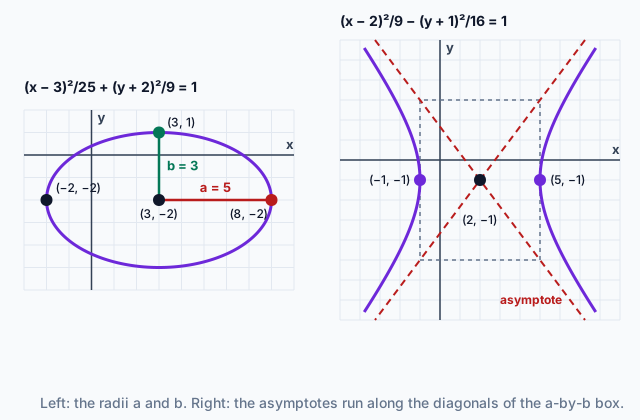
Take , the left picture in the diagram. The center is . The denominators are and , so and . The ellipse runs from to across and from to up and down, wider than it is tall because . Test the rightmost point, : , so it is on the curve.
The denominators are the squares of the radii. A 25 there means a radius of 5.
When the radii match and the ellipse is a circle. is the circle of radius 4 centered at . Multiply both sides by 16 and it becomes , the form you may know from geometry.
Quick check · Calculate
The ellipse has a rightmost point. What is its -coordinate?
2c. Hyperbolas: which way they open
Change the plus sign to a minus and the curve splits into two pieces, called branches. That is a hyperbola. Centered at :
- opens left and right.
- opens up and down.
The term that comes in positive decides the direction. The sizes of the denominators do not. Notice too that stays with and stays with in both forms.
Here is why the positive term decides. Take , centered at . On the horizontal line the -term is 0, so , and or . The curve crosses that line twice.
On the vertical line the -term is 0, and the equation says . The left side is never positive, so it never equals 1, and the curve never touches . One branch lies left of that line and the other right of it, as in the right picture of the diagram.
Quick check · Sort it
Tap an equation, then the curve it describes.
Ellipse or circle
Hyperbola opening left and right
Hyperbola opening up and down
2d. The asymptotes of a hyperbola
Far from the center, each branch of a hyperbola runs alongside two straight lines without ever reaching them. Those lines are its asymptotes, and both pass through the center:
The slope is over : the square root of the denominator under the -term over the square root of the denominator under the -term.
For , and , so the asymptotes are . The diagram draws them dashed. They run along the diagonals of a box that reaches 3 left and right of the center and 4 up and down.
The formula does not care which way the hyperbola opens, because is always under the -term and under the -term. So , which opens up and down, has exactly the same two asymptotes.
Quick check · Spot the error
A student finds an asymptote of the hyperbola . Tap the first line that goes wrong.
Part 3 Watch it done From a description to an equation
Watch each step, then do the last one yourself.
A hyperbola has center and opens up and down. It crosses its vertical line of symmetry, , at and . Its asymptotes are . Write its equation.
Step 1 · Choose the form
It opens up and down, so the -term is the positive one. With and the equation is , and the job is to find and .
Step 2 · Find b from the crossings
On the line the -term is 0, so and . The points and are each 3 from the center, so and .
Why this step?
Why does this curve cross the vertical line but never the horizontal line ?
On the -term is 0, and the equation would say . The left side is never positive, so no point of the curve has . That is why the branches open up and down, away from that line.
Step 3 · Use the slope of the asymptotes
The given asymptotes tell you the slope, . For a hyperbola in this form, the asymptotes have slopes .
Your step · Calculate
Finish it. A hyperbola centered at opens up and down, has , and has asymptotes . What number goes under in its equation?
Part 4 Try it Will the barge fit under the arch?
A stone arch over a canal is shaped like a parabola. An engineer puts it on a grid in meters, with the water surface along the -axis. The top of the arch is at , and its feet touch the water at and . Work on paper. You need the arch's equation first, then you can ask what fits under it.
Try it · Calculate
A canal arch is a parabola with its top at and its feet at and , in meters. Write it as . What is ? Give a decimal.
Try it · Decide and justify
A canal arch is a parabola with its top at and its feet at and , in meters, with the water along . A barge carries a load 12 meters wide that stands 4 meters above the water, centered under the top of the arch at . Does the load clear the arch?
Which reason supports your answer?
Part 5 Explain it Put it in writing
Nothing you type leaves this page.
Unit 4 is not on the AP Exam, so this is written practice for the course.
Written practice
The ellipse is given by , and the hyperbola by . (i) Identify the center of each curve and the points where each crosses the horizontal line . (ii) Explain why crosses the vertical line but never does. (iii) Write equations for the asymptotes of . (iv) A circle has the same center as and the same horizontal radius. Describe how its equation differs from the equation of .
Model answer
(i) Both are centered at . On each equation becomes , so or , and both curves cross at and . (ii) On , gives , so it crosses at and . gives , and the left side is never positive, so no point of has . (iii) For , and , so the asymptotes are . (iv) The circle has , so the 4 under becomes 16: .
Score your own answer. This is a self-check, not a grade. Tick each point your answer makes.
Part 6 Check yourself A badge on a grid
The three case questions use the same table of curves. Answer them from its equations.
A student designs a badge on a coordinate grid, in centimeters. Two of its outlines are conic sections, given in the table.
| Outline | Equation |
|---|---|
| Curve R | |
| Curve S |
Case question 1 · Multiple choice
Which statement describes curve R?
Case question 2 · Calculate
Curve S crosses the horizontal line at two points. How far apart are they, in centimeters?
Case question 3 · Select all
Which two lines are asymptotes of curve S? Pick two.
Select 2 answers, then check.
The rest stand on their own and do not use the case.
Check yourself · Fill the statement
A parabola has vertex , opens to the left, and passes through . Tap a blank, then tap an answer.
Written as , the parabola has = , = and = .
Check yourself · Put it in order
Put the four ellipses in order of horizontal radius, smallest first.
Part 7 Keep it Bring back earlier ideas
Pulling an older idea back up is what makes it last.
From 3.14 Polar Function Graphs · Decide and justify
The graph of for is a circle. If continues from to , does the graph gain any point that is not already on that circle?
Which reason supports your answer?
From 1.12 Transformations of Functions · Multiple choice
Let , whose range is . What is the range of ?
In three lines
- Parabola with vertex : opens up or down, opens left or right, and the sign of picks the way.
- Ellipse: , with horizontal radius and vertical radius ; a circle has .
- Hyperbola: the positive term sets the direction, and the asymptotes are either way.
Vocabulary
- Conic section
- A curve made by slicing a cone with a plane; in this course a parabola, an ellipse or a hyperbola whose line or lines of symmetry are vertical or horizontal.
- Parabola
- A curve written if it opens up or down, or if it opens left or right, with .
- Vertex
- The point where a parabola turns, which sits on its line of symmetry.
- Ellipse
- A curve written , centered at with horizontal radius and vertical radius .
- Horizontal radius
- For an ellipse centered at , the distance from the center to its leftmost or rightmost point.
- Vertical radius
- For an ellipse centered at , the distance from the center to its top or bottom point.
- Circle
- The special case of an ellipse where the horizontal radius and vertical radius are equal, .
- Hyperbola
- A two-branch curve written if it opens left and right, or if it opens up and down.
- Asymptotes
- The two lines through a hyperbola's center that its branches approach.
Course alignment, for teachers
AP Precalculus topic 4.6, Unit 4: Functions Involving Parameters, Vectors, and Matrices.
- Skill 1.B: Express functions, equations, or expressions in analytically equivalent forms that are useful in a given mathematical or applied context.
- Skill 2.A: Identify information from graphical, numerical, analytical, and verbal representations to answer a question or construct a model, with and without technology.
- Skill 2.B: Construct equivalent graphical, numerical, analytical, and verbal representations of functions that are useful in a given mathematical or applied context, with and without technology.
This lesson maps all 3 essential knowledge statements of the topic to the part that teaches each one: 3 are checked by a scored question. The map is in the lesson file.