Unit 4 · Topic 4.7 · about 30 minutes · 7 parts · 14 scored checks, 1 of them multiple choice
AP Precalculus 4.7: Parametrization of Implicitly Defined Functions
Not assessed on the AP Exam. Unit 4 is part of the course, but nothing in it is on the exam.
 Tap to open the picture full size
Part 1 Think first Keep the ship on the track
Guess before you learn. A wrong guess still makes the answer stick.
Predict first
A game draws an oval racetrack, the graph of . A clock ticks, and the programmer places the ship at and at each tick. Will the ship stay on the track?
In short. A parametrization of a curve given by an equation in and makes that equation true for every in its domain when and are substituted for and .
- A function is , and the inverse of an invertible is for in the domain of . A parabola solved for or for is parametrized the same way.
- The ellipse is , for .
- A hyperbola opening left and right is , , and one opening up and down is , , for with the values where left out.
Part 2 Learn it One parameter for two variables
2a. What a parametrization has to do
In 4.5 Implicitly Defined Functions you met equations such as that are not solved for either variable. A parametrization of the curve writes both coordinates in terms of one new variable, the parameter , as .
The test is substitution. Put in for and in for . The equation has to come out true for every value of in the domain, not for one or two of them.
Try on . The right side becomes , and the left side is . The two sides are the same expression in , so every point this produces is on the curve.
Now try . At it gives , and is true. At it gives , and is false. One value of that works proves nothing. Substituting turns the equation into , which holds only at and .
Quick check · Sort it
Each card is a pair , with wherever is in a denominator. Tap a card, then tap whether it satisfies for every in its domain.
Satisfies for every
Does not
2b. Functions, inverses and parabolas
Some curves hand you a parametrization. If , let be the parameter: . Substituting gives , true for every .
The inverse of an invertible function swaps the roles: , with running over the domain of . That interval matters. Take for . Its inverse is for , the top half of a parabola lying on its side. Let take every real value and you get the bottom half too, which is not the graph of the inverse.
The same idea works for any equation you can solve for one variable. A parabola that opens up or down can be solved for , and then becomes . One that opens left or right can be solved for , and then becomes .
The parabola from 4.6 Conic Sections opens left. Solve for : . Replace with :
At that gives the vertex, .
Quick check · Match
Tap a parabola, then a parametrization of it.
2c. Ellipses with cosine and sine
An ellipse cannot be solved for as one function, so it needs a different tool: the identity . The ellipse
is parametrized by and for .
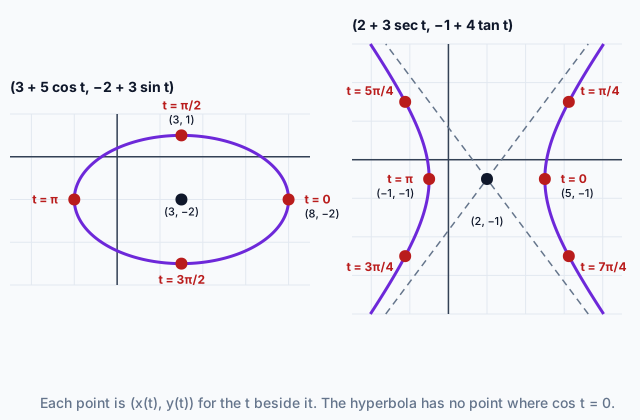
Watch it work on , the left picture in the diagram. Here , , and , so and . Substitute. becomes and becomes , so the left side is
for every . At the point is , the rightmost point, and at it is , the top.
The numbers in front of cosine and sine are the radii, 5 and 3, not the denominators 25 and 9. When the ellipse is a circle, and the same formulas give it.
Quick check · Fill the statement
Parametrize the ellipse , with and positive numbers in front of cosine and sine. Tap a blank, then tap an answer.
= + and = +
2d. Hyperbolas with secant and tangent
A hyperbola uses another form of the Pythagorean identity, , which says .
- Opening left and right, is , .
- Opening up and down, is , .
In both, . Secant goes with the variable whose term is positive, because is the positive term in . Put the tangent there and the left side comes out as , which is .
For the right picture in the diagram, , that gives and . At the point is . At , where , it is , on the other branch.
Secant and tangent do not exist where , so there is no point at or . As approaches either one, the point runs out along an asymptote.
Quick check · Spot the error
A student parametrizes the hyperbola . Tap the first line that goes wrong.
Part 3 Watch it done Parametrize a hyperbola and use it
Watch each step, then do the last one yourself.
Parametrize the hyperbola , check the parametrization, and find the -coordinate of its point at .
Step 1 · Read the curve
The -term is the positive one, so the branches open left and right. The center is . Under the -term is , so , and under the -term is , so .
Step 2 · Write the parametrization
Opening left and right, the secant goes with : and , for . There is no point where .
Step 3 · Check it by substitution
becomes and becomes , so the left side is . Since , that is 1 for every where it is defined.
Why this step?
Why does get the secant here, and not the tangent?
In the secant term is the positive one, and in this equation the -term is the positive one. If got the tangent, the left side would be , and the equation would be false for every .
Step 4 · Evaluate at the given t
The -coordinate is . Secant is one over cosine, so find first.
Your step · Calculate
Finish it. The hyperbola is parametrized by and . What is the -coordinate of its point at ?
Part 4 Try it Fly the drone round the stadium
A drone films a stadium by flying an oval loop at a fixed height. On a map in meters, its position is for . A second drone is programmed with .
Try it · Calculate
A drone flies the path for , in meters. Its path is the ellipse . What is ?
Try it · Decide and justify
One drone flies and another flies , both for , in meters. Do the two drones fly the same oval?
Which reason supports your answer?
Part 5 Explain it Put it in writing
Nothing you type leaves this page. Check your answer against the model and each point on the list.
Unit 4 is not on the AP Exam, so this is written practice for the course.
Written practice
The hyperbola is , and the parabola is . (i) Identify which way opens, and write a parametrization of using secant and tangent. (ii) Justify that your parametrization satisfies the equation of for every where it is defined. (iii) Explain why it gives no point at . (iv) Write a parametrization of , and describe how you decided which variable to replace with .
Model answer
(i) The -term is positive, so opens up and down. Its center is , with and , so and for . (ii) Then and , so the left side is . Since , that equals 1 for every where secant and tangent are defined. (iii) , and secant and tangent both have in the denominator, so neither nor exists. (iv) solves for as one expression in : . So I replace with : for every real .
Score your own answer. This is a self-check, not a grade. Tick each point your answer makes.
Part 6 Check yourself Paths in a game level
The three case questions use the same table of paths. Answer them from its parametrizations.
A level designer moves three objects along paths on a grid measured in tiles. Each path is a parametric function, given in the table.
| Path | Interval of | ||
|---|---|---|---|
Case question 1 · Multiple choice
Path A is for . Which equation does Path A satisfy for every ?
Case question 2 · Calculate
Path B is the hyperbola , for with . What is the -coordinate of its point at ?
Case question 3 · Select all
Path C is for every real . Which two equations does Path C satisfy for every ? Pick two.
Select 2 answers, then check.
The rest stand on their own and do not use the case.
Check yourself · Decide and justify
The function with domain is invertible. A student parametrizes the graph of its inverse as , letting take every real value. Is that a parametrization of the graph of the inverse?
Which reason supports your answer?
Check yourself · Fill the statement
Parametrize the hyperbola , with and positive numbers in front of the trigonometric functions. Tap a blank, then tap an answer.
= + and = +
Part 7 Keep it Bring back earlier ideas
Pulling an older idea back up is what makes it last.
From 4.6 Conic Sections · Calculate
The ellipse has a rightmost point. What is its -coordinate?
From 4.5 Implicitly Defined Functions · Sort it
Each card is an ordered pair . Tap a card, then tap whether it is a solution of .
On the graph
Not on the graph
In three lines
- A parametrization makes the curve's equation true for every in its domain; check it by substituting.
- A function is and an inverse is for in the domain of ; solve a parabola for or for first.
- Ellipse: . Hyperbola: the secant goes with the positive term, the tangent with the other, and skips the values where .
Vocabulary
- Parametrization
- A pair of functions of one parameter that, substituted for and , satisfies a curve's equation for every in the domain.
- Implicitly defined function
- A function described by an equation in and that is not solved for either variable, such as part of the graph of .
- Inverse
- For an invertible function , the function that undoes it; its graph can be parametrized as for in the domain of .
- Parabola
- The graph of or with . Solved for it is ; solved for it is .
- Ellipse
- The curve , parametrized by and for .
- Hyperbola
- A two-branch curve parametrized with secant and tangent: , when it opens left and right, and , when it opens up and down.
Course alignment, for teachers
AP Precalculus topic 4.7, Unit 4: Functions Involving Parameters, Vectors, and Matrices.
- Skill 1.B: Express functions, equations, or expressions in analytically equivalent forms that are useful in a given mathematical or applied context.
- Skill 2.A: Identify information from graphical, numerical, analytical, and verbal representations to answer a question or construct a model, with and without technology.
This lesson maps all 5 essential knowledge statements of the topic to the part that teaches each one: 5 are checked by a scored question. The map is in the lesson file.