Unit 4 · Topic 4.8 · about 30 minutes · 7 parts · 14 scored checks, 3 of them multiple choice
AP Precalculus 4.8: Vectors
Not assessed on the AP Exam. Unit 4 is part of the course, but nothing in it is on the exam.
 Tap to open the picture full size
Part 1 Think first Swim across the current
Guess before you learn. A wrong guess still makes the answer stick.
Predict first
A swimmer heads straight across a river, swimming at 3 kilometers per hour through the water. The current carries her downstream at 4 kilometers per hour. How fast is she moving relative to the riverbank?
In short. A vector is a directed line segment, written by its components as , with a magnitude, its length, and a direction.
- From to the vector is , its magnitude is , and a vector of magnitude at angle is .
- Sums and scalar multiples work component by component; is the unit vector in the direction of , and .
- The dot product equals , so a dot product of 0 between nonzero vectors means they are perpendicular.
Part 2 Learn it Length, direction, and what you can do with them
2a. A vector from two points
A vector is a directed line segment. The point where it starts is its tail, the point where it ends is its head, and its length is its magnitude, written .
Place a vector in the -plane from to . Its components are and , and you write the vector as . Head minus tail, in that order. From to is : 3 right and 4 down. If , you get the zero vector .
The vector points the same way as the segment from the origin to the point . Its magnitude comes from the Pythagorean theorem, , so .
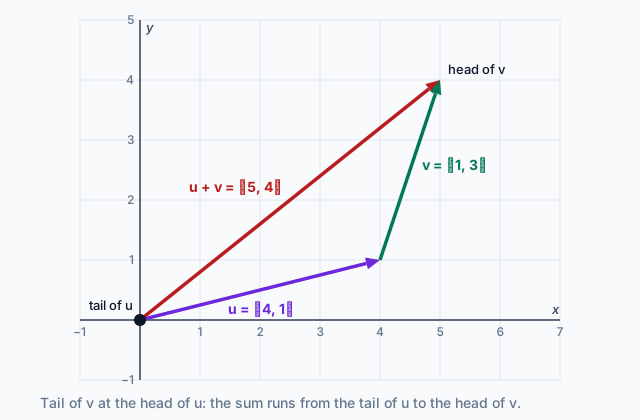
Two moves in a row add. The sum of and adds matching components: . To draw it, put the second vector's tail at the first one's head. The sum runs from the first tail to the second head, as in the diagram.
Quick check · Fill the statement
A vector has its tail at and its head at . Tap a blank, then tap an answer.
The vector from to is ⟨ , ⟩, and its magnitude is .
2b. Components from a length and an angle
Often you know how long a vector is and which way it points, but not where its head lands. Say makes the angle with the positive -axis, measured counterclockwise. Its head is on the circle of radius , so the trigonometry of 3.13 Trigonometry and Polar Coordinates gives the components:
A rope pulls with magnitude 20 at . The components are and , so the rope's vector is . The signs take care of themselves.
Going back from components to the angle is where students slip. You know , but arctangent only returns angles between and . For , , yet the vector points down and to the left. Its angle is . Sketch the vector and check the quadrant before you trust the arctangent.
Quick check · Multiple choice
A vector has magnitude 10 and makes an angle of radians with the positive -axis, measured counterclockwise. What is the vector in component form?
2c. Scaling, unit vectors, and i and j
Multiply a vector by a constant and you multiply each component: . The new vector is parallel to the original. points the same way and is three times as long. is parallel too, but the negative constant turns it to face the opposite way. Parallel means along the same line, so a vector pointing the opposite way still counts as parallel.
A unit vector has magnitude 1. For the unit vector in the direction of a nonzero , multiply by the reciprocal of its magnitude, . For , , so the unit vector is . Its signs match those of , because it points the same way.
Two unit vectors have names of their own: in the direction and in the direction. Scaling and adding them builds any vector, . So is also .
Quick check · Sort it
Tap a card, then tap whether the vector is parallel to . A vector along the same line counts as parallel whether it points the same way or the opposite way.
Parallel to , either way along its line
Not parallel to it
2d. The dot product and the angle between
The dot product of two vectors multiplies matching components and adds the results: . The answer is a number, not a vector. For example, .
That number also equals , where is the angle between and drawn tail to tail. So . When the dot product of two nonzero vectors is 0, and the vectors are perpendicular: .
Adding vectors head to tail makes a triangle, and two laws from trigonometry find its missing parts. In a triangle with sides , and opposite the angles , and , the Law of Cosines says , and the Law of Sines says .
Watch the angle. Where the second vector leaves the head of the first, the triangle's angle is not the angle between the vectors drawn tail to tail. The two add up to .
Quick check · Calculate
What is the angle between and , in radians? Use a calculator for the inverse cosine, and give your answer to two decimal places.
Part 3 Watch it done Find a plane's speed in a crosswind
Watch each step, then do the last one yourself.
A small plane flies with an airspeed of 200 kilometers per hour, its speed through the air. The wind blows at 50 kilometers per hour. Drawn tail to tail, the plane's heading and the wind's direction make an angle of . Find the plane's ground speed, its actual speed over the ground, to the nearest kilometer per hour.
Step 1 · Set up the sum
Let be the plane's motion through the air, with , and the wind, with . The motion over the ground is , and the ground speed is its magnitude. Draw , then put the tail of at the head of . The triangle has sides 200, 50 and .
Step 2 · Find the angle inside the triangle
Tail to tail, and make . In the triangle, the angle at the head of is , and it sits opposite the side .
Why this step?
Why is the triangle's angle and not ?
At the head of , the line of carries straight on, and makes with that continuation. The triangle's angle is measured from back along , on the other side of a straight line, so the two angles add up to .
Step 3 · Use the Law of Cosines
. Since , the last term ends up added rather than subtracted. That makes sense: the wind pushes partly along the plane's heading.
Your step · Calculate
Finish it. A plane's motion through the air has magnitude 200 kilometers per hour and the wind's has magnitude 50. Added head to tail, they form a triangle whose angle between those two sides is . What is the magnitude of the sum, the plane's ground speed, to the nearest kilometer per hour? Use a calculator for the square root.
The Law of Sines gives the direction. With the angle between and , , so radian. The wind speeds the plane up and turns its path about 0.19 radian toward the wind.
Part 4 Try it Point the robot at the door
A delivery robot crosses a plaza mapped in meters. It is at and has to drive in a straight line to a door at , covering 3 meters every second. Its software needs the move it makes each second: a vector that points at the door and has magnitude 3. Work it out on paper, then answer the two questions.
Try it · Put it in order
A robot at drives straight toward a door at , in meters, covering 3 meters each second. You want its move each second as a vector. Tap these results in the order you compute them.
Try it · Calculate
A robot starts at on a map in meters and drives in a straight line to a door at , covering 3 meters each second. How many seconds does the robot take to reach the door? Give your answer to two decimal places.
Part 5 Explain it Put it in writing
Nothing you type leaves this page. Check your answer against the model and each point on the list.
Unit 4 is not on the AP Exam, so this is written practice for the course.
Written practice
Let and . (i) Determine and the unit vector in the direction of . (ii) Determine the value of that makes and perpendicular, and justify your answer. (iii) Describe how compares with in direction and in magnitude.
Model answer
(i) , so . The unit vector in its direction is . (ii) , which is 0 when . The dot product equals , and neither vector is the zero vector, so a dot product of 0 means and : the vectors are perpendicular. (iii) . It is parallel to but points the opposite way, because the constant is negative, and its magnitude is , twice that of .
Score your own answer. This is a self-check, not a grade. Tick each point your answer makes.
Part 6 Check yourself A survey drone's flight log
The three case questions use the same flight log. Answer them from it.
A survey drone flies straight legs over a field. Its log records each leg as a vector on a map in meters, with measured east and measured north.
On a windy morning the log also records two velocities: , the drone's motion through the air, with magnitude 33 kilometers per hour, and , the wind, with magnitude 7 kilometers per hour. Drawn tail to tail, and make an angle of , and the drone's speed over the ground, , is 37 kilometers per hour.
| Leg | Vector |
|---|---|
Case question 1 · Multiple choice
A drone flies the leg , in meters, with east and north. What angle does make with east, measured counterclockwise, with ?
Case question 2 · Calculate
A drone flies the leg and then the leg , in meters. How far is it, in meters, from the point where the leg began? That is, what is ?
Case question 3 · Calculate
A drone's motion through the air, , has magnitude 33 kilometers per hour, and the wind, , has magnitude 7 kilometers per hour. Drawn tail to tail, and make an angle of , and the drone's speed over the ground, , is 37 kilometers per hour. Use the Law of Sines to find the angle between the wind, , and the drone's path over the ground, , in radians. Use a calculator for the inverse sine, and give your answer to two decimal places.
The rest stand on their own and do not use the case.
Check yourself · Decide and justify
The vectors and are drawn tail to tail. Is the angle between them acute, a right angle, or obtuse?
Which reason supports your answer?
Check yourself · Spot the error
A student finds the unit vector in the direction of . Tap the first line that goes wrong.
Part 7 Keep it Bring back earlier ideas
Pulling an older idea back up is what makes it last.
From 4.7 Parametrization of Implicitly Defined Functions · Spot the error
A student parametrizes the hyperbola . Tap the first line that goes wrong.
From 3.2 Sine, Cosine, and Tangent · Multiple choice
The terminal ray of an angle in standard position meets the circle of radius 25 centered at the origin at . Which is true?
In three lines
- A vector from to is , with magnitude ; at magnitude and angle it is .
- Add and scale component by component; is the unit vector in the direction of , and .
- ; a dot product of 0 means perpendicular, and a head-to-tail sum is a triangle for the Laws of Cosines and Sines.
Vocabulary
- Vector
- A directed line segment, with a magnitude and a direction; in the plane it is written by its components as .
- Tail
- The point where a vector begins when it is placed in the plane.
- Head
- The point where a vector ends when it is placed in the plane.
- Components
- The two numbers that identify a vector in the plane: from to they are and , and the vector is .
- Magnitude
- The length of a vector's line segment; for it is .
- Zero vector
- The vector , which you get when the tail and the head are the same point.
- Unit vector
- A vector of magnitude 1, such as , , or for a nonzero .
- Dot product
- The number , which equals the product of the two magnitudes and the cosine of the angle between the vectors.
- Law of Sines
- In any triangle with sides , and across from the angles , and , each angle's sine divided by the side across from it gives the same number: .
- Law of Cosines
- In any triangle with sides , and , where is the angle across from , .
Course alignment, for teachers
AP Precalculus topic 4.8, Unit 4: Functions Involving Parameters, Vectors, and Matrices.
- Skill 2.A: Identify information from graphical, numerical, analytical, and verbal representations to answer a question or construct a model, with and without technology.
- Skill 3.A: Describe the characteristics of a function with varying levels of precision, depending on the function representation and available mathematical tools.
- Skill 3.B: Apply numerical results in a given mathematical or applied context.
This lesson maps all 11 essential knowledge statements of the topic to the part that teaches each one: 11 are checked by a scored question. The map is in the lesson file.