Unit 4 · Topic 4.2 · about 30 minutes · 7 parts · 14 scored checks, 4 of them multiple choice
AP Psychology 4.2: Attitude Formation and Attitude Change
Unit 4: 15 to 25% of the multiple-choice section
 Tap to open the picture full size
Part 1 Think first Two helpers, one dull morning
Guess before you learn. A wrong guess still makes the answer stick.
Predict first
A school club needs 500 envelopes stuffed for a fundraiser, and two members spend a Saturday morning doing it. The job is every bit as dull as it sounds. Kai was promised 50 dollars for the morning. Noor helps for nothing. A week later a friend asks each of them how much they enjoyed the morning. Who says they enjoyed it more?
In short. Attitude formation and change is about how people come to hold beliefs and feelings about others and groups, why those attitudes resist evidence, and what pushes them to shift.
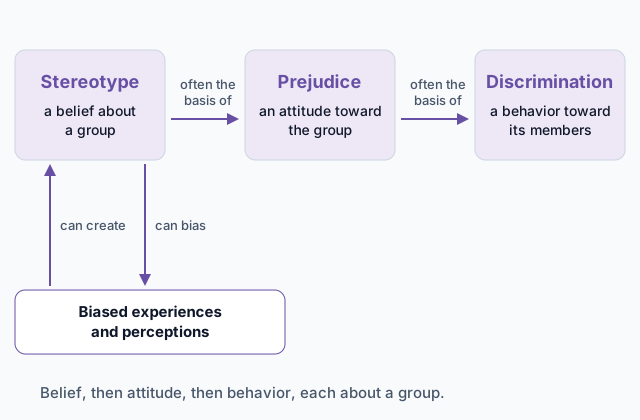
- A stereotype is a belief about a group; it can be the basis of prejudice, which is an attitude, and of discrimination, which is a behavior.
- Some attitudes are implicit: a person holds them without being aware of them or without admitting them, and they still color judgments of other groups.
- A belief can survive the evidence against it, and a conflict between what people do and what they believe pushes one of the two to change.
Part 2 Learn it How attitudes form, stick and shift
2a. Stereotypes, prejudice and discrimination
A stereotype is a generalized concept about a group: drummers are loud, the debate team is argumentative, people from the next town over are snobs. Stereotypes stick around partly because they save effort. Sizing up every stranger from scratch takes real thinking, and a ready-made idea about the group lets you guess fast. Stereotypes reduce cognitive load. The cost is that the guess is about the group, not about the person in front of you.
A stereotype can be the cause of biased perceptions and experiences, the result of them, or both. Meet two rude fans from a rival school and you may build a stereotype from that thin slice of experience. Once you hold it, you notice the rival fans who fit it and overlook the ones who do not.
A stereotype is a belief. It is frequently the basis of two other things, and it pays to keep all three apart:
- Prejudice is an attitude: an unjustified, usually negative, feeling or judgment about a group and its members.
- Discrimination is a behavior: treating people unfairly because of the group they belong to.
A stereotype can even sound positive and still lead to unfair treatment of the person who does not fit it.
Quick check · Sort it
Tap an example, then tap what it shows.
Stereotype (a belief)
Prejudice (an attitude)
Discrimination (a behavior)
2b. Attitudes you may not know you hold
Some attitudes are out in the open: you know you hold them, and you would say so if asked. Implicit attitudes are ones a person holds but may be unaware of, or may not acknowledge. Asking about them directly misses the point, so researchers look for them in reactions people do not deliberate over, such as how quickly someone links a group's name with pleasant or unpleasant words. A person can sincerely report no preference and still show one this way.
Research on implicit attitudes has focused on how they show up as negative evaluations of others, as in these four patterns:
- The just-world phenomenon is the belief that people get what they deserve. It leads people to blame victims: if something bad happened to her, she must have brought it on herself.
- Out-group homogeneity bias is seeing the members of other groups as all alike ("they're all the same") while seeing your own group as a mix of different individuals.
- In-group bias is favoring the groups you belong to over other groups.
- Ethnocentrism is judging other cultures by the standards of your own, so your culture's way of doing things looks like the right way.
None of these needs open hostility. Each can run quietly underneath a person's honest picture of themselves as fair.
Quick check · Match
Tap a term, then tap the example that shows it.
2c. When a belief outlasts the evidence
Belief perseverance is a belief persisting even when evidence suggests it is not accurate. Suppose a coach tells your team that the new transfer student failed the fitness test, and the next day admits he mixed up two names: she actually passed easily. Plenty of people still walk away thinking of her as out of shape. The evidence is gone, but the belief it built is still standing.
One thing that keeps beliefs alive is confirmation bias: looking for, noticing and remembering information that fits what you already believe, and brushing off information that does not. Someone sure that a new diner is overpriced remembers the one 20-dollar sandwich and forgets the cheap breakfast specials. Each confirming example feels like more proof, and the disconfirming ones never get weighed.
The two go together, so tell them apart by what each one describes:
- Belief perseverance is about the belief. It survives evidence against it.
- Confirmation bias is about how the person handles evidence. They favor what fits.
A person experiencing belief perseverance may engage in confirmation bias to hold on, which is why the two so often show up side by side. Beliefs about groups work the same way: a stereotype that survives a stack of counterexamples is belief perseverance at work.
Quick check · Fill the statement
Tap a blank, then tap a term.
Lena is sure her new neighbor is unfriendly. She remembers the two mornings he did not wave and forgets the many mornings he did, which is . Then her brother points out that the neighbor has shoveled her front walk after every snowstorm this winter, and she still calls him unfriendly. Her belief surviving that evidence is .
2d. When actions and attitudes clash
Cognitive dissonance is the mental discomfort you feel when your actions and your attitudes are in conflict. Say you believe wasting food is wrong, and you just threw away half your lunch. Holding both of those at once is uncomfortable, and people are motivated to make the discomfort go away.
There are two ways to do it, and both bring the action and the attitude back in line:
- Change the action. Next time, take less food or save the rest.
- Change the attitude. Decide that a little wasted food does not really matter.
An action that is already done cannot be taken back, so changing the attitude is often the easier route. That is how dissonance changes attitudes: people come to believe in what they have already done.
How far an attitude moves depends on how much outside reason there was for the action. In a classic study by Leon Festinger and James Carlsmith, people spent an hour on dull tasks and were then paid either a small amount or a large amount to tell someone waiting to take part that the tasks were enjoyable. Afterward, the people paid the small amount rated the tasks as more enjoyable. A large payment explained the lie by itself. A small one did not, so the attitude had to give.
Quick check · Multiple choice
Ben has always said that staying up late before a test is a bad idea. The night before his chemistry test, he plays video games until 2 a.m. The next day he tells his friends that losing a little sleep never hurt anyone's score. What best describes Ben's change?
Part 3 Watch it done Where a stereotype comes from, and what it does next
Watch each step, then do the last one yourself.
Coach Dale once coached two players from Riverside Middle School who often skipped practice. Now he believes Riverside kids are unreliable. What part did experience play in his stereotype, and what is the stereotype doing to him now?
Step 1 · Find the belief about the group
Dale believes Riverside kids are unreliable. That is a generalized concept about a whole group of people, so it is a stereotype.
Step 2 · Ask where the belief came from
It came from two players. Two people out of a whole school is a thin, lopsided slice of experience, so the stereotype is a result of biased experience.
Why this step?
Why does it matter that the belief came from only two players?
Because a belief built on two cases tells you about what Dale happened to see, not about the group. That is what it means for a stereotype to be the result of a biased experience rather than a fair sample of the group.
Your step · Decide and justify
Finish it. Coach Dale believes Riverside kids are unreliable after coaching two Riverside players who skipped practice. This season, when a Riverside player is late once, Dale brings it up for weeks, but he forgets the times his other players are late. What is the stereotype doing now?
Which reason supports your answer?
Part 4 Try it Read a study: finding an attitude nobody admits to
Illustrative study (made up for practice, not a published study). A summer camp splits its campers into a Red team and a Blue team, and campers pick their own team. A researcher recruits 40 counselors who went to the camp as kids: 20 were Red campers and 20 were Blue campers. Asked directly, every counselor says they like both teams equally. Then each counselor does a timed task on a laptop. Team names and words such as sunshine or rotten flash on the screen, and the counselor presses one key for some kinds of word and another key for the rest. The researcher records how many milliseconds each counselor takes to respond when Red names share a key with pleasant words, and when Blue names do. A faster response means the two are more closely linked in the counselor's mind.
| Group | Counselors | Red names with pleasant words | Blue names with pleasant words |
|---|---|---|---|
| Former Red campers | 20 | 612 | 748 |
| Former Blue campers | 20 | 731 | 605 |
Try it · Multiple choice
In an illustrative study, 40 camp counselors who say they like the camp's Red and Blue teams equally do a timed task pairing team names with pleasant and unpleasant words. What is the operational definition of a counselor's implicit attitude toward a team?
Try it · Decide and justify
In an illustrative study, 40 camp counselors who had picked their own team as campers did a timed task. Former Red campers responded faster when Red names were paired with pleasant words, and former Blue campers responded faster when Blue names were. The difference was statistically significant. Can the researcher conclude that being on a team as a child caused each counselor's faster responses for that team?
Which reason supports your answer?
Part 5 Explain it Write it the way the exam asks
Nothing you type leaves this page.
Free response is 33.3% of the exam score. This one is shaped like Question 2, Evidence-Based Question.
Free-response practice · Question 2 style
This is an Evidence-Based Question. Read the three sources, then answer the question they share: when people hold a belief about a group, does new evidence change the belief, or does the belief change how they handle the evidence? In parts B and C, cite the source you use, for example (Source 1).
Source 1. Illustrative study (made up for practice, not a published study). Researchers used a random draw to put 90 college students into three groups of 30. Two groups read a short news report claiming that students at Ardenvale College, a made-up school, cheat on exams more than students elsewhere. Right afterward, one of those two groups was told the report had been invented for the study and was false. The third group read nothing. Everyone then rated how honest Ardenvale students are, from 1 (very dishonest) to 7 (very honest). Mean ratings were 3.2 for the group whose report was not corrected, 3.9 for the group told the report was false, and 5.1 for the group that read nothing. The corrected group's mean was significantly lower than the no-report group's.
Source 2. Illustrative study (made up for practice, not a published study). Sixty high school students read a one-page log of a week at the Kestrel Rowing Club, a made-up club. The log listed 8 hardworking acts and 8 lazy acts by club members. A coin flip decided whether each student was first told that the club's members were known to be lazy or was told nothing about them. An hour later, students wrote down every act they could remember. Students told the members were lazy recalled a mean of 5.6 lazy acts and 2.3 hardworking acts. Students told nothing recalled a mean of 3.8 lazy acts and 3.9 hardworking acts. The differences were statistically significant.
Source 3. Illustrative study (made up for practice, not a published study). Eighty adults rated files of applicants for a summer lifeguard job from 1 (poor) to 10 (excellent). Each file showed the applicant's swim test time and high school. At the start, raters were told that one made-up school, Brindle Creek High, was known for students who goof off. A coin flip decided whether a rater also had to keep an eight-digit number in mind while rating. For Brindle Creek applicants with fast swim times, raters holding the number gave a mean of 4.1 and raters without it gave a mean of 7.2, a statistically significant difference. Applicants from other schools with the same swim times got nearly the same mean in both groups (7.4 and 7.5).
(A) Propose a specific and defensible claim, based in psychological science, that answers the question.
(B) (i) Support your claim using one piece of specific and relevant evidence from one of the sources. (ii) Explain how the evidence from part B (i) supports your claim, using a psychological perspective, theory, concept, or research finding.
(C) (i) Support your claim using a piece of specific and relevant evidence from a different source. (ii) Explain how the evidence from part C (i) supports your claim, using a different psychological perspective, theory, concept, or research finding from the one in part B (ii).
Model answer
(A) A belief about a group changes how people handle new evidence about that group more than the evidence changes the belief.
(B) (i) In Source 1, students who read the false report about Ardenvale College and were then told it was invented still rated Ardenvale students a mean of 3.9 for honesty, compared with 5.1 for students who never read the report. (ii) This is belief perseverance. Once the report was declared false, the evidence for the belief was gone, yet the corrected group still rated Ardenvale students as less honest than students who never heard the claim. Taking away the evidence did not take away the belief, so the evidence had little power over the belief, just as the claim says.
(C) (i) In Source 2, students told the rowing club's members were lazy recalled a mean of 5.6 lazy acts and 2.3 hardworking acts from a log that listed 8 of each, while students told nothing recalled 3.8 lazy and 3.9 hardworking acts. (ii) This is confirmation bias, a different concept from part B. Everyone read the same log, but the students who held the belief remembered the acts that fit it and lost most of the acts that went against it. The belief decided which evidence they kept, which is the direction my claim says the relationship runs.
Score your own answer. This is a self-check, not a grade. Tick each point your answer makes.
Part 6 Check yourself Read the study, then explain the change
On the exam, some multiple-choice questions share one set of data, the way these do.
Illustrative study (made up for practice, not a published study). A high school principal proposes moving lunch to 10:30 a.m. Researchers recruit 90 students who all oppose the idea and use a random draw to put 30 in each of three groups. Students in two groups record a one-minute video arguing for the early lunch, which they are told the student council will watch. One of these groups gets a 2-dollar snack card for recording it, and the other gets a 40-dollar gift card. The third group records nothing. Every student rates the early lunch from 1 (strongly oppose) to 9 (strongly favor) before the study and again a day later. A day later, the small-reward group's mean was significantly higher than each of the other two groups' means.
| Group | Students | Mean rating before | Mean rating a day later |
|---|---|---|---|
| Video, 2-dollar snack card | 30 | 2.4 | 4.6 |
| Video, 40-dollar gift card | 30 | 2.5 | 2.9 |
| No video | 30 | 2.4 | 2.5 |
Case question 1 · Calculate
In an illustrative early-lunch study, the group that recorded a video for a 2-dollar snack card had a mean rating of 2.4 before the study and 4.6 a day later. By how many points did that group's mean rating rise?
Case question 2 · Multiple choice
In an illustrative early-lunch study, students who opposed the idea were randomly assigned to record a video for it for a small reward or a large reward, or to record nothing. A day later, the small-reward group's mean rating had risen from 2.4 to 4.6 and the large-reward group's from 2.5 to 2.9. Which explanation fits these results best?
Case question 3 · Decide and justify
In an illustrative early-lunch study, one randomly assigned group recorded no video at all, and its mean rating went from 2.4 to 2.5. A classmate says that group was a waste, because its members did nothing. Is the classmate right?
Which reason supports your answer?
The rest stand on their own and do not use the case.
Check yourself · Spot the error
Members of the Westbrook marching band describe their own band as a mix of jokers, perfectionists and quiet types, but they say the Lakeside band is all the same. A student explains the example. Tap the first line that goes wrong.
Check yourself · Fill the statement
Tap a blank, then tap a term.
Mr. Reyes has one afternoon to place 60 new campers in swim groups, so instead of testing everyone he assumes that campers from the lake towns all swim well. That assumption is a . It saves him effort, which is what it means to say it reduces . When he puts every lake-town camper in the advanced group without a swim test, and two weak swimmers from the lake towns end up in the deep end, his action is .
Part 7 Keep it Bring back earlier ideas
Coming back to older ideas is how they stay usable on the exam.
Bring it back · Multiple choice
Ms. Ortiz expects a new student in her algebra class to struggle, so she calls on him less often and gives him less time to answer when she does. By winter he has fallen behind, just as she expected. Which idea best explains what happened?
Bring it back · Fill the statement
Tap a blank, then a word.
Dev learns his Spanish vocabulary in the school library, and he recalls it best when he is tested in that same library. That is memory. Maya, feeling low after her team loses, keeps recalling other days when things went wrong. That is memory.
In three lines
- A stereotype is a belief about a group that saves mental effort; prejudice is an attitude toward the group, and discrimination is behavior toward its members.
- Implicit attitudes can be held without awareness and show up as the just-world phenomenon, out-group homogeneity bias, in-group bias and ethnocentrism.
- Beliefs can outlast the evidence against them, helped by confirmation bias, and when actions and attitudes clash, people ease the discomfort by changing one to fit the other.
Vocabulary
- Stereotype
- A generalized concept about a group, which can reduce cognitive load and is frequently the basis of prejudiced attitudes and discriminatory behaviors.
- Prejudice
- An unjustified, usually negative attitude toward a group and its members.
- Discrimination
- Behavior that treats people unfairly because of the group they belong to.
- Implicit attitude
- An attitude a person holds but may be unaware of or may not acknowledge.
- Just-world phenomenon
- The belief that people get what they deserve, which can lead to blaming victims.
- Out-group homogeneity bias
- Seeing the members of other groups as all alike while seeing your own group as varied.
- In-group bias
- Favoring the groups you belong to over other groups.
- Ethnocentrism
- Judging other cultures by the standards of your own culture.
- Belief perseverance
- A belief persisting even when evidence suggests it is not accurate.
- Confirmation bias
- Seeking out and favoring information that fits what you already believe, which helps a person cling to a belief regardless of the evidence.
- Cognitive dissonance
- The mental discomfort that occurs when actions or attitudes are in conflict, which people are motivated to reduce by changing either one.
Course alignment, for teachers
AP Psychology topic 4.2, Unit 4: Social Psychology and Personality.
- Skill 1.B: Explain how cultural norms, expectations, and circumstances, as well as cognitive biases apply to behavior and mental processes.
- Skill 3.A: Identify psychology-related concepts in descriptions or representations of data.
- Skill 3.B: Calculate and interpret measures of central tendency, variation, and percentile rank in a given data set.
- Skill 4.B: Provide reasoning that is grounded in scientifically derived evidence to support, refute, or modify an established or provided claim, policy, or norm.
This lesson maps all 4 essential knowledge statements of the topic to the part that teaches each one: 4 are checked by a scored question. The map is in the lesson file.