Unit 4 · Topic 4.3 · about 30 minutes · 7 parts · 15 scored checks, 3 of them multiple choice
AP Psychology 4.3: Psychology of Social Situations
Unit 4: 15 to 25% of the multiple-choice section
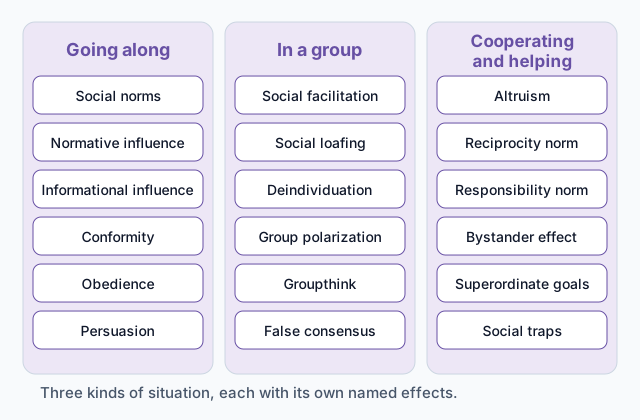 Tap to open the picture full size
Part 1 Think first One obvious answer, one unanimous group
Guess before you learn. A wrong guess still makes the answer stick.
Predict first
You sit at a table with a group of students for a quick vision test. On each round, everyone says aloud which of three lines matches a reference line, and you answer near the end. The right answer is easy to see. But on several rounds, everyone who answers before you gives the same clearly wrong answer. When researchers ran this setup with real participants, what did they find?
In short. The psychology of social situations studies how the people around you, and the groups you belong to, change what you think, feel and do.
- Unwritten expectations, the wish to be accepted, trust in what others seem to know and instructions from authority all push behavior toward what a situation expects.
- A message can persuade through careful thought about its arguments or through cues around it, and the way a request is set up changes the answer.
- Groups can lift or sap effort and push decisions further than any member would go, and whether someone helps depends on norms and on who else is there.
Part 2 Learn it Four ideas about people in situations, each checked as you go
2a. Norms, and two reasons people go along
Every situation comes with a script. Social norms are a group's expectations for how its members should act: face the door in an elevator, keep your voice down in a library. A role is the set of expectations that goes with a position, such as referee or team captain.
Why follow a norm nobody asked you to sign? Social influence theory gives two kinds of pressure. Normative social influence is going along to be accepted, or to avoid standing out. Informational social influence is going along because you think others know something you do not, which is strongest when a situation is unclear.
Conformity is changing your behavior or thinking to match a group. In Asch's line studies (the setup in Think first), conformity was strongest when the group was unanimous. It dropped sharply when just one other person gave the right answer, and it dropped when participants wrote their answers where the group could not see them.
Obedience is following the directives of an authority figure. In Stanley Milgram's studies, an experimenter told participants to give a learner stronger and stronger electric shocks for each mistake. The learner was an actor and got no real shocks. Far more participants obeyed to the end than anyone had predicted. Obedience was highest when the experimenter was in the room and the setting seemed legitimate. It fell when orders came by phone, when the learner was close by, and when other participants refused.
Quick check · Fill the statement
Tap a blank, then tap a word.
At her new job in a cafe, Lena notices that staff never eat in front of customers, though nobody ever wrote that down. That unwritten expectation is a social . She skips her snack at the counter so her coworkers will not think she is odd, which is social influence. When the espresso machine jams, she copies exactly what a senior barista does, because he seems to know how to fix it, which is social influence. As the newest hire, she is also expected to restock cups and wipe tables, the duties that come with her as junior barista. When her manager tells her she must clock out by 9, she does, which is .
2b. Persuasion: two routes and two ways to ask
Persuasion is any technique used to convince yourself or someone else of an idea, an action or a belief. The elaboration likelihood model says a message can work through two routes.
On the central route, you think hard about the arguments and the evidence. People take it when they care about the topic and have the time and attention to weigh it, and the attitudes it builds tend to last. On the peripheral route, you respond to cues around the message instead: how attractive or famous the speaker is, how upbeat the music is, how many arguments there seem to be. People take it when they are rushed, distracted or not very interested, and the change fades sooner.
The halo effect is one of those peripheral cues. One good trait, such as good looks or charm, leads people to assume other good traits, such as honesty or expertise. An actor selling a cold medicine is counting on it.
How a request is presented matters too. With the foot-in-the-door technique, you ask for something small first, and people who agreed are more likely to agree to a bigger request later. The door-in-the-face technique runs the other way: ask for something large that will be turned down, then ask for the smaller thing you wanted all along, which now seems reasonable.
Quick check · Match
Tap a term, then tap the example that shows it.
2c. What a group does to effort and decisions
Other people change how you perform even when nobody says a word. Social facilitation is better performance on a simple or well-practiced task when others are watching. On a hard or new task, an audience can make performance worse.
Groups change effort. In social loafing, people put less effort into a group task than they would alone, mostly when nobody can tell how much each person contributed. In deindividuation, being anonymous in a group, such as a masked crowd, lowers self-awareness and restraint, and people do things they would not do alone.
Groups change decisions. In group polarization, discussion among people who already lean the same way pushes the whole group further in that direction. In groupthink, the wish for harmony in a close group overrides a realistic look at the options: doubts go unspoken, dissent is discouraged, and a weak plan passes as if everyone agreed.
Groups also live in your head. The false consensus effect is the tendency to overestimate how many other people share your opinions and habits.
Work is where many adults spend their group life. Industrial-organizational (I/O) psychologists study how people perform in the workplace: how work is managed, how coworkers get along, and how people feel about their jobs. One thing they track is burnout, the exhaustion and detachment that build up after long stretches of work stress.
Quick check · Sort it
Tap an example, then tap the group effect it shows.
Social facilitation
Social loafing
Deindividuation
Group polarization
Groupthink
2d. Culture, cooperation and helping
Culture shapes how you see yourself and others. Individualism puts personal goals first and defines a person by their own traits and achievements. Collectivism puts the family's or group's goals first and defines a person by their relationships. Multiculturalism is several cultures sharing one society, each keeping its own traditions.
A superordinate goal, one no group can reach alone, unites groups in conflict and reduces hostility and stereotyping. In a social trap, each person acts in their own interest and the group ends up worse off, as when every boat overfishes a shared lake.
Altruism is selfless helping, with no thought of reward. Some researchers trace much helping to social debt instead. The social reciprocity norm says to help those who have helped you; the social responsibility norm says to help those who need help, especially those who depend on you. The helper's reason sets the norms apart from altruism: a norm-follower feels they owe help or ought to give it; an altruist helps from concern for the other person alone.
In the bystander effect, a person is less likely to help when others are present. In Darley and Latané's studies, people who believed others could also hear someone having a seizure helped more slowly, or not at all. Part of the reason is diffusion of responsibility: each person feels less responsible. Attention matters too: people in a hurry, or who see others stay calm, may not notice an emergency or read it as one.
Quick check · Match
Tap a term, then tap the example that shows it.
Part 3 Watch it done Explaining why nobody stopped
Watch each step, then make the last call yourself.
At 5 p.m. on a packed downtown sidewalk, a cyclist hits a curb, falls and lies still beside her bike. Dozens of people walk past for several minutes before anyone stops. Use the bystander effect to explain why help was so slow.
Step 1 · Start with the situation, not the people
It is tempting to decide the walkers were uncaring. The bystander effect points somewhere else: the more people are present, the less likely any one of them is to help. A crowded sidewalk is the very setting it predicts.
Why this step?
Why look at the crowd before judging the walkers' character?
Because the bystander effect is a finding about situations. People who help when they are alone help less when others are around, so the crowd explains more than anyone's personality does.
Step 2 · Name the situational variable
With dozens of people around, each walker can assume someone else will deal with it, or already has. That is diffusion of responsibility: the duty to act is spread so thin that nobody picks it up.
Step 3 · Name the attentional variables
It is rush hour, so people are hurrying and many are looking at their phones, and some never notice her. Those who do notice see everyone else walking on calmly, and that calm suggests nothing serious has happened.
Your step · Decide and justify
Finish the reasoning. A week later, the same cyclist falls on a quiet side street, and only one person, Omar, is walking by. Compared with any one walker on the packed sidewalk, how likely is Omar to help?
Which reason supports your answer?
Part 4 Try it Read a study: does a uniform change who follows an instruction?
Illustrative study (made up for practice, not a published study). A researcher stood near the exit of a busy train station beside an empty paper cup on the floor. She stopped adult passersby one at a time and said, "Pick up that cup and put it in the bin." Then she turned and walked on, and a hidden observer recorded whether the person did as told. Before each 15-minute block, a coin flip decided whether she wore a station staff uniform or ordinary clothes. She asked 60 people in each outfit. The difference between the two outfits was statistically significant.
| Researcher's outfit | People asked | Did as told | Percent |
|---|---|---|---|
| Station staff uniform | 60 | 44 | 73% |
| Ordinary clothes | 60 | 25 | 42% |
Try it · Multiple choice
In an illustrative study, a researcher in a train station told passersby to put a dropped cup in the bin and then walked on, and more did as told when she wore a staff uniform. Based on what obedience research has found, which change to the uniform condition would most likely raise the share who comply even further?
Try it · Decide and justify
In an illustrative study, a coin flip before each 15-minute block decided whether a researcher wore a station staff uniform or ordinary clothes. When she told passersby to put a dropped cup in the bin, 44 of 60 did so for the uniform and 25 of 60 for ordinary clothes, a statistically significant difference. A classmate says the study shows people obeyed the uniform because they were afraid of getting in trouble. Does the study show that?
Which reason supports your answer?
Part 5 Explain it Write it the way the exam asks
Nothing you type leaves this page.
Free response is 33.3% of the exam score. This one is shaped like Question 1, Article Analysis Question.
Free-response practice · Question 1 style
Illustrative study (made up for practice, not a published study). Researchers wanted to know whether people work less hard when their own work cannot be picked out from a group's. They recruited 96 students at one university. Before starting, each student signed a consent form saying they could stop at any time. A coin flip put each student in one of two groups. All students sat at tables of four and worked silently. Every student had 10 minutes to write as many uses for a paper clip as they could think of, one use per card. Students in the own-count group were told their own cards would be counted. Students in the pooled group dropped their cards into one shared box for their table and were told that only the group's total would be counted. In fact, every card carried a small mark showing who wrote it. The own-count group wrote a mean of 19.6 uses per student and the pooled group a mean of 13.2, and a statistical test showed the difference was statistically significant. Afterward, the researchers explained the hidden marks and why they had been needed, and offered each student the chance to have their cards removed from the results.
(A) Identify the research method used in this study.
(B) State the operational definition of effort in this study.
(C) Identify one ethical guideline described in the study. Describe one way the researchers applied it.
(D) Explain how the results support the concept of social loafing.
Model answer
(A) This is an experiment, because a coin flip assigned each student at random to the own-count group or the pooled group.
(B) Effort was measured as the number of uses for a paper clip a student wrote on cards in 10 minutes.
(C) Debriefing. The students in the pooled group were led to believe their own cards could not be counted, so afterward the researchers explained the hidden marks and why they were needed, and let students have their cards removed.
(D) Social loafing is putting less effort into a group task when no one can tell how much each person contributed. Students in the pooled group believed their own cards would vanish into a group total, and they wrote a mean of 13.2 uses against 19.6 for students who knew their own cards would be counted, a statistically significant difference. Effort dropped exactly when individual contributions seemed hidden, which is what social loafing predicts.
Score your own answer. This is a self-check, not a grade. Tick each point your answer makes.
Part 6 Check yourself Read the conditions, name what changed going along
Exam questions sometimes hang several items on one study. These three share this table.
Illustrative study (made up for practice, not a published study). Researchers played three tones and asked which one lasted longest. A computer randomly assigned 120 volunteers, 30 to each of four conditions. In the three group conditions, four actors answered aloud before the volunteer, and on 12 critical trials the actors gave a wrong answer. In the private condition, the volunteer heard the actors' answers but wrote their own answer where no one could see it. Each of the other three conditions differed from the unanimous-aloud condition, and every one of those differences was statistically significant.
| Condition | Volunteers | Mean wrong answers |
|---|---|---|
| Alone, no actors | 30 | 0.4 |
| Four actors all wrong, volunteer answers aloud | 30 | 4.2 |
| Four actors, one gives the right answer, volunteer answers aloud | 30 | 1.1 |
| Four actors all wrong, volunteer writes the answer privately | 30 | 1.5 |
Case question 1 · Multiple choice
In an illustrative tone-judging study, volunteers gave the group's wrong answer on a mean of 0.4 of 12 critical trials alone, 4.2 with four unanimous actors answering aloud, 1.1 when one of the four actors gave the right answer, and 1.5 when they wrote answers privately. Which conclusion does this table support?
Case question 2 · Calculate
In an illustrative tone-judging study, volunteers facing four unanimous actors and answering aloud gave the group's wrong answer on a mean of 4.2 of the 12 critical trials. There were 30 volunteers in that condition. On what percentage of the critical trials did the average volunteer in that condition go along with the group?
Case question 3 · Decide and justify
In an illustrative tone-judging study, volunteers who heard four actors give the same wrong answer gave that answer on a mean of 4.2 of 12 critical trials when they answered aloud, and 1.5 when they heard the same answers but wrote their own privately. A classmate says the drop shows that informational influence drove most of the going along in the aloud condition. Is the classmate right?
Which reason supports your answer?
The rest stand on their own and do not use the case.
Check yourself · Sort it
Tap an example, then tap what best explains the helping, going by the helper's own reason.
Altruism
Social reciprocity norm
Social responsibility norm
Check yourself · Fill the statement
Tap a blank, then tap a word or phrase.
A hospital hires a psychologist trained in psychology to find out why nurses on night shifts feel worn out and detached from their work after years of long hours. She suspects . At a planning meeting, a manager who loves the new 12-hour schedule assumes that most nurses love it too, which is an example of the effect.
Check yourself · Spot the error
During a fire drill, a teacher tells her class to leave their bags and walk straight to the field, and every student does, though several want their phones. A student explains why. Tap the first line that goes wrong.
Part 7 Keep it Bring back earlier ideas
A quick look back keeps earlier topics ready to use.
Bring it back · Multiple choice
Priya often tells friends that cheap fast fashion is wasteful. Then she buys a dozen cheap shirts in one online order. She feels uneasy about it, and over the next week she starts saying the shirts are well made and will last for years. Her change in attitude is best explained by
Bring it back · Fill the statement
Tap a blank, then tap a word.
Nadia, a ninth grader new to the soccer team, sees an older player benched for a game after skipping warm-ups. Nadia has never been benched herself, yet from then on she never skips a warm-up. She learned from a consequence someone else received, which is conditioning. For penalty kicks, she copies Mia, a ninth grader her own size, rather than the star senior. Mia is the whose behavior Nadia copies, and Nadia picked her because Mia is more to her than the senior is.
In three lines
- Norms, the wish to be accepted and trust in what others know pull people to conform, and directives from an authority figure produce obedience.
- Persuasion travels a central route through arguments or a peripheral route through cues, and the order of requests changes what people agree to.
- Groups change effort and decisions, culture shapes how people see themselves, and helping depends on social norms and on how many others are present.
Vocabulary
- Social norms
- The expectations and roles a society may have for its members in individual and social situations.
- Social influence theory
- The idea that social pressure to behave or think in certain ways can be normative (to be accepted) or informational (because others seem to know better).
- Persuasion
- The techniques applied to convince the self or others of particular ideas, actions or beliefs.
- Elaboration likelihood model
- A model that outlines two main routes to persuasion: the central route, through careful thought about the message, and the peripheral route, through cues around it.
- Halo effect
- Assuming a person has other good traits because of one good trait, an example of the peripheral route to persuasion.
- Foot-in-the-door and door-in-the-face
- Getting agreement to a large request by first asking a small one, or to a small request by first asking a large one that is refused.
- Conformity
- Adhering to the unspoken rules, norms or expectations of a group.
- Obedience
- Complying with the directives of an authority figure.
- Individualism, collectivism and multiculturalism
- Cultural patterns that put personal goals first, put the group's goals first, or hold several cultures within one society, each shaping how people see themselves and others.
- Group polarization
- Group discussion pushing members' shared leaning to a more extreme position.
- Groupthink
- A group's wish for harmony overriding a realistic look at its options.
- Diffusion of responsibility
- Each person in a group feeling less responsible to act because others are present.
- Social loafing
- Putting less effort into a group task than into the same task alone.
- Deindividuation
- Losing self-awareness and restraint in a group, especially when anonymous.
- Social facilitation
- Better performance on a mental or physical task done in front of others, usually a simple or well-practiced one.
- False consensus effect
- Overestimating the levels to which others agree with you.
- Superordinate goals
- Common goals that unite disparate groups and help reduce negative feeling and stereotyping between them.
- Social trap
- A situation in which individuals act in their own self-interest instead of uniting, to the detriment of the group.
- Industrial-organizational (I/O) psychology
- The study of how people perform in the workplace, including management, working relationships and how people feel about work, such as burnout.
- Altruism
- Selfless behavior that helps others.
- Social reciprocity norm and social responsibility norm
- Expectations that people help those who have helped them, and help those who need help, two ways social debt explains prosocial behavior.
- Bystander effect
- A person being less likely to help when others are present, predicted by situational and attentional variables.
Course alignment, for teachers
AP Psychology topic 4.3, Unit 4: Social Psychology and Personality.
- Skill 1.B: Explain how cultural norms, expectations, and circumstances, as well as cognitive biases apply to behavior and mental processes.
- Skill 2.D: Evaluate whether a psychological research scenario followed appropriate ethical procedures.
- Skill 3.B: Calculate and interpret measures of central tendency, variation, and percentile rank in a given data set.
- Skill 4.A: Propose a defensible claim.
This lesson maps all 15 essential knowledge statements of the topic to the part that teaches each one: 15 are checked by a scored question. The map is in the lesson file.