Unit 4 · Topic 4.1 · about 30 minutes · 7 parts · 14 scored checks, 4 of them multiple choice
AP Psychology 4.1: Attribution Theory and Person Perception
Unit 4: 15 to 25% of the multiple-choice section
 Tap to open the picture full size
Part 1 Think first The writer who did not pick a side
Guess before you learn. A wrong guess still makes the answer stick.
Predict first
Your class reads a short essay that argues hard for a four-day school week. Before you read it, your teacher says the writer did not choose the side: a coin flip decided which side the writer had to argue. Asked what the writer personally believes, what do most readers in a situation like this conclude?
In short. Attribution theory describes how people explain their own behavior and other people's, and person perception describes how people form impressions of others and of themselves.
- An attribution points either to the person (dispositional) or to the circumstances (situational), and predictable biases tilt which one people pick.
- Explanatory style is a habit of explaining good and bad events, optimistic or pessimistic, and locus of control is a belief about whether you or outside forces control your outcomes.
- Repeated exposure, expectations about people and comparisons with others all shape how people see themselves and the people around them.
Part 2 Learn it Four short ideas, each checked as you go
2a. The person or the situation
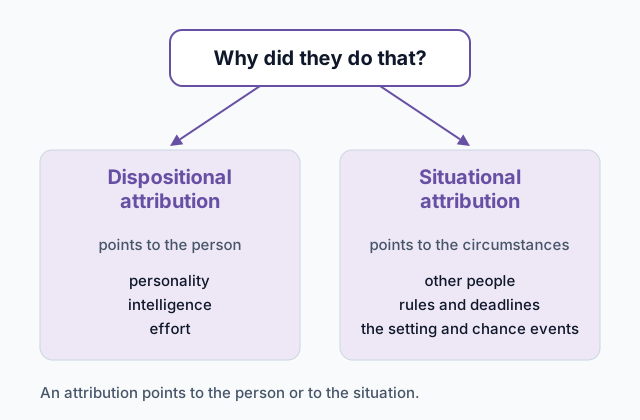
You explain behavior all day without noticing. A friend does not answer your text, a teammate drops an easy pass, you bomb a quiz. Psychologists call these explanations attributions: how people explain the behavior and mental processes of themselves and of others.
An attribution points in one of two directions. A dispositional attribution explains behavior by a quality inside the person, such as personality, intelligence or effort. "He failed the driving test because he is careless" is dispositional. A situational attribution explains behavior by the circumstances the person was in, such as other people, a rule, the setting or plain chance. "He failed because the examiner made him drive in a snowstorm" is situational.
The same act can be explained either way, and which way you go changes what you do next. If a new lab partner shows up without her half of the work, deciding she is lazy might make you stop counting on her. Deciding her printer broke leaves room to try again.
To classify an attribution, ignore whether it sounds fair, kind or likely. Ask one thing: does the explanation point to who the person is, or to what was happening around them?
Quick check · Sort it
Tap an explanation, then tap the kind of attribution it makes.
Dispositional attribution
Situational attribution
2b. Three biases in how we explain behavior
Attributions go wrong in predictable ways, and the errors change how people treat each other.
The fundamental attribution error is about explaining other people. When you watch someone else act, you give too much weight to their disposition and too little to their situation. A driver cuts you off, and your first thought is that he is a jerk, not that he might be rushing to a hospital.
Actor/observer bias compares how you explain yourself with how you explain others. When you are the one acting, you can see the pressures you are under, so you tend to explain your own behavior by the situation. When you watch someone else, the person stands out more than their circumstances, so you explain their behavior by disposition. You snapped at a friend because you were exhausted; your friend snapped at you because she is moody.
Self-serving bias is about your own successes and failures. People tend to credit a success to themselves and to blame a failure on the situation. An A means you are good at chemistry; a D means the test was unfair.
To tell them apart, ask whose behavior is being explained. Only other people's: fundamental attribution error. Yours set beside someone else's: actor/observer bias. Your own wins and losses: self-serving bias.
Quick check · Multiple choice
Jalen shows up 20 minutes late to practice and tells the coach the bus never came. Later that week his teammate Cole is late, and Jalen tells a friend that Cole just doesn't take practice seriously. Which bias best describes the difference between how Jalen explains his own lateness and how he explains Cole's?
2c. Habits of explaining, and who is in control
People do not explain events at random. Each of us has a predictable pattern, called an explanatory style: how we explain the good and bad events in our own lives and in other people's lives.
A pessimistic explanatory style treats a bad event as lasting and far-reaching. "I failed this quiz because I'm terrible at math, and I always will be." An optimistic explanatory style treats a bad event as temporary and limited to that one situation. "That quiz went badly because I studied the wrong section. Next time I'll check what it covers." With good events it runs the other way: the optimist expects a success to happen again, and the pessimist calls it a fluke.
A related idea is locus of control, a person's belief about what controls the outcomes in their life. Someone with an internal locus of control believes outcomes depend mostly on their own choices and effort. Someone with an external locus of control believes outcomes depend mostly on forces outside them, such as luck, fate or other people.
That belief shapes behavior. If you think your effort decides your grade, studying is worth the time. If you think your grade depends on luck or on which teacher you get, studying looks pointless, and there is little reason to start.
Quick check · Fill the statement
Tap a blank, then tap a word.
After losing a chess match, Nia tells herself, "I had an off day, and I'll play better next week." Nia's explanatory style is . Her friend Sam believes that how well he does at chess depends mostly on how much he practices, not on luck or on who he gets paired against. Sam's locus of control is .
2d. How we see ourselves and others
Person perception is how you form impressions of other people, and of yourself.
The mere exposure effect is liking something more because you have been exposed to it repeatedly over time. The song you found annoying in August is the one you are humming by October. Faces work the same way: a student you pass in the hall every day starts to seem likable, though you have never spoken.
A self-fulfilling prophecy happens when a belief about someone changes how you act toward them, and your behavior draws out the very behavior you expected. A manager who expects a new hire to struggle gives her vague instructions and little feedback. She struggles, and the manager feels proven right. A belief about yourself can work the same way.
Social comparison is judging yourself by comparing yourself with other people in your society or social circle. In upward social comparison you compare yourself with people who are doing better than you; in downward social comparison, with people doing worse.
Comparisons also set how deprived people feel. In relative deprivation, people judge what they lack against what the people around them have, not against what they need. A student with a perfectly good phone can feel she is missing out if every friend she has just got a newer one.
Quick check · Match
Tap a term, then tap the example that shows it.
Part 3 Watch it done Naming an attribution bias, one question at a time
Watch each step, then do the last one yourself.
After her debate team wins a round, Aisha says, "We won because I prepared harder than anyone." After the team loses the next round, she says, "The judge clearly favored the other school." Which attribution bias does Aisha show?
Step 1 · Find whose behavior is being explained
Both times, Aisha is explaining her own results: one win and one loss. She is not explaining anyone else's behavior.
Why this step?
Why settle whose behavior is explained before naming a bias?
Because two of the three biases depend on it. The fundamental attribution error is about explaining other people, and actor/observer bias compares yourself with someone else. If only your own results are being explained, neither of those fits.
Step 2 · Classify each attribution
The win is put down to her own preparation, something about her, so that attribution is dispositional. The loss is put down to the judge, a circumstance outside her, so that attribution is situational.
Your step · Decide and justify
Finish it. After her debate team wins a round, Aisha says, "We won because I prepared harder than anyone." After the team loses the next round, she says, "The judge clearly favored the other school." Which attribution bias does Aisha show?
Which reason supports your answer?
Part 4 Try it Read a study: does locus of control go with effort?
Illustrative study (made up for practice, not a published study). Researchers asked 160 students at one high school to fill out a questionnaire about locus of control. Students rated how much they agreed with statements such as "How well I do in school depends mostly on my own effort" and "How well I do in school depends mostly on luck." From their ratings, each student was classified as having a mostly internal or a mostly external locus of control. Over the next semester, the researchers counted how many of 12 optional online practice quizzes each student completed. The difference between the groups was statistically significant.
| Locus of control | Students | Mean quizzes completed (of 12) |
|---|---|---|
| Mostly internal | 88 | 7.9 |
| Mostly external | 72 | 4.6 |
Try it · Multiple choice
In an illustrative study, researchers used a questionnaire to classify 160 high school students as having a mostly internal or a mostly external locus of control, then counted how many optional practice quizzes each student completed over a semester. No one was assigned to a group, and nothing was changed for any student. Which research method did the researchers use?
Try it · Decide and justify
In an illustrative study, 160 students at one high school filled out a questionnaire and were classified as having a mostly internal or a mostly external locus of control. Over a semester, the mostly internal students completed a mean of 7.9 of 12 optional practice quizzes and the mostly external students a mean of 4.6, a statistically significant difference. Can the researchers conclude that an internal locus of control caused students to complete more quizzes?
Which reason supports your answer?
Part 5 Explain it Answer an article analysis question
Nothing you type leaves this page.
Free response is 33.3% of the exam score. This one is shaped like Question 1, Article Analysis Question.
Free-response practice · Question 1 style
Illustrative study (made up for practice, not a published study). Researchers wanted to know whether seeing a face many times makes people like it more. They recruited 90 students at one university. Before starting, each student read and signed a consent form that described the task and said they could stop at any time without penalty. A coin flip put each student in one of two groups. Both groups watched a slideshow of 40 photos of strangers' faces. In the repeated group, one target face appeared 10 times among the 40 photos. In the once group, the same target face appeared once, and other faces filled the remaining slides. Afterward, every student rated how much they liked the target face on a scale from 1 (not at all) to 9 (very much). The repeated group's mean rating was 6.3 and the once group's was 4.8, and a statistical test showed the difference was statistically significant.
(A) Identify the research method used in this study.
(B) State the operational definition of liking in this study.
(C) Identify one ethical guideline described in the study. Describe one way the researchers applied it.
(D) Explain the extent to which the research findings may or may not be generalizable, using specific and relevant evidence from the study.
(E) Explain how the results support the mere exposure effect.
Model answer
(A) This is an experiment, because a coin flip assigned each student at random to the repeated group or the once group.
(B) Liking was measured as each student's rating of the target face on the 1 to 9 scale after the slideshow.
(C) Informed consent. Before taking part, each student read and signed a form that described the task and said they could stop at any time without penalty.
(D) The findings may not generalize to all people, because every participant was a student at one university, and people of other ages or from other places could respond differently. The study also showed every face as a photo of a stranger, all within one slideshow, so it may not show how liking changes for real people seen over weeks.
(E) The mere exposure effect says that being exposed to a stimulus repeatedly makes people like it more. Students who saw the target face 10 times rated it 6.3, against 4.8 for students who saw it once, a statistically significant difference. Because the groups were formed at random, the number of exposures is the planned difference between them, so seeing the face more often led to liking it more.
Score your own answer. This is a self-check, not a grade. Tick each point your answer makes.
Part 6 Check yourself Read a pay survey
On the exam, some multiple-choice questions share one set of data, the way these do.
Illustrative data (made up for practice). A company surveyed the workers on two of its teams, which do the same job in different cities. Each worker reported their hourly pay, the hourly pay they believed was typical among the people they usually compare themselves with, and how satisfied they were with their pay on a scale from 1 (not at all) to 10 (completely). The difference in satisfaction between the teams was statistically significant.
| Team | Workers | Mean hourly pay | Mean pay of the people they compare with | Mean pay satisfaction (1 to 10) |
|---|---|---|---|---|
| Harbor | 30 | $21 | $18 | 7.2 |
| Ridge | 30 | $24 | $29 | 4.6 |
Case question 1 · Fill the statement
Tap a blank, then a word.
In a pay survey, Harbor team workers earn a mean of $21 an hour and compare themselves with people they believe earn $18, which is social comparison. Ridge team workers earn a mean of $24 an hour and compare themselves with people they believe earn $29, which is social comparison.
Case question 2 · Decide and justify
In a pay survey, Harbor team workers earn a mean of $21 an hour, compare themselves with people they believe earn $18, and rate their pay satisfaction 7.2 out of 10. Ridge team workers earn $24 an hour, compare themselves with people they believe earn $29, and rate their satisfaction 4.6. A manager says the Ridge team's lower satisfaction fits relative deprivation. Is the manager right?
Which reason supports your answer?
Case question 3 · Multiple choice
Which column in the table do you need, together with a team's own mean hourly pay, to tell whether that team's social comparison is upward or downward?
The rest stand on their own and do not use the case.
Check yourself · Spot the error
After failing her driving test, Tess says, "I'm hopeless at this, and everything I try is going to go wrong." A student explains what this shows. Tap the first line that goes wrong.
Check yourself · Put it in order
A self-fulfilling prophecy plays out on a soccer team. Tap the events in the order they happen.
Part 7 Keep it Bring back earlier ideas
Coming back to older ideas is how they stay usable on the exam.
Bring it back · Multiple choice
In his first month in a new town, Theo rides his bike around with no destination, and nobody rewards him for learning the streets. Weeks later, when a friend asks how to get to the public pool, Theo describes a route from memory right away. Which kind of learning does this best show?
Bring it back · Sort it
Tap a decision, then tap the error in thinking behind it.
Gambler's fallacy
Sunk-cost fallacy
In three lines
- An attribution explains behavior by the person (dispositional) or by the circumstances (situational), and the fundamental attribution error, actor/observer bias and self-serving bias tilt which one people choose.
- Explanatory style is an optimistic or pessimistic habit of explaining good and bad events, and locus of control is the belief that outcomes depend on yourself (internal) or on outside forces (external).
- Person perception is shaped by mere exposure, by self-fulfilling prophecies, and by upward and downward social comparison, which can leave people feeling relatively deprived.
Vocabulary
- Attribution
- How people explain the behavior and mental processes of themselves and others.
- Dispositional attribution
- An explanation that points to a quality inside the person, such as intelligence or personality.
- Situational attribution
- An explanation that points to the external circumstances a person experiences.
- Explanatory style
- A predictable pattern in how people explain good and bad events in their own lives and in others' lives, which can be optimistic or pessimistic.
- Fundamental attribution error
- Explaining other people's behavior with too much weight on their disposition and too little on their situation.
- Actor/observer bias
- Explaining your own behavior by the situation while explaining the same behavior in others by their disposition.
- Self-serving bias
- Crediting your successes to yourself and blaming your failures on the situation.
- Locus of control
- A belief about whether the outcomes in your life depend mostly on yourself (internal) or on outside forces such as luck or other people (external).
- Mere exposure effect
- Coming to like a stimulus more after being exposed to it repeatedly over time.
- Self-fulfilling prophecy
- Behaving in ways that draw out behavior from others, or yourself, that confirms what you already believed.
- Social comparison
- Evaluating yourself by comparing yourself with other members of society or your social circle, upward with people doing better or downward with people doing worse.
- Relative deprivation
- Judging how deprived you are by comparing what you have with what others have, rather than with what you need.
Course alignment, for teachers
AP Psychology topic 4.1, Unit 4: Social Psychology and Personality.
- Skill 1.B: Explain how cultural norms, expectations, and circumstances, as well as cognitive biases apply to behavior and mental processes.
- Skill 2.B: Evaluate the appropriate use of research design elements in experimental methodology.
- Skill 2.C: Evaluate the appropriate use of research design elements in non-experimental methodologies.
- Skill 4.A: Propose a defensible claim.
This lesson maps all 6 essential knowledge statements of the topic, and the one learning objective with none of its own, to the part that teaches each one: 7 are checked by a scored question. The map is in the lesson file.