Unit 4 · Topic 4.4 · about 30 minutes · 7 parts · 14 scored checks, 3 of them multiple choice
AP Psychology 4.4: Psychodynamic and Humanistic Theories of Personality
Unit 4: 15 to 25% of the multiple-choice section
 Tap to open the picture full size
Part 1 Think first Blaming the shoes
Guess before you learn. A wrong guess still makes the answer stick.
Predict first
At practice, Nico's coach mocks him in front of the whole team. Nico says nothing, and when his friends ask, he tells them practice was fine. That evening he trips over his little brother's shoes in the hall and yells at him for a full minute. Later his mother asks him why he got so angry. What is Nico most likely to say?
In short. Psychodynamic and humanistic theories explain personality from opposite starting points, one from forces a person cannot see and the other from a person's own push to grow.
- The psychodynamic view holds that unconscious processes drive personality, and that ego defense mechanisms protect the ego from threats without the person knowing.
- Projective tests use ambiguous stimuli to probe the preconscious and unconscious mind, and because the unconscious cannot be observed directly, some of the theory's claims are hard to test.
- The humanistic view holds that unconditional regard and the self-actualizing tendency are the main forces that move personality toward growth.
Part 2 Learn it Four short ideas, each checked as you go
2a. Forces you cannot see
Sigmund Freud built the psychodynamic theory of personality on one central claim: unconscious processes drive personality. Wishes, fears and conflicts a person is not aware of shape how they act, what they feel and which patterns keep repeating in their life. Later psychodynamic theorists disagreed with Freud about many details, but they kept that claim.
Freud pictured the mind in levels of awareness. Whatever you are thinking about right now is conscious. What you are not thinking about but can call up easily, like a friend's phone number, is preconscious. The unconscious holds material you cannot bring to mind even when you try, and in this view it still pushes on behavior. That is how a person can act on a feeling and give a sincere but wrong reason for it, the way Nico blamed the shoes.
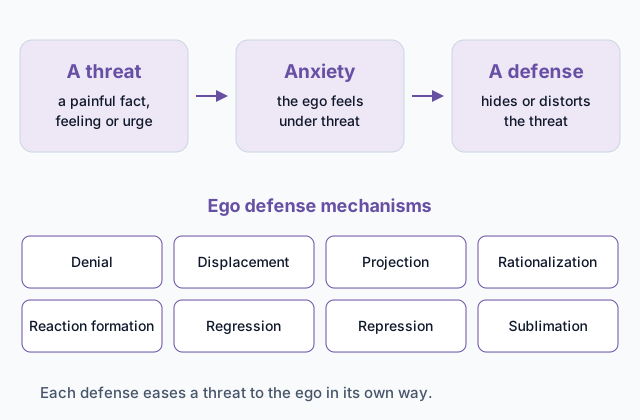
Freud called one part of personality the ego. It deals with the real world and has to manage what pushes up from below. When something threatens it, a painful fact or an urge the person cannot accept, the result is anxiety, and the ego protects itself.
Quick check · Fill the statement
Tap a blank, then tap a word.
As Rosa reads in the library, the words on the page are in her mind. Her locker combination is not in her thoughts, but she can recall it the moment she needs it, so it sits in her mind. In the psychodynamic view, a fear of being left out that she cannot bring to mind even when she tries, but that still steers whom she sits with, sits in her mind.
2b. Defenses that work without your knowing
Ego defense mechanisms protect the ego from threats, and they do it unconsciously. A person using one is not lying or scheming. They honestly experience the distorted version. Eight are worth knowing well:
- Denial: refusing to accept that a threatening fact is true.
- Displacement: moving a feeling from its real target to a safer one.
- Projection: seeing your own unacceptable feeling or urge in other people instead of in yourself.
- Rationalization: offering a sensible-sounding reason in place of the real, threatening one.
- Reaction formation: turning an unacceptable feeling into its opposite, often overdone.
- Regression: falling back on more childlike behavior under stress.
- Repression: pushing a threatening memory, thought or feeling out of awareness.
- Sublimation: channeling an unacceptable urge into an activity society values.
To name one, ask two questions. What is the threat? Then, what does the person do with it: refuse it, move it, hand it to someone else, explain it away, flip it, retreat from it, bury it, or put it to good use?
Deliberately choosing not to think about something is not repression, and knowingly making up an excuse is not rationalization. If the person is doing it on purpose, it is not a defense mechanism.
Quick check · Match
Tap a defense mechanism, then tap the example that shows it.
2c. Assessing what cannot be reported
If personality runs on things a person cannot report, asking them directly will not reach those things. So psychodynamic psychologists assess personality with projective tests: ambiguous stimuli with no right answer, designed to probe the preconscious and unconscious mind. The idea is that people project their hidden concerns onto whatever they are shown. In the Rorschach inkblot test, a person says what they see in a series of inkblots. In the Thematic Apperception Test (TAT), a person tells a story about each of several ambiguous pictures of people. A trained psychologist then interprets the answers.
Research can test some things about this and not others. It can test whether a projective test is reliable, giving similar results when it is taken twice or scored by two people, and whether its scores predict anything outside the test. Critics have long questioned how consistently these tests can be scored and how well they predict.
What research cannot do is observe the unconscious directly. And some psychodynamic explanations fit opposite results: warmth toward a rival can be called reaction formation, and coldness can be called the real feeling showing through. An explanation that fits any result cannot be put to a test it might fail. That makes a claim hard to test, which is not the same as showing it is false.
Quick check · Decide and justify
A psychologist with a psychodynamic view wants to learn about conflicts a client is not aware of. She can give him a questionnaire on which he rates 60 statements about himself, or show him a set of ambiguous drawings and ask him to tell a story about each one. Which assessment fits her view better?
Which reason supports your answer?
2d. Humanistic theory: regard and growth
Humanistic psychology, associated above all with Carl Rogers, starts from the other direction. It sees people as basically good and looks at conscious experience in the present: how you see yourself, and who you are becoming. Two forces drive personality in this view.
The self-actualizing tendency is a built-in push to grow and to become more fully the person you could be. Nobody has to reward it. Given the right conditions, it moves people forward on its own.
Those conditions come from unconditional regard, which Rogers called unconditional positive regard: being accepted and valued as a person whatever you do, fail at or feel. It does not mean approving of every choice. A parent can be unhappy about a lie and still make it plain that the child is loved. When regard comes with conditions (warmth only after good grades, belonging only for acting tough), people learn to hide parts of themselves to keep it, and growth stalls.
Because the person is the expert on their own experience, humanistic psychologists assess personality by asking. They use interviews and questionnaires on which people describe themselves, often comparing how a person sees themselves now with how they would like to be. A large gap between the two is read as a sign that growth has stalled.
Quick check · Sort it
Tap an example, then tap the idea it shows best.
Unconditional regard
Conditional regard
Self-actualizing tendency
Part 3 Watch it done Naming a defense, one question at a time
Watch each step, then do the last one yourself.
Theo applied for a summer job at a bike shop and talked about it for weeks. When the shop turns him down, he tells his friends calmly that it worked out for the best, because the hours would have clashed with soccer and the pay was low, though he knew both of those things when he applied. Which defense mechanism fits best?
Step 1 · Find the threat to the ego
Being turned down for a job he badly wanted carries a painful message: maybe he was not good enough. That is the threat.
Step 2 · Ask whether he accepts the facts
He does. He tells his friends he did not get the job, so he is not refusing to accept what happened, and the defense is not denial. What he changes is the reason the loss matters.
Why this step?
Why check whether he accepts the facts before naming the defense?
Because denial refuses the fact itself, while several other defenses accept the fact and change something else about it. Settling that first rules out denial and points to what he does with the threat.
Your step · Decide and justify
Finish the classification. Theo talked about a bike shop job for weeks. When he is turned down, he calmly tells friends it worked out for the best, since the hours clashed with soccer and the pay was low, though he knew both things when he applied. Which defense mechanism fits best?
Which reason supports your answer?
Part 4 Try it Read a study: does a projective test give the same answer twice?
Illustrative study (made up for practice, not a published study). A researcher gives 50 adults a picture-story test: each tells a story about each of eight ambiguous drawings. A trained scorer codes each person's stories as showing a strong hidden need for approval or not. Three weeks later the same adults take the same test again, and a second scorer, who has not seen the first codes, codes the new stories using the same scheme.
| First test | Second test: strong need | Second test: not strong | Total |
|---|---|---|---|
| Strong need | 14 | 9 | 23 |
| Not strong | 8 | 19 | 27 |
| Total | 22 | 28 | 50 |
Try it · Calculate
In an illustrative study, 50 adults took a picture-story test twice. Coded strong need both times: 14. Strong, then not strong: 9. Not strong, then strong: 8. Not strong both times: 19. What percent of the adults received the same code both times?
Try it · Decide and justify
In the illustrative study, 66% of 50 adults got the same code on a picture-story test taken three weeks apart. A classmate says the study shows that a need for approval is stored in the unconscious. Does the study show that?
Which reason supports your answer?
Part 5 Explain it Write it the way the exam asks
Nothing you type leaves this page.
Free response is 33.3% of the exam score. This one is shaped like Question 2, Evidence-Based Question.
Free-response practice · Question 2 style
Read the three sources, then answer the question they share: how does the kind of regard people receive relate to whether they take on challenges that help them grow? In parts B and C, cite the source you use, for example (Source 1).
Source 1. Illustrative study (made up for practice, not a published study). Researchers recruited 90 college students to solve word puzzles. A coin flip put each student in one of two groups. Before starting, students in one group heard the researcher say, "I will think well of you however this goes." Students in the other group heard, "I will be impressed if you do well." After the first set, every student could choose an easy or a hard set for a final optional round. In the first group, 29 of 45 students (64%) chose the hard set, compared with 14 of 45 (31%) in the second group. The difference was statistically significant.
Source 2. Illustrative study (made up for practice, not a published study). Researchers surveyed 300 high school students. Each student rated how much their parents' affection stays the same whatever their grades, and listed the new activities they had started on their own in the past year, such as a club, an instrument or a skill. Students who said their parents' affection stays the same whatever their grades tended to have started more new activities, a positive correlation of r = +0.38.
Source 3. Illustrative study (made up for practice, not a published study). A music school randomly assigned 40 beginning piano students to one of two kinds of feedback for a year. Half heard praise only when they played a piece with no mistakes. The other half heard, after every lesson, that their teacher enjoyed working with them however the lesson went. By the end of the year, 11 of 20 students (55%) in the first group had quit, compared with 4 of 20 (20%) in the second. The difference was statistically significant.
(A) Propose a specific and defensible claim, based in psychological science, that answers the question.
(B) (i) Support your claim using one piece of specific and relevant evidence from one of the sources. (ii) Explain how the evidence from part B (i) supports your claim, using a psychological perspective, theory, concept, or research finding.
(C) (i) Support your claim using a piece of specific and relevant evidence from a different source. (ii) Explain how the evidence from part C (i) supports your claim, using a different psychological perspective, theory, concept, or research finding from the one in part B (ii).
Model answer
(A) The more unconditionally people are accepted, the more willing they are to take on challenges that help them grow.
(B) (i) In Source 1, 64% of students who were told the researcher would think well of them however the puzzles went chose the hard final set, compared with 31% of students who were told the researcher would be impressed if they did well. (ii) This fits unconditional regard. Students in the first group were accepted whatever the result, so a hard set put nothing at risk and they took on the challenge. Students whose approval depended on doing well protected it by choosing the easy set, the way conditional regard leads people to play it safe.
(C) (i) In Source 2, students who said their parents' affection stays the same whatever their grades tended to have started more new activities on their own, a positive correlation of r = +0.38. (ii) This fits the self-actualizing tendency, a different concept from part B. When acceptance does not depend on meeting conditions, the built-in push to grow is free to work, which fits these students starting more new clubs and skills on their own, though a correlation alone cannot show the steady affection came first.
Score your own answer. This is a self-check, not a grade. Tick each point your answer makes.
Part 6 Check yourself Four people under threat
On the exam, some multiple-choice questions share one set of information, the way these do.
Illustrative cases (made up for practice). Each row describes a fictional person, a threat they face, and what they do next. Read each one through the psychodynamic view.
| Person | The threat | What they do |
|---|---|---|
| Priya | Was in a frightening car crash two years ago and was not hurt | Cannot recall anything about that day, even when her family describes it |
| Marcus | Feels intense anger at his older brother, which he finds unacceptable | Puts hours into writing songs and performs them at school shows that audiences praise |
| Tess | Is attracted to a classmate she believes she should not like | Mocks him loudly and often, more than anyone else in the class does |
| Jordan | Has been tempted to cheat on tests, a thought he will not admit even to himself | Keeps accusing his classmates of cheating |
Case question 1 · Multiple choice
In a table of illustrative cases, Priya was in a frightening car crash two years ago, was not hurt, and now cannot recall anything about that day, even when her family describes it. Which defense mechanism would a psychodynamic theorist use to explain this?
Case question 2 · Multiple choice
In a table of illustrative cases, Marcus feels intense anger at his older brother, which he finds unacceptable. He puts hours into writing songs and performs them at school shows that audiences praise. Which defense mechanism fits best?
Case question 3 · Decide and justify
In a table of illustrative cases, Tess is attracted to a classmate she believes she should not like, and she mocks him loudly, more than anyone else does. Jordan has been tempted to cheat, a thought he will not admit even to himself, and he keeps accusing classmates of cheating. A student says Tess and Jordan are using the same defense mechanism. Is the student right?
Which reason supports your answer?
The rest stand on their own and do not use the case.
Check yourself · Spot the error
A student explains what research can and cannot test about psychodynamic theory. Tap the first line that goes wrong.
Check yourself · Sort it
Tap each statement, then tap the theory it belongs to.
Psychodynamic
Humanistic
Part 7 Keep it Bring back earlier ideas
Coming back to older ideas is how they stay usable on the exam.
Bring it back · Fill the statement
Tap a blank, then a technique.
A charity first asks Dana to sign a short online petition, and a week later asks her to volunteer for a whole Saturday, which she agrees to. That is the technique. A band asks a club owner to book them every Friday for a month. When he says no, they ask for just one Friday night, and he agrees. That is the technique.
Bring it back · Multiple choice
Dev's short story wins a school writing contest, and he tells his family the judges must have had few good entries this year and he will not place again. A month later his next story gets a low grade, and he says he has never been a real writer and never will be. Which pattern do Dev's explanations show?
In three lines
- Psychodynamic theory holds that unconscious processes drive personality, and that ego defense mechanisms protect the ego from threats without the person knowing.
- Projective tests use ambiguous stimuli to probe the preconscious and unconscious; research can test their reliability, but it cannot observe the unconscious directly.
- Humanistic theory holds that unconditional regard and the self-actualizing tendency drive personality, and it assesses personality by asking people about themselves.
Vocabulary
- Psychodynamic theory of personality
- The theory that unconscious processes drive personality.
- Unconscious
- Thoughts, wishes, memories and feelings a person cannot bring to awareness, which in the psychodynamic view still shape behavior.
- Preconscious
- Material that is not in awareness right now but can be brought to mind easily.
- Ego defense mechanisms
- Processes that protect the ego unconsciously from threats.
- Denial
- Refusing to accept that a threatening fact is true.
- Displacement
- Moving a feeling or impulse from its real target to a safer one.
- Projection
- Attributing your own unacceptable feelings or urges to other people.
- Rationalization
- Offering a sensible-sounding reason in place of the real, threatening one.
- Reaction formation
- Turning an unacceptable feeling into its opposite, often in an exaggerated way.
- Regression
- Falling back on more childlike behavior under stress.
- Repression
- Pushing a threatening memory, thought or feeling out of awareness.
- Sublimation
- Channeling an unacceptable urge into an activity society values.
- Projective tests
- Assessments that use ambiguous stimuli, such as inkblots or pictures, designed to probe the preconscious and unconscious mind.
- Humanistic psychology
- The view that personality focuses on unconditional regard and the self-actualizing tendency as primary motivating factors.
- Unconditional regard
- Acceptance and valuing of a person whatever they do, which Carl Rogers called unconditional positive regard.
- Self-actualizing tendency
- A built-in push to grow and to become more fully the person one could be.
Course alignment, for teachers
AP Psychology topic 4.4, Unit 4: Social Psychology and Personality.
- Skill 1.A: Apply psychological perspectives, theories, concepts, and research findings to a scenario.
- Skill 2.C: Evaluate the appropriate use of research design elements in non-experimental methodologies.
This lesson maps all 4 essential knowledge statements of the topic to the part that teaches each one: 4 are checked by a scored question. The map is in the lesson file.