Unit 4 · Topic 4.5 · about 30 minutes · 7 parts · 13 scored checks, 3 of them multiple choice
AP Psychology 4.5: Social-Cognitive and Trait Theories of Personality
Unit 4: 15 to 25% of the multiple-choice section
 Tap to open the picture full size
Part 1 Think first From the back of the room to the front
Commit to a guess first. Even a wrong one helps the lesson stick.
Predict first
In September, Marisol joined her school's robotics team sure she was hopeless with tools, so she mostly watched. In October a teammate asked her to hold a part while he wired it, and the robot ran. She started asking for small jobs and doing them well, so the team began handing her harder ones. By spring she runs the build crew. What best explains how she changed?
In short. Social-cognitive theory explains personality as something a person, their actions and their surroundings keep shaping together, while trait theories describe personality as a set of enduring characteristics that can be measured.
- Reciprocal determinism means the person, their behavior and their environment each influence the other two, and self-efficacy and self-esteem both feed a person's self-concept.
- A trait is an enduring characteristic that leads to typical responses, and the Big Five are agreeableness, openness to experience, extraversion, conscientiousness and emotional stability.
- Personality inventories measure traits, and factor analysis groups the items whose answers go together into one trait scale.
Part 2 Learn it How each theory sees personality
2a. Person, behavior and environment
Social-cognitive theory, most closely tied to Albert Bandura, grows out of the social learning you met in 3.9. It says personality forms through an exchange that never stops. Three things keep acting on one another:
- the person: thoughts, beliefs, expectations and feelings;
- the person's behavior: what they actually do;
- the environment: the people, places and situations around them.
This is reciprocal determinism. Reciprocal because the influence runs in every direction, and determinism because together the three shape who someone becomes.
Take Kenji, who believes he is bad at math (person). He skips the extra practice problems (behavior), falls behind and gets moved to a slower class (environment), where little is asked of him, and that confirms his belief (person). The loop can turn the other way from any point. A teacher who pairs him with a patient study partner changes his environment. Working problems with her changes his behavior. Getting them right changes what he believes.
So in this view, personality is not a fixed thing a person carries from place to place unchanged. It is a pattern that keeps forming as a person and their situations act on each other.
Quick check · Sort it
Amara joined a running club. Tap each part of her story, then tap the part of reciprocal determinism it is.
Person
Behavior
Environment
2b. Self-concept: self-efficacy and self-esteem
The same loop shapes your self-concept: how you view yourself, and how you see yourself in relation to others. Two kinds of belief feed it, and students mix them up all the time.
Self-efficacy is your belief that you can succeed at a particular task, such as sinking a free throw, giving a speech or passing chemistry. It is specific. You can have high self-efficacy for drawing and low self-efficacy for parallel parking on the same afternoon. It matters for the loop in 2a, because people tend to try harder and stick with tasks longer when they believe they can do them, and succeeding then raises the belief.
Self-esteem is your overall sense of your own worth: whether, on the whole, you think well of yourself. It is general, not about any one task.
The two can point in different directions. A student can like herself a great deal and still be sure she will fail her driving test. Another can be certain he will ace calculus and still think poorly of himself overall. Both kinds of belief contribute to the self-concept, so a change in either one changes how a person sees themselves.
Social-cognitive psychologists usually measure these beliefs by asking. A self-efficacy scale, for example, has people rate how sure they are that they can do one particular task, from not sure at all to completely sure.
Quick check · Multiple choice
Priya thinks of herself as a worthwhile person and likes who she is. Before her first solo violin recital, though, she is certain she will lose her place and have to stop. Which best describes Priya?
2c. Traits: enduring and typical
Trait theories ask a different question. Instead of how personality forms, they ask how to describe it. They conclude that personality is a set of enduring characteristics that lead to typical responses to stimuli: the ways a person tends to act across many situations and over long stretches of time. Typical matters. Someone high in a trait does not show it every minute; they show it more often than most people do.
The Big Five theory proposes five traits that make up a personality. Each is a range, and everyone sits somewhere on each one:
- Agreeableness: kind, trusting and cooperative at the high end; critical and quick to clash at the low end.
- Openness to experience: curious and drawn to new ideas, art and activities at the high end; preferring the familiar at the low end.
- Extraversion: outgoing and energized by other people at the high end; quieter and more reserved at the low end.
- Conscientiousness: organized, careful and dependable at the high end; disorganized and careless at the low end.
- Emotional stability: calm and steady under stress at the high end; anxious and easily upset at the low end.
One angry outburst on a terrible day says little about agreeableness. Starting arguments at school, at home and at work for years says a lot.
Quick check · Match
Tap a trait, then tap the person who shows a high level of it.
2d. Measuring traits
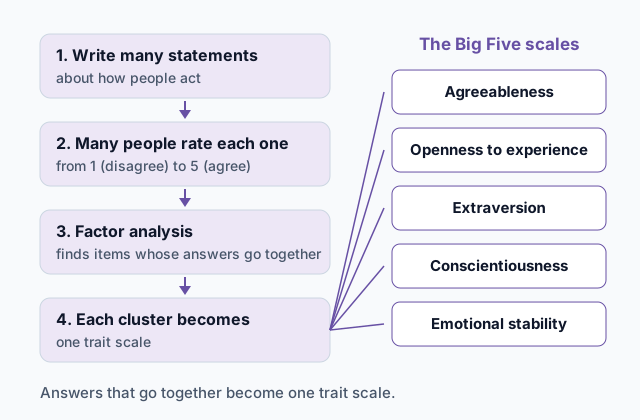
Trait psychologists measure traits with personality inventories: questionnaires with many statements, such as "I get my chores done right away," each answered on a scale from 1 (disagree strongly) to 5 (agree strongly). The projective tests of 4.4 ask for responses to ambiguous images. An inventory asks direct questions instead, and every answer is scored the same way for everyone.
So where do the five traits come from? Researchers write a long list of items and give it to many people. Then they run factor analysis, a statistical method that organizes the item responses by finding groups of items whose answers go together: people who agree with one item in a group tend to agree with the others in it. Each group is a factor, and the researchers name it by what its items have in common. The groups come from how people actually answered, not from which items a researcher expected to belong together.
Like any psychological test (2.8), an inventory is useful only if it is reliable, giving similar scores each time a person takes it, and valid, measuring the trait it claims to measure. Inventories are also self-report, so they depend on people describing themselves honestly.
Quick check · Fill the statement
Tap a blank, then tap a word.
A researcher gives 600 adults a 40-item personality . Factor analysis shows that people who agree with "I keep my things neat" also tend to with "I follow a daily schedule" and "I double-check my work," so the three items form one group. The researcher names that group .
Part 3 Watch it done Naming the traits an inventory found
Watch each step, then finish the last one yourself.
Illustrative data (made up for practice). A researcher gives 400 adults six statements and asks them to rate each from 1 (disagree strongly) to 5 (agree strongly):
- I keep my desk in order.
- I start conversations with strangers.
- I finish my work before I relax.
- I feel energized at big parties.
- I make a plan before a big job.
- I enjoy being the center of attention.
Factor analysis finds two clusters. People who agree with item 1 tend to agree with items 3 and 5, and people who agree with item 2 tend to agree with items 4 and 6. Answers in one cluster barely go with answers in the other. Name the trait each cluster measures.
Step 1 · Read what factor analysis found
The grouping came from how people answered. Items 1, 3 and 5 rise and fall together, and so do items 2, 4 and 6. Each cluster is one factor, so these six items measure two traits, not six.
Step 2 · Name the first cluster by what its items share
Items 1, 3 and 5 are about keeping order, finishing work and planning ahead. What runs through all three is being organized and dependable, which is conscientiousness.
Why this step?
Why name a cluster by what all of its items share, instead of by any one item in it?
Because the factor is whatever the items have in common. One item can be answered a certain way for reasons unrelated to the trait, such as a desk so small it is easy to keep neat. Only what runs through every item in the cluster is the trait it measures.
Your step · Decide and justify
Finish the naming. In an illustrative inventory, factor analysis grouped three items: "I start conversations with strangers," "I feel energized at big parties" and "I enjoy being the center of attention." Which trait does this cluster measure?
Which reason supports your answer?
Part 4 Try it Read a study: does conscientiousness go with on-time work?
Illustrative study (made up for practice, not a published study). A researcher asked 150 first-year students at one university to fill out a Big Five inventory in September. In December, with each student's permission, she recorded the percentage of their assignments that had been turned in on time. Students with higher conscientiousness scores tended to have a higher percentage of on-time assignments. The correlation was +0.48, and a statistical test showed it was statistically significant. No one was assigned to anything; the researcher only measured.
Try it · Fill the statement
Tap a blank, then a phrase.
A researcher measured first-year students' conscientiousness with a Big Five inventory and later recorded how many of their assignments were on time, without assigning students to anything. This is a study. Conscientiousness was operationally defined as .
Try it · Decide and justify
In an illustrative study, 150 first-year students filled out a Big Five inventory, and their conscientiousness scores correlated +0.48 with the percentage of assignments they turned in on time. The correlation was statistically significant, and the researcher assigned no one to anything. Can she conclude that conscientiousness causes students to turn work in on time?
Which reason supports your answer?
Part 5 Explain it Analyze a study the way the AAQ asks
What you type stays on this page.
Free response is 33.3% of the exam score. This one is shaped like Question 1, Article Analysis Question.
Free-response practice · Question 1 style
Illustrative study (made up for practice, not a published study). Researchers wanted to know whether a first session of early success at a skill, compared with a session spent not playing at all, changes students' belief that they can learn it and how much they practice. They recruited 84 students from beginning guitar classes at one high school. Before the study began, a parent of each student signed a form describing what the study involved, and each student agreed to take part. A computer randomly assigned half the students to a success group and half to a comparison group. In the first session, the success group learned three short songs chosen to be easy to master, and every student played all three. The comparison group spent the same time listening to a talk on the history of the guitar. Afterward, each student rated "How sure are you that you can learn a new song this month?" from 1 (not sure at all) to 10 (completely sure). Over the next four weeks, students logged their practice minutes in a class app. The success group's mean rating was 7.8 and the comparison group's was 5.9, and the success group logged a mean of 142 practice minutes against 96. A statistical test showed both differences were statistically significant.
(A) Identify the research method used in this study.
(B) State the operational definition of self-efficacy in this study.
(C) Identify one ethical guideline described in the study. Describe one way the researchers applied it.
(D) Explain how the results support reciprocal determinism.
Model answer
(A) This is an experiment, because a computer randomly assigned each student to the success group or the comparison group.
(B) Self-efficacy was measured as each student's 1 to 10 rating of how sure they were that they could learn a new song that month.
(C) Informed consent. Before the study began, a parent of each student signed a form describing what the study involved, and each student agreed to take part.
(D) The researchers set up the success group's first session with songs chosen to be easy (environment), and those students played all three (behavior). That group then rated their self-efficacy, a person factor, higher: a mean of 7.8 against 5.9. The same group went on to log more practice, a behavior: 142 minutes against 96. Both differences were statistically significant. So what the students did, and what the researchers set up for them, raised what they believed they could do, and the same group then practiced more. That fits reciprocal determinism, in which the person, their behavior and their environment keep shaping each other.
Score your own answer. This is a self-check, not a grade. Tick each point your answer makes.
Part 6 Check yourself Read a test-retest table
Some multiple-choice questions on the exam share one table, as these two do.
Illustrative data (made up for practice). Researchers gave a new five-trait personality inventory to 200 adults, then gave the same inventory to the same adults eight weeks later. For each trait scale, the table shows the correlation between people's first scores and their second scores.
| Trait scale | Correlation |
|---|---|
| Agreeableness | +0.81 |
| Openness to experience | +0.79 |
| Extraversion | +0.86 |
| Conscientiousness | +0.83 |
| Emotional stability | +0.41 |
Case question 1 · Multiple choice
In an illustrative study, 200 adults took a new personality inventory twice, eight weeks apart. Their two extraversion scores correlated +0.86. What does this result show about the extraversion scale?
Case question 2 · Decide and justify
In an illustrative study, 200 adults took a new personality inventory twice, eight weeks apart. Four trait scales correlated between +0.79 and +0.86 across the two sittings, but the emotional stability scale correlated only +0.41. A classmate says this shows that the adults' emotional stability really changed a lot in eight weeks. Is the classmate's reading the best one?
Which reason supports your answer?
The rest stand on their own and do not use the case.
Check yourself · Spot the error
Dario thinks well of himself overall, but in math class he never volunteers to work a problem at the board. A student explains Dario's self-concept. Tap the first line that goes wrong.
Check yourself · Sort it
Tap each description, then tap whether it shows a trait or not.
Shows a trait
Does not show a trait
Part 7 Keep it Pull back two earlier ideas
Retrieving an older idea now keeps it ready for the exam.
Bring it back · Multiple choice
Malik badly wanted a spot on the varsity soccer team. After he is cut, he tells his friends that being cut is a good thing, because practices would have taken time from his studies. Which ego defense mechanism does this example best show?
Bring it back · Fill the statement
Tap a blank, then a term.
Jonah is convinced the new bus route past his school is always late. He reads every online complaint about it and skips over the city's posted report showing the buses ran on time almost every day last month. Hunting for the complaints and passing over the report is . When a friend shows him the report, Jonah still says the route is always late. Keeping the belief after seeing the on-time record is .
In three lines
- Reciprocal determinism means the person, their behavior and their environment each shape the other two.
- Self-efficacy is a belief about succeeding at one task, self-esteem is an overall sense of worth, and both feed the self-concept.
- Trait theories describe enduring characteristics; the Big Five are measured with inventories, and factor analysis groups items whose answers go together.
Vocabulary
- Social-cognitive theory
- A theory of personality holding that reciprocal determinism shapes personality.
- Reciprocal determinism
- The person, their behavior and their environment each influencing the other two, which together shape personality.
- Self-concept
- How one views themselves and in relation to others.
- Self-efficacy
- A person's belief that they can succeed at a particular task, one of the beliefs that contribute to self-concept.
- Self-esteem
- A person's overall sense of their own worth, which also contributes to self-concept.
- Trait theories
- Theories concluding that personality involves a set of enduring characteristics that lead to typical responses to stimuli.
- Big Five theory
- The theory that agreeableness, openness to experience, extraversion, conscientiousness and emotional stability make up one's personality.
- Personality inventory
- A questionnaire of statements a person rates, used to measure traits such as the Big Five.
- Factor analysis
- A statistical method that organizes item responses by grouping the items whose answers go together.
Course alignment, for teachers
AP Psychology topic 4.5, Unit 4: Social Psychology and Personality.
- Skill 1.A: Apply psychological perspectives, theories, concepts, and research findings to a scenario.
- Skill 2.A: Determine the type of research design(s) used in a given study.
- Skill 3.C: Interpret quantitative or qualitative inferential data from a given table, graph, chart, figure, or diagram.
This lesson maps all 3 essential knowledge statements of the topic to the part that teaches each one: 3 are checked by a scored question. The map is in the lesson file.