Unit 1 · Topic 1.4 · about 30 minutes · 7 parts · 11 scored checks, 2 of them multiple choice, plus 2 from earlier lessons
AP U.S. Government and Politics 1.4: Challenges of the Articles of Confederation
Unit 1: 15 to 22% of the multiple-choice section
What you'll be able to do
- Explain the relationship between key provisions of the Articles of Confederation, and the debate over granting the federal government greater power formerly reserved to the states.
Key vocabulary
| Term | What it means | The exam trap |
|---|---|---|
| Executive enforcement | Implementation of public decisions through an executive institution. | Look for the institution charged with carrying a decision into effect. |
| Interstate commerce | Economic activity and rules operating across state boundaries. | A dispute across state borders differs from regulating trade within one state. |
| National judiciary | A national system of courts for adjudicating relevant legal disputes. | Lack of a national system does not mean that state courts were absent. |
| Articles of Confederation | The first national governing framework, whose weaknesses prompted demands for a stronger national arrangement. | Weak national powers did not mean the states lacked governments. |
| Shays’ Rebellion | An uprising that highlighted national difficulties in mounting an effective centralized military response. | The episode exposed weak centralized response capacity, not the nonexistence of military forces. |
| Coinage authority | Power to produce money, which the national government did not hold exclusively under the Articles. | Coinage power was not exclusive nationally; distinguish absence from lack of exclusivity. |
 Tap to open the picture full size
Part 1 Think first Predict what the evidence supports
Distinguish a missing national institution from a power that existed only in a weaker form.
Predict first
A national assembly reaches a decision, but each state can decline to supply the requested resources. Does reaching the decision prove that the national government can enforce it?
In short. The Articles of Confederation left national coordination dependent on institutions and state cooperation that often proved inadequate for enforcing decisions.
- Describe the missing institution or power, not only a broad weakness.
- National enforcement, courts, interstate-commerce authority, and monetary coordination are distinct functions.
- A reform’s effect depends on the mechanism it actually supplies.
Part 2 Learn it Confederation challenges
2a. Distinguish a formal power from an effective capacity
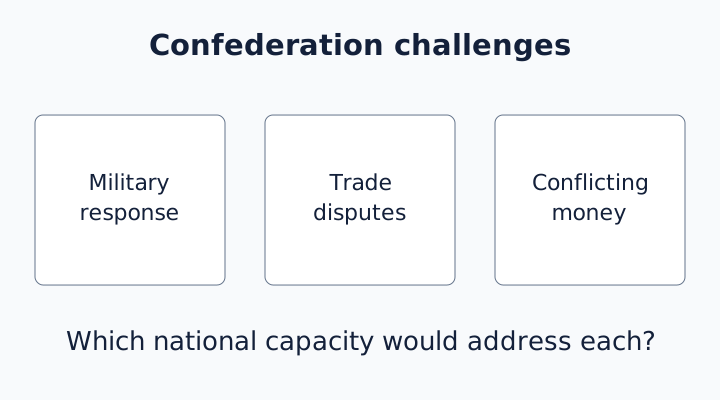
The Articles created a national Congress, but the national government lacked a separate executive branch capable of enforcing its decisions, including taxation. A national request could therefore depend on state cooperation rather than a reliable independent enforcement mechanism. This did not mean no government existed; state governments and the Confederation Congress still acted.
Shays’ Rebellion highlighted the difficulty of mounting an effective centralized military response. The lesson is about institutional capacity: possessing a national political body does not automatically supply the resources, enforcement arrangements, and command capacity needed to respond to a crisis. Avoid the stronger and inaccurate claim that the Articles prohibited every military function.
Primary text: Articles of Confederation, Articles VIII and IX, on state revenue and congressional functions.
Article VIII assigns the common treasury’s supply to the states and the levying of the taxes to their legislatures. This arrangement made national revenue depend on state cooperation.
Quick check · Fill the statement
Apply the distinction in the completed statement.
A request for revenue that depends on states volunteering compliance reveals weak national .
2b. Trace interstate and legal coordination problems
The absence of a national court system made national legal coordination harder; it did not mean that state courts disappeared. Likewise, Congress’s lack of power to regulate interstate commerce left barriers and competing state policies difficult to address through one national rule. A dispute crossing state borders could therefore expose weaknesses different from a dispute handled entirely within one state.
Separate these mechanisms. A court system concerns adjudicating disputes and interpreting law. Commerce regulation concerns rules for economic activity across state lines. Calling both problems weak government identifies a broad conclusion but leaves the causal explanation unfinished.
Quick check · Fill the statement
Apply the distinction in the completed statement.
A cross-border trade dispute concerns , while the absence of national courts concerns .
2c. Explain why money and enforcement mattered together
The national government lacked the exclusive power to coin money. Multiple sources of currency authority complicated coordination, alongside weak enforcement and commerce arrangements. The issue is not that people had never used money, but that the national framework did not provide exclusive central monetary authority.
To evaluate a proposed reform, connect it to a specific weakness: an executive can address enforcement; a national judiciary can address legal coordination; interstate-commerce authority can address cross-border rules; exclusive coinage authority can address monetary coordination. A reform need not solve every problem to address the weakness named in a question.
Quick check · Fill the statement
Apply the distinction in the completed statement.
A reform granting one national institution sole coinage authority would address the lack of monetary power.
Part 3 Watch it done Match an institutional reform to the problem
A national assembly’s decisions depend on voluntary state compliance. Its supporters propose an executive for implementation, a national court system for disputes, and authority to regulate cross-border trade.
Step 1 · Read the institutional evidence
The assembly can issue decisions but lacks an effective national institution for carrying them out. The court and trade proposals address different functions.
Why this step?
Why would establishing national courts not by itself supply the missing executive?
Adjudication resolves legal disputes. An executive implements decisions. Creating one function does not automatically create the other.
Step 2 · Separate the competing explanations
Locate the proposal that addresses implementation rather than confusing it with adjudication or commercial coordination.
Your step · Decide and justify
New condition: the assembly has created an executive to enforce its decisions, but states still impose conflicting rules on goods crossing their borders. Which further reform most directly addresses this remaining problem?
Which mechanism supports the inference in the new situation?
A contrasting worked example: coinage authority
A state issues its own money while Congress also coins money. First identify the conflict: national coinage authority is not exclusive. A reform giving the national government sole coinage power addresses that allocation. Creating an executive would address enforcement but would not itself decide who may coin money. The inference follows from the specific power involved, rather than the general claim that the confederation was weak.
Part 4 Try it Classify new situations
Original teaching scenarios: Assign each situation to the concept it most directly illustrates.
Try it · Sort it
Assign each situation to the concept it most directly illustrates.
Executive enforcement
Interstate commerce
National judiciary
Try it · Fill the statement
Complete the analysis of this situation.
Historical context: Shays’ Rebellion involved an armed uprising in Massachusetts. A critic uses the response difficulties to argue for stronger capacity.
Part 5 Explain it Write the causal or institutional connection
Free response is 50% of the exam score. This one is shaped like Question 1, Concept Application.
Free-response practice · Question 1 style
Original concept-application practice: a confederation’s assembly requests resources from its states, cannot implement decisions through a separate executive, and cannot establish one rule for trade among states. An original teaching argument says: “Shays’ Rebellion exposed inadequate national response capacity. A stronger national enforcement institution would make common decisions more effective.” This is an instructional argument, not a historical quotation. (A) Identify an enforcement weakness. (B) Describe a distinct commerce weakness. (C) Explain the argument’s perspective on national power, using its evidence and proposed reform. Explain why that reform would not necessarily solve every other weakness.
Model answer
The assembly depends on state cooperation because no separate executive reliably implements national decisions. Its inability to regulate interstate commerce leaves conflicting state trade rules difficult to coordinate nationally. The supplied argument favors stronger national capacity: it uses the difficulty of responding to Shays’ Rebellion to support an institution that can carry common decisions into effect. This connects a perceived response failure to a proposed national enforcement mechanism. Creating that mechanism would not by itself grant commerce authority, establish courts, or make coinage authority exclusive.
Score your own answer. This is a self-check, not a grade. Tick each point your answer makes.
Part 6 Check yourself Identify the missing mechanism
An original comparison of institutional problems under a hypothetical confederation, modeled on weaknesses discussed for the Articles.
| Problem | Evidence |
|---|---|
| Implementation | An assembly requests revenue but depends on state cooperation |
| Trade | States adopt competing rules for goods crossing borders |
| Courts | No national court system hears relevant national disputes |
Case question 1 · Multiple choice
Which reform most directly addresses the implementation problem?
Case question 2 · Multiple choice
Which statement explains why the trade problem differs from the court problem?
The rest stand on their own and do not use the case.
Check yourself · Spot the error
Select the statement with a conceptual or factual error.
Check yourself · Match
Match each idea to the explanation that distinguishes it from the alternatives.
Check yourself · Fill the statement
Recall the governing arrangement and the mechanism behind its revenue weakness.
The first national framework, the , relied on state legislatures to supply the common treasury. Its national revenue therefore depended on state .
Part 7 Keep it Retrieve and connect
From 1.1 Ideals of Democracy · Match
Match each safeguard to the institutional arrangement it describes.
From 1.3 Government Power and Individual Rights · Match
Match each idea to the explanation that distinguishes it from the alternatives.
In three lines
- Describe the missing institution or power, not only a broad weakness.
- National enforcement, courts, interstate-commerce authority, and monetary coordination are distinct functions.
- A reform’s effect depends on the mechanism it actually supplies.
Exam strategy for this topic
- Section I, Multiple Choice: 55 questions in 80 minutes.
- Section II, Free Response: 4 questions in 100 minutes.
- This lesson's Explain it is shaped like free-response question 1, Concept Application.
Distinguish a missing national institution from a power that existed only in a weaker form. Support the connection with a specific fact from the prompt.
Questions students ask
Did the Articles eliminate state courts?
No. The weakness was the absence of a national court system. State courts existed, so creating national adjudication addresses a different institutional gap from creating courts for the first time.
Why does Shays’ Rebellion matter here?
The uprising exposed weak centralized military capacity to respond to disorder. It supported an argument for stronger national capacity; it does not establish that the confederation had no military forces whatsoever.
What was wrong with monetary authority?
The national government lacked exclusive coinage power. That is different from a claim that it had no coinage authority at all.
Why separate trade regulation from enforcement?
Authority to set interstate trade rules addresses a power allocation. An executive supplies a mechanism for implementing decisions. One reform does not automatically supply the other.
Course alignment, for teachers
AP U.S. Government and Politics topic 1.4, Unit 1: Foundations of American Democracy.
- Skill 4.B: Explain how the argument or perspective in the source relates to political principles, institutions, processes, policies, and behaviors.
This lesson maps the one essential knowledge statement of the topic to the part that teaches each one: 1 is checked by a scored question. The map is in the lesson file.