Unit 1 · Topic 1.5 · about 30 minutes · 7 parts · 12 scored checks, 2 of them multiple choice, plus 2 from earlier lessons
AP U.S. Government and Politics 1.5: Ratification of the U.S. Constitution
Unit 1: 15 to 22% of the multiple-choice section
What you'll be able to do
- Explain the impact of political negotiation and compromise at the Constitutional Convention on the development of the constitutional system.
Key vocabulary
| Term | What it means | The exam trap |
|---|---|---|
| Great Compromise | A bicameral representation bargain combining a population-based House and equal state representation in the Senate. | This bargain designed Congress, not presidential selection. |
| Electoral College | A system in which electors from each state select the president through the constitutional process. | Electors select the president; the House/Senate representation bargain is separate. |
| Article V | The Constitution’s amendment process, separating proposal from state ratification. | A proposal still needs state ratification. |
| Three-Fifths Compromise | An apportionment and taxation formula involving the enslaved population, not a grant of voting rights. | The formula affected representation and taxation, not voting rights or human worth. |
| Bill of Rights | The first amendments protecting individual rights and limiting governmental power. | Identify which concern a proposed protection addresses. |
| Ratification | Formal approval through the constitutionally prescribed process. | Ratification is approval by the constitutionally required state process, not a presidential signature. |
 Tap to open the picture full size
Part 1 Think first Predict what the evidence supports
Identify which disagreement a bargain addressed and which tensions remained.
Predict first
A convention agrees on a new governing framework after difficult compromises. Does the agreement prove that every dispute about governmental power and rights is now settled?
In short. Constitutional ratification depended on institutional compromises, an amendment process, and disputes about national power and individual rights that remained unsettled.
- Explain the purpose and limits of each constitutional bargain.
- Article V separates proposing an amendment from ratifying it.
- Ratification created a framework for continuing disputes about power and rights.
Part 2 Learn it Different bargains
2a. Explain the institutional bargains without erasing their costs
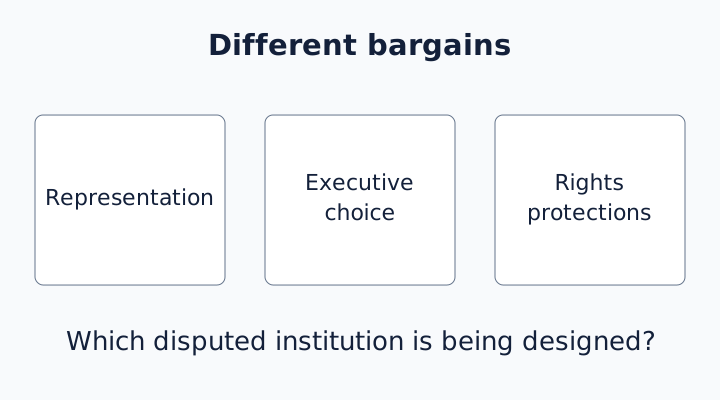
The Great, or Connecticut, Compromise combined a population-based House with a Senate giving states equal representation. The Electoral College established presidential selection through electors from each state rather than a direct national popular vote or a congressional vote. These arrangements addressed different disputes: legislative representation and selection of an executive.
Compromises over slavery protected slaveholding interests. The Three-Fifths Compromise used a formula counting three-fifths of a state’s enslaved population for House representation and taxation; it did not grant enslaved people voting rights or define them as partial human beings. Congress could not prohibit the importation of enslaved people before 1808, a delay that did not itself abolish slavery. The agreement to add a Bill of Rights responded to Anti-Federalist concerns about individual protections. Explain both the institutional bargain and what it left unresolved.
Quick check · Fill the statement
Apply the distinction in the completed statement.
The Great Compromise tied House representation to and gave states representation in the Senate.
2b. Separate proposal from ratification in Article V
Article V makes constitutional change possible through a demanding process. An amendment can be proposed by a two-thirds vote in both houses of Congress, or through a convention called after applications from two-thirds of the state legislatures. Ratification then requires three-fourths of the states through the constitutionally specified state process.
Proposal and ratification are different stages. A successful congressional proposal does not by itself amend the Constitution; the state ratification requirement remains. The alternative proposal route is not a free-standing power for one state to rewrite the Constitution. These thresholds combine national and state participation while making a temporary majority insufficient for easy constitutional revision.
Quick check · Fill the statement
Apply the distinction in the completed statement.
A proposed amendment still needs ratification by of the states.
2c. Identify the debate that the compromise did not settle
A compromise can secure agreement while leaving tensions unresolved. Different interests continued to contest the proper national role, state authority, and individual rights. A constitutional arrangement is therefore a framework for continuing political argument, not proof that every conflict disappeared at ratification.
Debates over government surveillance following the response to the September 11 attacks illustrate tensions between public authority and individual rights. Disputes over government’s role in public education illustrate continuing national/state and rights questions. These examples identify the kind of constitutional tension; a careful explanation does not assume that every particular policy has the same legal status or outcome. Name the asserted authority, the competing interest, and the institution or process that can address the dispute.
Quick check · Fill the statement
Apply the distinction in the completed statement.
In post-9/11 surveillance debates, an asserted national security interest can conflict with individual ; in public-school governance debates, national policy goals can conflict with authority.
Part 3 Watch it done Keep the stages of amendment distinct
An amendment receives a two-thirds vote in each house of Congress. It then receives ratification from two-thirds of the states. A student declares the amendment adopted.
Step 1 · Read the institutional evidence
The congressional stage reaches the proposal threshold. State ratification is a separate stage with a different threshold.
Why this step?
Why can the student not reuse the two-thirds fraction at the second stage?
Article V assigns two-thirds to proposal routes and three-fourths to ratification. Meeting one threshold does not change the other.
Step 2 · Separate the competing explanations
Follow both stages with their own thresholds, rather than treating an amendment as an ordinary law awaiting a president’s signature.
Your step · Decide and justify
Has this amendment completed ratification?
Which reason supports this classification?
Second worked example: interpret the Three-Fifths Compromise
Start with the formula’s purpose: apportioning representation and taxation. Then state the institutional consequence: counting part of an enslaved population affected a state’s allocation of representation. Finally state the limit: the formula did not enfranchise enslaved people or measure a fraction of human worth. A response that confuses apportionment with suffrage changes what the provision did.
Part 4 Try it Classify new situations
Original teaching scenarios: Assign each situation to the concept it most directly illustrates.
Try it · Sort it
Assign each situation to the concept it most directly illustrates.
Great Compromise
Electoral College
Article V
Try it · Fill the statement
Complete the analysis of this situation.
The Three-Fifths Compromise counted of the enslaved population for House representation and taxation, without granting voting rights. The importation bargain delayed a possible prohibition until . The promise of a addressed Anti-Federalist rights concerns.
Try it · Fill the statement
Complete the analysis of this situation.
An Article V proposal can come from a vote in both houses of Congress or a convention called on applications from state legislatures. Each proposal route uses a threshold for the relevant institution(s); final ratification requires of the states.
Try it · Fill the statement
Complete the analysis of this situation.
A fictional national surveillance policy after the 9/11 attacks raises a liberty challenge. A separate public-school policy raises a dispute over state authority. Both show that ratification left over national power, state authority, and individual rights.
Part 5 Explain it Write the causal or institutional connection
Free response is 50% of the exam score. This one is shaped like Question 1, Concept Application.
Free-response practice · Question 1 style
Original concept-application practice: a convention adopts a population-based lower chamber, an equal-state upper chamber, and a process requiring state ratification of amendments. Delegates claim that adopting these bargains eliminates all future disputes about governmental power. (A) Identify the representation compromise. (B) Describe why proposing an amendment is not enough to complete it. (C) Explain why a ratification bargain can leave constitutional tensions unresolved. (D) Explain how either post-9/11 surveillance or public-school governance illustrates a remaining tension involving a named authority and competing right or state role.
Model answer
The two chambers reflect the Great Compromise because they combine population-based and equal-state representation. Article V separates proposal from ratification, so state approval must still meet its own threshold after a proposal succeeds. Agreement on a governing framework does not eliminate disputes about national power, state authority, and individual rights; later controversies must still be addressed within that framework. A post-9/11 surveillance policy can assert national security authority while facing an individual-rights challenge. Public-school governance can place national policy aims in tension with state authority. Naming these competing claims explains the unresolved issue without assuming a legal outcome.
Score your own answer. This is a self-check, not a grade. Tick each point your answer makes.
Part 6 Check yourself Read a constitutional design table
An original convention simulation lists several proposed institutions. The table identifies mechanisms; it does not ask whether the bargains were morally acceptable.
| Provision | Design |
|---|---|
| Legislature | Population-based House and equal-state Senate |
| Executive selection | Electors from each state |
| Constitutional change | Proposal followed by state ratification |
Case question 1 · Multiple choice
Which provision most directly reflects the Great Compromise?
Case question 2 · Multiple choice
An amendment clears the congressional proposal threshold. What additional condition remains?
The rest stand on their own and do not use the case.
Check yourself · Spot the error
Select the statement with a conceptual or factual error.
Check yourself · Match
Match each idea to the explanation that distinguishes it from the alternatives.
Part 7 Keep it Retrieve and connect
From 1.1 Ideals of Democracy · Match
Match each idea to the question it answers.
From 1.1 Ideals of Democracy · Sort it
Classify each description by the document it describes.
Declaration of Independence
U.S. Constitution
Gettysburg Address
In three lines
- Explain the purpose and limits of each constitutional bargain.
- Article V separates proposing an amendment from ratifying it.
- Ratification created a framework for continuing disputes about power and rights.
Exam strategy for this topic
- Section I, Multiple Choice: 55 questions in 80 minutes.
- Section II, Free Response: 4 questions in 100 minutes.
- This lesson's Explain it is shaped like free-response question 1, Concept Application.
Identify which disagreement a bargain addressed and which tensions remained. Support the connection with a specific fact from the prompt.
Questions students ask
What did the Three-Fifths Compromise calculate?
It counted three-fifths of a state’s enslaved population for House representation and direct taxation. It increased slaveholding states’ representation without giving enslaved people a vote; it was not a measure of human worth.
Does proposal complete an amendment?
No. Either proposal route must be followed by ratification by three-fourths of the states. Proposal and ratification are distinct constitutional stages.
Did the 1808 bargain abolish slavery?
No. It delayed a possible prohibition on importing enslaved people. It did not itself abolish slavery or grant political rights.
How do later policy debates relate to ratification?
Surveillance after the 9/11 attacks and the role of government in public education illustrate continuing tensions among national power, state authority, and individual rights. The founding bargains did not settle every later application.
Course alignment, for teachers
AP U.S. Government and Politics topic 1.5, Unit 1: Foundations of American Democracy.
- Skill 1.E: Explain how political principles, institutions, processes, policies, and behaviors apply to different scenarios in context.
This lesson maps all 4 essential knowledge statements of the topic to the part that teaches each one: 4 are checked by a scored question. The map is in the lesson file.