Unit 1 · Topic 1.1 · about 30 minutes · 7 parts · 11 scored checks, 4 of them multiple choice
AP Physics 1: Algebra-Based 1.1: Scalars and Vectors in One Dimension
 Tap to open the picture full size
Part 1 Think first Who has it wrong?
Guess before you learn. A wrong guess still makes the answer stick.
Predict first
You walk 30 m down the hall to your locker, then 30 m back to the classroom door you left from. The step counter on your phone says you walked 60 m. Your physics teacher says your displacement for the trip is zero. Which of them has it wrong?
In short. A scalar is a quantity with a size only, and a vector is a quantity with a size and a direction.
- Distance and speed are scalars. Position, displacement, velocity and acceleration are vectors.
- A vector is drawn as an arrow that points its way, with a length in proportion to its magnitude.
- Along one axis, a component's sign gives its direction, so in a vector sum opposite directions take opposite signs.
Part 2 Learn it Four short ideas, each checked as you go
2a. Size only, or size and direction
Some quantities are complete once you give their size. The trip took 40 minutes. The speedometer reads 25 m/s. Each of those is a scalar, a quantity described by its magnitude only.
Others are not finished until you say which way. "The ball is moving at 6 m/s" leaves out whether it is on the way up or on the way down, and what happens next depends on which. A vector is a quantity described by both magnitude and direction.
The ones to keep straight in this course:
- Distance and speed are scalars.
- Position, displacement, velocity and acceleration are vectors.
Distance is how much ground you covered. Displacement is how far you ended up from where you started, and in which direction. Speed is how fast; velocity is how fast and which way. That is why your phone and your teacher could both be right about the trip to your locker.
Quick check · Sort it
Tap a statement, then the kind of quantity it gives.
Scalar
Vector
2b. Drawing a vector as an arrow
A vector is drawn as an arrow. The arrow points in the vector's direction, and its length is in proportion to its magnitude. Pick a scale, say 1 cm for every 4 m/s, and use it for every arrow in the same picture.
A cart moving 8 m/s to the right then gets an arrow 2 cm long pointing right. A cart moving 4 m/s to the left gets an arrow 1 cm long pointing left. Put the two side by side and you can read two facts straight off them. The first cart is faster, because its arrow is longer. The carts move in opposite directions, because the arrows point opposite ways.
Those two facts live in different parts of the arrow. The length is the magnitude. The way it points is the direction. An arrow pointing left is not a smaller arrow, only an arrow pointing left.
Quick check · Multiple choice
Right is positive. Arrows for the velocities of carts A and B are drawn to the same scale. Cart A's arrow points left and is twice as long as cart B's arrow, which points right. Which statement is correct?
2c. Signs instead of arrows
When you write a vector as a symbol, you put an arrow over it: is velocity as a vector, magnitude and direction together. You will see equations written this way, such as . For now, read the arrows as "these quantities are vectors". Lesson 1.3 is where that equation does its work.
When everything happens along one line, there is a shortcut. Choose an axis, call it , and say which way is positive: "right is positive". Each vector is then described by its component along that axis, a single number with a sign. The sign is the direction. With right positive, m/s is 5 m/s to the right and m/s is 5 m/s to the left. No arrow over the symbol is needed, because the sign already does that job. The same equation is written .
A minus sign never means slow, and it never means less than no motion. A cart with m/s is faster than one with m/s. Its speed, the magnitude of its velocity, is 12 m/s.
Quick check · Decide and justify
Take right as positive. A cart rolls to the left at 4 m/s. Lena writes its velocity as m/s. Jordan says she must also put an arrow over the , or her answer has no direction. Who is right?
Which reason supports your answer?
2d. Adding vectors along a line
To add vectors along one line, add their components, signs included. Opposite directions have opposite signs, so they partly cancel.
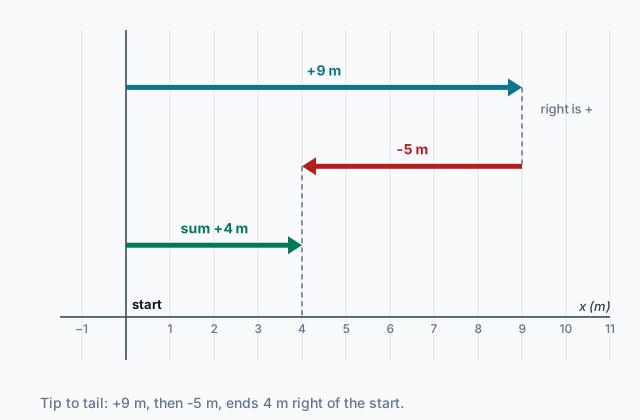
The diagram at the top of the page shows a cart that rolls 9 m to the right and then 5 m to the left, with right positive. The second arrow starts at the tip of the first, which is called drawing them tip to tail. The sum runs from the start of the first arrow to the tip of the last:
The cart ends 4 m to the right of where it began. The sign of the answer is its direction, which is why you say which way is positive before you add anything.
The tempting move is to add the sizes, 9 + 5 = 14. That 14 m is real, but it is the distance the cart rolled, a scalar. The vector sum is +4 m.
Quick check · Multiple choice
Take right as positive. A cart rolls 3.0 m to the right, then 5.0 m to the left. What is the component of its total displacement?
Part 3 Watch it done Finding a missing move
Watch each step, then do the last one yourself.
An elevator in a parking garage makes three moves along its shaft. Up is positive. It rises 12 m, then drops 20 m, then makes a third move. After the third move it is 3 m below where it started. What was the third move?
Step 1 · Say which way is positive
Up is positive, so every downward move gets a minus sign. Write that down before anything else, because every sign after this depends on it.
Step 2 · Name the pieces
Three moves, one of them unknown, and one place the elevator ends. Call the unknown third move . Each move gets a sign from the way it points, and so does the overall change from start to finish.
Why this step?
Why can the three moves simply be added?
All three moves lie along the same up-and-down line, so each is a component on one axis. Along one axis a vector sum is the sum of the signed numbers, and the signs take care of the directions.
Step 3 · Plan the sum
Add the three signed moves and set that sum equal to the signed overall change. Then the only unknown is , and one line of algebra finds it.
Your step · Calculate
Finish it. Up is positive. An elevator rises 12 m, then drops 20 m, then makes a third move , and ends 3 m below where it started. Write the vector sum with every sign in place and solve it. What is ? Include its sign.
m
Part 4 Try it Two people, two choices of positive
You and your lab partner film the same cart on the same track. You call the direction toward the door positive. She calls the direction toward the window positive, which is the opposite way. Neither choice is wrong. A sign convention is something you choose and state, not a fact about the cart, and the motion is the same whoever records it.
Try it · Fill the statement
You call the direction toward the door positive, and your partner calls the direction toward the window positive. Tap a blank, then a value.
A cart rolls toward the door at 3 m/s. You write its velocity as +3 m/s, and your partner writes it as . You both give its speed as . A second cart rolls toward the window at 2 m/s, and your partner writes its velocity as .
Part 5 Explain it Arrows, a sum, and why they agree
Nothing you type leaves this page. Check your answer against the model and each scoring point.
Free response is 50% of the exam score. This one is shaped like Question 2, Translation Between Representations.
Free-response practice · Question 2 style
A cart on a straight track is given a push. It rolls 1.6 m to the right, hits a spring bumper, and rolls 2.4 m to the left before it stops. Take right as positive. (A) On paper, draw an arrow for each of the two displacements, tip to tail, and an arrow for the total displacement. State your scale. (B) Write the total displacement as a sum of signed components, and calculate it with units. (C) Justify that your arrow for the total and your answer to (B) agree, in both direction and magnitude.
Model answer
(A) Scale: 1 cm stands for 0.4 m. The first arrow starts at the cart's starting point and is 4 cm long, pointing right. The second starts at the tip of the first and is 6 cm long, pointing left. The total runs from the start of the first arrow to the tip of the second, and is 2 cm long, pointing left. (B) Total displacement m. (C) The total arrow points left, the negative direction, which matches the minus sign in (B). It is 2 cm long, and 2 cm at 0.4 m per cm is 0.8 m, the magnitude of the sum.
Score your own answer. This is a self-check, not a grade. Tick each point your answer makes.
Part 6 Check yourself A robot in a hallway
The three case questions use the same robot. Answer them from the log.
A delivery robot drives along a straight hallway. East is positive. Its log lists the four legs of one trip in order. The robot also has an odometer, which counts how far its wheels roll.
| Leg | Move |
|---|---|
| 1 | 6.0 m east |
| 2 | 2.5 m west |
| 3 | 4.0 m west |
| 4 | 1.5 m east |
Case question 1 · Calculate
East is positive. A hallway robot drives four legs in order: 6.0 m east, 2.5 m west, 4.0 m west and 1.5 m east. What is the component of its total displacement for the trip, to the nearest 0.1 m? Include its sign.
Case question 2 · Multiple choice
East is positive. A hallway robot drives four legs in order: 6.0 m east, 2.5 m west, 4.0 m west and 1.5 m east. Its odometer counts how far its wheels roll. After the trip, how does the odometer reading compare with the magnitude of the robot's total displacement?
Case question 3 · Multiple choice
East is positive. A hallway robot drives 6.0 m east, then 2.5 m west. At the end of the second leg it is still moving west. Where is it at that moment, compared with its starting point?
The rest stand on their own and do not use the case.
Check yourself · Spot the error
Take right as positive. Cart P has m/s and cart Q has m/s. A student works out which cart is faster. Tap the first line that goes wrong.
Check yourself · Match
Right is positive, and on a grid each square stands for 2 m/s. Tap a velocity, then the description of the arrow that would show it.
Part 7 Keep it Hold on to it
This is the first lesson of the course, so there is nothing earlier to bring back yet. From the next lesson on, two questions from earlier lessons appear here.
In three lines
- A scalar has magnitude only, such as distance or speed. A vector has magnitude and direction, such as position, displacement, velocity or acceleration.
- A vector is an arrow whose length is in proportion to its magnitude. Along one axis its component's sign gives the direction, so needs no arrow over it.
- To add vectors on a line, state which way is positive, give opposite directions opposite signs, and add. Adding the sizes gives a distance, not the vector sum.
Vocabulary
- Scalar
- A quantity described by magnitude only, such as distance or speed.
- Vector
- A quantity described by both magnitude and direction, such as position, displacement, velocity or acceleration.
- Magnitude
- The size of a quantity with its direction left out, which is never negative: a velocity of 12 m/s to the left has a magnitude of 12 m/s.
- Vector component
- The part of a vector along one axis, written without an arrow, whose sign gives its direction along that axis.
- Vector sum
- The single vector that two or more vectors add up to; in one dimension, the sum of their components with opposite directions given opposite signs.
Course alignment, for teachers
AP Physics 1: Algebra-Based topic 1.1, Unit 1: Kinematics.
- Skill 1.A: Create diagrams, tables, charts, or schematics to represent physical situations.
- Skill 2.C: Compare physical quantities between two or more scenarios or at different times and locations in a single scenario.
- Skill 3.B: Apply an appropriate law, definition, theoretical relationship, or model to make a claim.
- Skill 3.C: Justify or support a claim using evidence from experimental data, physical representations, or physical principles or laws.
This lesson maps all 6 essential knowledge statements of the topic to the part that teaches each one: 6 are checked by a scored question. The map is in the lesson file.