Unit 2 · Topic 2.9 · about 30 minutes · 7 parts · 14 scored checks, 1 of them multiple choice
AP Physics 1: Algebra-Based 2.9: Circular Motion
 Tap to open the picture full size
Part 1 Think first A stopper on a string
Commit to a guess first. Being wrong now makes the right idea stick better.
Predict first
You whirl a rubber stopper on a string in a flat circle above your head, at a steady speed. Suddenly the string snaps. Seen from above, which path does the stopper follow in the moment after the string breaks?
In short. An object moving in a circle accelerates toward the center, with , and real forces, or parts of them, cause that acceleration; none of them is a separate centripetal force.
- If the speed is changing too, a tangential acceleration along the path adds to the centripetal acceleration as a vector.
- Period and frequency describe the repeating trip: , and at constant speed .
- In a circular orbit gravity alone turns the satellite, and links the period to the orbit's radius and the central body's mass.
Part 2 Learn it Four short ideas, each checked as you go
2a. Turning is accelerating
Whirl the stopper at a steady speed. Its speed never changes, but its velocity does: at every instant the velocity points along the circle, tangent to it, and that direction keeps turning. A change in velocity is an acceleration, so an object going around a circle at constant speed is accelerating.
That acceleration points toward the center of the circle, and it is called centripetal acceleration. Its size depends on the speed and the radius of the path:
Double the speed and is four times as big. Keep the speed and make the circle twice as wide, and is half as big.
If the speed is changing as well, there is a second part. Tangential acceleration is the rate at which the speed changes, and it points along the path: forward when the object speeds up, backward when it slows down. The object's acceleration is the vector sum of the two parts. A car speeding up around a bend has an acceleration that points toward the center of the bend, tilted forward.
Quick check · Match
A car drives counterclockwise around a flat, circular test track. Tap what the car is doing, then the direction of its acceleration at that instant.
2b. Period and frequency
Motion around a circle at constant speed is called uniform circular motion, and it repeats, so you can describe it by how long one trip takes. The period is the time for one full trip around the circle. The same word covers one full rotation of a spinning wheel, or one full cycle of anything that repeats, such as a swinging pendulum.
The frequency is the number of revolutions completed each second. A fan blade that turns 10 times a second has revolutions per second, or 10 Hz, and each turn takes a tenth of a second. Period and frequency are reciprocals:
In one period, an object at constant speed travels once around its circle, a distance of . Distance divided by time is speed, so , or
Every point on a turning wheel has the same period. A spot near the rim has a bigger circle to cover in that time than a spot near the hub, so it moves faster.
Quick check · Calculate
A playground merry-go-round turns at a steady frequency of 0.20 revolutions per second. A child sits 2.0 m from its center. What is the child's speed? Give your answer to the nearest 0.1 m/s.
2c. Real forces do the turning
Centripetal acceleration needs a net force, or at least part of one, pointing toward the center, as 2.5 says any acceleration does. That net force always comes from forces you can name.
- One force. A puck on frictionless ice circles a peg on a string. Gravity and the normal force cancel, and the string's tension alone points at the center.
- More than one. At the top of a vertical loop a roller coaster car is upside down. Gravity pulls it down and the track pushes it down, both toward the center. The slower the car goes, the less the track has to push. At the minimum speed that push is zero, gravity alone causes the centripetal acceleration, and gives . Any slower and the car drops off the circle.
- Parts of forces. On a road banked toward the center, part of the normal force points at the center, and part of the static friction can too. A ball whirled on a string so the string sweeps out a cone, a conical pendulum, is turned by the horizontal part of the tension.
The net force toward the center is often called the centripetal force. That names a job real forces do, not one more force, so it never gets an arrow of its own on a free-body diagram.
Quick check · Sort it
Each card names an object moving in a circle at a steady speed. Tap a card, then decide what causes its centripetal acceleration.
One force, pointing straight at the center, does it all
It takes more than one force, or part of a tilted force
2d. Circular orbits
A satellite in a circular orbit is a ball on a string with no string. Only gravity acts on it, so its gravitational attraction to the central body alone causes its centripetal acceleration.
From 2.6, a planet of mass pulls on a satellite of mass at distance from the planet's center with a force . Set that equal to , put in , and the satellite's mass cancels:
This is Kepler's third law for a circular orbit. The square of the period is proportional to the cube of the orbit's radius. A satellite four times as far out takes eight times as long to go around, because .
Nothing about the satellite appears in the equation, not even its mass. What sets the constant in front is the mass of the central body: around a more massive planet, an orbit of the same radius has a shorter period.
Quick check · Decide and justify
Two satellites orbit Earth in circular orbits of the same radius. Satellite P has three times the mass of satellite Q. How do their periods compare?
Which reason supports your answer?
Part 3 Watch it done A banked curve with no friction
Watch each step, then finish the problem yourself.
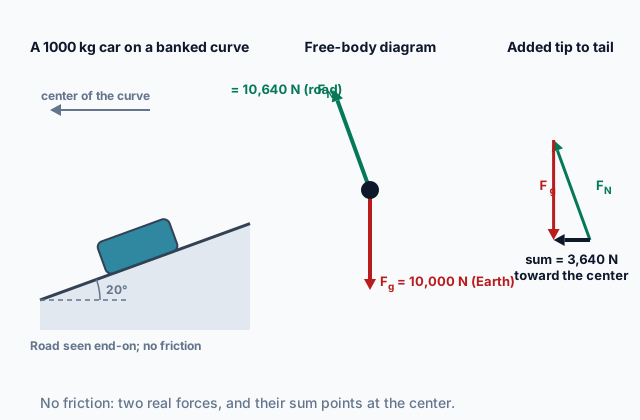
A highway curve has a radius of 90 m and is banked at 20° to the horizontal, tilted down toward the center of the curve. On ice the road exerts no friction, but at one particular speed a car can still take the curve without sliding up or down the bank. Find that speed.
Step 1 · List the forces on the car
With no friction, two forces act: gravity, , straight down, and the normal force , perpendicular to the road. The road tilts toward the center, so tilts toward the center too, as in the diagram at the top of the page. There is no extra arrow for a centripetal force.
Step 2 · Choose axes along the acceleration
The car goes around a horizontal circle at one height, so its acceleration, , points horizontally at the center. Take horizontal, toward the center, and straight up. Then .
Why this step?
Why horizontal and vertical axes here, when a block sliding down a ramp gets an axis along the slope?
Axes go along the acceleration. A block sliding down a ramp accelerates along the slope. This car never moves up or down the bank; it circles at one height, so its acceleration is horizontal. With axes tilted along the bank, both equations would carry part of the acceleration.
Step 3 · Write both equations and combine them
Only points off the axes, so only it is split, in the equations and not on the diagram. Vertically: . Toward the center: . Divide the second equation by the first: , so . The mass cancels, so the same speed works for a truck and for a motorbike.
Your step · Calculate
Finish it. A highway curve of radius 90 m is banked at 20° to the horizontal, tilted down toward the center. The road is icy, so friction is negligible. At what speed can a car take the curve without sliding up or down the bank? Give your answer to the nearest 0.1 m/s.
m/s
Part 4 Try it Off the design speed
A new situation. Engineers bank a curve for one speed, but drivers do not all drive at that speed. On a dry day, static friction from the road on the tires makes up the difference, and you can say which way it points without a single number.
Try it · Decide and justify
A curve on a dry road is banked so that a car taking it at 20 m/s needs no friction from the road. A slow truck takes the curve at a steady 12 m/s without sliding. Which way does the static friction force exerted by the road on the truck's tires point?
Which reason supports your answer?
One more turn, this time over the top of a hill, where the road itself is part of a circle.
Try it · Draw the forces
A car coasts over the crest of a rounded hill, where the road curves like the top of a circle, and it stays in contact with the road. Friction and air resistance are negligible. Build the car's free-body diagram at the crest, and set each arrow's length to compare with the other.
The dot is the car. One diagram that fits
Pick each force exerted on the car, then choose the way it points and how long its arrow is compared with the others. The arrows are drawn for you.
Part 5 Explain it Diagram, expression and graph
Nothing you type leaves this page. Check your answer against the model and each scoring point.
Free response is 50% of the exam score. This one is shaped like Question 2, Translation Between Representations.
Free-response practice · Question 2 style
A small ball of mass kg hangs from a light string 0.80 m long and swings back and forth, so it moves along part of a vertical circle of radius m. Air resistance is negligible. Consider the instant the ball passes through the lowest point of its swing with speed . Take up as positive, and use m/s².
(a) On paper, draw the free-body diagram of the ball at the lowest point. Represent each force as a straight arrow starting on the dot, and label each one with what exerts it.
(b) Starting from your diagram, derive an expression for the tension in the string at the lowest point, in terms of , , and .
(c) On axes of against , sketch the tension at the lowest point for speeds from up to m/s. Label the value at each end of your graph.
(d) Justify that your graph and your expression from (b) agree. Refer to the slope of the graph and to its intercept on the axis, and explain why the tension is greater than the gravitational force whenever the ball is moving.
Model answer
(a) A dot for the ball with two arrows starting on it: the gravitational force exerted by Earth, , straight down, and the tension exerted by the string, , straight up. There is no centripetal force arrow and no force along the path.
(b) At the lowest point the center of the ball's circle is the point the string hangs from, straight above, so the centripetal acceleration points up. With up positive, , so .
(c) A straight line that starts at N when and rises to N at m²/s².
(d) The expression is , which is linear in , so the graph against is a straight line. Its slope is kg/m, positive, and the graph rises 8.0 N over 16 m²/s², the same slope. Putting into the expression gives N, the intercept: a ball hanging at rest needs the string only to hold up its weight. For any speed above zero the term is positive, so : the net force has to point up, toward the center, to turn the ball's velocity, so the string pulls up harder than gravity pulls down.
Score your own answer. This is a self-check, not a grade. Tick each point your answer makes.
Part 6 Check yourself Three satellites
Both case questions use the satellites' table.
A space probe surveys a distant planet and tracks three satellites, each in a circular orbit around it. Each orbit radius is measured from the center of the planet, and each period is the time for one full orbit. Satellite C's period has not been measured yet.
| Satellite | Orbit radius (×10⁷ m) | Period (s) |
|---|---|---|
| A | 1.0 | 7,200 |
| B | 4.0 | 57,600 |
| C | 9.0 | ? |
Case question 1 · Calculate
Using the table of the planet's three satellites, what is the period of satellite C? Give your answer to three significant figures.
Case question 2 · Multiple choice
At a second planet, the probe tracks a satellite in a circular orbit of radius m with a period of 3,600 s. Comparing it with the first planet's satellites in the table, how does the second planet's mass compare with the first planet's?
The rest stand on their own and do not use the case.
Check yourself · Spot the error
A roller coaster car goes around the inside of a vertical circular loop of radius . A student finds the slowest speed the car can have at the top and still follow the loop, taking toward the center of the loop as positive. Tap the first line that goes wrong.
Check yourself · Sketch the graph
Cars drive around a flat, circular test track of radius 50 m, each at its own steady speed. Sketch the size of a car's centripetal acceleration against its speed, for speeds from 0 to 25 m/s. The first point is fixed at 0.
One shape that fits
Drag a point up or down, or tap it and use the arrow keys. The shape is checked, and the graph must pass through the values the question gives.
Check yourself · Draw the forces
A ball on a light string moves in a horizontal circle at constant speed, so the string sweeps out a cone. The string makes 30° with the vertical. At this instant the center of the ball's circle is directly to its left, and the string runs up and to the left from the ball to the point it hangs from. Air resistance is negligible. Build the ball's free-body diagram, and set each arrow's length to compare with the other.
The dot is the ball. One diagram that fits
Pick each force exerted on the ball, then choose the way it points and how long its arrow is compared with the others. The arrows are drawn for you.
Part 7 Keep it Bring back earlier ideas
Pulling an older idea back up is what makes it last.
From 1.2 Displacement, Velocity, and Acceleration · Sort it
Tap a card, then say whether the object in it is accelerating.
Accelerating
Not accelerating
From 2.2 Forces and Free-Body Diagrams · Draw the forces
You toss a ball straight up. It has left your hand and is still rising. Air resistance is negligible. Build the free-body diagram of the ball.
The dot is the ball. One diagram that fits
Pick each force exerted on the ball, then choose the way it points. The arrows are drawn for you.
In three lines
- An object moving in a circle accelerates toward the center with , and a changing speed adds a tangential part.
- At a steady speed, real forces or parts of them add up to a net force toward the center; a centripetal force is never an extra arrow.
- and , and for a circular orbit .
Vocabulary
- Centripetal acceleration
- The component of an object's acceleration directed toward the center of its circular path, with magnitude .
- Tangential acceleration
- The rate at which an object's speed changes, directed tangent to its circular path.
- Uniform circular motion
- The motion of an object traveling in a circular path at a constant speed.
- Period
- The time, , to complete one full circular path, one full rotation, or one full cycle of oscillatory motion.
- Frequency
- The rate, , at which an object completes revolutions, related to the period by .
- Kepler's third law
- For a satellite in a circular orbit, the relation between its period, its orbit radius and the mass of the central body.
Course alignment, for teachers
AP Physics 1: Algebra-Based topic 2.9, Unit 2: Force and Translational Dynamics.
- Skill 1.B: Create quantitative graphs with appropriate scales and units, including plotting data.
- Skill 2.A: Derive a symbolic expression from known quantities by selecting and following a logical mathematical pathway.
- Skill 2.D: Predict new values or factors of change of physical quantities using functional dependence between variables.
- Skill 3.A: Create experimental procedures that are appropriate for a given scientific question.
- Skill 3.C: Justify or support a claim using evidence from experimental data, physical representations, or physical principles or laws.
This lesson maps all 14 essential knowledge statements of the topic to the part that teaches each one: 14 are checked by a scored question. The map is in the lesson file.