Unit 6 · Topic 6.5 · about 30 minutes · 7 parts · 13 scored checks, 2 of them multiple choice
AP Physics 1: Algebra-Based 6.5: Rolling
 Tap to open the picture full size
Part 1 Think first A box and a ball on the same drop
Commit to a guess first. Being wrong now makes the right idea stick better.
Predict first
A box and a solid rubber ball have the same mass. Both start from rest at the top of ramps with the same height and the same slope. The box slides down a ramp of slick ice, where friction is negligible. The ball rolls without slipping down a ramp with a rubber surface. Air resistance is negligible for both. Which one is moving faster when it reaches the bottom?
In short. A rolling object moves and turns at once, so its total kinetic energy is its translational kinetic energy plus its rotational kinetic energy, and when it rolls without slipping its center's motion is tied to its turning by .
- Without slipping, , and , because the rim is laid on the ground with no sliding.
- In the ideal case, the friction on an object rolling without slipping dissipates no energy, because the point it acts on does not slide along the surface.
- While an object slips, its center's motion and its rotation cannot be directly related, and kinetic friction at the sliding contact dissipates energy.
Part 2 Learn it Four short ideas, each checked as you go
2a. Rolling ties the two motions together
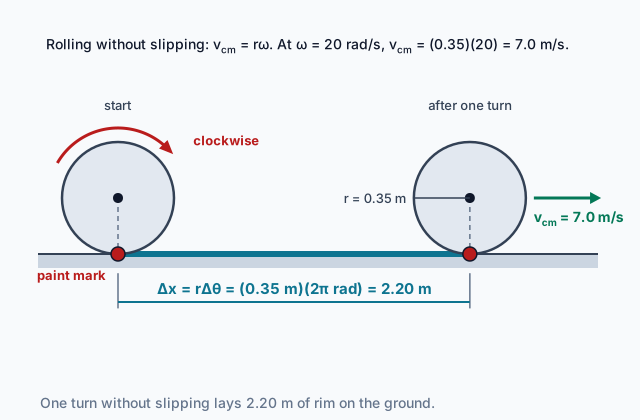
Paint a mark on a tire where it touches the road, then roll the wheel forward one full turn without letting it skid. The mark comes back to the bottom, and in between, the whole rim has been laid down on the road like tape coming off a roll. So the center moves forward one rim length, . For the 0.35 m wheel in the diagram, that is 2.20 m.
The same is true for any part of a turn. While an object rolls without slipping, the distance its center of mass moves equals the length of rim laid down:
with in radians, as in 5.2 Connecting Linear and Rotational Motion. Divide both sides by the time and you get the speeds, and do it again for the accelerations:
These look like the rim equations from 5.2, but they say something new. There, a point on a wheel fixed to an axle moved in a circle. Here the center of the whole object moves along the ground, and its speed is set by how fast it turns. The diagram's wheel turning at 20 rad/s has its center moving at m/s.
Quick check · Calculate
A skateboard rolls along a level sidewalk at a steady 4.5 m/s, and its wheels roll without slipping. Each wheel has a radius of 0.030 m. What is the angular speed of each wheel?
2b. Kinetic energy of a rolling object
In 6.1 Rotational Kinetic Energy a disk slid and spun on ice, and its kinetic energy had two parts. A rolling object is the same, so its total kinetic energy is
with about the center of mass. The difference is that rolling fixes the spin. With , the rotational part is set by the speed too.
Take a 2.0 kg thin hoop rolling at 3.0 m/s. Its translational part is J. Its rotational inertia is , so its rotational part is J as well, 18 J in all. A 2.0 kg solid disk at the same speed has , so its rotational part is half as much, 4.5 J, and its total is 13.5 J.
The radius cancels. What matters is how the mass is spread: the more of it sits far from the center, the bigger the rotational share at a given speed. For an extended object a problem gives you , as in 5.4 Rotational Inertia.
Quick check · Multiple choice
A 6.0 kg bowling ball of radius 0.11 m rolls without slipping down a level lane at 5.0 m/s. Its rotational inertia about its center is 0.029 kg·m². What is its total kinetic energy, to the nearest 5 J?
2c. Friction that takes no energy
A ball rolling down a ramp needs friction. Without it, the ball would slide down without starting to turn, the way the box did on the ice. So static friction from the ramp acts on the ball the whole way down.
Yet in the ideal case, that friction dissipates no energy. Look at where it acts: on the bit of the ball touching the ramp. When the ball rolls without slipping, that bit is not sliding along the ramp at that instant; it is set down and lifted off, like the paint mark. Friction that acts on a point that does not slide along the surface does no work on the system and turns none of its energy into thermal energy.
So for a rolling object and Earth, mechanical energy stays the same, as in 3.4 Conservation of Energy. A thin hoop rolling from rest down a 0.80 m drop has , so m/s. A box sliding down a frictionless ramp of the same height reaches m/s.
Real balls slow a little as they roll across a floor. That rolling friction is outside this course; here rolling is ideal.
Quick check · Decide and justify
A solid rubber ball rolls without slipping down a ramp, and static friction from the ramp acts on it the whole way down. Treat the rolling as ideal, and take the ball and Earth as the system. Does the friction dissipate any of the system's mechanical energy?
Which reason supports your answer?
2d. When an object slips
A bowler releases a ball so that it slides down the lane without turning. Now its bottom does slide, forward over the wood, and the lane exerts kinetic friction on the ball, backward.
That one force changes both motions at once. It slows the ball's center, and because it acts at the bottom of the ball, off its center, it makes a torque that sets the ball turning faster and faster. While this goes on, the ball is slipping: is larger than , and the two cannot be directly related. You can say how each one changes, and that is all this course asks: the center slows and the spin grows. Once the falling and the growing meet, the bottom stops sliding and the ball rolls without slipping from then on.
The slide also costs energy. Kinetic friction acts on a point that moves along the lane, so it dissipates energy from the ball, and the ball and lane warm up a little.
A car's tires spinning on ice slip the other way: is larger than , and kinetic friction dissipates energy there too.
Quick check · Sort it
Treat each rolling object as ideal. Tap a card, then whether friction from the surface dissipates any of the object's energy at the moment described.
Dissipates none
Dissipates some
Part 3 Watch it done A cylinder rolling up a ramp
Watch each step, then finish the problem yourself.
A 1.5 kg solid cylinder of radius 0.040 m rolls without slipping along level ground at 4.0 m/s, then rolls without slipping up a ramp. Its rotational inertia about its axis is . Treat the rolling as ideal and air resistance as negligible. How high above its starting height does its center rise before it stops?
Step 1 · Write the total kinetic energy at the bottom
. Rolling gives , so the rotational part is , and . The radius cancels.
Step 2 · Set up conservation of energy
Take the cylinder and Earth as the system. When the center has risen by the cylinder has stopped turning as well as moving, since the whole way. So , and the mass cancels: .
Why this step?
Static friction from the ramp acts on the cylinder all the way up. Why can you still set the kinetic energy at the bottom equal to ?
The cylinder rolls without slipping, so the part of it touching the ramp does not slide along the ramp. Friction acting on a point that does not slide does no work, so it dissipates none of the system's energy, and the system's mechanical energy stays the same.
Your step · Calculate
Finish it. A 1.5 kg solid cylinder of radius 0.040 m, with rotational inertia about its axis, rolls without slipping at 4.0 m/s and then rolls without slipping up a ramp, so its total kinetic energy at the bottom is . Rolling is ideal and air resistance is negligible. How high above its starting height does its center rise before it stops? Give your answer to the nearest 0.01 m.
m
Part 4 Try it A spinning ball set down on the floor
A new situation, and the reverse of the bowling ball: here the ball starts with spin and no forward motion. You spin a basketball so that, seen from the side, it turns clockwise with its center not moving, then set it gently on a level gym floor. At first it skids. Before you answer, picture which way the bottom of a clockwise ball moves, and which way friction on the ball must then point.
Try it · Draw the forces
Seen from the side, a 0.60 kg basketball spins clockwise with its center at rest, and you set it on a level gym floor. Just after it touches down, its bottom skids to the left over the floor, and the coefficient of kinetic friction between ball and floor is 0.50. Build the free-body diagram of the ball while it skids, and set each arrow's length to compare the forces.
The dot is the basketball. One diagram that fits
Pick each force exerted on the basketball, then choose the way it points and how long its arrow is compared with the others. The arrows are drawn for you.
Try it · Sketch the graph
Seen from the side, a basketball spins clockwise with its center at rest, and you set it on a level gym floor at 0 s. It skids for about 0.2 s, and from then on it rolls without slipping to the right. Treat the rolling as ideal. Sketch the speed of the ball's center against time from 0 to 0.8 s. The first point is fixed at 0.
One shape that fits
Drag a point up or down, or tap it and use the arrow keys. Only the shape is checked.
Part 5 Explain it Solid ball against hollow ball
Nothing you type leaves this page. Check your answer against the model and each scoring point.
Free response is 50% of the exam score. This one is shaped like Question 4, Qualitative/Quantitative Translation.
Free-response practice · Question 4 style
A uniform solid ball and a thin-walled hollow ball have the same mass and the same radius . About its center, the solid ball's rotational inertia is and the hollow ball's is . Both are released from rest, side by side, at the top of the same ramp, a height above its bottom, and both roll without slipping all the way down. Treat the rolling as ideal and air resistance as negligible.
(a) Make a claim about which ball is moving faster at the bottom of the ramp, or whether their speeds are equal, and which one reaches the bottom first. Explain your reasoning in words, without equations, using how the energy of each ball is shared.
(b) Write the rotational inertia of either ball as . Starting from conservation of energy, derive an expression for the speed of a ball's center at the bottom, in terms of , and . Then write for each ball.
(c) Explain how your expressions in (b) are consistent with your claim in (a), including why neither nor appears in them and why the faster ball at the bottom also arrives first.
(d) Static friction from the ramp acts on each ball. Explain why it does not appear in your energy equation in (b). Then explain what would change in your reasoning if the hollow ball slipped on part of the ramp.
Model answer
(a) The solid ball is moving faster at the bottom and arrives first. Both lose the same gravitational potential energy, and friction takes none of it, so both have the same total kinetic energy at the bottom. Rolling ties each ball's spin to its speed. The hollow ball has all its mass out at its surface, while much of the solid ball's mass is near its center, so at any speed the hollow ball needs more energy for its spin. More of its share goes into turning and less into moving forward, so its center is slower.
(b) Mechanical energy is conserved: . Rolling without slipping gives , so and . So
Solid ball, : . Hollow ball, : .
(c) is in the denominator, so the larger is, the smaller is. The hollow ball's is larger, so it is slower, as claimed: against . The factor is the energy-sharing argument of (a) in symbols: of the total, the fraction is translational. cancels because both the energy lost and the kinetic energy are proportional to it, and cancels because makes the rotational part . Only how the mass is spread, , is left, which is all the claim used. The forces on each ball are constant, so each speeds up at a constant rate from rest; over the same ramp length , , so , and the ball with the larger final speed takes less time.
(d) Static friction acts on the part of the ball touching the ramp, and while the ball rolls without slipping that part does not slide along the ramp. So the friction does no work and dissipates no energy, and the system's mechanical energy stays the same. If the hollow ball slipped, would no longer hold, so the speed and the spin could not be tied together as in (b). Its bottom would slide along the ramp, and kinetic friction would dissipate some energy, so would no longer all end up as the ball's kinetic energy.
Score your own answer. This is a self-check, not a grade. Tick each point your answer makes.
Part 6 Check yourself Four objects filmed on a gym floor
Both case questions use the gym floor table.
A student films four objects moving across a level gym floor, one at a time. From the video she measures each object's center speed and angular speed at one moment, and she looks up its mass, radius and rotational inertia about its center. Each object was turning in the direction a rolling object turns as it moves forward. Some of the objects were rolling without slipping at that moment, and some may not have been.
| Object | Mass (kg) | Radius (m) | Rotational inertia (kg·m²) | Center speed (m/s) | Angular speed (rad/s) |
|---|---|---|---|---|---|
| Bowling ball | 6.0 | 0.11 | 0.029 | 3.3 | 30.0 |
| Hoop | 1.2 | 0.50 | 0.30 | 2.5 | 5.0 |
| Soccer ball | 0.43 | 0.11 | 0.0035 | 4.4 | 40.0 |
| Solid cylinder | 2.0 | 0.10 | 0.010 | 1.5 | 22.0 |
Case question 1 · Multiple choice
Using the gym floor table, which object was slipping on the floor at the moment she measured it?
Case question 2 · Calculate
Using the gym floor table, what is the hoop's total kinetic energy at the moment she measured it? Give your answer to the nearest 0.1 J.
The rest stand on their own and do not use the case.
Check yourself · Spot the error
A 0.50 kg thin hoop, with rotational inertia about its center, starts from rest and rolls without slipping down a ramp, dropping 0.45 m. Rolling is ideal and air resistance is negligible. A student works out the speed of its center at the bottom. Tap the first line that goes wrong.
Check yourself · Match
Each quantity belongs to a wheel of radius r moving along level ground. Tap a quantity, then what it equals or how it is found.
Part 7 Keep it Bring back earlier ideas
Pulling an older idea back up is what makes it last.
From 6.1 Rotational Kinetic Energy · Calculate
A 0.20 kg flying disc sails across a field. At one instant its center of mass moves at 9.0 m/s and it spins at 40 rad/s about its center of mass, where its rotational inertia is 0.0030 kg·m². What is its total kinetic energy at that instant? Give your answer to the nearest 0.1 J.
A new situation, and this time the linear speed is the thing held fixed. A CD stores its music along one spiral track that starts near the center of the disc and winds outward. As the disc plays, the laser slowly moves out along the track, and the track has to pass under the laser at the same linear speed the whole time, about 1.2 m/s. So the motor keeps adjusting how fast the disc turns.
From 5.2 Connecting Linear and Rotational Motion · Calculate
A CD player reads a disc's track as it passes under the laser at a steady 1.2 m/s. At one moment the laser is reading the track 0.025 m from the center of the disc. What is the magnitude of the disc's angular velocity at that moment? Give your answer to the nearest 1 rad/s.
In three lines
- A rolling object's total kinetic energy is its translational plus its rotational kinetic energy, .
- Without slipping, , and , and in the ideal case friction dissipates no energy.
- While an object slips, its center's motion and its rotation cannot be directly related, and kinetic friction dissipates energy.
Vocabulary
- Total kinetic energy
- The sum of a system's translational kinetic energy, from the motion of its center of mass, and its rotational kinetic energy, from its rotation: .
- Rolling without slipping
- Rolling in which the part of the object touching the surface does not slide along it, so the center's motion is related to the rotation by , and .
- Rolling while slipping
- Rolling in which the object's surface slides over the surface it touches, so its center's motion and its rotation cannot be directly related, and kinetic friction dissipates energy.
Course alignment, for teachers
AP Physics 1: Algebra-Based topic 6.5, Unit 6: Energy and Momentum of Rotating Systems.
- Skill 1.A: Create diagrams, tables, charts, or schematics to represent physical situations.
- Skill 2.A: Derive a symbolic expression from known quantities by selecting and following a logical mathematical pathway.
- Skill 2.C: Compare physical quantities between two or more scenarios or at different times and locations in a single scenario.
- Skill 3.C: Justify or support a claim using evidence from experimental data, physical representations, or physical principles or laws.
This lesson maps all 5 essential knowledge statements of the topic to the part that teaches each one: 5 are checked by a scored question. The map is in the lesson file.