Unit 2 · Topic 2.4 · about 30 minutes · 7 parts · 13 scored checks, 2 of them multiple choice
AP Physics 1: Algebra-Based 2.4: Newton’s First Law
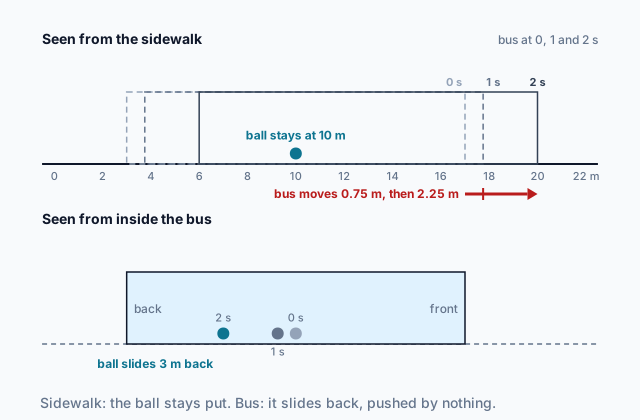 Tap to open the picture full size
Part 1 Think first A probe between the stars
Commit to a guess first. Being wrong now makes the right idea stick better.
Predict first
A space probe is drifting between the stars, so far from any star or planet that nothing pushes or pulls on it. Its engines are off, and it is moving at 15 km/s. What happens to its motion over the next ten years?
In short. Newton's first law says that when the net force on a system is zero, its velocity stays constant, so a system at rest stays at rest and a moving one keeps the same speed in the same direction.
- The net force is the vector sum of every force exerted on the system, and when it is zero the system is in translational equilibrium, .
- Forces can balance along one axis and not along another, and then the velocity changes only along the axis where they do not balance.
- An inertial reference frame is one from which an observer finds the first law holding, such as the ground, or anything moving at a constant velocity relative to it.
Part 2 Learn it Four short ideas, each checked as you go
2a. Adding up the forces
The net force on a system is the vector sum of all the forces exerted on it. Along one line that is ordinary adding, once each force carries a sign for its direction.
Two movers push a sofa east across a floor, one with 200 N and the other with 150 N, and friction from the floor pushes it west with 300 N. Take east as positive: N, which is 50 N east. Adding the sizes to get 650 N would treat friction as if it pushed east too.
Forces along different axes are added axis by axis. The sofa also has the gravitational force pulling it down and the floor's normal force pushing it up, and neither one changes the east-west sum. Add the vertical forces on their own. Here they add to zero, so the net force is just the horizontal sum. When both sums are nonzero, the net force points at an angle, and you combine the two sums the way you combined velocity components in 1.5.
The net force is a total, not one more force. It never gets an arrow of its own on a free-body diagram.
Quick check · Calculate
Two sled dogs pull a sled north across level snow on separate lines, one with a force of 120 N and the other with 90 N. Friction from the snow pushes south on the sled with 160 N, and the wind pushes south on the sled and its rider with 30 N. The vertical forces on the sled and rider balance. Take north as positive. What is the net force on the sled and rider?
2b. When the forces add to zero
When the net force on a system is zero, the system is in translational equilibrium:
The forces are all still there. They just add to nothing.
Newton's first law says what that does: if the net force exerted on a system is zero, the velocity of the system stays constant. A book lying on a desk stays at rest. A hockey puck sliding across frictionless ice keeps the same speed in the same direction. Both are in equilibrium, and one law covers both, because being at rest is a velocity of zero that stays zero.
The same law also tells you what a constant velocity means: if the velocity is not changing, nothing unbalanced is acting, so the net force is zero. Take a car cruising along a straight highway at a steady 30 m/s, and treat the air as the only thing holding it back. The road pushes its tires forward and the air pushes it back, and those two are equal. It is tempting to think the forward push has to win, since the car is moving forward. It does not. A bigger forward push would make the car speed up.
Nothing has to push a moving object to keep it moving. Things on Earth slow down because friction or air resistance acts on them.
Quick check · Decide and justify
A delivery truck drives north along a straight, level highway at a steady 25 m/s. Treat air resistance as the only force holding it back. A passenger says the forward force of the road on the truck's tires must be bigger than the air resistance, or the truck would slow down. Is the passenger right?
Which reason supports your answer?
2c. Balanced one way, not the other
Forces can balance along one axis and not along another. When that happens, the velocity changes only along the axis where they do not balance.
You have already seen one case. A ball rolls off a table, as in 1.5. Once it leaves the edge, nothing acts on it horizontally, so its horizontal velocity stays the same. Gravity acts vertically and nothing balances it, so its vertical velocity keeps changing.
Now turn it around. You shove a box across a level floor and let go. Vertically, gravity and the floor's normal force balance, so the box never rises or sinks into the floor. Horizontally, friction from the floor is the only force, pointing back against the slide, and nothing balances it. So the box's velocity changes only horizontally: it slows down along the line it was already moving, until it stops.
So take one axis at a time and ask whether the forces along it add to zero. The answer can be yes for one axis and no for the other, and the velocity changes only along the axis where the answer is no.
Quick check · Multiple choice
A curling stone slides north across level ice after it leaves the thrower's hand. Friction from the ice on the stone is small but not negligible, and air resistance is negligible. Take north as positive. How does the stone's velocity change while it slides?
2d. Where the first law holds
The first law makes a claim you can test: zero net force, constant velocity. Whether you see the claim hold depends on where you watch from.
The picture at the top of this page shows a ball resting on the smooth floor of a bus, with friction negligible, as the bus pulls away from a stop. From the sidewalk, nothing pushes the ball horizontally, and it stays where it was while the bus speeds up underneath it. The first law holds. From a seat on the bus, the ball starts to slide toward the back, faster and faster, and still nothing pushes it. Measured from the bus, the first law fails.
An inertial reference frame is one from which an observer would find Newton's first law holding. The sidewalk is one. The bus is one while it waits at the stop or cruises at a steady velocity in a straight line, but not while it speeds up, slows down or turns. That matches what you saw in 1.4: an inertial frame is one that is not accelerating.
Unless a problem says otherwise, assume the frame you measure from is inertial.
Quick check · Sort it
Each card describes where an observer watches from. Tap a card, then decide whether that observer would find Newton's first law holding there.
An inertial frame
Not an inertial frame
Part 3 Watch it done Pushing a box of books at a steady speed
Watch each step, then finish the problem yourself.
You push a 30 kg box of books across a level, carpeted floor in a straight line at a steady speed. You push on its back edge with a force of 200 N, directed 30° below the horizontal, toward the way the box slides. Find the friction force from the carpet and the normal force from the floor.
Step 1 · Name the forces
Four forces act on the box. Earth's gravitational force, N, points straight down. Your push, 200 N, points forward and 30° below the horizontal. The floor's normal force points straight up, and friction from the carpet points back, against the slide.
Step 2 · Use the first law
The box moves in a straight line at a steady speed, so its velocity is constant, and the net force on it is zero along both axes. Take the direction the box slides as and up as .
Why this step?
Why is the net force zero, when you are clearly pushing the box forward?
Because its velocity is not changing. Your forward push is matched by friction pushing back, so the two add to zero along . If your push won, the box would speed up.
Step 3 · Balance along x
Only part of your push is horizontal: N forward. Friction is the only other force along , so and N, pointing back.
Your step · Calculate
Finish it. You push a 30 kg box of books across a level floor in a straight line at a steady speed, pushing with a force of 200 N directed 30° below the horizontal, toward the way it slides. Take up as positive. How large is the normal force the floor exerts on the box?
N
Part 4 Try it A puck on a braking train
A new situation, and this time the frame is the question. A train is moving east along a straight track. On a passenger's tray table, a hockey puck sits on a sheet of slick plastic, so friction on the puck is negligible. While the train cruises at a steady speed, the puck stays put on the tray. Then the train brakes, and the puck slides east across the tray, toward the front of the train. Decide what that slide tells you, then describe the puck from the ground beside the track.
Try it · Decide and justify
A train moves east along a straight track. A hockey puck sits on a sheet of slick plastic on a passenger's tray table, so friction on it is negligible. When the train brakes, the puck slides east across the tray. The passenger says something must have pushed the puck east. Is the passenger right?
Which reason supports your answer?
Try it · Fill the statement
A train moving east brakes, and a puck on a slick tray table in it, with friction negligible, slides east across the tray. Tap a blank, then the phrase that completes the sentence.
Measured from the ground, the puck's velocity while the train brakes, because the net force on it is . The ground is an inertial frame, and the braking train is .
Part 5 Explain it Two diagrams and a graph
Nothing you type leaves this page.
Free response is 50% of the exam score. This one is shaped like Question 2, Translation Between Representations.
Free-response practice · Question 2 style
A worker slides a 40 kg crate to the right across a level warehouse floor by pushing it horizontally. From to s she pushes with a force of 160 N, and the crate moves at a constant 1.2 m/s. At s she lets go, and the crate slides to a stop. Friction from the floor is not negligible. Take right as and up as , and use m/s².
(a) On paper, draw two free-body diagrams of the crate: one for a moment before s, and one for a moment after she lets go, while the crate is still sliding. Represent each force as a straight arrow starting on the dot, and label each one with what exerts it.
(b) Starting from your first diagram, derive expressions for the friction force and the normal force on the crate in terms of , and , writing the equation you use along each axis. Then find the size of each.
(c) Sketch a graph of the crate's velocity against time from until it stops. You do not need to know when it stops, or the exact shape of the falling part.
(d) Justify that your graph agrees with your two diagrams. For each stretch of the graph, refer to the net force along , and explain why the crate's vertical velocity stays zero the whole time.
Model answer
(a) Before 3.0 s, four arrows from the dot: the gravitational force exerted by Earth, , down; the normal force exerted by the floor, , up and the same length; the worker's push, , to the right; and friction exerted by the floor, , to the left and the same length as the push. After she lets go, three arrows: down, up and the same length, and to the left. Neither diagram has a force of motion to the right. Friction is the same 160 N in both diagrams, since the normal force has not changed.
(b) The velocity is constant, so the crate is in translational equilibrium along both axes. Along : , so . Along : , so . Substituting, N and N.
(c) A horizontal line at m/s from 0 to 3.0 s, then a line or curve that falls from 1.2 m/s to zero with no jump at 3.0 s, after which the graph stays at zero. Any shape that falls all the way to zero earns this part; why the fall is in fact a straight line comes in 2.5.
(d) From 0 to 3.0 s the first diagram's horizontal forces cancel, so the net force along is zero, and by Newton's first law the velocity stays constant: the graph is flat. After 3.0 s the only horizontal force is friction, pointing left, so the net force along is not zero and points opposite the velocity. The velocity changes only along that direction, so the rightward velocity decreases and the graph slopes down to zero. In both diagrams the normal force and the gravitational force balance, so the net force along is zero the whole time, and the crate's vertical velocity stays zero: it never lifts off the floor or sinks into it.
Score your own answer. This is a self-check, not a grade. Tick each point your answer makes.
Part 6 Check yourself A skydiver's fall
Both case questions use the skydiver's table.
A skydiver jumps from a hot-air balloon that is hanging still, so she starts falling from rest. Her velocity is recorded every 3 s, with down as positive. She and her gear have a mass of 75 kg. Air resistance pushes up on her, and it grows as she falls faster.
| Time (s) | Velocity (m/s) |
|---|---|
| 0 | 0 |
| 3 | 27 |
| 6 | 42 |
| 9 | 47 |
| 12 | 49 |
| 15 | 50 |
| 18 | 50 |
| 21 | 50 |
Case question 1 · Multiple choice
Using the skydiver's velocity table, with down as positive: at 6 s, how does the size of the air resistance on her compare with the size of the gravitational force on her?
Case question 2 · Calculate
Using the skydiver's velocity table, with down as positive: she and her gear have a mass of 75 kg. How large is the upward force of air resistance on her at 18 s?
The rest stand on their own and do not use the case.
Check yourself · Draw the forces
A girl pulls her little brother on a sled to the right across level snow at a steady 1.5 m/s, using a horizontal rope. The gravitational force on the sled and her brother together is 300 N, and friction from the snow on the sled is 45 N. Build the free-body diagram of the sled and her brother, and set each arrow's length to compare with the others.
The dot is the sled and her brother. One diagram that fits
Pick each force exerted on the sled and her brother, then choose the way it points and how long its arrow is compared with the others. The arrows are drawn for you.
Check yourself · Spot the error
A 1200 kg elevator rises at a steady 2 m/s. Air resistance is negligible, and up is positive. A student works out how hard its cable pulls up on it. Tap the first line that goes wrong.
Part 7 Keep it Bring back earlier ideas
Pulling an older idea back up is what makes it last.
From 2.3 Newton’s Third Law · Draw the forces
A hockey puck slides to the right across level ice after a player has hit it with a stick. Friction and air resistance are negligible. Build the free-body diagram of the puck while it slides.
The dot is the puck. One diagram that fits
Pick each force exerted on the puck, then choose the way it points and how long its arrow is compared with the others. The arrows are drawn for you.
From 1.4 Reference Frames and Relative Motion · Sort it
A rider on a train moving at a steady velocity along a straight track and a person on the platform watch the same events. Air resistance is negligible. Tap each measurement, then where it belongs.
Depends on the observer's frame
The same in every inertial frame
In three lines
- The net force is the vector sum of every force on a system; when it is zero the system is in translational equilibrium and its velocity stays constant.
- Forces can balance along one axis and not another, and the velocity changes only along the axis where they do not balance.
- An inertial reference frame is one where the first law holds: the ground, or anything moving at a constant velocity relative to it.
Vocabulary
- Net force
- The vector sum of all the forces exerted on a system.
- Translational equilibrium
- A configuration of forces on a system in which the net force exerted on it is zero, .
- Newton's first law
- The law that if the net force exerted on a system is zero, the velocity of that system remains constant.
- Inertial reference frame
- A frame of reference from which an observer would verify Newton's first law, which is a frame that is not accelerating.
Course alignment, for teachers
AP Physics 1: Algebra-Based topic 2.4, Unit 2: Force and Translational Dynamics.
- Skill 1.C: Create qualitative sketches of graphs that represent features of a model or the behavior of a physical system.
- Skill 2.A: Derive a symbolic expression from known quantities by selecting and following a logical mathematical pathway.
- Skill 3.B: Apply an appropriate law, definition, theoretical relationship, or model to make a claim.
- Skill 3.C: Justify or support a claim using evidence from experimental data, physical representations, or physical principles or laws.
This lesson maps all 5 essential knowledge statements of the topic to the part that teaches each one: 5 are checked by a scored question. The map is in the lesson file.