Unit 4 · Topic 4.3 · about 30 minutes · 7 parts · 13 scored checks, 2 of them multiple choice
AP Physics 1: Algebra-Based 4.3: Conservation of Linear Momentum
 Tap to open the picture full size
Part 1 Think first A shove on the ice
Commit to a guess first. Being wrong now makes the right idea stick better.
Predict first
A 40 kg girl and her 80 kg father stand face to face, at rest, on skates on smooth ice. He holds his arms out stiff and does not push. She shoves hard on his hands. Friction from the ice is negligible. What happens just after the shove?
In short. Conservation of linear momentum says a system's total momentum stays constant whenever the net external force on it is zero, and the system you choose decides whether that is so.
- A system's total momentum is the sum of its parts' momenta, each with its sign, and its center of mass moves at .
- Inside a system, any change in one object's momentum is balanced by an equal and opposite change somewhere else in the system.
- When the net external force on a system is not zero, momentum crosses its boundary, and the system's momentum changes by the impulse exerted on it, .
Part 2 Learn it Four short ideas, each checked as you go
2a. Adding up a system's momentum
An object's momentum is , and it points the same way as its velocity. A system of several objects has a total momentum, the sum of the momenta of its parts:
Along a line, that means keeping signs. Take right as positive. A 3.0 kg cart rolling right at 2.0 m/s has kg·m/s. A 2.0 kg cart rolling left at 1.5 m/s has kg·m/s. Their total is kg·m/s. Drop the minus sign and you get 9.0, three times too much.
The whole collection can also be described as one system with one velocity: the velocity of its center of mass, the point you located in 2.1 Systems and Center of Mass.
For the two carts, m/s, to the right. Neither cart moves at 0.60 m/s, but the point that stands for the system does. Divide by the total mass, not by the number of objects: the heavier cart counts for more.
Quick check · Calculate
On a level track, a 0.60 kg cart rolls right at 2.5 m/s and a 0.90 kg cart rolls left at 1.0 m/s. Take right as positive. What is the velocity of the center of mass of the two-cart system? Include the sign, and give your answer to the nearest 0.01 m/s.
2b. Equal and opposite impulses
Two carts collide on a level track. For the moment they touch, cart A pushes cart B forward and cart B pushes cart A back. By Newton's third law, from 2.3 Newton’s Third Law, those two forces are equal in size and opposite in direction at every instant, and they last exactly as long, because neither cart can touch the other without being touched back. An impulse is an average force times the time it acts, . So the impulse A exerts on B is equal and opposite to the impulse B exerts on A.
Each impulse changes the momentum of the cart it acts on. Add the two changes and you get zero: whatever momentum B gains, A loses.
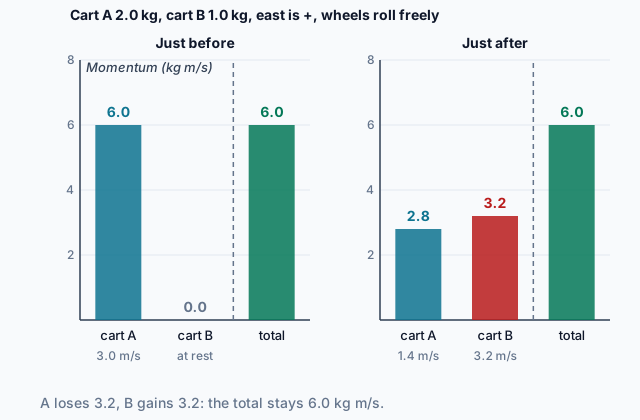
The diagram at the top of the page puts numbers on it. Cart A, 2.0 kg, moves at 3.0 m/s into cart B, 1.0 kg, at rest. Just after, A moves at 1.4 m/s and B at 3.2 m/s, both forward. Cart A's momentum drops from 6.0 to 2.8 kg·m/s, a change of kg·m/s, and cart B's rises from 0 to kg·m/s. The total is 6.0 kg·m/s before and after.
The velocity changes are not equal. B's velocity changed by 3.2 m/s and A's by only 1.6 m/s, because A has twice the mass. It is the momentum changes that match.
Quick check · Decide and justify
A loaded 12,000 kg truck and a 1,200 kg car collide head-on on a highway. During the collision, how does the size of the car's change in momentum compare with the size of the truck's?
Which reason supports your answer?
2c. The system decides
Momentum is conserved in every interaction: whatever one object gains, something else loses. Whether a particular system's momentum stays constant depends on what you put inside it.
Draw the line around both carts of a collision and their pushes on each other are internal. The two impulses cancel inside the system, so its total does not change. You can always choose a system this way, so that its total momentum is constant.
Draw the line around cart B alone and cart A is outside. Its push is now an external force, and it transfers momentum into the system. The system's momentum changes by exactly the impulse exerted on it:
If the net external force on the system you chose is zero, its total momentum is constant. If the net external force is not zero, momentum is transferred between the system and its environment. A dropped ball, taken alone, gains downward momentum, because Earth's pull is external to it. Put Earth in the system and Earth gains just as much momentum upward, a change far too small to notice in something so massive.
The center of mass follows the same rule. With no net external force, is constant: in the diagram's collision, m/s before, during and after.
Quick check · Sort it
Each card describes an event and names a system. Tap a card, then what happens to that system's total momentum during the event.
Stays constant
Changes
2d. Just before and just after
To find a velocity just after a collision or an explosion, choose a system that contains everything that pushes during it. Set the total momentum just before equal to the total just after, and solve for the one unknown.
The word just matters. During a collision the objects push on each other far harder than anything outside pushes on them, and only for a moment. A dart hitting a block on a rough floor feels a huge push for a few milliseconds, while the floor's friction is small, so its impulse over those milliseconds is negligible. Momentum is constant from just before to just after, even though friction slows the block down afterward.
An explosion runs the same way. A 2.0 kg spring launcher sits at rest on a level track, its wheels rolling freely, and fires a 0.50 kg ball east at 6.0 m/s along the track. The total was zero before, so it is zero after: , and m/s. The launcher recoils west.
In two dimensions, momentum is conserved along each axis separately. When two pucks on an air table collide at an angle, the total momentum along is the same before and after, and so is the total along . Write both equations and reason from them about which way an object must move; you will not be asked to solve two unknowns at once.
Quick check · Multiple choice
On a level air table, where friction is negligible, puck A of mass 0.30 kg slides east at 2.0 m/s and hits puck B of mass 0.30 kg, which is at rest. Just after the collision, puck A moves east and north, with an eastward part slower than 2.0 m/s. Take east and north as positive. Which describes puck B's velocity just after the collision?
Part 3 Watch it done A cart bounces off a heavier one
Watch each step, then finish the problem yourself.
On a level track, with the wheels rolling freely, a 0.50 kg cart moving east at 2.0 m/s runs into a 1.5 kg cart at rest. Just after the collision, the 0.50 kg cart moves west at 0.40 m/s. Take east as positive. What is the velocity of the 1.5 kg cart just after the collision?
Step 1 · Choose the system
Take both carts. Their pushes on each other are internal. Earth's pull and the track's push on each cart are vertical and balance, and with the wheels rolling freely nothing pushes along the track, so the net external force is zero. The total momentum just after equals the total just before.
Why this step?
Why take both carts as the system, instead of the 1.5 kg cart alone?
With both carts inside, the pushes between them are internal, their impulses cancel, and one equation, total before equals total after, holds. With the 1.5 kg cart alone, the other cart's push is external, and you would need the impulse it delivered, which nobody measured.
Step 2 · Total momentum before
Only the 0.50 kg cart moves: kg·m/s.
Step 3 · Sign the velocities after
The 0.50 kg cart now moves west, so its velocity is m/s, not . The 1.5 kg cart's velocity is the unknown .
Your step · Calculate
Finish it. On a level track, with the wheels rolling freely, a 0.50 kg cart moving east at 2.0 m/s runs into a 1.5 kg cart at rest. Just after the collision, the 0.50 kg cart moves west at 0.40 m/s. Take east as positive. What is the velocity of the 1.5 kg cart just after the collision? Include the sign, and give your answer to the nearest 0.01 m/s.
m/s
Part 4 Try it Two carts pushed apart
A new situation: nothing moves at the start. Two carts sit touching on a level track, with a squeezed spring plunger between them, and a pin holds it shut. Pull the pin and the plunger pushes the carts apart. First draw the forces on one cart while the plunger pushes. Then practice explosions like this one, with new numbers each time.
Try it · Draw the forces
Two carts sit at rest, touching, on a level track, with a squeezed spring plunger on the left cart pressing against the right cart. The wheels roll freely. A pin is pulled, and for about 0.03 s the plunger pushes the right cart, which has a mass of 1.0 kg, to the right with a force of about 20 N. Build the free-body diagram of the right cart while the plunger pushes, and set each arrow's length to compare the forces.
The dot is the right cart. One diagram that fits
Pick each force exerted on the right cart, then choose the way it points and how long its arrow is compared with the others. The arrows are drawn for you.
Part 5 Explain it Design a test of momentum conservation
Nothing you type leaves this page. Check your answer against the model and each scoring point.
Free response is 50% of the exam score. This one is shaped like Question 3, Experimental Design and Analysis.
Free-response practice · Question 3 style
A student wants to test whether the total momentum of a two-cart system is conserved when the carts collide. She has a level track, two carts whose wheels roll freely, a motion sensor for each end of the track, a balance, and a spring bumper fixed to the front of cart 1.
(a) Describe a procedure for measuring the total momentum of the two-cart system just before and just after a collision, for at least five collisions at different starting speeds. Say what she measures, with which equipment, and give enough detail that another student could repeat it.
(b) Take the two carts as the system. Explain why its total momentum should be the same just before and just after a collision. Say which graph of her results should be a straight line, and what its slope should be if momentum is conserved.
In every run, cart 1, of mass 0.50 kg, is pushed east toward cart 2, of mass 1.00 kg, which starts at rest. East is positive. Her results:
- Run 1: cart 1 before, 0.42 m/s; cart 1 after, m/s; cart 2 after, 0.26 m/s
- Run 2: cart 1 before, 0.61 m/s; cart 1 after, m/s; cart 2 after, 0.36 m/s
- Run 3: cart 1 before, 0.83 m/s; cart 1 after, m/s; cart 2 after, 0.49 m/s
- Run 4: cart 1 before, 1.02 m/s; cart 1 after, m/s; cart 2 after, 0.62 m/s
- Run 5: cart 1 before, 1.19 m/s; cart 1 after, m/s; cart 2 after, 0.71 m/s
(c) On paper, calculate the total momentum before and after each collision, plot the total after against the total before, and draw a best-fit line. Calculate its slope, and explain whether her data support the claim that the system's momentum is conserved.
(d) Her partner repeats the runs, but he launches cart 1 by hand and keeps his hand on it, still pushing it east, until after the collision. Explain whether his values of total momentum after would be larger than, smaller than or equal to his values of total momentum before.
Model answer
(a) Weigh each cart on the balance to get its mass. Fix a motion sensor at each end of the track, the west one aimed at cart 1 and the east one at cart 2, each recording velocity against time. Set cart 2 at rest in the middle of the track. Push cart 1 east and let go well before it reaches cart 2. From the sensors' velocity-time graphs, read cart 1's velocity just before the collision and each cart's velocity just after it, with east positive, so a cart moving west gets a negative velocity. The east sensor counts motion toward itself as negative, so it reads cart 2 moving east as a negative velocity: reverse the sign of its readings so both sensors use east as positive. Repeat with at least five different pushes, from gentle to hard.
(b) Each cart's push on the other is internal, and the two impulses are equal and opposite, so they cancel. On each cart, Earth's pull and the track's push are vertical and balance, and the wheels roll freely, so nothing pushes along the track. The net external force on the system is zero, so its total momentum is constant. A graph of total momentum after against total momentum before should be a straight line through the origin with slope 1.
(c) Before, : 0.210, 0.305, 0.415, 0.510 and 0.595 kg·m/s. After, : for run 1, , then 0.300, 0.405, 0.520 and 0.590 kg·m/s. The points lie close to one straight line through the origin. Two points on my best-fit line, not data points, are and kg·m/s, so the slope is . Every run's total after is within about 2.5 percent of its total before, so the data support the claim: the momentum cart 1 lost is the momentum cart 2 gained.
(d) Larger. His hand is outside the two-cart system and keeps pushing east between the reading just before and the reading just after, so the net external force on the system is not zero. His push transfers eastward momentum into the system, so each total after is larger than the total before it, and his points sit above a line of slope 1. Momentum is still conserved; it came in from outside his system.
Score your own answer. This is a self-check, not a grade. Tick each point your answer makes.
Part 6 Check yourself Two gliders on an air track
Both case questions use the glider table.
Two gliders collide on a level air track, where friction is negligible. Glider A has a mass of 0.40 kg and glider B a mass of 0.80 kg. Their bumpers are pressed together from 0.15 s to 0.25 s. Motion sensors record each glider's momentum, with east as positive.
| Time (s) | Glider A (kg·m/s) | Glider B (kg·m/s) |
|---|---|---|
| 0.00 | +0.48 | -0.12 |
| 0.10 | +0.48 | -0.12 |
| 0.20 | +0.20 | +0.16 |
| 0.30 | -0.06 | +0.42 |
| 0.40 | -0.06 | +0.42 |
Case question 1 · Calculate
Using the glider table, with east as positive: what impulse does glider B exert on glider A between 0.00 s and 0.40 s? Include the sign, and give your answer to the nearest 0.01 N·s.
Case question 2 · Multiple choice
Using the glider table, with east as positive: what is the velocity of the two gliders' center of mass at 0.20 s, while their bumpers are pressed together?
The rest stand on their own and do not use the case.
Check yourself · Spot the error
A 60 kg skater stands at rest on smooth ice holding a 3.0 kg ball. She throws the ball east at 8.0 m/s. Take east as positive. A student finds the skater's velocity just after the throw. Tap the first line that goes wrong.
Check yourself · Match
Take east and up as positive. Tap each event, then the impulse exerted on the system it names.
Check yourself · Fill the statement
Two carts collide on a level track, their wheels rolling freely. Take both carts as the system. Tap a blank, then an answer.
During the collision, the velocity of the system's center of mass , because the force on the system is zero. If the track were tilted, Earth's pull along it would momentum between the system and its environment.
Part 7 Keep it Bring back earlier ideas
Pulling an older idea back up is what makes it last.
From 2.3 Newton’s Third Law · Decide and justify
A bus moving at 25 m/s hits a small bug that is hovering almost still, and the bug splats on the windshield. During the collision, how does the force the bus exerts on the bug compare with the force the bug exerts on the bus?
Which reason supports your answer?
From 2.1 Systems and Center of Mass · Calculate
Two carts sit on a straight track. Positions are measured from the left end of the track, with right as positive. A 0.40 kg cart is at m and a 1.20 kg cart is at m. Where is the center of mass of the two-cart system? Give your answer to the nearest 0.01 m.
In three lines
- A system's total momentum is the sum of its parts' momenta with signs, and its center of mass moves at the total momentum over the total mass.
- Two interacting objects exert equal and opposite impulses on each other, so one's gain in momentum is the other's loss.
- With no net external force a system's momentum is constant; otherwise it changes by the impulse from outside, .
Vocabulary
- Total momentum
- The sum of the momenta of a system's constituent parts, , with each momentum's direction kept.
- Center-of-mass velocity
- The one velocity that describes a collection of objects as a single system, , which is constant when no net external force acts.
- Conservation of linear momentum
- The principle that momentum is conserved in all interactions, so a system's total momentum is constant whenever the net external force on it is zero.
- Impulse
- The average force exerted on a system times the time interval it acts, , which equals the system's change in momentum.
Course alignment, for teachers
AP Physics 1: Algebra-Based topic 4.3, Unit 4: Linear Momentum.
- Skill 1.A: Create diagrams, tables, charts, or schematics to represent physical situations.
- Skill 2.A: Derive a symbolic expression from known quantities by selecting and following a logical mathematical pathway.
- Skill 2.D: Predict new values or factors of change of physical quantities using functional dependence between variables.
- Skill 3.C: Justify or support a claim using evidence from experimental data, physical representations, or physical principles or laws.
This lesson maps all 12 essential knowledge statements of the topic to the part that teaches each one: 12 are checked by a scored question. The map is in the lesson file.