Unit 2 · Topic 2.8 · about 30 minutes · 7 parts · 11 scored checks, 1 of them multiple choice
AP Physics 1: Algebra-Based 2.8: Spring Forces
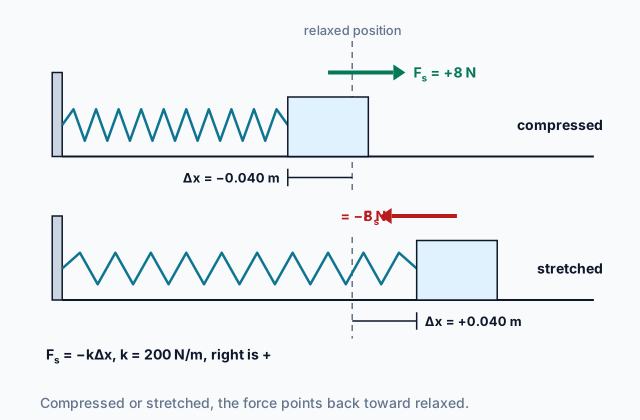 Tap to open the picture full size
Part 1 Think first Two bags on one spring
Commit to a guess first. Being wrong now makes the right idea stick better.
Predict first
A spring hangs from a hook. With nothing on it, it is 20 cm long. You hang a bag of marbles from it, and once the bag settles the spring is 24 cm long. You hang a second, identical bag beside the first. When both bags settle, how long is the spring?
In short. A spring force is the push or pull an ideal spring exerts on an object attached to it, set by how much the spring's length has changed and aimed back toward its relaxed length.
- An ideal spring has negligible mass, and its force is proportional to the change in its length from its relaxed length, whether it is stretched or compressed.
- Hooke's law, , gives the force, and the spring constant , in N/m, says how stiff the spring is.
- The spring's force always points back toward its relaxed length, opposite the change in length, whichever way the object is moving. On a level, frictionless surface that is the equilibrium position.
Part 2 Learn it Three short ideas, each checked as you go
2a. A spring's force grows with its change in length
A spring with nothing pulling or pushing on it sits at its relaxed length. Stretch it and it pulls back on whatever holds its end. Squeeze it and it pushes back. How hard it pulls or pushes depends on how much its length has changed from that relaxed length.
For an ideal spring the rule is as simple as it gets: the force is proportional to the change in length. Stretch the spring 2 cm and it pulls with some force. Stretch it 4 cm and it pulls twice as hard, and 6 cm, three times as hard. Compress it 2 cm and it pushes with the same size of force that a 2 cm stretch gives. An ideal spring also has negligible mass, so you never count it in a system's mass. A real spring behaves this way as long as it is not stretched past its limits.
The word that matters is change. The spring in the bag question is 20 cm long relaxed and 24 cm long with one bag on it, so its change in length is 4 cm, not 24 cm. Double the weight and the change doubles to 8 cm.
Quick check · Sketch the graph
A student finds that when a 6 N weight hangs at rest from an ideal spring, the spring is stretched 4 cm. Sketch the size of the force the spring exerts against how far it is stretched, from 0 to 8 cm. The first point is fixed at zero.
One shape that fits
Drag a point up or down, or tap it and use the arrow keys. The shape is checked, and the graph must pass through the values the question gives.
2b. Hooke's law and its minus sign
Write the proportion as an equation and you have Hooke's law:
Here is how far the end of the spring has moved from where it sits when the spring is relaxed, positive one way along your axis and negative the other. The spring constant belongs to the spring alone and is measured in newtons per meter. A stiff spring has a large : it takes a big force to change its length a little.
The size of the force is times the size of . The spring in the diagram at the top of this page has N/m, so moving its end 0.040 m gives N. Use meters: in centimeters you would get 800, a hundred times too big.
The minus sign carries the direction. In the diagram right is positive. Stretch the spring so its end moves 0.040 m right, and m, so N, a pull to the left. Compress it 0.040 m and m, so N, a push to the right. The force always has the opposite sign to the displacement.
Quick check · Match
A block on a level, frictionless table is joined to a horizontal ideal spring with N/m, and the spring's other end is fixed to a wall. Right is positive, and is how far the spring's end is from where it sits when the spring is relaxed. Tap each displacement, then the force the spring exerts on the block.
2c. Always back toward the relaxed length
The force a spring exerts on an object always points back toward where the spring would be relaxed, opposite to the change in its length. That is what the minus sign says. For a block on a level, frictionless table, with nothing else pushing along the spring, the relaxed position is also the equilibrium position of the object-spring system, where the net force is zero and the block could sit at rest.
The direction depends only on where the object is, never on which way it is moving. Pull a block on a spring to the right and let go. It slides back left, through the relaxed position, and keeps going. Once past it the spring is squeezed, so it pushes right, slowing the block even though it is still moving left.
Hang a block from a spring and it settles where the spring's upward pull balances gravity, using the balance from 2.4: in size. That resting point is below the relaxed length. Lift the block part way back up and the spring is still stretched, so it still pulls up, though the resting point is now below the block. What points toward the resting point is the net force, the spring's pull and gravity together.
Quick check · Spot the error
A block on a level, frictionless table is joined to a horizontal ideal spring with N/m, whose left end is fixed to a wall. Right is positive, and is how far the spring's end is from where it sits when the spring is relaxed. A student pushes the block left, compressing the spring 0.05 m, then lets go, and explains the spring's force. Tap the first line that goes wrong.
Part 3 Watch it done Weighing with a spring
Watch each step, then finish the problem yourself.
A light spring hangs from a hook. A 0.40 kg block hanging at rest from it stretches it 0.050 m. The block is then replaced by a 0.60 kg block, which also comes to rest. Find the spring constant, then how far the spring is stretched with the 0.60 kg block.
Step 1 · Find the forces on the first block
Take up as positive. Two forces act on the 0.40 kg block. Earth pulls it down with N. The spring is stretched, and it pulls the block up. Nothing else touches it.
Why this step?
Why does the spring pull the block up, when the block has pulled the spring's end down?
Because a spring's force points opposite to the displacement of its end. With up as positive the end moved down, so m, and comes out positive: up, back toward where the spring was relaxed.
Step 2 · Balance the forces to find k
The block is at rest, so the forces on it balance: , which gives N/m. That number belongs to the spring, so it stays the same when the block changes.
Step 3 · Set up the second block
The 0.60 kg block weighs N. At rest the spring must pull up on it with 6.0 N, and it is the same spring, so in size N.
Your step · Calculate
Finish it. A light spring hangs from a hook. A 0.40 kg block hanging at rest from it stretches it 0.050 m. The block is replaced by a 0.60 kg block, which also comes to rest. How far is the spring stretched now? Give your answer in centimeters.
cm
Part 4 Try it A homemade spring scale
A new situation, with no numbers to plug in. You want to turn an ideal spring into a scale for weighing fruit. It hangs from a hook beside a ruler, with a pointer on its lower end. With nothing hanging, you mark the pointer's position as 0 N. Then you hang a 5 N weight, wait for it to settle, and mark the pointer's new position as 5 N. You have no 10 N weight, but you still want a 10 N mark.
Try it · Decide and justify
An ideal spring hangs beside a ruler. You mark its pointer's position with nothing hanging as 0 N, and its position with a 5 N weight hanging at rest as 5 N. Where should the 10 N mark go, measured from the 0 N mark?
Which reason supports your answer?
Part 5 Explain it Derive it, then put in numbers
Nothing you type leaves this page.
Free response is 50% of the exam score. This one is shaped like Question 1, Mathematical Routines.
Free-response practice · Question 1 style
A block of mass hangs at rest from the lower end of a vertical ideal spring with spring constant . The spring's upper end is fixed to a ceiling. Take up as positive, and use m/s².
(a) Draw a free-body diagram of the block at rest. Then derive an expression for the distance the spring is stretched from its relaxed length, in terms of , and .
(b) The block's mass is 0.30 kg, and the spring is stretched 0.060 m. Calculate the spring constant .
(c) A student pulls the block straight down a further 0.020 m and holds it still. Calculate the magnitude of the force the spring now exerts on the block, and state its direction.
(d) The student lets go. Calculate the magnitude and direction of the block's acceleration at the instant it is released.
Model answer
(a) The free-body diagram has two arrows of equal length from the block: the spring's force up and the gravitational force down. The spring is stretched by , so its force has size and points up. The block is at rest, so the forces balance: , which gives .
(b) From (a), N/m.
(c) The spring is now stretched m from its relaxed length, so the force has size N. The spring is stretched, so it pulls the block up, back toward its relaxed length.
(d) Just after release the spring pulls up with 4.0 N and gravity pulls down with N, so the net force is N, up, back toward the equilibrium position where the block hung at rest. Then m/s², directed up.
Score your own answer. This is a self-check, not a grade. Tick each point your answer makes.
Part 6 Check yourself A spring and a set of masses
Both case questions use the spring table.
A student hangs an ideal spring from a hook beside a meter stick. She hangs slotted masses from its lower end, one set at a time, and once each set hangs at rest she records the spring's full length.
| Mass hung (kg) | Spring length (cm) |
|---|---|
| 0.00 | 15.0 |
| 0.10 | 17.5 |
| 0.20 | 20.0 |
| 0.30 | 22.5 |
| 0.40 | 25.0 |
Case question 1 · Calculate
Using the spring table, in which a student recorded an ideal spring's full length with different masses hanging from it at rest, find the spring's spring constant.
Case question 2 · Multiple choice
Using the spring table, in which a student recorded an ideal spring's full length with different masses hanging from it at rest, how long would the spring be with 0.60 kg hanging from it at rest?
The rest stand on their own and do not use the case.
Check yourself · Draw the forces
A 3.0 kg block sits on a level, frictionless table against the end of a horizontal ideal spring with spring constant 250 N/m. The spring's other end is fixed to a wall on the block's left. You push the block left until the spring is compressed 0.040 m, then hold the block still with your hand. Right is positive. Build the block's free-body diagram, and set each arrow's length to compare with the others.
The dot is the block. One diagram that fits
Pick each force exerted on the block, then choose the way it points and how long its arrow is compared with the others. The arrows are drawn for you.
Check yourself · Fill the statement
Fill in the facts about ideal springs. Tap a blank, then a word.
A spring that needs a bigger force to stretch it by 1 cm has a spring constant. A spring constant is measured in . Compressing an ideal spring by 2 cm instead of 1 cm makes its push as large.
Part 7 Keep it Bring back earlier ideas
Pulling an older idea back up is what makes it last.
From 2.3 Newton’s Third Law · Sort it
Tap each string, rope or chain, then whether its tension is the same at every point along it.
Same at every point
Differs from point to point
A new situation: a tilted surface, and this time something holds the object in place. A crate of apples sits on the loading ramp of a delivery truck. The ramp rises to the right at 35° above the horizontal, its surface is rough, and the crate stays put without sliding. Before you build the diagram, picture the axes along the ramp and across it.
From 2.2 Forces and Free-Body Diagrams · Draw the forces
A crate rests on a rough loading ramp that rises to the right at 35° above the horizontal, and it does not slide. Build the crate's free-body diagram, choosing each force's direction from the ramp's own directions and its length compared with the others.
The dot is the crate. One diagram that fits
Pick each force exerted on the crate, then choose the way it points and how long its arrow is compared with the others. The arrows are drawn for you.
In three lines
- An ideal spring has negligible mass, and its force is proportional to the change in its length from its relaxed length.
- Hooke's law, , gives that force, with in meters and in N/m.
- The force points back toward the spring's relaxed length whichever way the object moves, which on a level, frictionless surface is the equilibrium position. At rest it balances the other forces on the object.
Vocabulary
- Ideal spring
- A spring with negligible mass that exerts a force proportional to the change in its length from its relaxed length.
- Relaxed length
- The length of a spring that is neither stretched nor compressed, at which it exerts no force.
- Hooke's law
- The equation for the force an ideal spring exerts on an object, where is the change in the spring's length from its relaxed length.
- Spring constant
- The constant in Hooke's law, the force per meter of stretch or compression, which measures how stiff a spring is in N/m.
- Equilibrium position
- The position at which the net force on the object of an object-spring system is zero, so the object could stay there at rest. On a level, frictionless table it is where the spring is relaxed; for a hanging block it is below that, where the spring's pull balances gravity.
Course alignment, for teachers
AP Physics 1: Algebra-Based topic 2.8, Unit 2: Force and Translational Dynamics.
- Skill 1.B: Create quantitative graphs with appropriate scales and units, including plotting data.
- Skill 2.A: Derive a symbolic expression from known quantities by selecting and following a logical mathematical pathway.
- Skill 2.C: Compare physical quantities between two or more scenarios or at different times and locations in a single scenario.
- Skill 3.A: Create experimental procedures that are appropriate for a given scientific question.
- Skill 3.B: Apply an appropriate law, definition, theoretical relationship, or model to make a claim.
This lesson maps all 3 essential knowledge statements of the topic to the part that teaches each one: 3 are checked by a scored question. The map is in the lesson file.