Unit 2 · Topic 2.5 · about 30 minutes · 7 parts · 12 scored checks, 1 of them multiple choice
AP Physics 1: Algebra-Based 2.5: Newton’s Second Law
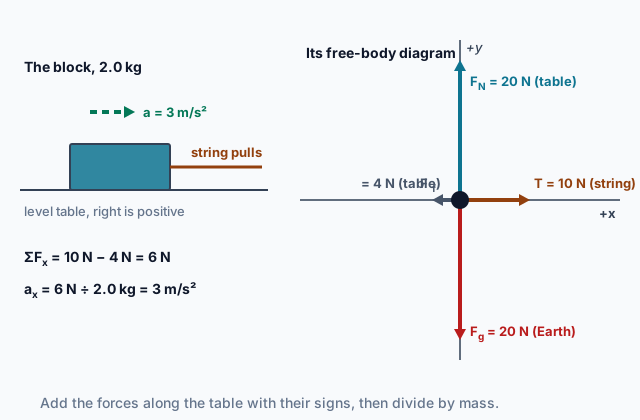 Tap to open the picture full size
Part 1 Think first A steady push on a rolling cart
Commit to a guess first. Being wrong now makes the right idea stick better.
Predict first
A loaded cart sits on a smooth, level floor. Its wheels are so good that friction and air resistance are negligible. You push it with a steady force, exactly the same push the whole time, for 5 seconds. While you keep pushing, what does the cart's speed do?
In short. Newton's second law says that the acceleration of a system's center of mass is the net external force on the system divided by the system's mass, and points the same way as that net force.
- Forces are unbalanced when the net force on a system is not zero, and the velocity of a system's center of mass changes only when a nonzero net external force is exerted on it.
- The size of the acceleration is proportional to the size of the net force, and the same net force gives a more massive system a smaller acceleration: .
- Forces between parts of the system are internal and cancel in pairs, so the net force counts only what the environment exerts on the system.
Part 2 Learn it Four short ideas, each checked as you go
2a. Balanced or unbalanced
Add up every force exerted on a system, as vectors, and you get the net force. When the forces add to zero, they are balanced. When they do not, they are unbalanced: the net force exerted on the system is not zero.
The velocity of a system's center of mass changes only if a nonzero net external force is exerted on the system. A change can be speeding up, slowing down or turning, since velocity has a direction as well as a size.
A ball tossed straight up is stopped for an instant at the top of its flight, yet the forces on it are unbalanced: gravity pulls it down and nothing cancels that pull. Its velocity was upward a moment ago and will be downward a moment from now. A train gliding along a straight track at a steady 30 m/s is the other case. The rails' forward push on its driving wheels and the backward push of the air are balanced, and its velocity stays the same.
The word external matters. Forces between parts of the system cancel in pairs, as 2.3 showed, so only forces from outside can change how the system's center of mass moves.
Quick check · Sort it
Tap each situation, then whether the net force exerted on the object in it is zero or not zero.
Net force is zero
Net force is not zero
2b. The net force sets the acceleration
Newton's second law says how the velocity changes:
The acceleration of the system's center of mass has a size proportional to the size of the net force. Double the net force and the acceleration doubles. Give the same net force to a system with twice the mass and it gets half the acceleration. A net force of 1 N gives 1 kg an acceleration of 1 m/s².
The top of that fraction is the net force, not whichever force looks biggest. In the diagram at the top of this page, a string drags a 2.0 kg block across a table to the right with 10 N while friction from the table pulls back with 4 N. Up and down, gravity and the table's push balance. Along the table, with right as positive, N, so . The 10 N pull alone would give 5 m/s², too much, because it leaves out the friction working against the pull.
So work one axis at a time: add the forces along it with their signs, then divide by the mass.
Quick check · Calculate
A rope pulls a 25 kg sled east across level snow with a horizontal force of 80 N. The snow exerts a friction force of 30 N on the sled, pointing west. Take east as positive. What is the sled's acceleration? Give your answer to the nearest 0.1 m/s².
2c. Acceleration points along the net force
The second law is a vector equation, so it settles direction too: the acceleration always points the same way as the net force. It does not have to point the way the object is moving.
A car braking for a red light is still moving forward. But the road's friction on its tires points backward, and nothing pushes it forward hard enough to cancel that. The net force points backward, so the acceleration points backward, and an acceleration opposite the velocity is exactly what slowing down means. A ball tossed straight up is still rising, yet the net force on it, gravity, points down the whole way, and so does its acceleration.
The law also runs the other way. If a cart on a track is speeding up to the left, the net force on it points to the left, whatever forces make up that net force. If it is moving to the left and slowing down, the net force points to the right.
So keeping something moving does not take a force in the direction it moves. The net force tells you how the velocity is changing, not which way the velocity points.
Quick check · Spot the error
A 1500 kg car moving east brakes on a level road. Along the road, friction from the road exerts 6000 N on it and air resistance exerts 750 N, both pointing west. Take east as positive. A student finds the car's acceleration. Tap the first line that goes wrong.
2d. Pick the system, then use its forces and its mass
In , the net force and the mass belong to the same system, so choose the system first.
A dog on smooth ice pulls two sleds tied one behind the other. Take both sleds as the system. The rope between the sleds pulls the back sled forward and the front sled backward, equally hard. Both of those pulls are internal, and they cancel in the sum. The only horizontal external force is the dog's pull, so the system's acceleration is the dog's pull divided by the mass of both sleds.
Now take the back sled alone. The rope between the sleds is outside this system, so its pull is external, and it is the only horizontal force on the back sled. Divide it by that sled's mass alone.
Both choices are correct; they answer different questions. The mistake is mixing them: dividing the forces on one object by the mass of another, or counting an internal force in a system's net force. Pick the system, list only the forces its environment exerts on it, and divide by its mass.
Quick check · Fill the statement
Two lab carts, 1.0 kg in front and 2.0 kg behind, are joined by a short string on a level track where friction is negligible. A force sensor pulls the front cart forward with a steady 6.0 N. Tap a blank, then an answer.
Take both carts as the system. The string's pulls on the two carts are forces of this system. The system's acceleration is the net external force divided by , which gives .
Part 3 Watch it done Two blocks pushed across a floor
Watch each step, then finish the problem yourself.
On a level floor where friction is negligible, you push a 4.0 kg block to the right with a horizontal 36 N force. It pushes on a 2.0 kg block resting against its front face, and the two slide together. Take right as positive. Find the force the 4.0 kg block exerts on the 2.0 kg block.
Step 1 · Choose both blocks as the system
Take the two blocks together, a system of mass kg. Gravity and the floor's normal forces are vertical, and they balance, because nothing moves up or down. Along the floor, the only external force is your 36 N push.
Why this step?
Why does the push between the two blocks not appear in the net force on this system?
Both blocks are inside the system. The 4.0 kg block pushes the 2.0 kg block to the right, and the 2.0 kg block pushes back on it to the left just as hard. Those two forces are internal and add to zero, so only your push, from the environment, changes how the system's center of mass moves.
Step 2 · Find the acceleration
, to the right. The blocks stay in contact, so each one has this acceleration.
Step 3 · Change the system
A force between the blocks is internal to the two-block system, so to find it, choose a system it acts on from outside. Take the 2.0 kg block alone. Along the floor, the only force on it is the push from the 4.0 kg block, so that push is its net force, and for this block alone.
Your step · Calculate
Finish it. On a level floor where friction is negligible, you push a 4.0 kg block to the right with a horizontal 36 N force, and it pushes a 2.0 kg block resting against its front face. The blocks slide together with an acceleration of 6.0 m/s² to the right. Take right as positive. How large is the force the 4.0 kg block exerts on the 2.0 kg block?
N
Part 4 Try it A puck tapped from the side
A new situation, and this time the force is sideways to the motion. A hockey puck glides east across smooth ice. A player reaches out and taps it with her stick, pushing it due north for a moment. Decide which way the puck accelerates while the stick touches it. Then practice the second law with new numbers each time.
Try it · Decide and justify
A hockey puck slides east across ice where friction is negligible. A player taps it with her stick, pushing it due north for a moment. While the stick is pushing, which way does the puck accelerate?
Which reason supports your answer?
Part 5 Explain it Measure it, graph it, find the mass
Nothing you type leaves this page.
Free response is 50% of the exam score. This one is shaped like Question 3, Experimental Design and Analysis.
Free-response practice · Question 3 style
A student wants to test Newton's second law and use it to find the mass of a cart. The cart sits on a level track where friction is negligible. A force sensor is fixed to the cart, and a light string runs from the sensor over a light pulley at the end of the track to a hook. When the hook is released, slotted masses hanging from it pull the cart along the track. She also has a motion detector, a set of slotted masses and a meterstick.
(a) Describe a procedure she could follow to measure the force on the cart and the cart's acceleration for several different forces. Say what she measures with which equipment, and give enough detail that another student could repeat it.
Her averaged results for five hanging masses:
- N,
- N,
- N,
- N,
- N,
(b) On paper, plot the cart's acceleration on the vertical axis against the force sensor's reading on the horizontal axis, and draw a best-fit line. Explain why the points should fall on a straight line through the origin, and what physical quantity the slope of that line represents.
(c) Calculate the mass of the cart and the sensor together from the slope of your best-fit line.
(d) She later learns that her force sensor reads every force 8 percent higher than the force really exerted. Explain whether this makes her mass from (c) too large or too small.
Model answer
(a) Put the motion detector at the far end of the track, facing the cart. With the string slack, zero the force sensor. Hang a small slotted mass on the hook, hold the cart still, start recording with both the sensor and the detector, and release the cart. The force sensor records the string's pull on the cart; read its steady value while the cart moves. The motion detector records the cart's velocity against time, and the slope of the straight part of that graph is the acceleration. Stop the cart before it reaches the pulley. Repeat with at least five different hanging masses, three runs each, and average and for each one.
(b) The track is level and friction is negligible, so gravity and the track's normal force balance, and the string's pull is the only unbalanced force on the cart and sensor: . The second law gives , and is the same for every run, so is proportional to . That is a straight line through the origin, since no force means no acceleration, and its slope is , one over the mass of the cart and sensor. Her five points lie close to one straight line that passes very near the origin, so the data support it.
(c) Two points far apart on my line, not data points, are and , so the slope is . Then kg. A line drawn by hand with a slope from 2.4 to 2.6 gives 0.38 to 0.42 kg.
(d) Each recorded force is 1.08 times the real force, while each acceleration is measured correctly. Every point moves to the right by the same factor, so the slope comes out smaller than the true . Then comes out too large.
Score your own answer. This is a self-check, not a grade. Tick each point your answer makes.
Part 6 Check yourself A model rocket's flight
Both case questions use the model rocket's table.
A student launches a model rocket straight up. Treat its mass as 0.50 kg for the whole flight. The table lists the forces on the rocket at three moments. The engine's thrust points up, the gravitational force points down, and air resistance points opposite to the rocket's velocity.
| Moment | Motion | Thrust (N) | Gravitational force (N) | Air resistance (N) |
|---|---|---|---|---|
| A | Rising, engine burning | 14.0 | 5.0 | 0.5 |
| B | Rising, engine burned out | 0.0 | 5.0 | 1.5 |
| C | Falling at a steady speed under its parachute | 0.0 | 5.0 | 5.0 |
Case question 1 · Calculate
Using the model rocket's table, with up as positive, what is the rocket's acceleration at moment A? Give your answer to the nearest 1 m/s².
Case question 2 · Multiple choice
Using the model rocket's table, with up as positive: at moment B the rocket is still rising, but its engine has burned out. What is its acceleration at that moment?
The rest stand on their own and do not use the case.
Check yourself · Draw the forces
A bucket of water is hauled straight up a well on a rope. Near the top it is still moving up, but it is slowing down. Air resistance is negligible. Build the bucket's free-body diagram, and set each arrow's length to compare with the others.
The dot is the bucket. One diagram that fits
Pick each force exerted on the bucket, then choose the way it points and how long its arrow is compared with the others. The arrows are drawn for you.
Check yourself · Match
A cart on a level track, with friction negligible, has an acceleration when the net force on it is and its mass is . Tap each change, then the cart's new acceleration.
Part 7 Keep it Bring back earlier ideas
Pulling an older idea back up is what makes it last.
From 2.2 Forces and Free-Body Diagrams · Draw the forces
You toss a ball straight up. It has left your hand and is still rising. Air resistance is negligible. Build the free-body diagram of the ball.
The dot is the ball. One diagram that fits
Pick each force exerted on the ball, then choose the way it points. The arrows are drawn for you.
From 1.2 Displacement, Velocity, and Acceleration · Sort it
Tap a card, then say whether the object in it is accelerating.
Accelerating
Not accelerating
In three lines
- Forces are unbalanced when the net force on a system is not zero, and only a nonzero net external force changes the velocity of its center of mass.
- The acceleration is the net force divided by the system's mass, , and points along the net force, not necessarily along the velocity.
- Choose the system first, count only the external forces on it, and divide by its own mass.
Vocabulary
- Unbalanced forces
- A configuration of forces such that the net force exerted on a system is not equal to zero.
- Net force
- The vector sum of all the forces exerted on a system, written or .
- Newton's second law
- The acceleration of a system's center of mass has a magnitude proportional to the magnitude of the net force exerted on the system and is in the same direction as that net force: .
- Center of mass
- The mass-weighted average position of a system's parts. The system can be modeled as a single object located there, and the second law gives that point's acceleration.
Course alignment, for teachers
AP Physics 1: Algebra-Based topic 2.5, Unit 2: Force and Translational Dynamics.
- Skill 1.A: Create diagrams, tables, charts, or schematics to represent physical situations.
- Skill 2.A: Derive a symbolic expression from known quantities by selecting and following a logical mathematical pathway.
- Skill 2.D: Predict new values or factors of change of physical quantities using functional dependence between variables.
- Skill 3.B: Apply an appropriate law, definition, theoretical relationship, or model to make a claim.
This lesson maps all 3 essential knowledge statements of the topic to the part that teaches each one: 3 are checked by a scored question. The map is in the lesson file.