Unit 4 · Topic 4.4 · about 30 minutes · 7 parts · 11 scored checks, 1 of them multiple choice
AP Physics 1: Algebra-Based 4.4: Elastic and Inelastic Collisions
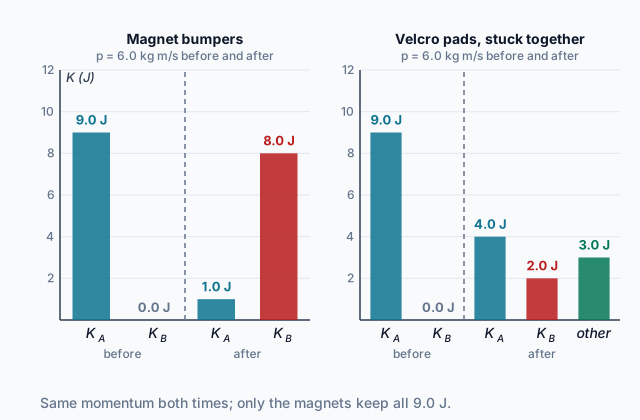 Tap to open the picture full size
Part 1 Think first Two gliders and a pair of magnets
Commit to a guess first. Being wrong now makes the right idea stick better.
Predict first
Two identical gliders sit on a level air track, where friction is negligible. Each has a magnet on its bumper, facing the other with like poles, so they push each other apart without ever touching, and the pair loses no kinetic energy in the collision. You send glider A toward glider B, which is at rest. What happens?
In short. A collision is elastic when the system's total kinetic energy is the same after as before, and inelastic when that total goes down.
- Momentum is conserved in every collision of an isolated system; kinetic energy is conserved only in an elastic one, and even then each object's share can change.
- In an inelastic collision, nonconservative forces between the objects transform some kinetic energy into thermal energy and sound, often while denting or bending them.
- Objects that stick together leave with one shared velocity, and that is a perfectly inelastic collision.
Part 2 Learn it Three short ideas, each checked as you go
2a. Elastic: the total stays, the shares change
Take two gliders on a level air track, with right as positive. Glider A, 2.0 kg, moves right at 3.0 m/s toward glider B, 1.0 kg, at rest. Their bumpers carry magnets that push them apart. With both gliders as the system, nothing outside pushes along the track, so the total momentum, kg·m/s, is the same after the collision as before. That holds in every collision of an isolated system.
Kinetic energy is a separate question. Afterward A moves at 1.0 m/s and B at 4.0 m/s, both to the right. Before, the system has J. After, it has , which is J. A collision in which the system's total kinetic energy at the end equals its total at the start is elastic. The left chart in the diagram at the top of the page shows these bars.
Now look at the shares. A dropped from 9.0 J to 1.0 J, and B went from nothing to 8.0 J. In an elastic collision each object's kinetic energy can change; only the system's total has to come out the same. So you judge a collision by adding up every object, before and after, never by watching one of them.
Quick check · Decide and justify
On a level air track, with right as positive, a 1.0 kg glider moving right at 4.0 m/s hits a 3.0 kg glider at rest. Afterward the 1.0 kg glider moves left at 2.0 m/s and the 3.0 kg glider moves right at 2.0 m/s. A student says this cannot be an elastic collision, because the 1.0 kg glider lost most of its kinetic energy. Is the collision elastic?
Which reason supports your answer?
2b. Inelastic: some kinetic energy becomes something else
Swap the magnets for rubber bumpers and send glider A in at 3.0 m/s again. This time A leaves at 1.4 m/s and B at 3.2 m/s, both to the right. The momentum is still kg·m/s. The kinetic energy is , which is J, less than the 9.0 J the system started with. A collision in which the system's total kinetic energy decreases is inelastic.
The missing 1.92 J did not vanish. While the bumpers were squashed together, the forces between them were nonconservative, like the friction in 3.4 Conservation of Energy: the rubber did not give back all the energy it took in as it was squashed. Those forces transformed 1.92 J into other forms of energy: thermal energy that warms the rubber, and the sound of the knock. Squashing the rubber out of shape is how that transfer happens; the change of shape is where the forces did their work, not a third form of energy.
To classify a collision, add up the kinetic energy of every object just before and just after. The same total means elastic; a smaller total means inelastic. Bouncing apart settles nothing: these gliders bounced apart and still lost kinetic energy.
Quick check · Calculate
On a level track, with right as positive, a 1.5 kg cart moving right at 4.0 m/s hits a 0.50 kg cart at rest. The carts' wheels roll freely. Just after the collision, the 1.5 kg cart moves right at 2.6 m/s and the 0.50 kg cart moves right at 4.2 m/s. How much of the system's kinetic energy is transformed into other forms in the collision? Give your answer to the nearest 0.01 J.
2c. Perfectly inelastic: stuck together
Now put Velcro pads on the bumpers. Glider A hits glider B and the two stay stuck, moving off as one object with one velocity. A collision in which the objects stick together and move with the same velocity afterward is perfectly inelastic.
A shared velocity means momentum alone gives the answer: , so m/s. The kinetic energy after is J. Of the 9.0 J the system started with, 3.0 J was transformed, almost all of it into thermal energy as the hooks drag through the loops and lock, more than the rubber bumpers lost. The right chart in the diagram at the top of the page shows it.
The momentum of a stuck pair is the total mass times the shared velocity, and it still equals the momentum before. Sticking costs kinetic energy, never momentum.
Quick check · Sort it
Each card describes a collision along a straight line, with friction negligible during it. Tap a card, then the kind of collision it is.
Elastic
Inelastic, and the objects separate
Perfectly inelastic
Part 3 Watch it done Two railroad cars couple
Watch each step, then finish the problem yourself.
A 30,000 kg railroad car rolls east at 2.0 m/s along a straight, level track and runs into a 20,000 kg car at rest. The couplers latch, and the two cars roll on together. The wheels roll freely and air resistance is negligible. Take east as positive. How much kinetic energy is transformed into other forms in the coupling?
Step 1 · Choose the system
Take both cars. The track is level and the wheels roll freely, so nothing outside pushes along the track, and the forces between the couplers are internal. The system's momentum is the same just after the coupling as just before.
Why this step?
Why not use conservation of kinetic energy to find the speed after the coupling?
The cars latch together, so the collision is perfectly inelastic, and the coupler forces transform some kinetic energy into other forms. Kinetic energy is not conserved here; only momentum is, so momentum is the tool for the speed.
Step 2 · The shared velocity
Stuck together, the cars have one velocity: , so m/s, east.
Step 3 · Kinetic energy before
Only the first car moves: J, or 60 kJ.
Your step · Calculate
Finish it. A 30,000 kg railroad car rolling east at 2.0 m/s on a straight, level track couples with a 20,000 kg car at rest, and the two roll on together at 1.2 m/s east. The wheels roll freely and air resistance is negligible. Take east as positive. How much kinetic energy is transformed into other forms in the coupling? Give your answer in kilojoules, to the nearest 0.1 kJ.
kJ
Part 4 Try it Reading an elastic collision from one side
A lab partner measured only one glider before and after an elastic collision, and you want the energy the other glider carried away. In an elastic collision the total kinetic energy is fixed, so what one glider gives up, the other gains.
Try it · Calculate
On a level air track, with right as positive, a 0.30 kg glider moving right at 5.0 m/s collides elastically with a 0.20 kg glider at rest. Just after the collision, the 0.30 kg glider moves right at 1.0 m/s. How much kinetic energy does the 0.20 kg glider have just after the collision? Give your answer to the nearest 0.01 J.
Part 5 Explain it Claim, derive, connect
Nothing you type leaves this page. Check your answer against the model and each scoring point.
Free response is 50% of the exam score. This one is shaped like Question 4, Qualitative/Quantitative Translation.
Free-response practice · Question 4 style
A cart of mass rolls at speed along a straight, level track toward a second cart of mass at rest. The wheels roll freely, and air resistance is negligible. Velcro pads on the bumpers make the carts stick together when they collide. A student says the fraction of the system's kinetic energy transformed into other forms is the same whatever is, because momentum is conserved in every case.
(a) Make a claim about how the fraction of the system's kinetic energy that is transformed depends on , comparing a second cart much heavier than with one much lighter than . Explain your reasoning in words, without equations.
(b) Derive an expression for the fraction of the system's initial kinetic energy that is transformed, , in terms of and .
(c) Explain how your expression in (b) is consistent with your claim in (a).
(d) The two carts are identical, . Calculate the fraction transformed, and describe where that energy goes.
Model answer
(a) The heavier the second cart, the larger the fraction transformed, so the student is wrong. After they stick, the pair carries the same momentum the first cart had. Shared over more mass, that momentum means a slower pair, and kinetic energy depends on the square of the speed but only on the first power of the mass, so a heavier, slower pair has less kinetic energy. Into a much heavier cart, the pair barely moves and nearly all the kinetic energy is transformed. Into a much lighter cart, the first cart hardly slows and very little is transformed.
(b) Momentum is conserved: , so . Then and . So , and .
(c) The fraction grows as grows, so it does depend on , as claimed. When is much larger than , the denominator is close to and the fraction is close to 1: nearly all the kinetic energy is transformed. When is much smaller than , the numerator is tiny compared with the denominator and the fraction is close to 0. The speed cancels, so this holds at any speed.
(d) With , the fraction is : half the kinetic energy is transformed. The nonconservative forces between the Velcro pads as they mesh and crush turn most of it into thermal energy in the pads, with a little leaving as sound. The momentum after is still .
Score your own answer. This is a self-check, not a grade. Tick each point your answer makes.
Part 6 Check yourself Four runs on a cart track
Both case questions use the collision table.
A student runs four collisions on a level track, where the carts' wheels roll freely. In every trial, cart 1 (mass 2.00 kg) moves at m/s toward cart 2, which is at rest, with right as positive. Between trials she changes cart 2's mass and the bumpers on both carts. Motion sensors record each cart's velocity just after the collision.
| Trial | Mass of cart 2 (kg) | Cart 1 after (m/s) | Cart 2 after (m/s) |
|---|---|---|---|
| 1 | 4.00 | -0.20 | +1.00 |
| 2 | 1.60 | +1.00 | +1.00 |
| 3 | 1.00 | +0.72 | +2.16 |
| 4 | 2.80 | -0.30 | +1.50 |
Case question 1 · Multiple choice
Using the collision table, in which trial was the collision elastic?
Case question 2 · Calculate
Using the collision table: how much of the system's kinetic energy was transformed into other forms in trial 1, where cart 2 has a mass of 4.00 kg? Give your answer to the nearest 0.01 J.
The rest stand on their own and do not use the case.
Check yourself · Spot the error
On a level track, with right as positive, a 2.0 kg cart moving right at 5.0 m/s hits a 3.0 kg cart at rest, and the carts stick together. The wheels roll freely. A student works out what happens. Tap the first line that goes wrong.
Check yourself · Fill the statement
Two lumps of modeling clay fly toward each other, hit, and stick in one squashed lump. Take both lumps as the system, and look only at the moment of the collision. Tap a blank, then an answer.
While the lumps squash, the forces between them are forces. They transform some of the system's kinetic energy into , and through the collision the system's momentum .
Part 7 Keep it Bring back earlier ideas
Pulling an older idea back up is what makes it last.
A new situation: two objects moving opposite ways at the same time. Two skaters glide toward each other across smooth ice, one heading east and one heading west. Decide what their kinetic energies add up to as one system. Then practice the kinetic energy of a single object with new numbers each time.
From 3.1 Translational Kinetic Energy · Calculate
Two skaters glide toward each other on smooth ice. Take east as positive. A 50 kg skater moves east at 3.0 m/s, and a 40 kg skater moves west at 4.0 m/s. What is the total translational kinetic energy of the two skaters? Give your answer to the nearest joule.
From 2.3 Newton’s Third Law · Decide and justify
A bus moving at 25 m/s hits a small bug that is hovering almost still, and the bug splats on the windshield. During the collision, how does the force the bus exerts on the bug compare with the force the bug exerts on the bus?
Which reason supports your answer?
In three lines
- Momentum is conserved in every collision of an isolated system; kinetic energy is conserved only in an elastic one.
- Classify a collision by the system's total kinetic energy: the same after means elastic, less after means inelastic.
- Objects that stick share one velocity, a perfectly inelastic collision; the lost kinetic energy becomes thermal energy and sound.
Vocabulary
- Elastic collision
- A collision in which the system's total kinetic energy after the collision equals its total kinetic energy before, although each object's kinetic energy may change.
- Inelastic collision
- A collision in which the system's total kinetic energy decreases, because nonconservative forces transform some of it into other forms of energy.
- Perfectly inelastic collision
- An inelastic collision in which the objects stick together and move with the same velocity afterward.
Course alignment, for teachers
AP Physics 1: Algebra-Based topic 4.4, Unit 4: Linear Momentum.
- Skill 1.B: Create quantitative graphs with appropriate scales and units, including plotting data.
- Skill 2.A: Derive a symbolic expression from known quantities by selecting and following a logical mathematical pathway.
- Skill 2.C: Compare physical quantities between two or more scenarios or at different times and locations in a single scenario.
- Skill 3.A: Create experimental procedures that are appropriate for a given scientific question.
- Skill 3.B: Apply an appropriate law, definition, theoretical relationship, or model to make a claim.
This lesson maps all 5 essential knowledge statements of the topic to the part that teaches each one: 5 are checked by a scored question. The map is in the lesson file.