Unit 6 · Topic 6.2 · about 30 minutes · 7 parts · 12 scored checks, 1 of them multiple choice
AP Physics 1: Algebra-Based 6.2: Torque and Work
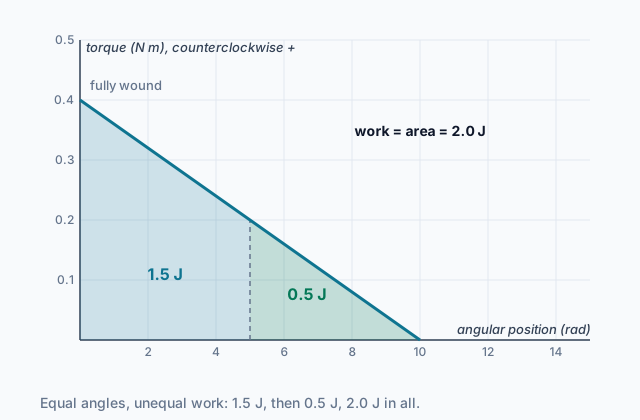 Tap to open the picture full size
Part 1 Think first Two revolving doors
Commit to a guess first. Being wrong now makes the right idea stick better.
Predict first
Ana and Ben each push on the outer edge of a revolving door. Ana's door is locked. She pushes as hard as she can for ten seconds, and it never moves. Ben's door is free, and his gentle push turns it a quarter of a turn. Whose push gave more energy to their door?
In short. A torque does work on a rigid object when the object turns through an angle while the torque is exerted, and for a steady torque that work is .
- The angle is in radians. A torque in the sense the object turns does positive work and transfers energy in; a torque against the turning does negative work and takes energy out.
- When the torque changes as the object turns, the work is the area under a graph of torque against angular position.
- For a rigid object turning about a fixed axis, if torques are the only things doing work on it, their total work equals the change in its rotational kinetic energy, .
Part 2 Learn it Three short ideas, each checked as you go
2a. Energy moves only through an angle
In 3.2 Work a force did work on an object only if the object moved while the force was exerted. Rotation follows the same rule. A torque transfers energy into or out of a rigid object only if the object turns through an angle while the torque is exerted.
Lean on a wrench fitted to a bolt that is rusted solid and you exert a large torque, but the bolt turns through no angle. Your torque gives it no energy at all.
The sense of the torque decides which way the energy goes. A torque in the same sense the object is turning, both counterclockwise say, does positive work and transfers energy into the object. A torque against the turning, like a brake pad pressed on a spinning wheel, does negative work and takes energy out.
One wheel can have both at once. A motor's torque feeds energy into a grinding wheel while friction at the axle takes some back out, and what happens to the wheel's spin depends on the total.
Quick check · Sort it
Each card names a torque on an object at the moment described. Tap a card, then what that torque does to the energy of the object it is exerted on.
Transfers energy into the object
Transfers energy out of the object
Transfers no energy to or from the object
2b. Work by a steady torque
For a torque that stays the same while the object turns, the work is
where is the angular displacement from 5.1 Rotational Kinematics, in radians, and the work is negative when the torque opposes the turning.
The radians matter, and a string shows why. Wrap one around a wheel of radius and pull it along the rim with a steady force . As the wheel turns through , the string unwinds a length (5.2 Connecting Linear and Rotational Motion), so the pull does work . That arc length holds only with the angle in radians, so change revolutions to radians first: one revolution is rad.
A 15 N pull on a string around a 0.20 m wheel makes a torque of 3.0 N·m, and through 2.0 rad it does J of work. A radian has no unit, so N·m times rad is a joule.
Where does that energy go? If torques are the only things doing work on a rigid object turning about a fixed axis, their total work equals the change in its rotational kinetic energy from 6.1 Rotational Kinetic Energy, , just as the net work on an object equaled its in 3.2 Work.
Quick check · Calculate
A mechanic tightens a lug nut with a wrench. She exerts a steady torque of 35 N·m on the nut, in the sense the nut turns, while it turns through 150°. How much work does her torque do on the nut? Give your answer to the nearest 1 J.
2c. When the torque changes: the area under its graph
Most real torques change as the object turns. The spring in a wind-up toy exerts its largest torque when it is fully wound and less as it unwinds. Then there is no one torque to put into .
Graph the torque against angular position instead. Over a small enough turn the torque is nearly steady, so that sliver of turning does of work: the area of a thin strip under the graph. Add the strips, and the work is the area between the graph and the angle axis. With the object turning in the positive sense, area below the axis, where the torque opposes the turning, is negative work.
The diagram at the top of the page is the toy's spring. Its torque falls from 0.40 N·m to zero over 10 rad. The first 5 rad, a trapezoid, give the gear 1.5 J, and the last 5 rad, a triangle, only 0.5 J.
The strips also show how the energy builds. If this torque is the only one doing work, each small turn adds to the kinetic energy. So a graph of kinetic energy against angle climbs as steeply as the torque is large: a straight line where the torque is steady, bending over where it falls.
Quick check · Sketch the graph
A motor starts a grinding wheel from rest. Its torque on the wheel is a steady 6.0 N·m while the wheel turns through its first 3.0 rad, then falls steadily to zero at 6.0 rad. Friction is negligible, so the motor's torque is the only one doing work on the wheel. Sketch the wheel's rotational kinetic energy against its angular position from 0 to 6.0 rad. The first point is fixed at 0.
One shape that fits
Drag a point up or down, or tap it and use the arrow keys. The shape is checked, and the graph must pass through the values the question gives.
Part 3 Watch it done Spinning up a potter's wheel
Watch each step, then finish the problem yourself.
A potter's wheel has a rotational inertia of 1.2 kg·m² about its axle and starts from rest. Its motor exerts a steady torque of 4.0 N·m on it while the wheel turns through 3.0 revolutions, and friction at the axle is negligible. How fast is the wheel turning at the end?
Step 1 · Put the angle in radians
rad.
Why this step?
Why can the 3.0 revolutions not go straight into ?
The equation comes from a force along the rim times the arc length it moves through, , and that arc length holds only with the angle in radians. Using 3.0 would make the work times too small.
Step 2 · Find the work the motor's torque does
The torque is steady and in the sense the wheel turns, so J, positive.
Step 3 · Set the work equal to the change in kinetic energy
The axle pushes on the wheel at the axis, so its force exerts no torque, and friction is negligible. The motor's torque is the only one doing work, so , since the wheel starts from rest.
Your step · Calculate
Finish it. A potter's wheel with rotational inertia 1.2 kg·m² about its axle starts from rest. Its motor exerts a steady torque of 4.0 N·m while the wheel turns through 3.0 revolutions, and friction at the axle is negligible. What is the wheel's angular speed at the end? Give your answer to the nearest 0.1 rad/s.
rad/s
Part 4 Try it Stopping a wheel, then a turntable
Two situations the lesson has not shown. First a brake, where the torque takes energy out and the angle is what you are after. Then a motor turning a turntable, with new numbers each time.
Try it · Calculate
A bicycle sits upside down on a repair stand, and its front wheel spins at 18 rad/s. The wheel's rotational inertia about its axle is 0.12 kg·m², and friction at the axle is negligible. A mechanic presses a brake pad against the rim, which exerts a steady friction torque of 0.60 N·m against the spin until the wheel stops. Through what angle does the wheel turn while it stops? Give the size of the angle, to the nearest 0.1 rad.
Part 5 Explain it A torque graph, an energy graph and the equation
Nothing you type leaves this page. Check your answer against the model and each scoring point.
Free response is 50% of the exam score. This one is shaped like Question 2, Translation Between Representations.
Free-response practice · Question 2 style
A turntable with rotational inertia about its axle starts from rest at angular position . Counterclockwise is positive, and the turntable turns counterclockwise the whole time. Friction is negligible, and a motor exerts a counterclockwise torque on it. A graph of the motor's torque against angular position is a straight line from 6.0 N·m at down to 2.0 N·m at rad, then a level line at 2.0 N·m from rad to rad.
(a) On paper, sketch that graph of the motor's torque against angular position from 0 to 7.0 rad. Using your graph, calculate the work the motor's torque does on the turntable from to 2.0 rad, and from rad to 7.0 rad.
(b) Derive an expression for the turntable's angular speed at rad in terms of and the total work the motor's torque does from 0 to 7.0 rad. Then calculate the angular speed.
(c) On paper, sketch the turntable's rotational kinetic energy against angular position from 0 to 7.0 rad. Label its value at 2.0 rad and at 7.0 rad. Make the shape of each stretch agree with the torque graph, and explain why it has that shape.
(d) For the stretch from 2.0 rad to 7.0 rad, justify that the area you used in (a) agrees with . Then explain why with N·m and rad does not give the work in the first stretch.
Model answer
(a) The torque graph falls in a straight line from 6.0 N·m at to 2.0 N·m at 2.0 rad, then runs level at 2.0 N·m out to 7.0 rad, all of it above the angle axis. From 0 to 2.0 rad the region under the graph is a trapezoid: J. From 2.0 rad to 7.0 rad it is a rectangle: J. Both are positive, because the torque is in the sense the turntable turns.
(b) The axle's force acts at the axis and exerts no torque, and friction is negligible, so the motor's torque is the only one doing work, and its total work equals the change in rotational kinetic energy. From rest, , so . The total work is J, so rad/s.
(c) The energy rises from 0 to 8.0 J between 0 and 2.0 rad, along a curve that starts steep and gets less steep, bending downward. It then rises in a straight line from 8.0 J at 2.0 rad to 18.0 J at 7.0 rad. Each small turn adds to the kinetic energy, so the steepness of the energy graph at any angle equals the torque there. In the first stretch the torque falls from 6.0 to 2.0 N·m, so the slope falls from 6.0 to 2.0 J per rad; in the second it stays 2.0 N·m, so the slope stays 2.0 J per rad and the line is straight.
(d) From 2.0 rad to 7.0 rad the torque is 2.0 N·m at every angle, so the region under the graph is a rectangle whose height is the torque and whose width is the angular displacement, rad. Its area, height times width, is J, the same number. In the first stretch the torque is 6.0 N·m only at and less at every angle after it, so J is the area of a rectangle that sits above the graph. It overstates the work by the triangle between that rectangle's top and the falling line, J. holds only where the torque is constant.
Score your own answer. This is a self-check, not a grade. Tick each point your answer makes.
Part 6 Check yourself A flywheel on a test stand
Both case questions use the flywheel's table.
A student tests a flywheel driven by a small motor. The flywheel's rotational inertia about its axle is , and it starts from rest. It turns counterclockwise the whole time, and counterclockwise is positive. During each stretch of the test, the motor's torque and the torque from friction at the axle each stay steady.
| Stretch | Motor's torque (N·m) | Axle friction's torque (N·m) | Angle turned (rad) |
|---|---|---|---|
| 1 | +2.0 | -0.50 | 48 |
| 2 | 0 | -0.50 | 30 |
| 3 | +0.50 | -0.50 | 50 |
Case question 1 · Multiple choice
Using the flywheel's table, with counterclockwise positive: during stretch 3 the flywheel's angular speed stays the same. Which describes the work done on the flywheel during stretch 3?
Case question 2 · Calculate
Using the flywheel's table, with counterclockwise positive: what is the flywheel's angular speed at the end of stretch 1? Give your answer to the nearest 1 rad/s.
The rest stand on their own and do not use the case.
Check yourself · Spot the error
A twisted rubber band turns a toy propeller. The band's torque on the propeller falls steadily from 0.050 N·m, when the band is fully wound, to zero after the propeller has turned through 60 rad. A classmate works out the work the band's torque does on the propeller over those 60 rad. Tap the first line that goes wrong.
Check yourself · Match
A motor drives a wheel through a belt, then brakes it. The wheel turns counterclockwise the whole time, and counterclockwise is positive. Each stretch below describes the torque the belt exerts on the wheel as the wheel's angular position changes. Tap a stretch, then the work that torque does on the wheel during it.
Check yourself · Decide and justify
Two identical wheels turn on frictionless axles, and both start at rest. A motor exerts a steady 4.0 N·m torque on wheel P while P turns through 2.0 rad. Another motor exerts a steady 2.0 N·m torque on wheel Q while Q turns through 4.0 rad. No other torque does work on either wheel. Which wheel is then spinning faster?
Which reason supports your answer?
Part 7 Keep it Bring back earlier ideas
Pulling an older idea back up is what makes it last.
From 5.1 Rotational Kinematics · Calculate
You face a combination lock and take counterclockwise as positive. You turn its dial 2.5 revolutions clockwise. What is the dial's angular displacement, in radians? Include the sign, and give your answer to the nearest 0.01 rad.
From 3.2 Work · Decide and justify
A student pushes a 20 kg box 3.0 m across a carpeted floor with a horizontal push, at a steady walking speed the whole way. A classmate says the student's push did no work on the box, since the box's kinetic energy never changed. Did the student's push do work on the box?
Which reason supports your answer?
In three lines
- A torque transfers energy into or out of a rigid object only while the object turns through an angle: positive work in the sense of the turning, negative against it.
- For a steady torque, with the angle in radians; for a changing one, the work is the area under the torque against angular position graph.
- When torques are the only things doing work on a rigid object turning about a fixed axis, their total work equals the change in its rotational kinetic energy, .
Vocabulary
- Work done by a torque
- The energy a torque transfers into or out of a rigid system while the system rotates through an angular displacement; for a constant torque, .
- Angular displacement
- The angle, in radians, through which a rigid system rotates about an axis, .
- Rotational kinetic energy
- The kinetic energy a rigid system has because it rotates, .
- Rigid system
- A system that holds its shape as it rotates, so every point in it turns through the same angle.
Course alignment, for teachers
AP Physics 1: Algebra-Based topic 6.2, Unit 6: Energy and Momentum of Rotating Systems.
- Skill 1.B: Create quantitative graphs with appropriate scales and units, including plotting data.
- Skill 2.A: Derive a symbolic expression from known quantities by selecting and following a logical mathematical pathway.
- Skill 2.C: Compare physical quantities between two or more scenarios or at different times and locations in a single scenario.
- Skill 2.D: Predict new values or factors of change of physical quantities using functional dependence between variables.
- Skill 3.A: Create experimental procedures that are appropriate for a given scientific question.
This lesson maps all 3 essential knowledge statements of the topic to the part that teaches each one: 3 are checked by a scored question. The map is in the lesson file.