Unit 6 · Topic 6.3 · about 30 minutes · 7 parts · 13 scored checks, 1 of them multiple choice
AP Physics 1: Algebra-Based 6.3: Angular Momentum and Angular Impulse
 Tap to open the picture full size
Part 1 Think first Two ways to push a merry-go-round
Commit to a guess first. Being wrong now makes the right idea stick better.
Predict first
A playground merry-go-round sits at rest, and friction at its axle is negligible. Each push is counterclockwise, always perpendicular to the line from its center to your hands. In one trial you give it Push 1: 100 N at the rim for 2 seconds. In another trial, starting again from rest, you give it Push 2: the same 100 N, halfway between the center and the rim, for 4 seconds. In which trial is the merry-go-round turning faster when you let go?
In short. Angular momentum is the rotational counterpart of momentum, measured about an axis or a point, and a torque exerted for a time, an angular impulse, changes it: .
- A rigid system turning about an axis has . An object moving along a line has about a chosen point, so its angular momentum depends on the point you choose.
- Angular impulse, , has the sense of the torque, clockwise or counterclockwise, no matter which way the object is turning, and it equals the change in angular momentum, .
- Angular impulse is the area under a graph of net torque against time, and the net torque is the slope of a graph of angular momentum against time.
Part 2 Learn it Four short ideas, each checked as you go
2a. Angular momentum of a turning object
In 4.1 Linear Momentum, momentum, , measured the motion a moving object carries. A turning object carries rotation in the same way. The angular momentum of a rigid system about an axis has magnitude
where is the rotational inertia about that axis from 5.4 Rotational Inertia and the angular velocity from 5.1 Rotational Kinematics. With in kg·m² and in rad/s, comes out in kg·m²/s.
Like angular velocity, angular momentum has a sense, clockwise or counterclockwise. In one dimension a sign does that job: pick one sense as positive and give the sign of .
Take counterclockwise as positive. A grinding wheel with kg·m² spinning counterclockwise at 150 rad/s has kg·m²/s. A merry-go-round with kg·m² turning clockwise at 0.75 rad/s has kg·m²/s. The slow merry-go-round carries a hundred times the angular momentum of the fast wheel, because so much of its mass sits far from its axle.
Both factors count equally: double the rotational inertia or double the angular velocity, and doubles.
Quick check · Calculate
A potter's wheel has a rotational inertia of 0.80 kg·m² about its axle. Seen from above, it turns clockwise at 3.5 rad/s. Take counterclockwise as positive. What is the wheel's angular momentum about its axle? Include the sign.
2b. Angular momentum without turning
An object does not have to turn to have angular momentum. A puck sliding in a straight line has angular momentum about any point you choose. About a point, its magnitude is
where is the distance from the point to the object and is the angle between the line from the point to the object and the object's velocity. As with torque in 5.3 Torque, is a perpendicular distance, here from the point to the line the object moves along.
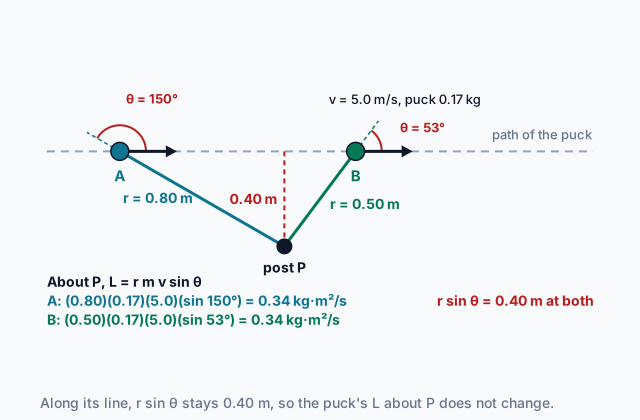
The diagram shows a 0.17 kg puck sliding at 5.0 m/s past a post P, on a line 0.40 m from it. At A, m and is 150°. At B, m and is about 53°. Both give m, so kg·m²/s at each. A puck sliding at a steady velocity in a straight line keeps the same angular momentum about P all the way along.
Change the point and the answer changes. About a point 0.80 m from the line, doubles. About a point on the line itself, and . So the distance, the mass, the speed and the angle all count, and an angular momentum means nothing until you say which point it is about.
Quick check · Sort it
A 0.17 kg hockey puck slides across level, frictionless ice at a steady 5.0 m/s along a straight line that passes 0.40 m from a post at point P. At first it is 0.50 m from P. Each card makes one change. Tap a card, then how the size of the angular momentum it describes compares with the size of the puck's angular momentum about P at first.
Larger
Equal
Smaller
2c. Angular impulse
A torque changes angular momentum by acting for a time, just as a force changes momentum in 4.2 Change in Momentum and Impulse. The angular impulse a torque delivers is the torque multiplied by the time interval it acts:
Its unit is the N·m·s, which is the same as kg·m²/s. Angular impulse has the sense of the torque that delivers it, which need not be the sense the object turns. A brake pressed on a wheel spinning clockwise exerts a counterclockwise torque, so its angular impulse is counterclockwise, and the wheel slows.
The rotational form of the impulse-momentum theorem says the angular impulse of the net torque equals the change in angular momentum:
A flywheel with kg·m² starts at rest, and a motor exerts a net torque of 2.0 N·m on it for 6.0 s. The angular impulse is 12 N·m·s, so the flywheel ends with kg·m²/s and rad/s. A net torque of 4.0 N·m for 3.0 s gives the same 12 N·m·s and the same spin. That is the merry-go-round at the start of this lesson.
Keep every sign. When a torque reverses an object's rotation, the size of is larger than the size of either angular momentum alone.
Quick check · Decide and justify
A bicycle wheel spins clockwise on a stand, as you see it from where you stand. You press a brake pad on its rim for 2 seconds, and the pad exerts a counterclockwise torque on the wheel about its axle. When you let go, the wheel is slower but still turning clockwise. In which sense is the angular impulse the brake pad delivered to the wheel?
Which reason supports your answer?
2d. Areas and slopes
A torque that changes as it acts still delivers an angular impulse: the area between a graph of the net torque against time and the time axis. Area above the axis is positive angular impulse; area below it is negative. If the net torque on a fan rises steadily from 0 to 4.0 N·m in 0.50 s, the area is a triangle, N·m·s.
Run the idea backward and the slope of a graph of angular momentum against time is the net torque:
A level stretch means no net torque. With counterclockwise positive, a falling stretch means a net torque that is clockwise.
For a rigid object on a fixed axle, stays the same, so and
That is Newton's second law for rotation from 5.6 Newton’s Second Law in Rotational Form, the case you have used so far. The angular momentum form is the more general one. It still holds for a system that changes its own rotational inertia, which is where the next topic goes.
Quick check · Sketch the graph
A wheel turns on a frictionless axle, with counterclockwise as positive. At 0 s its angular momentum is +1.0 kg·m²/s. A graph of the net torque on the wheel against time reads +0.50 N·m from 0 to 2 s, 0 from 2 s to 3 s, and -1.0 N·m from 3 s to 6 s. Sketch the wheel's angular momentum against time from 0 to 6 s. The first point is fixed at the wheel's angular momentum at 0 s.
One shape that fits
Drag a point up or down, or tap it and use the arrow keys. The shape is checked, and the graph must pass through the values the question gives.
Part 3 Watch it done A push against the turn
Watch each step, then finish the problem yourself.
A playground merry-go-round has a rotational inertia of 300 kg·m² about its axle, and friction at the axle is negligible. Seen from above, it turns clockwise at 0.60 rad/s. A parent pushes along its rim so that her push exerts a steady counterclockwise torque of 160 N·m about the axle for 1.5 s. Take counterclockwise as positive. Find the merry-go-round's angular velocity when she stops pushing.
Step 1 · Write the starting angular momentum with its sign
It turns clockwise, so rad/s and kg·m²/s.
Step 2 · Find the angular impulse
The axle's force acts at the axis and makes no torque, and friction is negligible, so the parent's torque is the net torque. The angular impulse is N·m·s.
Why this step?
The merry-go-round is turning clockwise when she starts pushing. Why is the angular impulse positive?
Angular impulse has the sense of the torque, not the sense of the rotation. Her push is counterclockwise for the whole 1.5 s, so every bit of it adds counterclockwise angular momentum. Part of it cancels the clockwise angular momentum the merry-go-round started with, and whatever is left over is counterclockwise.
Your step · Calculate
Finish it. A merry-go-round with a rotational inertia of 300 kg·m² turns clockwise at 0.60 rad/s, seen from above, with friction at its axle negligible. A parent's push delivers an angular impulse of +240 N·m·s to it, with counterclockwise as positive. What is its angular velocity when she stops pushing? Include the sign.
rad/s
Part 4 Try it A skater passing a lamp post
A new situation: nothing here turns at all. A skater glides straight across a frozen pond past a lamp post at its edge, and the question is her angular momentum about the post.
Try it · Calculate
A 60 kg skater glides in a straight line across level ice at a steady 3.0 m/s, and friction is negligible. At one instant she is 5.0 m from a lamp post, and the angle between the line from the post to her and her velocity is 150°. What is the magnitude of her angular momentum about the post?
Part 5 Explain it Push, run, brake
Nothing you type leaves this page. Check your answer against the model and each scoring point.
Free response is 50% of the exam score. This one is shaped like Question 1, Mathematical Routines.
Free-response practice · Question 1 style
A playground merry-go-round turns on a vertical axle, and friction at the axle is negligible. Its rotational inertia about the axle is . Seen from above, take counterclockwise as positive.
(a) The merry-go-round starts at rest. A parent pushes on its rim, a distance from the axle, with a constant force of magnitude perpendicular to the line from the axle, for a time , turning it counterclockwise. Derive an expression for the merry-go-round's angular velocity when the parent stops, in terms of , , and .
(b) kg·m², m, N and s. Calculate the angular impulse the parent delivers and .
(c) A child of mass runs at a constant speed along a straight path across the playground that passes a perpendicular distance from the axle. Derive an expression for the magnitude of her angular momentum about the axle at any point on her path, in terms of , and . Calculate it for kg, m/s and m. Then explain why her angular momentum about a point on her own path is zero.
(d) Later, with the merry-go-round turning counterclockwise at and no one on it, a brake exerts a clockwise torque on it whose magnitude falls steadily from 60 N·m to 0 over 4.0 s. Calculate the angular impulse the brake delivers, the merry-go-round's angular velocity when the brake's torque reaches 0, and the average net torque on it over those 4.0 s.
Model answer
(a) The push is perpendicular to the line from the axle, so its torque is , counterclockwise. The axle's force makes no torque, so this is the net torque, and its angular impulse is . By the rotational impulse-momentum theorem, , so
(b) Angular impulse N·m·s, counterclockwise. Then rad/s, counterclockwise.
(c) About the axle, , where is her distance from the axle and the angle between that line and her velocity. Both change as she runs, but is always the perpendicular distance from the axle to her path, . So at every point. kg·m²/s. About a point on her path, the line from the point to her lies along her velocity, so is 0° or 180°, , and . The same motion has different angular momenta about different points.
(d) The brake's angular impulse is the area under its torque graph, a triangle: N·m·s, clockwise, so N·m·s. The merry-go-round's angular momentum goes from kg·m²/s to kg·m²/s, so rad/s, still counterclockwise. The average net torque is N·m, which is 30 N·m clockwise.
Score your own answer. This is a self-check, not a grade. Tick each point your answer makes.
Part 6 Check yourself A turntable spun up and braked
Both case questions use the turntable table.
A student tests a record turntable whose platter has a rotational inertia of 0.040 kg·m² about its spindle. Seen from above, the platter turns counterclockwise, which she takes as positive. From 0 to 2 s the motor drives it. From 2 s to 4 s the motor is off and friction is negligible. At 4 s she presses a felt brake pad against the platter's edge. A sensor records the platter's angular velocity each second.
| Time (s) | Angular velocity (rad/s) |
|---|---|
| 0 | 2.0 |
| 1 | 5.0 |
| 2 | 8.0 |
| 3 | 8.0 |
| 4 | 8.0 |
| 5 | 4.5 |
| 6 | 1.0 |
Case question 1 · Calculate
Using the turntable table, with counterclockwise as positive, what is the net torque on the 0.040 kg·m² platter from 0 to 2 s? Give your answer to the nearest 0.01 N·m.
Case question 2 · Multiple choice
Using the turntable table, with counterclockwise as positive, which describes the angular impulse delivered to the platter from 4 s to 6 s?
The rest stand on their own and do not use the case.
Check yourself · Spot the error
A 0.20 kg puck slides at a steady 3.0 m/s in a straight line across level, frictionless ice. At one instant it is 1.5 m from a point Q on the ice, and the angle between the line from Q to the puck and the puck's velocity is 30°. A student finds the magnitude of the puck's angular momentum about Q. Tap the first line that goes wrong.
Check yourself · Match
Each feature is read from a graph for one wheel turning on a fixed axle. Tap a feature of a graph, then what it tells you about the wheel.
Check yourself · Fill the statement
Tap a blank, then an answer.
The net torque on an object equals the rate at which its changes. When the object's cannot change, as for a rigid wheel on a fixed axle, that rate equals the rotational inertia times the object's , which is Newton's second law for rotation.
Part 7 Keep it Bring back earlier ideas
Pulling an older idea back up is what makes it last.
From 5.6 Newton’s Second Law in Rotational Form · Calculate
Two children push on a playground merry-go-round whose rotational inertia about its axle is 500 kg·m², and friction at the axle is negligible. One child's push exerts a counterclockwise torque of 300 N·m about the axle. The other, pushing the opposite way, exerts a clockwise torque of 120 N·m. Take counterclockwise as positive. What is the merry-go-round's angular acceleration? Give your answer to the nearest 0.01 rad/s².
A new situation: the object comes in one way and leaves the other, and this time the unknown is the force. A hockey player meets a pass with her stick and sends the puck straight back the way it came.
From 4.2 Change in Momentum and Impulse · Calculate
A 0.16 kg hockey puck slides to the right across level ice at 12 m/s. A player's stick meets it and sends it back to the left at 18 m/s. The stick is in contact with the puck for 0.020 s, and friction from the ice is negligible. Take right as positive. What is the average force the stick exerts on the puck? Include the sign.
In three lines
- A rigid system has about its axis; an object moving along a line has about a point, which depends on the point chosen.
- Angular impulse, , has the sense of the torque and equals the change in angular momentum, , with every sign kept.
- Angular impulse is the area under net torque against time, net torque is the slope of angular momentum against time, and with constant , .
Vocabulary
- Angular momentum
- The rotational counterpart of momentum, measured about an axis or a point: for a rigid system about an axis, and for an object about a given point, even one that is not turning.
- Angular impulse
- The product of the torque exerted on an object or rigid system and the time interval during which the torque is exerted, , in the same direction as the torque.
- Change in angular momentum
- The difference between an object's final and initial angular momentum, .
- Rotational form of the impulse-momentum theorem
- The statement that the angular impulse delivered to an object or rigid system equals its change in angular momentum, .
Course alignment, for teachers
AP Physics 1: Algebra-Based topic 6.3, Unit 6: Energy and Momentum of Rotating Systems.
- Skill 1.B: Create quantitative graphs with appropriate scales and units, including plotting data.
- Skill 2.A: Derive a symbolic expression from known quantities by selecting and following a logical mathematical pathway.
- Skill 2.D: Predict new values or factors of change of physical quantities using functional dependence between variables.
- Skill 3.B: Apply an appropriate law, definition, theoretical relationship, or model to make a claim.
This lesson maps all 13 essential knowledge statements of the topic to the part that teaches each one: 13 are checked by a scored question. The map is in the lesson file.