Unit 5 · Topic 5.1 · about 30 minutes · 7 parts · 13 scored checks, 1 of them multiple choice
AP Physics 1: Algebra-Based 5.1: Rotational Kinematics
 Tap to open the picture full size
Part 1 Think first A fan that spins up
Commit to a guess first. Being wrong now makes the right idea stick better.
Predict first
You switch on a ceiling fan. It starts from rest and speeds up at a steady rate for 4 seconds. Compare the angle its blades turn through in the first 2 seconds with the angle they turn through in the last 2 seconds.
In short. Rotational kinematics describes how a system turns about an axis, using its angular displacement, angular velocity and angular acceleration.
- Angular displacement is , measured in radians, with clockwise or counterclockwise chosen as positive.
- Average angular velocity is and average angular acceleration is , and graphs of , and against time are linked by slopes and areas.
- With constant angular acceleration, , and hold, the same relationships as motion along a line.
Part 2 Learn it Four short ideas, each checked as you go
2a. Measuring a turn in radians
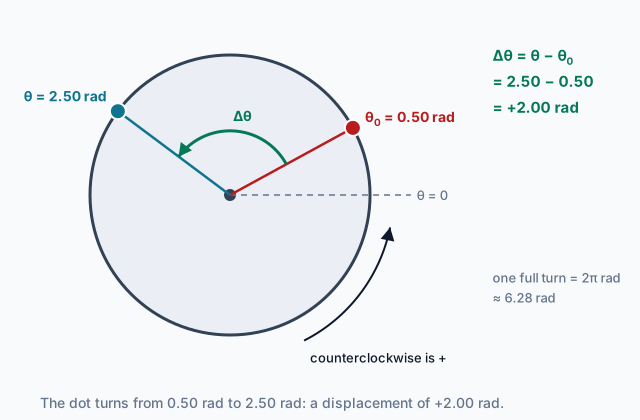
Start with the axis of rotation, the line a system turns around, such as a wheel's axle. Paint a dot on the wheel and draw a fixed reference line out from the axle. The dot's angular position is the angle from that line to the dot.
Measure angles in radians. One full turn is rad, about 6.28 rad, so half a turn is rad and one radian is about 57 degrees. The rotation equations in this unit expect radians.
Angular displacement is the change in angular position, final minus initial, just as was in 1.2 Displacement, Velocity, and Acceleration:
In the diagram the dot moves from rad to rad, so rad.
The sign needs a convention. Looking along the axis, choose clockwise or counterclockwise as positive and say which; the other way is negative. The diagram takes counterclockwise as positive, so the same 2.00 rad turned clockwise would be rad. Angular position keeps counting past a full turn: two turns counterclockwise is rad, not zero.
Quick check · Calculate
You face a combination lock and take counterclockwise as positive. You turn its dial 2.5 revolutions clockwise. What is the dial's angular displacement, in radians? Include the sign, and give your answer to the nearest 0.01 rad.
2b. When a turning system is one object, and when it is not
A wheel is a rigid system: it holds its shape as it turns. Even so, at any instant the top of a spinning wheel moves one way, the bottom moves the opposite way, and the points on the axle do not move at all. No single point's motion describes the spin. So when its rotation is what you are studying, a rigid system cannot be modeled as an object, the single point of 1.2 Displacement, Velocity, and Acceleration.
Sometimes the rotation you care about is a whole system going around an axis outside it. Then the motion of its center of mass (2.1 Systems and Center of Mass) describes that rotation well, and the system may be treated as a single object.
Earth does both. It spins on its own axis once a day and goes around the Sun once a year. For the yearly trip, Earth's spin is negligible: follow Earth's center of mass as it goes around the center of mass of the Earth-Sun system, and Earth is a single object. For day and night, the spin is the whole question, and Earth is a rigid system turning about its own axis.
Quick check · Sort it
Each card names a system and the rotation a question is about. Tap a card, then decide whether the system can be treated as a single object for that question or must be described as a rigid system turning about its axis.
Treat it as a single object
Describe a rigid system's rotation
2c. Average rates, and what the graphs show
Average angular velocity is the angular displacement divided by the time it takes, and average angular acceleration is the change in angular velocity divided by the time:
These are the average velocity and acceleration of 1.2 Displacement, Velocity, and Acceleration with angles where positions were, so their units are rad/s and rad/s². A fan blade that turns 30 rad in 2.0 s has rad/s.
Signs work the same way too. The sign of an angular acceleration is a direction, not a report on speeding up. A wheel speeds up when and have the same sign, and slows down when they have opposite signs.
The graphs follow the rules of 1.3 Representing Motion. The slope of an angular position-time graph is the angular velocity, and the slope of an angular velocity-time graph is the angular acceleration. Going the other way, the area under an angular velocity-time graph is the angular displacement, and the area under an angular acceleration-time graph is the change in angular velocity. Area below the time axis counts as negative.
Quick check · Decide and justify
A ceiling fan turns clockwise as seen from below. You switch it off and it slows down. Take counterclockwise, as seen from below, as positive. What is the sign of the fan's average angular acceleration while it slows?
Which reason supports your answer?
2d. Constant angular acceleration: three familiar equations
When the angular acceleration is constant, the three equations of 1.3 Representing Motion carry straight over, with for , for and for :
Choose among them the same way as before. List what you know and what you want, then take the equation that leaves out the quantity you neither know nor need. The first has no angle in it, and the third has no time.
Say a turntable starts from rest and speeds up at . After 3.0 s, rad/s, and it has turned rad.
Write every quantity with its sign before you substitute. If the angular acceleration changes along the way, these equations do not apply; describe the motion from its graphs instead.
Quick check · Match
Every wheel here turns with a constant angular acceleration. Tap a question, then the equation that answers it most directly.
Part 3 Watch it done A fan turned down to a lower setting
Watch each step, then do the last one yourself.
A ceiling fan turns counterclockwise, as seen from below, at 15 rad/s. You switch it to a lower setting, and it slows with a constant angular acceleration to 6.0 rad/s in 3.0 s. Take counterclockwise, as seen from below, as positive. Find the fan's angular acceleration and the angle it turns through while it slows.
Step 1 · List what you know, with signs
The fan turns counterclockwise the whole time, so both angular velocities are positive: rad/s and rad/s, over s. The angular acceleration is constant, so the three equations apply.
Step 2 · Find the angular acceleration
From : .
Why this step?
Why is the angular acceleration negative when the fan never stops turning counterclockwise?
Its sign is the direction of the change in angular velocity, not the direction the fan turns. The angular velocity drops from +15 rad/s to +6.0 rad/s, a negative change. A positive angular velocity with a negative angular acceleration is a fan turning counterclockwise and slowing down.
Step 3 · Choose the equation for the angle
You want , and you know , and . The equation uses exactly those. Because is negative, its term takes angle away from what a steady 15 rad/s would give.
Your step · Calculate
Finish it. A ceiling fan turning counterclockwise, as seen from below, at 15 rad/s slows with a constant angular acceleration to 6.0 rad/s in 3.0 s. Counterclockwise, as seen from below, is positive. Through what angle does the fan turn while it slows? Give your answer in radians, to the nearest 0.1 rad.
rad
Part 4 Try it A washing machine's spin cycle
A new situation, read from a description rather than a table. A washing machine's drum turns about a horizontal axle. During a spin cycle it speeds up, holds a steady angular velocity, and then brakes, and in each stretch its angular acceleration is constant.
Try it · Sketch the graph
A washing machine drum starts from rest and speeds up with a constant angular acceleration for 4 s, until it turns at 40 rad/s. It turns at a steady 40 rad/s for the next 4 s, then slows with a constant angular acceleration and stops 2 s later. Take clockwise, as you face the machine, as positive; the drum turns clockwise the whole time. Sketch the drum's angular velocity against time from 0 to 10 s. The first point is fixed at 0.
One shape that fits
Drag a point up or down, or tap it and use the arrow keys. The shape is checked, and the graph must pass through the values the question gives.
Part 5 Explain it One graph, three ways to read it
Nothing you type leaves this page. Check your answer against the model and each scoring point.
Free response is 50% of the exam score. This one is shaped like Question 2, Translation Between Representations.
Free-response practice · Question 2 style
A small motor turns a platform about a vertical axle in a physics lab. Take clockwise, as seen from above, as positive, and the platform's angular position as at . A sensor records the platform's angular velocity. Its graph against time is one straight line, from rad/s at to rad/s at s, crossing zero at s.
(a) Sketch the platform's angular acceleration against time from 0 to 6.0 s, label its value, and justify it from the angular velocity graph.
(b) Calculate the platform's angular displacement from 0 to 3.0 s from the area under the angular velocity graph. Then show, using , that the equation gives the same result.
(c) Sketch the platform's angular position against time from 0 to 6.0 s. Label at 3.0 s and at 6.0 s, and explain how the slope of your graph at 0, 3.0 s and 6.0 s agrees with the angular velocity graph. Then derive an expression for the time at which the platform is back at , in terms of and , and justify that it agrees with your sketch.
(d) Put your angular position at 6.0 s into , and justify that the result agrees with the angular velocity graph at 6.0 s, sign included. Argue the sign from something other than that graph's value at 6.0 s.
Model answer
(a) A level line at from 0 to 6.0 s. The angular acceleration is the slope of the angular velocity graph, and a straight line has one slope: , which is counterclockwise.
(b) From 0 to 3.0 s the area under the graph is a triangle above the axis: rad. The equation gives rad. They agree because the equation is that area: rad is the rectangle a steady 6.0 rad/s would fill, and rad takes away the triangle above the falling line.
(c) The graph starts at 0 and rises along a curve that bends downward to a peak of 9.0 rad at 3.0 s, then falls more and more steeply back to 0 at 6.0 s, a rounded arch. Its slope is +6.0 rad/s at the start, 0 at the peak and rad/s at 6.0 s, the same as the angular velocity graph at those times. Setting gives or s, which is where the arch comes back to the axis. That matches the area too: rad above the axis and rad below it.
(d) With , , so the angular velocity has a size of 6.0 rad/s, the same as at the start. This equation cannot give the sign, since rad/s both fit. The angular acceleration does: rad/s. Put another way, the platform was at rest at 3.0 s and stayed negative, so after 3.0 s it could only turn the negative way. That is the rad/s the graph shows at 6.0 s: counterclockwise at 6.0 rad/s.
Score your own answer. This is a self-check, not a grade. Tick each point your answer makes.
Part 6 Check yourself A bicycle wheel and its brake
Both case questions use the bicycle wheel's table.
A student turns a bicycle upside down and spins its front wheel by hand. She takes clockwise, as she sees the wheel from the right side of the bike, as positive. She lets go at and reads the wheel's angular velocity from a video once every second. Friction is negligible, so nothing slows the wheel until s, when she presses the brake lightly. From then on the wheel slows with a constant angular acceleration until it stops.
| Time (s) | Angular velocity (rad/s) |
|---|---|
| 0 | 10.0 |
| 1 | 10.0 |
| 2 | 10.0 |
| 3 | 10.0 |
| 4 | 7.5 |
| 5 | 5.0 |
| 6 | 2.5 |
| 7 | 0.0 |
Case question 1 · Calculate
Using the bicycle wheel's table, with clockwise as positive, what is the wheel's angular displacement from 0 to 7 s? Give your answer in radians.
Case question 2 · Multiple choice
Using the bicycle wheel's table, with clockwise as positive, what is the wheel's average angular acceleration from 3 s to 7 s?
The rest stand on their own and do not use the case.
Check yourself · Spot the error
A merry-go-round turns counterclockwise, seen from above, at 2.0 rad/s. Take counterclockwise as positive. A parent pushes it so that it speeds up with a constant angular acceleration of until it turns at 3.0 rad/s. A student finds the angle it turns through while it speeds up. Tap the first line that goes wrong.
Check yourself · Fill the statement
A sensor records a potter's wheel as it speeds up. Tap a blank, then an answer.
The slope of the wheel's angular position-time graph at 2 s is its at 2 s. The slope of its angular velocity-time graph is its . The area under its angular velocity-time graph from 0 to 5 s is its over those 5 s.
Check yourself · Sketch the graph
A turntable starts from rest and speeds up with a constant angular acceleration of for 3 s, then turns at a steady angular velocity. Take counterclockwise, seen from above, as positive, and the turntable's angular position as 0 at . Sketch its angular position against time from 0 to 6 s. The first point is fixed at 0.
One shape that fits
Drag a point up or down, or tap it and use the arrow keys. The shape is checked, and the graph must pass through the values the question gives.
Part 7 Keep it Bring back earlier ideas
Pulling an older idea back up is what makes it last.
From 1.2 Displacement, Velocity, and Acceleration · Decide and justify
Take east as positive. A car driving west speeds up from a velocity of m/s to m/s in 3 s. Is its average acceleration positive or negative?
Which reason supports your answer?
From 1.3 Representing Motion · Calculate
A cart on a level track is moving east at 1 m/s at . Its acceleration-time graph is a level line at from 0 to 3 s, then a level line at from 3 s to 5 s. Take east as positive. What is the cart's velocity at s?
In three lines
- Angular displacement is in radians, with clockwise or counterclockwise chosen as positive; one revolution is rad.
- A rigid system turning about its own axis cannot be modeled as an object; a system whose rotation its center of mass describes can.
- Average angular velocity and acceleration, slopes and areas, and the three constant-acceleration equations all carry over from motion along a line.
Vocabulary
- Axis of rotation
- The line a system turns around, such as a wheel's axle, from which angles are measured.
- Angular displacement
- The angle, in radians, through which a point on a rigid system rotates about a specified axis, .
- Rigid system
- A system that holds its shape but whose points move in different directions as it rotates, so it cannot be modeled as an object.
- Average angular velocity
- The average rate at which angular position changes with respect to time, .
- Average angular acceleration
- The average rate at which angular velocity changes with respect to time, .
Course alignment, for teachers
AP Physics 1: Algebra-Based topic 5.1, Unit 5: Torque and Rotational Dynamics.
- Skill 1.B: Create quantitative graphs with appropriate scales and units, including plotting data.
- Skill 2.A: Derive a symbolic expression from known quantities by selecting and following a logical mathematical pathway.
- Skill 2.D: Predict new values or factors of change of physical quantities using functional dependence between variables.
- Skill 3.A: Create experimental procedures that are appropriate for a given scientific question.
- Skill 3.C: Justify or support a claim using evidence from experimental data, physical representations, or physical principles or laws.
This lesson maps all 9 essential knowledge statements of the topic to the part that teaches each one: 9 are checked by a scored question. The map is in the lesson file.