Unit 7 · Topic 7.2 · about 30 minutes · 7 parts · 13 scored checks, 2 of them multiple choice
AP Physics 1: Algebra-Based 7.2: Frequency and Period of SHM
 Tap to open the picture full size
Part 1 Think first A steel ball and a wooden ball
Commit to a guess first. Being wrong now makes the right idea stick better.
Predict first
Two pendulums hang side by side from a beam, each on a string 1.0 m long. One bob is a steel ball and the other is a wooden ball of the same size, so the steel ball has several times the mass. You pull both aside by the same small angle and let go at the same moment. Air resistance is negligible. Which one finishes a full swing out and back first?
In short. The period of an oscillation is the time one full cycle takes and the frequency is the number of cycles each second; for an object on a spring or a pendulum at a small angle, the period follows from one short equation.
- : a period in seconds and a frequency in hertz are reciprocals of each other.
- An object on an ideal spring has , so more mass or a softer spring means a longer period, and plays no part.
- A simple pendulum displaced by a small angle has , set by its length and , not by the mass of its bob.
Part 2 Learn it Three short ideas, each checked as you go
2a. Period and frequency
An oscillating object repeats one motion over and over. One complete cycle takes it from a starting point out to both ends of its motion and back to that point, moving the same way it was moving at the start. The period is the time one cycle takes, in seconds. The frequency is the number of cycles each second, in hertz (Hz); 1 Hz is one cycle per second.
The two describe the same motion from opposite ends, so each is the reciprocal of the other:
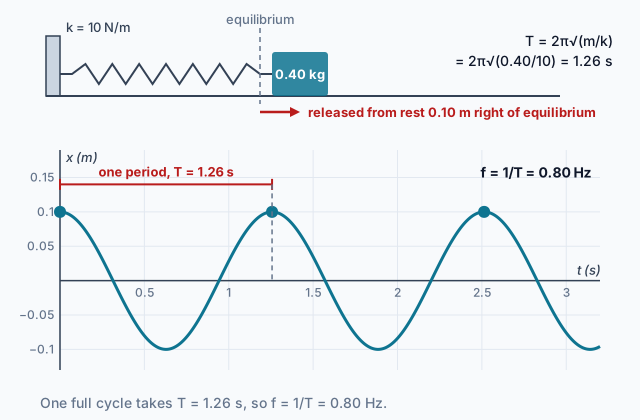
The block in the diagram takes 1.26 s to get from one peak of its position graph to the next, so its frequency is Hz, four fifths of a cycle each second.
Watch the word "swing". A pendulum that swings from the left side to the right has done half a cycle. It has to come back to the left to finish one.
To measure a period with a stopwatch, time many cycles and divide by the count. Starting and stopping the watch by hand costs you a tenth of a second or two, whether you time one cycle or twenty. Over twenty cycles, that error is shared out and almost disappears from each one.
Quick check · Calculate
A fishing float bobs up and down as small waves pass under it. A student counts 12 complete up-and-down cycles in 30 s. What is the frequency of the float's motion? Give your answer to the nearest 0.01 Hz.
2b. An object on a spring
For an object of mass on an ideal spring with spring constant (the of 2.8 Spring Forces), the period is
A heavier object takes longer for each cycle. At a given stretch the spring pulls with the same force whatever is on the end of it, and more mass speeds up less under that force. A stiffer spring, with a larger , pulls harder at every stretch, so it shortens the period.
The square root matters. Four times the mass gives twice the period, not four times. For the block in the diagram, s. Swap in a 1.60 kg block and the period becomes 2.51 s.
Notice what is missing from the equation: . Hang the same spring and block vertically, and gravity only moves the point the block oscillates about lower down. The period is the same as on a level table, and it would be the same on the Moon.
Quick check · Sketch the graph
A block slides on a level, frictionless track, attached to an ideal spring with spring constant 40 N/m. The block can be swapped for others of different mass. Sketch the period of the oscillation against the block's mass, from 0 to 1.6 kg. The first point is fixed at 0: a block with almost no mass would have almost no period.
One shape that fits
Drag a point up or down, or tap it and use the arrow keys. Only the shape is checked.
2c. A simple pendulum
A simple pendulum is a small, heavy bob on a light string or rod, swinging from a fixed pivot. Pulled aside by a small angle and released, it oscillates with period
where is the length from the pivot to the center of the bob and m/s². A longer pendulum takes longer for each cycle, and again it goes as the square root: a 4.0 m pendulum has twice the period of a 1.0 m one.
The bob's mass is nowhere in the equation. A heavier bob is pulled harder by gravity, but it has more mass to speed up, and the two cancel. That is why the steel and wooden balls stayed in step. What does change the period is . On the Moon, where is about a sixth of its value here, the same pendulum takes about 2.4 times as long for each cycle.
The equation is for small angles. Released from 10 degrees, a real pendulum's period is within 0.2 percent of it; released from 45 degrees, the real period runs about 4 percent longer. Keep the angle small when you want the equation to hold.
Quick check · Multiple choice
A simple pendulum swinging through a small angle has a period of 2.0 s. Its length, pivot to the center of the bob, is made four times as long, and its bob is replaced with one of the same size but twice the mass. What is the new period?
Part 3 Watch it done A clock that ticks once a second
Watch each step, then finish the problem yourself.
A grandfather clock ticks each time its pendulum reaches one end of its swing, so it ticks once at the left end and once at the right end of every cycle. To keep time, it must tick once every second. Treat the pendulum as a simple pendulum swinging through a small angle, and use m/s². How long must the pendulum be, from its pivot to the center of its bob?
Step 1 · Find the period from the ticks
There are two ticks in every cycle, one at each end of the swing. One tick per second means one full cycle takes 2.0 s, so s.
Why this step?
Why is the period 2.0 s and not 1.0 s, when the clock ticks every second?
A period is a full cycle, out and back. Between one tick and the next, the bob only goes from one end of its swing to the other, which is half a cycle. Using 1.0 s would give a pendulum a quarter as long, and the clock would run twice as fast.
Step 2 · Solve the period equation for the length
Square both sides of to get , then multiply both sides by :
Squaring first clears the square root, so is no longer stuck inside it.
Your step · Calculate
Finish it. A grandfather clock's pendulum, treated as a simple pendulum swinging through a small angle, must have a period of 2.0 s so that the clock ticks once a second. Using with m/s², how long must the pendulum be, from its pivot to the center of its bob? Give your answer to the nearest 0.01 m.
m
Part 4 Try it Change one thing at a time
A new setting: a lab where you change the mass, the spring or the length and read the period straight off. Before each change, say whether you expect the period to grow, shrink or stay put.
Try it · Decide and justify
In the Spring and Pendulum Lab, you pick Block on a spring, set Mass to 0.8 kg and Spring constant k to 20 N/m, and read the Period. You want a period half as long, and you may change only Mass. What should you set it to?
Which reason supports your answer?
Now a real machine. A car's body rides on springs, and after a bump it bounces on them. The shock absorbers are there to stop that bounce, and with worn ones a car keeps bobbing.
Try it · Calculate
A car's body, of mass 900 kg, rides on suspension springs that act together like one ideal spring with spring constant N/m. Its shock absorbers are worn out, so after a bump the body bounces up and down with nothing slowing the motion. What is the frequency of the bounce? Give your answer to the nearest 0.01 Hz.
Part 5 Explain it Design a test of the spring's period
Nothing you type leaves this page. Check your answer against the model and each scoring point.
Free response is 50% of the exam score. This one is shaped like Question 3, Experimental Design and Analysis.
Free-response practice · Question 3 style
A student wants to test how the period of an object on a spring depends on the object's mass. She hangs an ideal spring from a clamp and hangs a mass hanger from it, with slotted masses she can add to the hanger. She has a stopwatch, a meterstick and an electronic balance. Before the timing runs she finds the spring constant from how far known weights stretch the spring, as in 2.8 Spring Forces, and gets N/m.
(a) Describe a procedure she could follow to measure the period of the oscillation for at least five different masses. Say what she measures, with which equipment, and how she keeps the timing error small. Give enough detail that another student could repeat it.
(b) Starting from , identify a quantity she could plot on the vertical axis against on the horizontal axis to get a straight line, and state what the slope of that line should equal in terms of .
Her results are listed here. Each mass is the total of the hanger and the slotted masses on it, and each time is for 10 complete oscillations.
- 0.100 kg: 4.4 s
- 0.200 kg: 6.3 s
- 0.300 kg: 7.8 s
- 0.400 kg: 8.9 s
- 0.500 kg: 10.0 s
(c) On paper, calculate the period and its square for each trial, plot the graph you named in (b) and draw a best-fit line. Calculate its slope, and explain whether her data support the claim that the period of this spring is given by .
(d) Her partner repeats every trial, but he starts the stopwatch as he says "one" for the first oscillation and stops it as he says "ten", so each time he records really covers 9 oscillations. He still divides each time by 10. Explain whether the spring constant he calculates from the slope of his graph is larger than, smaller than or equal to 20 N/m.
Model answer
(a) Find the total mass of the hanger and its slotted masses on the balance. Hang it from the spring, let it come to rest, and clamp the meterstick beside it to mark that resting point. Pull the mass down about 2 cm and let go from rest, so it bounces straight up and down without swinging. Start the stopwatch as it passes the mark moving down, counting "zero", count each later pass moving down, and stop at "ten". The period is that time divided by 10. Timing 10 cycles shares the error of starting and stopping the watch by hand across 10 periods. Do three runs for each mass and average them, for at least five masses from 0.100 kg to 0.500 kg.
(b) Squaring both sides gives . So a graph of against should be a straight line through the origin, with slope .
(c) The periods are 0.44, 0.63, 0.78, 0.89 and 1.00 s, and their squares are 0.19, 0.40, 0.61, 0.79 and 1.00 s². The points lie close to one straight line through the origin. Two points on my best-fit line, not data points, are and , so its slope is s²/kg. Using the she measured from the spring's stretch, the equation predicts a slope of s²/kg. The measured slope is within about 2 percent of that, and the line passes through the origin, so the data support for this spring: the period grows with the square root of the mass.
(d) Larger. Each of his times covers 9 oscillations, so dividing by 10 makes every period 0.9 of its true value and every of it. Every point drops by the same factor, so his line is still straight and through the origin, but less steep, with a slope of about s²/kg. Since , a smaller slope gives a larger spring constant, about 25 N/m.
Score your own answer. This is a self-check, not a grade. Tick each point your answer makes.
Part 6 Check yourself Four pendulums on a beam
Both case questions use the pendulum table.
A student hangs four simple pendulums from a beam and releases each from rest at a small angle. For each one she records the length from the pivot to the center of the bob, the bob's mass, and the time the pendulum takes for 10 complete oscillations.
| Pendulum | Length (m) | Bob mass (kg) | Time for 10 oscillations (s) |
|---|---|---|---|
| A | 0.40 | 0.050 | 12.6 |
| B | 0.40 | 0.200 | 12.5 |
| C | 0.90 | 0.050 | 18.9 |
| D | 1.60 | 0.200 | 25.2 |
Case question 1 · Calculate
Using the pendulum table, what is the frequency of pendulum C? Give your answer to the nearest 0.01 Hz.
Case question 2 · Multiple choice
Using the pendulum table: which two pendulums should the student compare to test whether the bob's mass affects the period, and what do they show?
The rest stand on their own and do not use the case.
Check yourself · Spot the error
A 0.80 kg block on a level, frictionless track is attached to an ideal spring and oscillates with a frequency of 2.5 Hz. A student finds the spring constant. Tap the first line that goes wrong.
Check yourself · Sort it
Each card describes one change to an oscillator released from a small displacement. Tap a card, then what the change does to the oscillator's period.
The period gets longer
The period gets shorter
The period stays the same
Check yourself · Match
Use m/s². Tap each oscillator, then its period.
Part 7 Keep it Bring back earlier ideas
Pulling an older idea back up is what makes it last.
From 2.8 Spring Forces · Sketch the graph
A student finds that when a 6 N weight hangs at rest from an ideal spring, the spring is stretched 4 cm. Sketch the size of the force the spring exerts against how far it is stretched, from 0 to 8 cm. The first point is fixed at zero.
One shape that fits
Drag a point up or down, or tap it and use the arrow keys. The shape is checked, and the graph must pass through the values the question gives.
From 3.3 Potential Energy · Fill the statement
A spring toy has an ideal spring. Tap a blank, then an answer.
Compressing the spring 3 cm stores stretching it 3 cm. Compressing it 9 cm stores as much energy as compressing it 3 cm. With the zero at its relaxed length, the energy the spring stores is never .
In three lines
- A period is the time for one full cycle and a frequency is the number of cycles each second, so .
- An object on an ideal spring has : more mass or a softer spring lengthens the period, and does not enter.
- A simple pendulum at a small angle has : its length and set the period, and the bob's mass does not.
Vocabulary
- Period
- The time for one complete cycle of an object's motion, related to the frequency by .
- Frequency
- The number of complete cycles an object makes each second, measured in hertz, the reciprocal of the period.
- Ideal-spring oscillator
- An object attached to an ideal spring, whose period is for an object of mass and a spring with spring constant .
- Simple pendulum
- A small bob on a light string or rod swinging from a pivot, whose period when displaced by a small angle is for a length from the pivot to the bob's center.
Course alignment, for teachers
AP Physics 1: Algebra-Based topic 7.2, Unit 7: Oscillations.
- Skill 1.B: Create quantitative graphs with appropriate scales and units, including plotting data.
- Skill 2.A: Derive a symbolic expression from known quantities by selecting and following a logical mathematical pathway.
- Skill 2.D: Predict new values or factors of change of physical quantities using functional dependence between variables.
- Skill 3.A: Create experimental procedures that are appropriate for a given scientific question.
- Skill 3.C: Justify or support a claim using evidence from experimental data, physical representations, or physical principles or laws.
This lesson maps all 3 essential knowledge statements of the topic to the part that teaches each one: 3 are checked by a scored question. The map is in the lesson file.