Unit 8 · Topic 8.3 · about 30 minutes · 7 parts · 12 scored checks, 2 of them multiple choice
AP Physics 1: Algebra-Based 8.3: Fluids and Newton’s Laws
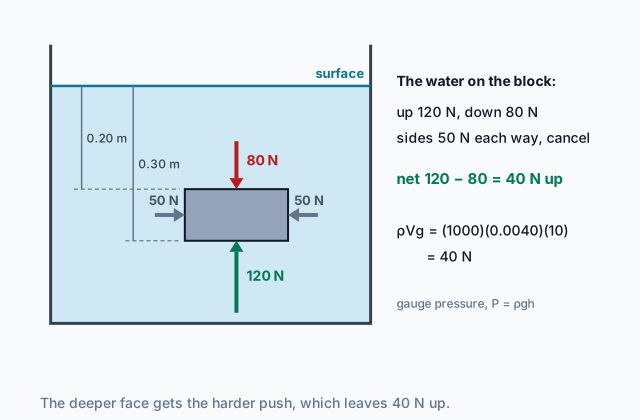 Tap to open the picture full size
Part 1 Think first A rock held deeper
Commit to a guess first. Being wrong now makes the right idea stick better.
Predict first
You hold a fist-sized rock on a string so that it hangs completely under the water in a swimming pool, 0.5 m below the surface. Then you lower it to 2.5 m below the surface, still well clear of the bottom. Compared with at 0.5 m, how large is the total force the water exerts on the rock at 2.5 m, all of its pushes added together?
In short. The buoyant force is the net upward force a fluid exerts on an object in it, and its size equals the weight of the fluid the object displaces.
- It is the sum of the pushes the fluid's particles exert on every face of the object, and those pushes are larger on the deeper faces, so the sum points up.
- Its size is , where is the fluid's density and is the volume of fluid displaced, the part of the object below the surface.
- Newton's laws describe the particles of a fluid and the objects in it: a fluid's velocity changes only when a net force acts on it, and an object floating at rest has a buoyant force equal to its weight.
Part 2 Learn it Four short ideas, each checked as you go
2a. Newton's laws inside a fluid
A fluid is made of particles, and Newton's laws hold for every bit of it. Take a small parcel of water, a cube the size of a sugar cube in the middle of a still fish tank, as your system. Earth pulls it down. The water around it pushes on it from every side, a little harder from below than from above. The parcel's velocity stays at zero, so by Newton's first law the net force on it is zero: the extra push from below exactly matches its weight.
A fluid's velocity changes only when the net force on a parcel of it is not zero. Water falling from a kettle's spout speeds up, because gravity pulls it and nothing balances that pull. Water sweeping around a river bend at a steady speed is changing direction, so the water around it must push it harder from the outside of the bend than from the inside.
What a fluid does as a whole comes from these pushes between its particles together with the external forces on it: gravity, and the walls and floor that hold it. A pond lies flat. Coffee in a braking car sloshes forward, because the cup slows first and the coffee keeps going until the cup's wall pushes it back.
Quick check · Sort it
Each card describes a small parcel of water or coffee. Tap a card, then whether the net force exerted on that parcel is zero or not zero.
Net force is zero
Net force is not zero
2b. Where the buoyant force comes from
Hold a closed, empty plastic box under water and you feel the water shove it up. That push is the buoyant force: the net upward force a fluid exerts on an object in it.
It is not a new kind of force. Water particles crowd against every face of the box, and the buoyant force is all of their pushes added together. The pressure in a fluid grows with depth, as in 8.2 Pressure, so the water pushes up on the deeper bottom face harder than it pushes down on the top. The pushes on opposite sides are at matching depths, so they cancel.
The diagram at the top of this page puts numbers on one block. Each push is the pressure times the face's area, with . The top face, 0.20 m down with an area of 0.040 m², gets N down. The bottom gets 120 N up and each side 50 N. These count only the water's depth. The open tank's air adds about 4000 N to the top and the same to the bottom, so it cancels. What is left is 40 N up, the buoyant force.
A free-body diagram shows the buoyant force as one arrow in place of all those pushes, never beside them. Air does this too: it is a fluid, and its pressure is also greater lower down.
Quick check · Multiple choice
A closed plastic box is held at rest, completely under the water in a tank, with its top face level. Why does the total force exerted on the box by the water point up?
2c. How big the buoyant force is
You can find the size of the buoyant force without adding up a single push. Imagine the block gone and its space filled with water of the same shape. That water would sit still, so by Newton's first law the water around it pushes up on it with a net force equal to its weight. The surrounding water presses on that surface the same way whatever is inside, so the block gets the very same push.
So the buoyant force equals the weight of the fluid the object displaces:
Here is the density of the fluid, not of the object, and is the volume of fluid displaced, which is the volume of the part of the object below the surface. For the block in the diagram, and N, the same 40 N the pushes added to.
Two things are missing from that equation: the object's mass and its depth. A lead block and a plastic block of the same size, both held under water, get the same buoyant force. Lower either one and the pushes on its top and bottom grow by the same amount, so their difference stays put.
Quick check · Calculate
A stone with a volume of and a mass of 1.2 kg hangs at rest from a thread, completely under the surface of a tank of seawater and clear of the bottom. Seawater has a density of 1030 kg/m³. How large is the buoyant force the seawater exerts on the stone? Give your answer to the nearest 0.01 N.
2d. Floating, sinking and hanging
Now put the buoyant force into Newton's laws for the object. Gravity pulls it down, the fluid pushes it up with , and anything else that touches it, a string or the floor of a tank, adds its own force.
Floating at rest. Nothing else touches it and its velocity stays at zero, so . A floating object settles until the fluid it displaces weighs as much as it does. A steel ship floats, though steel is far denser than water, because its hull is a hollow shell around a large volume of air. It sinks in only until the seawater pushed aside by the part below the waterline weighs as much as the whole ship.
Sunk. If the object's weight is more than for its whole volume, it cannot displace enough fluid to float. Resting on the bottom with water all around it, it gets a normal force from the bottom that makes up the difference: .
Hanging from a string. A string holding it still under the surface pulls with , which is why a rock feels lighter in a pool.
Let go of a beach ball held under water, and the buoyant force beats its weight: the net force points up, so the ball accelerates upward.
Quick check · Decide and justify
A steel cargo ship floats at rest in a calm harbor, even though steel is about eight times as dense as seawater. A visitor says the seawater must push up on the ship harder than gravity pulls it down, or the ship would sink. Is the visitor right?
Which reason supports your answer?
Part 3 Watch it done A floating dock section
Watch each step, then finish the problem yourself.
A section of a floating boat dock is a concrete shell around a foam core, with a rectangular bottom 2.0 m by 2.5 m, and it is 0.50 m tall. Its mass is 900 kg. It floats at rest, level, on a fresh water lake, whose density is 1000 kg/m³. Find how far below the surface its bottom sits.
Step 1 · Name the forces on the dock section
Two forces act on the floating section: Earth's gravitational force, N, pointing down, and the water's buoyant force , pointing up. Nothing else touches it.
Step 2 · Use Newton's first law
The section floats at rest, so its velocity is constant and the net force on it is zero. Take up as positive: , so N.
Why this step?
Why not find the buoyant force from with the section's whole volume, ?
Because the section is not wholly under the surface. The in is the volume of water displaced, which is only the part of the section below the surface, and that part is what you are trying to find. The first law gives the buoyant force without it, and then can be turned around to give the volume.
Your step · Calculate
Finish it. A section of a floating dock is a concrete shell around a foam core, with a rectangular bottom 2.0 m by 2.5 m, and it is 0.50 m tall. Its mass is 900 kg, and it floats at rest and level on fresh water, density 1000 kg/m³. How far below the surface is its bottom? Give your answer to the nearest 0.01 m.
m
Part 4 Try it A balloon in air
A new fluid. Air has no fixed shape, so it is a fluid too, and everything in this lesson holds for it. On a still day a child lets go of a helium balloon, and it starts to rise with its string trailing below. Take the balloon, the helium inside it and the string as the system, and work out what pushes it up.
Try it · Fill the statement
A helium balloon is let go on a still day and starts to rise. Take the balloon, its helium and its string as the system. Tap a blank, then a word or phrase.
The air pushes on every part of the balloon's surface, and it pushes hardest on the of the balloon, where the air pressure is greatest. The buoyant force equals the weight of the that the balloon pushes aside, and the balloon starts to rise because that force is the gravitational force on the system.
Part 5 Explain it Design a test of the buoyant force
Nothing you type leaves this page. Check your answer against the model and each scoring point.
Free response is 50% of the exam score. This one is shaped like Question 3, Experimental Design and Analysis.
Free-response practice · Question 3 style
A student wants to test the claim that the buoyant force on an object equals the weight of the fluid it displaces. She has an aluminum bar with a rectangular cross section, 0.040 m by 0.050 m, and 0.15 m long; a force sensor held by a clamp on a stand, from which the bar can hang; a tall beaker of fresh water, density 1000 kg/m³, standing on a lab jack that raises it in small steps; and a ruler. Use m/s².
(a) Describe a procedure she could use to measure the buoyant force on the bar for at least five different submerged volumes. Say what she measures, with which equipment, and give enough detail that another student could repeat it.
(b) The bar hangs at rest from the sensor, long side vertical, with part of it under the water. Derive an expression for the buoyant force on the bar in terms of the sensor's reading with the bar in air, , and its reading with the bar partly under water, . Then, if the claim is true, identify a graph of her results that should be a straight line, and state what its slope should equal.
With the bar hanging in air, the sensor reads 8.10 N. Her readings, with the depth of the bar's bottom face below the water's surface:
- m: the sensor reads 7.71 N
- m: 7.29 N
- m: 6.92 N
- m: 6.49 N
- m: 6.12 N
(c) Calculate the submerged volume and the buoyant force for each reading. On paper, plot the graph you named in (b) and draw a best-fit line. Calculate its slope, and explain whether her data support the claim.
(d) Her partner repeats the experiment without reading depths off the ruler. He raises the jack until the water just touches the bottom of the bar, then raises it 0.020 m more at each step, and records 0.020 m, 0.040 m and so on as the depth . As the bar goes in, the water level in the beaker rises. Explain whether the slope of his graph is larger than, smaller than or equal to the slope of hers.
Model answer
(a) Hang the bar from the force sensor by one end, long side vertical, and record the reading with the bar in air. Measure the cross section with the ruler. Raise the jack until, with the ruler held upright against the bar, the water's surface is 0.020 m above the bar's bottom face, wait until the bar and the water are still, and record the sensor's reading. Repeat at 0.040 m, 0.060 m and so on, for five or more depths, checking that the bar never touches the beaker's side or bottom, and do the whole set three times, averaging the readings at each depth. The submerged volume at each step is the cross-sectional area times the depth read off the ruler.
(b) The bar is at rest, so the net force on it is zero. With up as positive, the sensor pulls up with , the water pushes up with and gravity pulls down with : . In air the water does not push on it. The air does, but its buoyant force on the bar, about N, is smaller than the 0.01 N the sensor reads to, so , and . If the claim is true, with the water's density, so a graph of against the submerged volume should be a straight line through the origin with slope N/m³.
(c) The cross section is , so the volumes are 4.0, 8.0, 12, 16 and , and the buoyant forces, N minus each reading, are 0.39, 0.81, 1.18, 1.61 and 1.98 N. The points lie close to a straight line through the origin. Two points on my best-fit line, not data points, are and , so the slope is N/m³. That matches for water to within about 1 percent, and the line passes through the origin, so the buoyant force is proportional to the volume of water displaced, with exactly the constant the claim predicts. The data support the claim.
(d) Larger. The bar pushes water up the beaker as it goes in: the level rises by the bar's submerged volume divided by the beaker's area, which grows in step with the true depth. So each true depth is more than the depth he records, by the same fraction at every step, and each of his volumes is too small by that fraction. His buoyant forces are the real ones, so the same rise in is plotted over a smaller run in , and his line is steeper than hers. He would find a slope above .
Score your own answer. This is a self-check, not a grade. Tick each point your answer makes.
Part 6 Check yourself Three blocks in a tank
Both case questions use the table of blocks.
A student drops three solid blocks into a tank of fresh water, density 1000 kg/m³. Each block measures 0.10 m by 0.10 m by 0.050 m, so each has a volume of . A wire mesh shelf near the bottom of the tank lets water reach all around any block that sinks onto it. Once everything is still, she records where each block rests.
| Block | Mass (kg) | Where it rests |
|---|---|---|
| Pine | 0.30 | Floating at the surface |
| Rubber | 0.65 | On the mesh shelf |
| Aluminum | 1.35 | On the mesh shelf |
Case question 1 · Calculate
Using the table of blocks in fresh water: how large is the buoyant force on the pine block once it is at rest? Give your answer to the nearest 0.1 N.
Case question 2 · Multiple choice
Using the table of blocks in fresh water: once all three blocks are at rest, how do the buoyant forces on them compare?
The rest stand on their own and do not use the case.
Check yourself · Draw the forces
A 2.7 kg aluminum block with a volume of hangs at rest from a string, completely under fresh water (density 1000 kg/m³) in a tank, touching neither the sides nor the bottom. Build the block's free-body diagram, and set each arrow's length to compare with the others.
The dot is the aluminum block. One diagram that fits
Pick each force exerted on the aluminum block, then choose the way it points and how long its arrow is compared with the others. The arrows are drawn for you.
Check yourself · Spot the error
A 0.90 kg rock with a volume of lies on the pebbly bottom of a pond, completely under fresh water (density 1000 kg/m³), with water all around it. Take up as positive. A student finds the normal force the pond bottom exerts on the rock. Tap the first line that goes wrong.
Part 7 Keep it Bring back earlier ideas
Pulling an older idea back up is what makes it last.
From 2.4 Newton’s First Law · Spot the error
A 1200 kg elevator rises at a steady 2 m/s. Air resistance is negligible, and up is positive. A student works out how hard its cable pulls up on it. Tap the first line that goes wrong.
From 2.5 Newton’s Second Law · Calculate
A rope pulls a 25 kg sled east across level snow with a horizontal force of 80 N. The snow exerts a friction force of 30 N on the sled, pointing west. Take east as positive. What is the sled's acceleration? Give your answer to the nearest 0.1 m/s².
In three lines
- The buoyant force is the net upward force a fluid exerts on an object, the sum of the pushes of its particles, which are larger on the deeper faces.
- Its size is the weight of the fluid displaced, , with the fluid's density and the volume of the object below the surface.
- Newton's laws hold for a fluid and the objects in it: a fluid's velocity changes only under a net force, and a floating object at rest has .
Vocabulary
- Fluid
- A substance that has no fixed shape, such as a liquid or a gas, whose behavior as a whole comes from the interactions between its particles and the external forces exerted on it.
- Buoyant force
- The net upward force a fluid exerts on an object, the result of the collective forces exerted on the object by the particles of the fluid.
- Displaced fluid
- The fluid an object pushes out of the way, whose volume equals the volume of the object below the surface and whose weight equals the buoyant force, .
- Net force
- The vector sum of all the forces exerted on a system; a parcel of fluid's velocity changes only when the net force on it is not zero.
Course alignment, for teachers
AP Physics 1: Algebra-Based topic 8.3, Unit 8: Fluids.
- Skill 1.A: Create diagrams, tables, charts, or schematics to represent physical situations.
- Skill 2.A: Derive a symbolic expression from known quantities by selecting and following a logical mathematical pathway.
- Skill 2.D: Predict new values or factors of change of physical quantities using functional dependence between variables.
- Skill 3.B: Apply an appropriate law, definition, theoretical relationship, or model to make a claim.
This lesson maps all 5 essential knowledge statements of the topic to the part that teaches each one: 5 are checked by a scored question. The map is in the lesson file.