Unit 3 · Topic 3.1 · about 30 minutes · 7 parts · 12 scored checks, 2 of them multiple choice
AP Physics 1: Algebra-Based 3.1: Translational Kinetic Energy
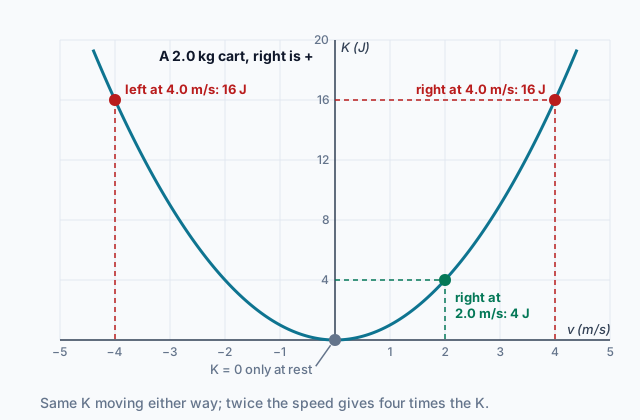 Tap to open the picture full size
Part 1 Think first A jogger and a fastball
Commit to a guess first. Being wrong now makes the right idea stick better.
Predict first
A 60 kg jogger runs along a path at 2.0 m/s. On a field beside the path, a pitcher throws a 0.15 kg baseball at 40 m/s. Which one carries more energy because of its motion?
In short. Translational kinetic energy is the energy an object has because it moves, .
- Mass counts once and speed counts squared: double the mass and doubles, double the speed and is four times as large.
- It is a scalar: the sign of the velocity disappears when it is squared, so has no direction and is never negative.
- It depends on the frame of reference, because velocity does, so observers moving differently can measure different kinetic energies for the same object.
Part 2 Learn it Three short ideas, each checked as you go
2a. Mass once, speed squared
An object that moves along a line has energy because it moves. That is its translational kinetic energy:
With in kilograms and in meters per second, comes out in joules (1 J is 1 kg·m²/s²). A 2.0 kg cart at 3.0 m/s has J.
Mass and speed do not count the same way. Mass enters once, so doubling it doubles : put a second identical cart beside the first at the same speed and the pair carries 18 J. Speed is squared, so doubling it makes four times as large. At 6.0 m/s the same 2.0 kg cart has J. Triple the speed and is nine times as large.
Square the speed first, then multiply by the mass and by one half. Writing and forgetting the square, or squaring the whole product , are the two slips to watch for.
Quick check · Calculate
A 0.40 kg soccer ball leaves a player's foot at 15 m/s. What is its translational kinetic energy just after the kick? Give your answer to the nearest joule.
2b. A scalar that is never negative
Kinetic energy has a size and no direction. It is a scalar, like mass or time, not a vector like velocity.
Look at what goes into it. Mass is never negative. A velocity can be negative, since the sign only says which way along the axis the object moves, but the formula squares it, and a squared number is never negative. With right as positive, a 2.0 kg cart moving left at 3.0 m/s has m/s and J, exactly what it has moving right at 3.0 m/s. A moving object's kinetic energy is positive, and it is zero only when the object is at rest. There is no negative kinetic energy, and no kinetic energy "to the left".
The same holds when a direction changes and the speed does not. A runner going around a bend at a steady 5 m/s has a velocity that keeps turning and a kinetic energy that stays the same.
Because kinetic energy is a scalar, the kinetic energies of several objects add as plain positive numbers. Objects moving opposite ways do not cancel.
Quick check · Decide and justify
A 0.50 kg ball is thrown straight down from a balcony at 6.0 m/s. Take up as positive, so the ball's velocity as it leaves the hand is m/s. A student writes the ball's translational kinetic energy at that moment as J. Is the student right?
Which reason supports your answer?
2c. It depends on who is measuring
Velocity depends on the frame of reference, as you saw in 1.4 Reference Frames and Relative Motion. Kinetic energy is built from velocity, so it depends on the frame too. Two observers can measure different kinetic energies for the same object at the same moment, and each is right in their own frame.
A 60 kg passenger sits in a train moving east at 20 m/s. To someone standing on the platform she moves at 20 m/s, so her kinetic energy is , which is 12,000 J. To the person in the next seat she is not moving at all, so her kinetic energy is zero.
To find an object's kinetic energy in a frame, find its velocity in that frame first, then square it. If the passenger walks east along the aisle at 1.5 m/s, the train measures J. The platform sees her moving at 21.5 m/s and measures about 13,900 J. Her walk added 67.5 J in the train's frame and about 1,900 J in the platform's, because the velocities are combined first and the result is squared afterward.
Quick check · Match
A 2.0 kg package sits on the floor of a delivery van driving east at 10 m/s along a straight road. Take east as positive. Tap an observer, then the translational kinetic energy of the package that observer measures.
Part 3 Watch it done A puck and a block of ice
Watch each step, then finish the problem yourself.
A 0.16 kg hockey puck slides across a rink at 25 m/s. A 4.0 kg block of ice slides across the same rink. How fast must the block slide to have the same translational kinetic energy as the puck?
Step 1 · Find the puck's kinetic energy
J. Square the 25 m/s before multiplying by the mass.
Step 2 · Set the block's kinetic energy equal to it and solve for v
The block needs J. Multiply both sides by 2 and divide by the mass to get on its own, then take the square root: .
Why this step?
Why is the block's speed not just the puck's speed divided by 25, the ratio of the two masses?
Mass enters the kinetic energy once, but speed enters it squared. A block with 25 times the mass needs its to be 25 times smaller, not its . Dividing the speed itself by 25 would divide by 625, which is far too much, and the block would carry only a small fraction of the puck's energy.
Your step · Calculate
Finish it. A 0.16 kg hockey puck slides across a rink at 25 m/s, and a 4.0 kg block of ice slides across the same rink. How fast must the block slide to have the same translational kinetic energy as the puck? Give your answer to the nearest 0.1 m/s.
m/s
Part 4 Try it Two skaters passing
A new situation: two objects moving opposite ways at the same time. Two skaters glide toward each other across smooth ice, one heading east and one heading west. Decide what their kinetic energies add up to as one system. Then practice the kinetic energy of a single object with new numbers each time.
Try it · Calculate
Two skaters glide toward each other on smooth ice. Take east as positive. A 50 kg skater moves east at 3.0 m/s, and a 40 kg skater moves west at 4.0 m/s. What is the total translational kinetic energy of the two skaters? Give your answer to the nearest joule.
Part 5 Explain it Claim, derive, connect
Nothing you type leaves this page. Check your answer against the model and each scoring point.
Free response is 50% of the exam score. This one is shaped like Question 4, Qualitative/Quantitative Translation.
Free-response practice · Question 4 style
A cart of mass rolls along a straight, level track at speed . Two students each want to give the cart more translational kinetic energy. Student 1 stacks a second identical cart on top, so the mass is , and launches the pair at the original speed . Student 2 keeps the mass and launches the cart at speed . Student 1 says the two changes give the same kinetic energy, since kinetic energy depends on both mass and speed.
(a) Make a claim about which student's cart has the greater translational kinetic energy, and how many times greater it is than the other's. Explain your reasoning in words, without equations.
(b) Derive expressions for and , the kinetic energies of Student 1's and Student 2's carts, in terms of and . Then derive the ratio .
(c) Explain how your expressions in (b) are consistent with your claim in (a).
(d) Take the cart's original direction as positive. Student 2 now launches the cart of mass at speed in the opposite direction. Explain, using your expression for , whether the cart's kinetic energy is different from before.
Model answer
(a) Student 2's cart has the greater kinetic energy, twice as much as Student 1's. Kinetic energy is proportional to mass, so doubling the mass at the same speed doubles it. It is proportional to the square of the speed, so doubling the speed makes it four times as large. Student 1's change makes the kinetic energy twice the original and Student 2's makes it four times the original, so Student 2's cart has twice as much as Student 1's, and Student 1's claim is wrong.
(b) and . Then .
(c) The original cart has , so is 2 times the original and is 4 times it. The factor of 2 on the mass comes through once, while the factor of 2 on the speed is squared and comes through as 4. So : Student 2's cart has twice the kinetic energy, as claimed. The ratio has no or left in it, so it holds for any cart at any speed.
(d) Moving the other way, the velocity is , and , the same as before. Squaring removes the sign, so kinetic energy is a scalar with no direction, and reversing the cart leaves it unchanged.
Score your own answer. This is a self-check, not a grade. Tick each point your answer makes.
Part 6 Check yourself A test track
Both case questions use the test track's table.
Four carts move along a long, straight test track. A sensor fixed to the ground records each cart's velocity at the same instant, with east as positive.
| Cart | Mass (kg) | Velocity (m/s) |
|---|---|---|
| A | 2.0 | +5.0 |
| B | 6.0 | -3.0 |
| C | 1.0 | -8.0 |
| D | 8.0 | +2.0 |
Case question 1 · Multiple choice
Using the test track's table, with east as positive, which cart has the greatest translational kinetic energy at that instant, as measured from the ground?
Case question 2 · Calculate
Using the test track's table, with east as positive: an observer walks east beside the track at 2.0 m/s. What translational kinetic energy does she measure for cart B at that instant? Give your answer to the nearest joule.
The rest stand on their own and do not use the case.
Check yourself · Spot the error
A 3.0 kg cart on a level track speeds up from 2.0 m/s to 6.0 m/s, moving the same way the whole time. A student works out its new translational kinetic energy. Tap the first line that goes wrong.
Check yourself · Sort it
Each card describes a change to something moving along a straight line. Tap a card, then what happens to its translational kinetic energy.
Stays the same
Becomes twice as large
Becomes four times as large
Check yourself · Fill the statement
A suitcase sits on the floor of a train moving north at 25 m/s along a straight track. Tap a blank, then an answer.
A passenger seated in the train measures the suitcase's kinetic energy as . A person standing on the platform measures a kinetic energy for the suitcase that is . Later the train runs south at 25 m/s, and the person on the platform finds the suitcase's kinetic energy is its value going north.
Part 7 Keep it Bring back earlier ideas
Pulling an older idea back up is what makes it last.
From 1.4 Reference Frames and Relative Motion · Multiple choice
A cyclist rides east at 8 m/s along a straight bike path. A jogger ahead of her runs east at 3 m/s on the same path. Take east as positive. What is the jogger's velocity measured by the cyclist?
From 1.1 Scalars and Vectors in One Dimension · Spot the error
Take right as positive. Cart P has m/s and cart Q has m/s. A student works out which cart is faster. Tap the first line that goes wrong.
In three lines
- Translational kinetic energy is : mass counts once, speed counts squared.
- It is a scalar. Squaring removes the velocity's sign, so is never negative and has no direction.
- It depends on the frame: find the velocity in the observer's frame first, then square it.
Vocabulary
- Translational kinetic energy
- The energy an object has because it moves from place to place, , set by its mass and the square of its speed.
- Scalar quantity
- A quantity with a size and no direction, such as mass, time or kinetic energy, so it is never drawn as an arrow.
- Frame of reference
- The point of view of an observer, with its own origin and axes, from which positions and velocities, and so kinetic energies, are measured.
Course alignment, for teachers
AP Physics 1: Algebra-Based topic 3.1, Unit 3: Work, Energy, and Power.
- Skill 1.C: Create qualitative sketches of graphs that represent features of a model or the behavior of a physical system.
- Skill 2.B: Calculate or estimate an unknown quantity with units from known quantities, by selecting and following a logical computational pathway.
- Skill 3.B: Apply an appropriate law, definition, theoretical relationship, or model to make a claim.
- Skill 3.C: Justify or support a claim using evidence from experimental data, physical representations, or physical principles or laws.
This lesson maps all 3 essential knowledge statements of the topic to the part that teaches each one: 3 are checked by a scored question. The map is in the lesson file.