Unit 8 · Topic 8.1 · about 30 minutes · 7 parts · 13 scored checks, 1 of them multiple choice
AP Physics 1: Algebra-Based 8.1: Internal Structure and Density
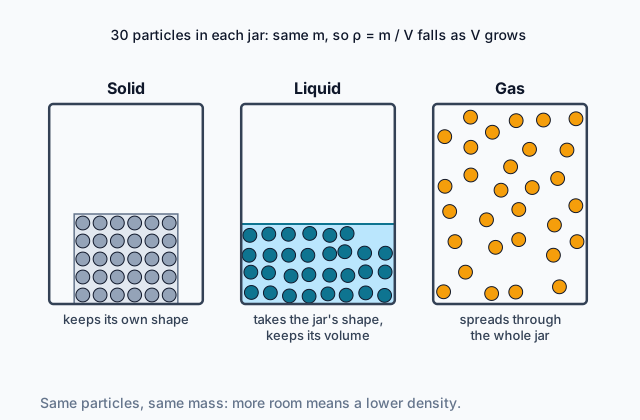 Tap to open the picture full size
Part 1 Think first A cubic meter of water
Commit to a guess first. Being wrong now makes the right idea stick better.
Predict first
A glass fish tank is a cube, 1 m long, 1 m wide and 1 m tall, and it is filled to the brim with water. About how much mass of water does it hold?
In short. A fluid is a substance with no fixed shape, and every fluid can be described by its density, the ratio of its mass to its volume, .
- Solids, liquids and gases behave differently because their atoms and molecules interact differently: held in place in a solid, close but sliding in a liquid, far apart in a gas.
- Liquids and gases are both fluids. Neither keeps a shape of its own; each takes the shape of whatever holds it.
- An ideal fluid is a model: it is incompressible, so its density never changes when it is squeezed, and it has no viscosity.
Part 2 Learn it Four short ideas, each checked as you go
2a. Solids, liquids and gases
Ice, liquid water and steam are made of the same molecules. What changes from one to the next is how strongly those molecules hold on to each other, and that is true of every substance. The way atoms and molecules interact is what gives a solid, a liquid and a gas their different properties.
In a solid, each particle is pulled hard toward its neighbors. It vibrates, but it stays in its own spot, so a solid keeps its shape. A spoon is the same spoon in any drawer.
In a liquid, the particles still attract each other enough to stay packed close, but not enough to pin each one in place. They slide past one another. A liquid keeps its volume but flows into the shape of the bottom of its container.
In a gas, the particles are far apart and moving fast, and the pull between them hardly matters except when two collide. Nothing holds them together, so a gas spreads out to fill whatever container it is in.
The diagram shows the same 30 particles all three ways. Most substances take up less room as solids than as liquids. Water is an exception: its molecules freeze into an open pattern, so ice takes up about 9 percent more room than the water it froze from.
Quick check · Sort it
Each card describes a substance's particles or how the substance behaves. Tap a card, then the state of matter it describes.
Solid
Liquid
Gas
2b. What makes a fluid
A fluid is a substance that has no fixed shape. Pour it into a different container and it takes that container's shape. Liquids and gases are both fluids: water in a glass, the air in a balloon, the gasoline in a car's tank. A solid is not a fluid, because its particles are held in place.
Being a fluid is about shape, not about how fast something flows. Honey on a cold morning pours so slowly that it seems almost solid, but tip the jar and leave it, and the honey settles into a new shape. A quick stream of water and a slow drip of syrup are both fluids.
What a liquid and a gas keep is different. Pour 500 mL of juice from a carton into a wide bowl and you still have 500 mL; only its shape changed. Let the air out of a balloon in a closed room and it spreads through the whole room, because a gas keeps neither its shape nor its volume.
Everything in the rest of this unit is about fluids.
Quick check · Decide and justify
In 1927 a physicist heated some pitch, a black, tar-like material, poured it into a glass funnel and let it cool. Three years later he cut open the funnel's stem. Cold pitch feels hard, and a sharp hammer blow shatters it. Yet ever since, the cold pitch has been creeping out through the stem, and a new drop falls about once a decade. Is pitch a fluid?
Which reason supports your answer?
2c. Density: mass per volume
Pick up a brick and then a loaf of bread the same size, and the difference you feel is density. Density is the ratio of mass to volume:
The symbol is the Greek letter rho. In SI units, mass is in kilograms and volume in cubic meters, so density is in kg/m³. Labs and labels often use g/cm³ instead, and a milliliter is the same as a cubic centimeter: 1 mL = 1 cm³.
Converting between the two units is where answers go wrong. A gram is kg. A centimeter is m, so a cubic centimeter is . Then
Water is 1.00 g/cm³, or 1000 kg/m³. Air at room temperature is about 1.2 kg/m³.
In a uniform material, density does not depend on how big the piece is. A bigger piece has more mass and more volume in the same ratio, so the mass of a piece is proportional to its volume.
Quick check · Calculate
A solid metal block measures 4.0 cm by 5.0 cm by 10.0 cm and has a mass of 540 g. What is the density of the metal, in kg/m³? Give your answer to the nearest 10 kg/m³.
2d. The ideal fluid
Real fluids do two things that a simpler model, the ideal fluid, leaves out.
The first is compression. Squeeze a fluid, and if its volume shrinks while its mass stays the same, its density goes up. A fluid whose density does not change when it is squeezed is incompressible. Liquids come close: press on a capped bottle filled to the brim with water and the bottle hardly gives. Gases do not come close. A bike pump crams more and more air into the same tire, so the air in the tire gets denser with every stroke.
The second is viscosity, a fluid's internal friction, its resistance to flowing. Honey and motor oil are viscous. Water is much less so, and air even less.
An ideal fluid is incompressible and has no viscosity. Like the object model from 1.2 Displacement, Velocity, and Acceleration, it is a simplification you choose because what it leaves out does not matter much for the question. Water running through a garden hose is close to ideal. Air being pumped into a tire is not.
Quick check · Fill the statement
Tap a blank, then an answer.
At the bottom of the deepest ocean trench, the water is squeezed by about 11 km of water above it, yet it is only a few percent denser than water at the surface. That makes water close to . Equal volumes of motor oil and water poured down the same ramp do not race along together: the oil creeps more slowly because it has a greater . An ideal fluid takes both ideas to their limit. Its density however hard it is squeezed, and it has no internal friction at all.
Part 3 Watch it done The density of a cooking oil
Watch each step, then finish the problem yourself.
A student measures the density of a cooking oil. Her empty graduated cylinder has a mass of 120.0 g. She pours in oil up to the 80.0 mL mark, and the cylinder and oil together now have a mass of 192.8 g. Find the density of the oil in kg/m³.
Step 1 · Find the mass of the oil alone
The second reading is the cylinder and the oil together, so subtract the cylinder: g.
Why this step?
Why subtract the cylinder's mass, rather than divide the 192.8 g reading by the oil's volume?
Density is a property of the oil, so the mass and the volume in must both be the oil's. The 80.0 mL is the oil's volume alone. Dividing the combined mass by it would count 120 g of glass as oil and give a density more than twice too big.
Step 2 · Write the volume in cubic centimeters
A milliliter is a cubic centimeter, so cm³. Dividing a mass in grams by this volume gives a density in g/cm³, and each 1 g/cm³ is 1000 kg/m³.
Your step · Calculate
Finish it. An empty graduated cylinder has a mass of 120.0 g. With cooking oil poured in to the 80.0 mL mark, the cylinder and oil together have a mass of 192.8 g. What is the density of the oil, in kg/m³? Give your answer to the nearest 10 kg/m³.
kg/m^3
Part 4 Try it Cutting a steel bar
A new situation: nothing is measured, and the question is what changes when a piece of material is cut. A machinist saws a steel bar into two unequal pieces. Decide what happens to the density first. Then practice finding densities from a block's size and mass, with new numbers each time.
Try it · Decide and justify
A machinist saws a uniform 2.4 kg steel bar into two pieces, one twice as long as the other. How does the density of the longer piece compare with the density of the shorter piece?
Which reason supports your answer?
Part 5 Explain it Derive it, then put numbers in
Nothing you type leaves this page. Check your answer against the model and each scoring point.
Free response is 50% of the exam score. This one is shaped like Question 1, Mathematical Routines.
Free-response practice · Question 1 style
A trophy is a solid brass figure glued to a solid wooden base. The base has volume and density . The figure has volume and density , with greater than . The glue's mass and volume are negligible.
(a) Derive an expression for the average density of the whole trophy, its total mass divided by its total volume, in terms of , , and .
(b) The base has a volume of 600 cm³ and a density of 0.75 g/cm³. The figure has a volume of 50 cm³ and a density of 8.5 g/cm³. Calculate the trophy's average density in kg/m³.
(c) A classmate says the average density should be halfway between the two densities, about 4.6 g/cm³. Use your expression from part (a) to explain why the trophy's average density is much closer to the wood's density.
(d) The maker wants a trophy with an average density of 2000 kg/m³, using the same base and a larger brass figure. Derive an expression for the volume of brass needed to give an average density , and then calculate that volume.
Model answer
(a) Each part's mass is its density times its volume, so the trophy's mass is and its volume is . Then .
(b) g/cm³. Since 1 g/cm³ is 1000 kg/m³, that is about 1350 kg/m³.
(c) In the expression, each density is multiplied by its own part's volume before dividing by the total volume, so each density counts in proportion to the volume it fills. The halfway value would be right only if . Here the wood fills 600 of the 650 cm³, so counts twelve times as heavily as , and the average lands near 0.75 g/cm³. The brass holds almost half the trophy's mass, 425 g of 875 g, but very little of its volume.
(d) Set and collect the terms: , so . In the same units as the other densities, 2000 kg/m³ is 2.0 g/cm³, so cm³. Check: g/cm³.
Score your own answer. This is a self-check, not a grade. Tick each point your answer makes.
Part 6 Check yourself Four clear liquids
Both case questions use the four-liquid table.
A student is handed four samples of clear liquid, labeled W, X, Y and Z, and is told that exactly two of them are the same liquid. She measures each sample's volume in a graduated cylinder and its mass on a balance, subtracting the mass of the empty cylinder each time.
| Sample | Volume (mL) | Mass (g) |
|---|---|---|
| W | 50.0 | 46.0 |
| X | 50.0 | 63.0 |
| Y | 80.0 | 73.6 |
| Z | 40.0 | 46.0 |
Case question 1 · Multiple choice
Using the four-liquid table: exactly two of the samples are the same liquid. Which two?
Case question 2 · Calculate
Using the four-liquid table: what is the mass of 2.0 L of liquid X? One liter is 1000 cm³. Give your answer in kilograms, to the nearest 0.01 kg.
The rest stand on their own and do not use the case.
Check yourself · Spot the error
A 200 cm³ sample of seawater has a mass of 206 g. A student finds its density in kg/m³. Tap the first line that goes wrong.
Check yourself · Sketch the graph
A student pours a liquid with a density of 0.80 g/cm³ into a beaker, 25 cm³ at a time, and records the mass of liquid in the beaker after each pour. Sketch the mass of the liquid against its volume, from 0 to 125 cm³. The first point is fixed at 0.
One shape that fits
Drag a point up or down, or tap it and use the arrow keys. The shape is checked, and the graph must pass through the values the question gives.
Check yourself · Decide and justify
A compressor pumps air into a steel scuba tank, whose volume does not change. By the time the compressor stops, the tank holds about 200 times the mass of air it held at the start. While the air is being pumped in, can the air in the tank be modeled as an ideal fluid?
Which reason supports your answer?
Part 7 Keep it Bring back earlier ideas
Pulling an older idea back up is what makes it last.
From 2.1 Systems and Center of Mass · Fill the statement
A sandcastle is built from damp sand. Take the sand and the water in the castle as the system. Tap a blank, then an answer.
The castle keeps its shape, where a pile of dry sand would slump, because of the between the grains. On a hot afternoon the water evaporates, so mass the system, while sunlight carries energy it.
From 2.6 Gravitational Force · Fill the statement
On the space station, an astronaut compares two closed boxes that look identical. Tap a blank, then a word.
She shakes each box back and forth and feels which one is harder to speed up and slow down. That compares their mass. Back on Earth, she hangs each box from a spring scale, which compares how strongly Earth attracts them: their mass. Experiments have shown that these two kinds of mass are .
In three lines
- Solids, liquids and gases differ because their particles interact differently, and liquids and gases are fluids: neither has a fixed shape.
- Density is mass per volume, , the same for any piece of a uniform material; 1 g/cm³ is 1000 kg/m³.
- An ideal fluid is a model that is incompressible and has no viscosity.
Vocabulary
- Fluid
- A substance that has no fixed shape, so it takes the shape of its container; liquids and gases are both fluids.
- Density
- The ratio of a substance's mass to its volume, , in kg/m³.
- Ideal fluid
- A model of a fluid that is incompressible and has no viscosity.
- Incompressible
- Describes a fluid whose volume, and so whose density, does not change when it is squeezed.
- Viscosity
- A fluid's internal friction, its resistance to flowing; honey has far more of it than water.
Course alignment, for teachers
AP Physics 1: Algebra-Based topic 8.1, Unit 8: Fluids.
- Skill 1.B: Create quantitative graphs with appropriate scales and units, including plotting data.
- Skill 2.B: Calculate or estimate an unknown quantity with units from known quantities, by selecting and following a logical computational pathway.
- Skill 2.C: Compare physical quantities between two or more scenarios or at different times and locations in a single scenario.
- Skill 3.A: Create experimental procedures that are appropriate for a given scientific question.
- Skill 3.C: Justify or support a claim using evidence from experimental data, physical representations, or physical principles or laws.
This lesson maps all 4 essential knowledge statements of the topic to the part that teaches each one: 4 are checked by a scored question. The map is in the lesson file.