Unit 4 · Topic 4.1 · about 30 minutes · 7 parts · 13 scored checks, 2 of them multiple choice
AP Physics 1: Algebra-Based 4.1: Linear Momentum
 Tap to open the picture full size
Part 1 Think first Two shopping carts
Commit to a guess first. Being wrong now makes the right idea stick better.
Predict first
Two shopping carts roll toward you across a level parking lot, and their wheels roll freely. One is loaded, with a total mass of 30 kg, and rolls at 1.0 m/s. The other is empty, 10 kg, and rolls at 3.0 m/s. You stop each one with a steady push of your hands, and each takes 1.0 s to stop. Which cart needs the harder push?
In short. Linear momentum is an object's mass times its velocity, , a vector that points the same way the object moves.
- Along a line its direction is a sign: choose a positive direction, and an object moving the other way has negative momentum.
- A system's total momentum is the sum of its objects' momenta with their signs, so momenta in opposite directions cancel in part or in full.
- A collision is modeled as an interaction where the forces between the objects dwarf the net external force, and an explosion as one where forces inside the system push its objects apart; only the states before and after are analyzed.
Part 2 Learn it Three short ideas, each checked as you go
2a. Mass times velocity
An object's linear momentum is its mass times its velocity:
With mass in kilograms and velocity in meters per second, momentum comes out in kg·m/s. It has no unit name of its own. In this course, "momentum" on its own means linear momentum unless a question says otherwise.
The two shopping carts each have a momentum of 30 kg·m/s: for the loaded one and for the empty one. Mass and speed count the same way, once each, so three times the mass at a third of the speed gives the same momentum.
Kinetic energy, from 3.1 Translational Kinetic Energy, does not treat them alike. Speed is squared there, so the empty cart has J and the loaded cart only 15 J. Same momentum, different kinetic energies, so the two quantities are not interchangeable. Momentum has no one half and no square in it. Writing , or squaring the speed out of habit, are the slips to watch for.
Quick check · Calculate
A 55 kg skateboarder, board included, rolls along a level path at 4.0 m/s. What is the magnitude of the skateboarder's momentum? Give your answer to the nearest kg·m/s.
2b. A vector, so a sign on a line
Momentum is a vector, and it points the same way as the velocity. A cart rolling left has momentum to the left.
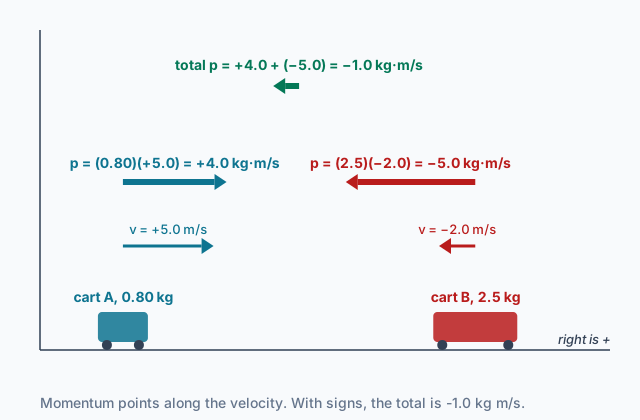
Along a line, that direction is a sign. Choose a positive direction first, then give each velocity its sign before you multiply. In the diagram, with right as positive, the 0.80 kg cart moving right at 5.0 m/s has kg·m/s, and the 2.5 kg cart moving left at 2.0 m/s has kg·m/s.
A system's total momentum is the sum of its objects' momenta, signs included: kg·m/s, which is 1.0 kg·m/s to the left. Momenta in opposite directions cancel, in part or in full. Kinetic energies never do.
Comparing two momenta means comparing size and direction. A cart that bounces straight back at the same speed keeps its kinetic energy, but its momentum is now the same size pointing the other way, so it is a different momentum. And a larger size can come from either factor: the slow, heavy cart in the diagram carries more momentum than the fast, light one.
Quick check · Decide and justify
Two identical 1.2 kg carts roll toward each other on a level track, each at 1.5 m/s. Take right as positive. A student says the total momentum of the two-cart system is 3.6 kg·m/s, since each cart has 1.8 kg·m/s. Is the student right?
Which reason supports your answer?
2c. Collisions and explosions as models
Momentum is the tool for analyzing collisions and explosions, and both are models: simplified pictures that hold when a condition is met.
A collision is an interaction in which the forces the objects exert on each other are much larger than the net external force on them while it lasts. When two carts meet on a level track, their bumpers push on each other far harder than anything outside does. Gravity and the track's normal force balance, and friction on the free-rolling wheels is negligible.
Only the states just before and just after a collision are analyzed. So each object can be treated with the object model from 1.2 Displacement, Velocity, and Acceleration, as a single object with no internal structure. A bumper squashes and springs back during the contact, and none of that enters the analysis.
An explosion is an interaction in which forces inside the system push its objects apart. A firework shell bursting fits, and so does a compressed spring released between two carts at rest. Take both carts as the system, as in 2.1 Systems and Center of Mass, so the spring's pushes are internal.
Those two conditions overlap. What separates the models in practice is how the objects start. In a collision they come in and meet. In an explosion they start together, at rest or moving as one, and something inside the system, a spring, a push between them or burning fuel, drives them apart. What momentum does in each comes in 4.2 Change in Momentum and Impulse and 4.3 Conservation of Linear Momentum.
Quick check · Sort it
Each card describes a brief interaction between objects. Tap a card, then the model that fits it.
Collision model
Explosion model
Part 3 Watch it done A car and a truck on one road
Watch each step, then finish the problem yourself.
A 1200 kg car drives east at 15 m/s. A 3000 kg truck drives west at 8.0 m/s on the same straight road, toward the car. Find the total momentum of the system of the car and the truck.
Step 1 · Choose a positive direction and sign each velocity
Take east as positive. The car moves east, so m/s. The truck moves west, so m/s, even though its speed is 8.0 m/s.
Step 2 · Find the car's momentum
kg·m/s, pointing east like the car's velocity.
Why this step?
Why does the truck's velocity get a minus sign when its speed, 8.0 m/s, is a positive number?
The sign is the direction. Momentum points the same way as the velocity, and the truck moves west, the negative direction, so its velocity and its momentum are both negative. Leaving the sign off would count the truck's momentum as if it pointed east, the same way as the car's, and the two would add instead of partly cancelling.
Your step · Calculate
Finish it. A 1200 kg car drives east at 15 m/s, and a 3000 kg truck drives west at 8.0 m/s on the same straight road. Take east as positive. What is the total momentum of the system of the car and the truck? Give your answer with its sign, to the nearest 100 kg·m/s.
kg·m/s
Part 4 Try it A bat meets a ball
A new situation, looked at from the inside of a collision. A pitch comes in to the right, and the batter's swing sends the 0.15 kg baseball back to the left. The bat touches the ball for less than a thousandth of a second, and during that time it pushes on the ball with more than ten thousand newtons. Air resistance is negligible. Draw the forces on the ball during the hit, then decide what makes the collision model fit. After that, practice the momentum of a single cart with new numbers each time.
Try it · Draw the forces
A 0.15 kg baseball was moving to the right when the bat met it, and the bat sends it back to the left. While they touch, the bat pushes on the ball with more than ten thousand newtons. Air resistance is negligible. Build the free-body diagram of the ball while the bat is touching it, with lengths that compare the forces.
The dot is the baseball. One diagram that fits
Pick each force exerted on the baseball, then choose the way it points and how long its arrow is compared with the others. The arrows are drawn for you.
Try it · Multiple choice
A bat touches a 0.15 kg baseball for less than a thousandth of a second and pushes on it with more than ten thousand newtons. Earth pulls down on the ball with 1.5 N the whole time, and air resistance is negligible. Why can the hit be modeled as a collision, with only the ball's motion just before and just after analyzed?
Part 5 Explain it Derive it, then put numbers in
Nothing you type leaves this page. Check your answer against the model and each scoring point.
Free response is 50% of the exam score. This one is shaped like Question 1, Mathematical Routines.
Free-response practice · Question 1 style
Three carts move along a straight, level track, with right as positive. Cart 1, of mass , moves right at speed . Cart 2, of mass , moves left at speed . Cart 3 has mass .
(a) Derive an expression for the total momentum of the system of carts 1 and 2, in terms of and .
(b) Determine which of carts 1 and 2 has the momentum of greater magnitude, and the direction of the total momentum from (a). Justify both.
(c) Cart 3 is added to the system. Derive an expression for the velocity, magnitude and direction, that cart 3 must have for the total momentum of all three carts to be zero.
(d) Take kg and m/s. Calculate the total momentum of carts 1 and 2, and the velocity of cart 3 from (c).
(e) A student says that because the total momentum of the three carts is zero, their total kinetic energy must also be zero. Calculate the total translational kinetic energy of the three carts with the values in (d), and explain why a total momentum of zero does not mean the kinetic energy is zero.
Model answer
(a) Each momentum takes the sign of its velocity: and . So .
(b) Cart 2's momentum has the greater magnitude, against , because the carts have the same speed and cart 2 has twice the mass. The total, , is negative, so it points left, the direction of cart 2's larger momentum.
(c) , so : a third of , to the right.
(d) kg·m/s, which is 0.90 kg·m/s to the left. m/s, to the right.
(e) Cart 1 has J, cart 2 has J and cart 3 has J, so the total is J. All three carts are moving. Momentum is a vector, so momenta in opposite directions cancel in the sum: . Kinetic energy is a scalar and never negative, so each cart's share adds. A total momentum of zero says only that the momenta balance, not that the kinetic energy is zero.
Score your own answer. This is a self-check, not a grade. Tick each point your answer makes.
Part 6 Check yourself Two carts bounce apart
Both case questions use the collision table.
Two carts roll toward each other on a level track, collide and bounce apart. Cart A starts on the left. Motion sensors record each cart's velocity just before and just after the collision, with right as positive.
| Cart | Mass (kg) | Velocity just before (m/s) | Velocity just after (m/s) |
|---|---|---|---|
| A | 0.50 | +1.00 | -0.50 |
| B | 1.50 | -0.20 | +0.30 |
Case question 1 · Calculate
Using the collision table, with right as positive, what is cart B's momentum just after the collision? Give your answer with its sign, to the nearest 0.01 kg·m/s.
Case question 2 · Multiple choice
Using the collision table, with right as positive, which cart has the momentum of greater magnitude just before the collision?
The rest stand on their own and do not use the case.
Check yourself · Spot the error
Two balls roll toward each other across a smooth, level floor. A 0.40 kg ball rolls east at 2.5 m/s, and a 0.60 kg ball rolls west at 1.0 m/s. A student finds the total momentum of the two balls. Tap the first line that goes wrong.
Check yourself · Match
Carts roll along a straight track, with east as positive. Tap a cart, then its momentum.
Check yourself · Fill the statement
Two carts on a level track collide, and the foam bumper on one of them squashes flat for a moment before the carts bounce apart. Tap a blank, then an answer.
While the carts touch, the forces they exert on each other are much than the net external force on the two carts. The analysis compares the carts just before and just after they touch, so the squashing of the bumper , and each cart can be treated as with no internal structure.
Part 7 Keep it Bring back earlier ideas
Pulling an older idea back up is what makes it last.
From 3.1 Translational Kinetic Energy · Decide and justify
A 0.50 kg ball is thrown straight down from a balcony at 6.0 m/s. Take up as positive, so the ball's velocity as it leaves the hand is m/s. A student writes the ball's translational kinetic energy at that moment as J. Is the student right?
Which reason supports your answer?
From 2.3 Newton’s Third Law · Decide and justify
A bus moving at 25 m/s hits a small bug that is hovering almost still, and the bug splats on the windshield. During the collision, how does the force the bus exerts on the bug compare with the force the bug exerts on the bus?
Which reason supports your answer?
In three lines
- Linear momentum is , in kg·m/s, with mass and speed each counted once.
- It is a vector along the velocity, so on a line it carries a sign, and a system's total is the signed sum of its objects' momenta.
- A collision is modeled by forces between the objects that dwarf the net external force, an explosion by internal forces pushing objects apart, and both are analyzed only before and after.
Vocabulary
- Linear momentum
- An object's mass times its velocity, , a vector quantity with the same direction as the velocity.
- Collision
- A model for an interaction in which the forces the involved objects exert on each other are much larger than the net external force on them during the interaction.
- Explosion
- A model for an interaction in which forces internal to a system move objects within that system apart.
- Object model
- Treating an object or system as a single object with no internal structure, which works for a collision because only its initial and final states are analyzed.
Course alignment, for teachers
AP Physics 1: Algebra-Based topic 4.1, Unit 4: Linear Momentum.
- Skill 1.C: Create qualitative sketches of graphs that represent features of a model or the behavior of a physical system.
- Skill 2.B: Calculate or estimate an unknown quantity with units from known quantities, by selecting and following a logical computational pathway.
- Skill 2.C: Compare physical quantities between two or more scenarios or at different times and locations in a single scenario.
- Skill 3.B: Apply an appropriate law, definition, theoretical relationship, or model to make a claim.
This lesson maps all 6 essential knowledge statements of the topic to the part that teaches each one: 6 are checked by a scored question. The map is in the lesson file.