Unit 2 · Topic 2.1 · about 30 minutes · 7 parts · 13 scored checks, 1 of them multiple choice
AP Physics 1: Algebra-Based 2.1: Systems and Center of Mass
 Tap to open the picture full size
Part 1 Think first A hammer tossed end over end
Commit to a guess first. Being wrong now makes the right idea stick better.
Predict first
You toss a hammer to a friend across a lawn, and it tumbles end over end as it flies. Air resistance is negligible. Most points on the hammer swoop around in loops, but one point traces a smooth arc, the same shape a tossed ball makes. Which point is it?
In short. A system is a group of objects you choose to study together, and its center of mass is the average position of its parts, each weighted by its mass.
- A system's properties come from the interactions between the objects inside it, and energy or mass can cross between the system and its environment.
- When what happens inside does not matter for your question, the whole system can be treated as one object; when it does matter, the internal structure enters the analysis.
- An evenly spread mass has its center of mass on every line of symmetry, and along any axis .
Part 2 Learn it Four short ideas, each checked as you go
2a. Drawing a line around a system
A system is whatever you choose to study: one cart, two carts and the spring between them, a whole train. Everything outside it is the environment. From here on, choosing the system is the first move in nearly every problem, and the right choice depends on the question you are asking.
What a system is like comes from how the objects inside it interact. Dry sand and damp sand are the same grains, but in damp sand a thin film of water pulls neighboring grains together. Damp sand holds the shape of a castle; dry sand slumps into a pile. Same parts, different interactions, different system.
The edge of a system is not a wall. A pot of soup on a stove takes in energy from the burner and loses mass as steam rises off it. A car burns gasoline and pushes exhaust out of its tailpipe, so a system of the car and its fuel loses mass as it drives. Whether anything crosses depends on where you draw the line: count the steam as part of your system, and no mass leaves it. The same choice sorts interactions. Two carts joined by a spring push on each other through it; take both carts as the system and that push is internal, but take one cart alone and the spring's push is an interaction with its environment.
Quick check · Fill the statement
A sandcastle is built from damp sand. Take the sand and the water in the castle as the system. Tap a blank, then an answer.
The castle keeps its shape, where a pile of dry sand would slump, because of the between the grains. On a hot afternoon the water evaporates, so mass the system, while sunlight carries energy it.
2b. One object, or many?
The object model from 1.2 Displacement, Velocity, and Acceleration works for a whole system too. If the properties and interactions of the objects inside do not matter for the behavior you care about, treat the system as a single object. A marching band crossing a football field is one object when all you want to know is when it reaches the far end zone.
The parts still move in their own ways. While the band marches north, trombone slides pump back and forth and flags spin. Objects inside a system can behave differently from each other and from the system as a whole, and sometimes that is the very thing you are asked about.
When it is, the internal structure changes the analysis. Ignoring air resistance, a water balloon and a rubber ball of the same mass dropped from the same height land at the same moment. What happens at the instant they land depends entirely on what is inside them.
Structure can also change when conditions outside the system change. An ice cube on a counter is a rigid block you could slide like a puck. Warm the room, and the same water becomes a puddle whose parts flow apart.
Quick check · Decide and justify
A family drives 300 km to visit relatives. In the back of the minivan, two kids bounce around and swap seats the whole way. Can the minivan and everyone in it be modeled as a single object to find how long the drive takes?
Which reason supports your answer?
2c. Symmetry finds the center of mass
Every system has one point that can stand for all of it: its center of mass. For many objects you can find it without any arithmetic.
If a system's mass is spread symmetrically, its center of mass lies on every line of symmetry, so it sits where those lines cross. A uniform ruler is symmetric about its middle mark, so that is its center of mass. Two equal weights on the ends of a light bar balance at the bar's midpoint. A uniform round dinner plate has its center of mass at its center.
The center of mass does not have to be inside the material. A bagel is symmetric about every line through the middle of its hole, so its center of mass is in the hole, where there is no bagel at all.
Symmetry needs the mass to match on both sides, not only the shape. Swap one of those equal weights for a heavier one and the bar still looks symmetric, but its mass is not. The center of mass shifts toward the heavier weight. How far it shifts takes a calculation, and that comes next.
Quick check · Match
Tap an object, then where its center of mass is.
2d. Calculating the center of mass
When the mass is not symmetric, calculate. Along an axis,
Multiply each object's mass by its position, add the products, and divide by the total mass. Each position keeps its sign, so an object on the negative side of the origin pulls the sum down.
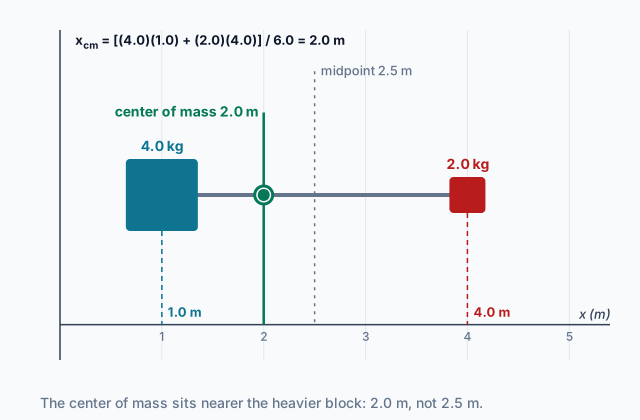
The diagram has a 4.0 kg block at 1.0 m and a 2.0 kg block at 4.0 m. Then m, not the 2.5 m midpoint. Each object counts in proportion to its mass, so the center of mass is pulled toward the heavier block. It always lands between the two outermost objects.
For objects spread over a flat surface, do the same thing along each axis on its own: once with the positions, once with the positions.
Once you have it, you can model the whole system as a single object located at its center of mass. The tumbling hammer is the classic case: modeled that way, it flies like a tossed ball, while every other point on it loops around that one.
Quick check · Calculate
Two carts sit on a straight track. Positions are measured from the left end of the track, with right as positive. A 0.40 kg cart is at m and a 1.20 kg cart is at m. Where is the center of mass of the two-cart system? Give your answer to the nearest 0.01 m.
Part 3 Watch it done Three balls on an L-shaped frame
Watch each step, then finish the problem yourself.
Three small balls are fixed to a light, L-shaped frame lying flat on a table. Take to the right and toward the top of the table, with the origin at the corner of the L. A 2.0 kg ball sits at the corner, . A 1.0 kg ball sits at at the end of the horizontal arm, and another 1.0 kg ball sits at at the end of the vertical arm. Find the center of mass of the three balls.
Step 1 · Model each ball and add up the mass
Each ball is small next to the frame, so treat each as an object at its own point, and the frame is light, so leave it out. The total mass is kg. That total goes under every sum, whichever axis you work along.
Step 2 · Work along the x axis on its own
Use only the coordinates: m.
Why this step?
Why does the 2.0 kg corner ball add nothing to the top of that fraction, yet still count in the 4.0 kg at the bottom?
Its position along is zero, so its mass times position is zero. But it is still part of the system's mass, and a heavy ball sitting at the origin pulls the center of mass toward the origin. Leaving its 2.0 kg out of the total would push the answer away from the corner, as if the ball were not there.
Your step · Calculate
Finish it. On a light, L-shaped frame, a 2.0 kg ball sits at the corner , a 1.0 kg ball at and another 1.0 kg ball at , with to the right and toward the top of the table. What is the coordinate of the center of mass of the three balls? Give your answer to the nearest 0.01 m.
m
Part 4 Try it A painter's plank
A new situation, and this time one of the objects is not small. A painter lays a uniform plank across two sawhorses and sets a can of paint on it. A plank is not a point, but it is symmetric, so you already know where its own center of mass is. Use that to replace the plank with a single object, then combine it with the can.
Try it · Calculate
A uniform plank of mass 4.0 kg is 2.0 m long. A 6.0 kg can of paint sits on it 1.80 m from the plank's left end. Measure positions from the left end, with right as positive. Where is the center of mass of the plank and the can together? Give your answer to the nearest 0.01 m.
Try it · Decide and justify
A uniform 4.0 kg plank 2.0 m long rests on two sawhorses. A painter takes away a 6.0 kg can that sat near the right end and instead spreads 6.0 kg of sand in an even layer along the whole plank. Where is the center of mass of the plank and the sand?
Which reason supports your answer?
Part 5 Explain it Derive it, then put numbers in
Nothing you type leaves this page. Check your answer against the model and each scoring point.
Free response is 50% of the exam score. This one is shaped like Question 1, Mathematical Routines.
Free-response practice · Question 1 style
Two carts are on a straight, level track. Positions are measured from the left end of the track, with right as positive. Cart A, of mass , is at , and cart B, of mass , is to its right at . Call the distance between them .
(a) Derive an expression for the distance from cart A to the center of mass of the two-cart system, in terms of , and .
(b) Use your expression to explain which cart the center of mass is closer to when is greater than .
(c) Cart A has a mass of 2.0 kg and is at m. Cart B has a mass of 3.0 kg and is at m. Calculate the position of the system's center of mass.
(d) Cart A is given a push and then rolls right at a steady 0.25 m/s, while cart B stays at rest. Calculate the average velocity of the system's center of mass over the next 2.0 s, and explain why it is not the same as cart A's velocity.
Model answer
(a) . Then .
(b) When , is more than half of , so is more than . The center of mass is past the midpoint, closer to cart B, the heavier cart.
(c) m, so m.
(d) After 2.0 s cart A is at m and cart B is still at 1.30 m, so m. The average velocity of the center of mass is m/s, to the right. Modeled as a single object at its center of mass, the system moves more slowly than cart A because only cart A moves, and it holds only 2.0 kg of the system's 5.0 kg. The objects in a system can move differently from each other and from the system as a whole.
Score your own answer. This is a self-check, not a grade. Tick each point your answer makes.
Part 6 Check yourself A toy train
Both case questions use the toy train's table.
A student sets a toy train of three cars on a straight track. Positions are measured from the left end of the track, with right as positive. Each car's mass is centered at the position listed. Car A is the locomotive, at the right-hand end of the train.
| Car | Mass (kg) | Position (m) |
|---|---|---|
| A | 1.0 | 0.90 |
| B | 0.50 | 0.50 |
| C | 0.50 | 0.10 |
Case question 1 · Calculate
Using the toy train's table, with right as positive, where is the center of mass of the three cars? Give your answer to the nearest 0.01 m.
Case question 2 · Multiple choice
Using the toy train's table, with right as positive: car A uncouples and rolls 0.40 m to the right, while cars B and C stay where they are. How far does the center of mass of the three cars move?
The rest stand on their own and do not use the case.
Check yourself · Spot the error
On a straight track with right as positive, a 2.0 kg block is at m and a 3.0 kg block is at m. A student finds the center of mass of the two blocks. Tap the first line that goes wrong.
Check yourself · Sort it
Each card names a system and a question about it. Tap a card, then decide whether the system can be modeled as a single object for that question or whether you need what is inside it.
A single object will do
Need what is inside
Part 7 Keep it Bring back earlier ideas
Pulling an older idea back up is what makes it last.
From 1.2 Displacement, Velocity, and Acceleration · Fill the statement
A freight train moves along a straight track, with east as the positive direction. It starts at m and stops at m. Tap a blank, then tap an answer.
Modeled as an object, the whole train is a single that keeps the train's . Its displacement is .
From 1.5 Vectors and Motion in Two Dimensions · Calculate
By lunchtime, a hiker's displacement from camp is 7.0 km east and 4.0 km north. Take east as and north as . At what angle north of east does her displacement point? Give your answer to the nearest degree.
In three lines
- A system is the set of objects you choose to study; its properties come from the interactions inside it, and energy or mass can cross its boundary.
- Treat a system as one object when its insides do not matter for the question, and look inside when they do.
- The center of mass lies on any line of symmetry of an evenly spread mass, and along an axis it is .
Vocabulary
- System
- The object or group of objects you choose to study, whose properties are determined by the interactions between the objects within it.
- Environment
- Everything outside the chosen system, which can interact with the system's parts and exchange energy or mass with it.
- Internal structure
- How the objects inside a system are arranged and interact. It matters when the question depends on how the parts move relative to each other, and can be ignored when only the system's motion as a whole is asked about.
- Center of mass
- The point along each axis given by , where a system can be modeled as a single object.
- Line of symmetry
- A line across which a system's mass is distributed the same way on both sides, so the center of mass lies on it.
Course alignment, for teachers
AP Physics 1: Algebra-Based topic 2.1, Unit 2: Force and Translational Dynamics.
- Skill 1.B: Create quantitative graphs with appropriate scales and units, including plotting data.
- Skill 2.B: Calculate or estimate an unknown quantity with units from known quantities, by selecting and following a logical computational pathway.
- Skill 2.C: Compare physical quantities between two or more scenarios or at different times and locations in a single scenario.
- Skill 3.B: Apply an appropriate law, definition, theoretical relationship, or model to make a claim.
This lesson maps all 9 essential knowledge statements of the topic to the part that teaches each one: 9 are checked by a scored question. The map is in the lesson file.