Unit 4 · Topic 4.2 · about 30 minutes · 7 parts · 13 scored checks, 1 of them multiple choice
AP Physics 1: Algebra-Based 4.2: Change in Momentum and Impulse
 Tap to open the picture full size
Part 1 Think first Clay or rubber
Commit to a guess first. Being wrong now makes the right idea stick better.
Predict first
You drop a lump of clay and a rubber ball of the same mass from the same height, so they hit the floor at the same speed. The clay stops dead. The rubber ball bounces back up almost as fast as it came down. Count both how hard the floor pushes and for how long. Which one gets more push from the floor in total?
In short. Impulse is the average net force on a system multiplied by the time it acts, and it equals the system's change in momentum: .
- Change in momentum is final momentum minus initial momentum, , with the sign of each velocity kept.
- Impulse points the way the net force points, and the same change in momentum can come from a large force over a short time or a small force over a long time.
- Impulse is the area under a graph of net force against time, net force is the slope of a graph of momentum against time, and for a system of constant mass becomes .
Part 2 Learn it Four short ideas, each checked as you go
2a. A change in momentum keeps its sign
Momentum, , is a vector that points the way the object moves. The change in momentum is the final momentum minus the initial momentum:
Along a line, a sign does the job of the arrow. Pick a positive direction, give every velocity its sign, and then subtract.
A 0.40 kg soccer ball rolls right at 5.0 m/s into a wall and rolls back left at 3.0 m/s. With right as positive, kg·m/s and kg·m/s, so kg·m/s. Subtracting the speeds, 5.0 minus 3.0, gives a change four times too small, as if the ball had only slowed down without turning around.
That is the clay and the rubber ball. A bounce changes momentum by more than a stop from the same speed does, because the momentum has to get to zero and then keep going. The minus sign in kg·m/s means something too: the change points left, the way the wall pushed.
Quick check · Calculate
A 0.60 kg basketball is passed against a gym wall. Just before it hits, it moves horizontally to the right at 7.0 m/s, and just after, it moves horizontally to the left at 5.0 m/s. Take right as positive. What is the change in the basketball's momentum during the bounce? Include the sign.
2b. Impulse: a force acting for a time
A force changes momentum by acting for some time. The impulse it delivers is the average force multiplied by the time interval:
Its unit is the newton-second, N·s, which is the same as kg·m/s. Impulse is a vector, and the impulse of the net force points the way the net force points, which need not be the way the object moves. A goalkeeper's gloves push back on a ball flying at the net.
The impulse-momentum theorem says the impulse of the net external force on a system equals the system's change in momentum:
Kick a 0.45 kg ball resting on the grass with an average force of 900 N for 0.010 s. Along the kick, that is the only force, so the impulse is 9.0 N·s and the ball leaves at m/s.
The theorem also works the other way. Catch a tossed egg and its momentum ends at zero whatever you do, so the impulse on it is fixed. Let your hands move back with it and the stop takes longer, so the same impulse needs a smaller average force. Stiff hands stop it fast, with a large force, and it breaks.
Quick check · Decide and justify
In a crash test, a dummy moving forward at 15 m/s is brought to rest. In one run only the steering wheel stops it. In another run only an airbag stops it, over a much longer time. Does the airbag deliver a smaller impulse to the dummy than the steering wheel does?
Which reason supports your answer?
2c. Areas and slopes
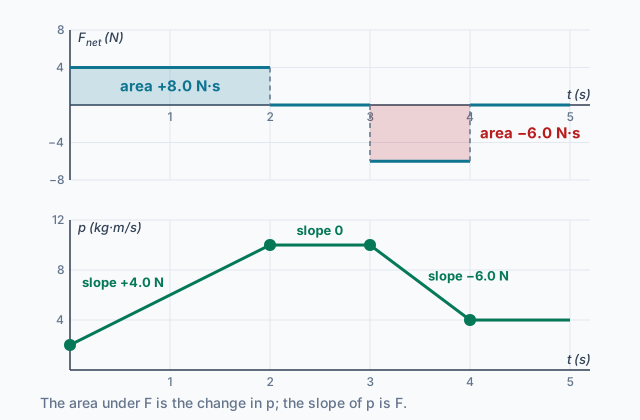
Real pushes rarely stay steady. A bat's force on a ball climbs and falls in about a thousandth of a second. When the force changes, the impulse is the area between a graph of the net force against time and the time axis. Area above the axis is positive impulse; area below it is negative.
The top graph in the diagram is the net force on a cart that starts with 2.0 kg·m/s of momentum, with right as positive. A steady +4.0 N for 2.0 s delivers N·s, so the momentum climbs to 10 kg·m/s. For the next second there is no net force and no area, and the momentum stays put. Then N for 1.0 s takes away 6.0 N·s, leaving 4.0 kg·m/s.
The bottom graph runs the idea backward. Its slope, , is the net force: 8.0 kg·m/s gained in 2.0 s is a slope of 4.0 N. A level stretch means zero net force, a steep stretch a large one, and a falling stretch a net force pointing the negative way. On a curved momentum graph, the slope at an instant gives the net force at that instant.
Quick check · Sketch the graph
A 1.5 kg cart rolls to the right at 4.0 m/s along a level track, with right as positive. A graph of the net force on the cart against time reads 0 from 0 to 2 s, a steady -2.0 N from 2 s to 5 s, and 0 again from 5 s to 6 s. Sketch the cart's momentum against time from 0 to 6 s. The first point is fixed at the cart's momentum at 0 s.
One shape that fits
Drag a point up or down, or tap it and use the arrow keys. The shape is checked, and the graph must pass through the values the question gives.
2d. Net force is the rate of change of momentum
Divide the impulse-momentum theorem by the time interval and it says the net external force on a system equals the rate at which the system's momentum changes:
That is the slope from the last chunk, written as an equation. For a system whose mass stays the same, such as a cart or a ball, the change in momentum is the mass times the change in velocity, so
Newton's second law from 2.5 Newton’s Second Law is this theorem in the case you have used all along. Give the diagram's cart a mass of 2.0 kg: its momentum rises 4.0 kg·m/s each second while the 4.0 N acts, so its velocity rises 2.0 m/s each second, and m/s² is the acceleration Newton's second law gives.
The momentum form is the more general one, as long as the same material stays inside the system you chose. For a rocket, that means drawing the system around the rocket and all the exhaust it has thrown out: nothing leaves that system, so its total momentum changes only when a net external force acts on it. A system whose mass changes as it moves, such as the rocket on its own, is outside this course, and you will not be asked to calculate with one.
Quick check · Fill the statement
Tap a blank, then an answer.
The net external force on a system equals the rate at which the system's changes. If no material enters or leaves the system, its stays constant, and that rate becomes the mass times the , which is Newton's second law.
Part 3 Watch it done A cart meets a bumper
Watch each step, then finish the problem yourself.
A 0.50 kg cart rolls left at 0.80 m/s along a level track, where its wheels roll freely, and runs into a bumper mounted on a force sensor. The sensor's graph of the bumper's force on the cart against time is a triangle: the force, pushing right, rises from 0 to a peak of 12 N and falls back to 0 over 0.10 s. Then the cart leaves the bumper. Take right as positive. Find the cart's velocity as it leaves.
Step 1 · Write the starting momentum with its sign
The cart moves left, so its velocity is m/s and its momentum is kg·m/s.
Step 2 · Find the impulse from the graph
Gravity and the normal force are vertical and balance, and the wheels roll freely, so along the track the bumper's force is the net force. The impulse is the area under its graph, a triangle: N·s. The bumper pushes right, so the impulse is N·s.
Why this step?
The cart is moving left the whole time it presses into the bumper. Why is the impulse positive?
Impulse points the way the net force points, not the way the object moves. The bumper pushes right on the cart for the whole 0.10 s, so every bit of the push adds momentum in the positive direction. Part of it cancels the cart's leftward momentum, and whatever is left over is rightward momentum.
Your step · Calculate
Finish it. A 0.50 kg cart rolls left at 0.80 m/s along a level track, its wheels rolling freely, and hits a bumper. The bumper delivers an impulse of +0.60 N·s to the cart, with right as positive. What is the cart's velocity as it leaves the bumper? Include the sign.
m/s
Part 4 Try it A puck sent back
A new situation: the object comes in one way and leaves the other, and this time the unknown is the force. A hockey player meets a pass with her stick and sends the puck straight back the way it came.
Try it · Calculate
A 0.16 kg hockey puck slides to the right across level ice at 12 m/s. A player's stick meets it and sends it back to the left at 18 m/s. The stick is in contact with the puck for 0.020 s, and friction from the ice is negligible. Take right as positive. What is the average force the stick exerts on the puck? Include the sign.
Part 5 Explain it Two graphs, one push
Nothing you type leaves this page. Check your answer against the model and each scoring point.
Free response is 50% of the exam score. This one is shaped like Question 2, Translation Between Representations.
Free-response practice · Question 2 style
A 0.80 kg cart moves to the right along a level track at 0.50 m/s. Its wheels roll freely and air resistance is negligible. A student pushes the cart horizontally for a short time. A motion sensor records the cart's position and velocity, and its software calculates the momentum from them. Take right as positive. The graph of the cart's momentum against time has three straight pieces: level at 0.40 kg·m/s from to s, rising in a straight line to 1.60 kg·m/s at s, then level at 1.60 kg·m/s until s.
(a) On paper, draw a free-body diagram of the cart at s. Represent each force as a straight arrow starting on the dot, and label each one with what exerts it.
(b) Sketch a graph of the net force on the cart against time from to s. Label the value of the net force on each piece.
(c) Using your graph from (b), calculate the impulse delivered to the cart from s to s, and justify that it agrees with the momentum graph.
(d) Starting from the impulse-momentum theorem, derive an expression for the cart's velocity after the push in terms of its starting velocity , its mass , the push and the time the push lasts. Then calculate .
(e) In a second trial the cart starts the same way and the push again begins at s, but it is a steady push half as large, and it gives the cart the same change in momentum. Describe how the net force graph and the momentum graph each change, and use the impulse-momentum theorem to justify that the two new graphs still agree with each other.
Model answer
(a) Three arrows from the dot: the gravitational force exerted by Earth, , down; the normal force exerted by the track, , up and the same length; and the student's push, , to the right. No friction arrow, since the wheels roll freely, and no force of motion.
(b) The net force is the slope of the momentum graph. From 0 to 0.20 s and from 0.50 s to 0.80 s the momentum is level, so the net force is 0. From 0.20 s to 0.50 s the slope is N. So the graph is 0, then a level step at +4.0 N from 0.20 s to 0.50 s, then 0 again.
(c) The impulse is the area under the net force graph: N·s, to the right. The momentum graph rises by kg·m/s over the same time. A newton-second is a kilogram meter per second, so the two agree, as says they must.
(d) , so . Then m/s, to the right, which matches m/s from the momentum graph.
(e) The push is now 2.0 N. The same change in momentum needs the same impulse, and with halved means doubles, to s. The net force graph is a step half as tall, 2.0 N, and twice as wide, from 0.20 s to 0.80 s, with the same 1.2 N·s of area. The momentum graph still starts at 0.40 kg·m/s and ends at 1.60 kg·m/s, but it rises half as steeply, with a slope of 2.0 N, over 0.60 s instead of 0.30 s. The two agree because the slope of the momentum graph over the push equals the height of the force step, and the area of the step equals the rise in momentum.
Score your own answer. This is a self-check, not a grade. Tick each point your answer makes.
Part 6 Check yourself A ball against three surfaces
Both case questions use the force-plate table.
A student rolls a 0.20 kg rubber ball along a smooth floor into a force plate fixed to a wall. Each time, the ball arrives moving left at 6.0 m/s and bounces straight back to the right. She covers the plate with three different surfaces and records the ball's rebound speed and how long it touches the plate. Take right as positive.
| Surface | Rebound speed (m/s) | Contact time (s) |
|---|---|---|
| Steel | 5.0 | 0.0040 |
| Wood | 4.0 | 0.010 |
| Foam | 1.0 | 0.050 |
Case question 1 · Calculate
Using the force-plate table, with right as positive, what impulse does the steel-covered plate deliver to the 0.20 kg ball? Include the sign.
Case question 2 · Multiple choice
Using the force-plate table, which surface makes the plate exert the greatest average force on the ball?
The rest stand on their own and do not use the case.
Check yourself · Spot the error
A 0.15 kg baseball arrives at a bat moving at 30 m/s and leaves in the opposite direction at 40 m/s. The bat is in contact with the ball for 0.0015 s, and gravity's effect during the hit is negligible. A student finds the average force the bat exerts on the ball. Tap the first line that goes wrong.
Check yourself · Match
Tap a feature of a graph, then what it tells you about the object.
Check yourself · Draw the forces
A 0.060 kg tennis ball flies to the left and is hit by a racket, which sends it back to the right. Air resistance is negligible. Build the free-body diagram of the ball at an instant during the hit when the ball is still moving left and the racket pushes on it with 300 N, and set each arrow's length to compare with the others.
The dot is the tennis ball. One diagram that fits
Pick each force exerted on the tennis ball, then choose the way it points and how long its arrow is compared with the others. The arrows are drawn for you.
Part 7 Keep it Bring back earlier ideas
Pulling an older idea back up is what makes it last.
From 1.3 Representing Motion · Sort it
Tap each task, then whether you would find the answer from the slope of the graph named or from the area under it.
From a slope
From an area
From 2.5 Newton’s Second Law · Calculate
A rope pulls a 25 kg sled east across level snow with a horizontal force of 80 N. The snow exerts a friction force of 30 N on the sled, pointing west. Take east as positive. What is the sled's acceleration? Give your answer to the nearest 0.1 m/s².
In three lines
- Change in momentum is final minus initial, , with every velocity's sign kept, so a bounce changes momentum by more than a stop.
- Impulse, , points the way the net force points and equals the change in momentum; a longer stop lowers the force, not the impulse.
- Impulse is the area under net force against time, net force is the slope of momentum against time, and with constant mass is .
Vocabulary
- Impulse
- The product of the average force exerted on a system and the time interval during which it is exerted, , a vector in the direction of the net force.
- Change in momentum
- The difference between a system's final momentum and its initial momentum, .
- Impulse-momentum theorem
- The statement that the impulse exerted on a system equals the system's change in momentum, .
- Net external force
- The sum of the forces exerted on a system by objects outside it, which equals the rate of change of the system's momentum, .
Course alignment, for teachers
AP Physics 1: Algebra-Based topic 4.2, Unit 4: Linear Momentum.
- Skill 1.B: Create quantitative graphs with appropriate scales and units, including plotting data.
- Skill 2.A: Derive a symbolic expression from known quantities by selecting and following a logical mathematical pathway.
- Skill 2.D: Predict new values or factors of change of physical quantities using functional dependence between variables.
- Skill 3.A: Create experimental procedures that are appropriate for a given scientific question.
- Skill 3.C: Justify or support a claim using evidence from experimental data, physical representations, or physical principles or laws.
This lesson maps all 8 essential knowledge statements of the topic to the part that teaches each one: 8 are checked by a scored question. The map is in the lesson file.