Unit 5 · Topic 5.2 · about 30 minutes · 7 parts · 12 scored checks, 1 of them multiple choice
AP Physics 1: Algebra-Based 5.2: Connecting Linear and Rotational Motion
 Tap to open the picture full size
Part 1 Think first Two horses on one carousel
Commit to a guess first. Being wrong now makes the right idea stick better.
Predict first
A carousel turns at a steady rate. Mia rides a horse on the outer edge, 6 m from the center pole, and her little brother rides a horse 3 m from the pole. Over one minute, who goes around the pole more times?
In short. A point on a turning rigid object moves along a circle, and its linear distance, speed and tangential acceleration are the object's angular displacement, angular velocity and angular acceleration multiplied by the point's distance from the axis.
- , and , with every angle in radians.
- Every point on a rigid object has the same angular velocity and angular acceleration, so points farther from the axis move faster, and while the object speeds up or slows down, they have a larger tangential acceleration.
- The tangential acceleration points along the circle and is a separate thing from the centripetal acceleration, which points toward the axis.
Part 2 Learn it Three short ideas, each checked as you go
2a. From an angle to a distance
In 5.1 Rotational Kinematics you described a turning object with angles, measured in radians. Now pick one point on it, a distance from the axis of rotation. As the object turns, that point goes around a circle of radius . When the object turns through an angle , the point travels a linear distance along the arc of that circle:
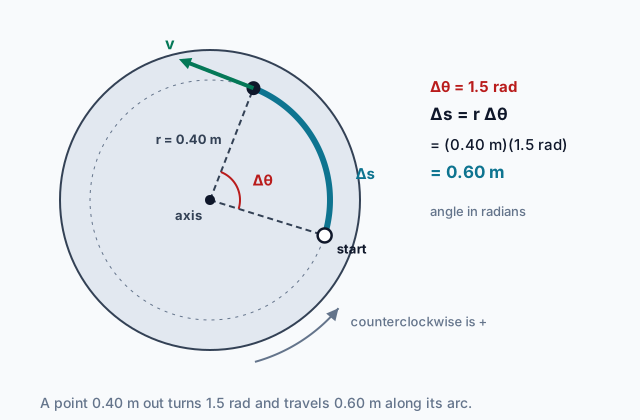
The diagram at the top of the page shows one case: a point 0.40 m from the axis, a turn of 1.5 rad, and an arc m long. Measured from a starting mark instead of as a change, the same rule reads .
The angle has to be in radians, because that is what makes the equation true. A radian is the angle whose arc is exactly as long as the radius, so times the number of radians is the length of the arc. Degrees and revolutions do not work that way, so change them to radians first: one revolution is rad, and is rad. Put in one full turn and you get , the distance around the circle you used in 2.9 Circular Motion.
The arc runs the same way the object turns, clockwise or counterclockwise.
Quick check · Calculate
A bicycle sits upside down on a repair stand, and a mechanic spins its front wheel. The valve on the wheel is 0.35 m from the axle. While the wheel turns through 2.0 revolutions, how far does the valve travel along its circular path? Give your answer to the nearest 0.1 m.
2b. One angle for the whole object
A wheel, a fan blade or a carousel is a rigid system: it holds its shape as it turns. A line painted from the axle out to the rim stays a straight line, so every point on it turns through the same angle in the same time. That makes the angular motion the same everywhere. Every point on a rigid system has the same angular velocity , and when the turning speeds up or slows down, the same angular acceleration .
The linear motion is not the same everywhere. Divide by the time the turn takes. The point's does not change, so , which is
Here is the point's linear velocity, the same velocity you met in 1.2 Displacement, Velocity, and Acceleration, and it points along the circle, tangent to it. With in meters and in rad/s, comes out in m/s: a radian is one length divided by another, so it carries no unit of its own.
On a carousel turning at 0.50 rad/s, a horse 6.0 m from the pole moves at 3.0 m/s, and a horse 3.0 m out moves at 1.5 m/s. Twice as far out, twice as fast. A point on the axis itself, at , does not move at all.
Quick check · Sketch the graph
A helicopter's main rotor turns at a steady 40 rad/s. Sketch the linear speed of points on the rotor against their distance from the axis of rotation, along a line from the axis out to the tip of one blade, 5.0 m away. The first point is fixed at 0.
One shape that fits
Drag a point up or down, or tap it and use the arrow keys. The shape is checked, and the graph must pass through the values the question gives.
2c. Speeding up: the tangential acceleration
When the angular velocity changes, every point's speed changes with it. Since and stays fixed, a change changes the point's speed by . Divide by :
This is the tangential component of the point's acceleration, the part along the circle that 2.9 Circular Motion described: forward when the point speeds up, backward when it slows down. All points share one , so a point twice as far out has twice the tangential acceleration. A table saw blade that speeds up at 200 rad/s² gives a tooth 0.12 m from the axle m/s².
Keep it apart from the centripetal acceleration, , which points toward the axis and is there whenever the point moves in a circle. A fan turning at a steady 8 rad/s has , so its blades have no tangential acceleration, yet every point on them still has a centripetal acceleration. This lesson works only with the tangential part.
Signs follow the rotation. Choose clockwise or counterclockwise as positive, as in 5.1 Rotational Kinematics. With counterclockwise positive, a wheel turning counterclockwise and slowing down has a negative , so each point's is negative too, pointing backward along its circle.
Quick check · Fill the statement
A circular saw is switched on, and its blade speeds up with a constant angular acceleration. Point P on the blade is 0.040 m from the axle, and point Q is 0.080 m from it. Tap a blank, then an answer.
P and Q have the same . Q's tangential acceleration is P's. Each point's tangential acceleration points .
Part 3 Watch it done Clay on a potter's wheel
Watch each step, then finish the problem yourself.
A potter's wheel turns counterclockwise, seen from above, at 3.0 rad/s. The potter presses the pedal, and over the next 4.0 s the wheel speeds up steadily to 5.0 rad/s. A lump of clay is stuck to the wheel 0.15 m from its axis; the wheel's rim is 0.20 m from the axis. Take counterclockwise as positive. Find the clay's linear speed at the end, and the tangential component of its acceleration while the wheel speeds up.
Step 1 · The clay turns with the wheel
The wheel holds its shape, so the clay turns through the same angle as every other point on it, in the same time. Its angular velocity is the wheel's, 5.0 rad/s at the end. What belongs to the clay alone is its distance from the axis, m, not the rim's 0.20 m.
Step 2 · Linear speed from angular velocity
m/s, along the clay's circle. The radian carries no unit of its own, so meters times rad/s leaves m/s.
Step 3 · The wheel's angular acceleration
The angular velocity rises steadily, so , positive, because the counterclockwise rotation is speeding up.
Why this step?
Why does the clay have the same angular acceleration as a point on the rim, when it is closer to the axis and its speed changes by less?
At every moment every point on the wheel turns through the same angle in the same time, so every point's angular velocity is the wheel's, and they all change together, from 3.0 to 5.0 rad/s in 4.0 s. The clay's speed changes by less because and its is smaller. That is a difference in the linear motion, not in the angular motion.
Your step · Calculate
Finish it. A potter's wheel turning counterclockwise speeds up steadily from 3.0 rad/s to 5.0 rad/s in 4.0 s. A lump of clay is stuck to it 0.15 m from the axis, and the rim is 0.20 m from the axis. Take counterclockwise as positive. What is the tangential component of the clay's acceleration while the wheel speeds up? Give your answer to the nearest 0.001 m/s².
m/s^2
Part 4 Try it A disc that keeps changing speed
A new situation, and this time the linear speed is the thing held fixed. A CD stores its music along one spiral track that starts near the center of the disc and winds outward. As the disc plays, the laser slowly moves out along the track, and the track has to pass under the laser at the same linear speed the whole time, about 1.2 m/s. So the motor keeps adjusting how fast the disc turns.
Try it · Calculate
A CD player reads a disc's track as it passes under the laser at a steady 1.2 m/s. At one moment the laser is reading the track 0.025 m from the center of the disc. What is the magnitude of the disc's angular velocity at that moment? Give your answer to the nearest 1 rad/s.
Try it · Decide and justify
A CD player keeps the track passing under its laser at a steady 1.2 m/s. During the album the laser moves out from the track 0.025 m from the center of the disc to the track 0.050 m from the center. How does the magnitude of the disc's angular velocity while the laser reads at 0.050 m compare with its value while the laser read at 0.025 m?
Which reason supports your answer?
Part 5 Explain it Two riders on one platform
Nothing you type leaves this page. Check your answer against the model and each scoring point.
Free response is 50% of the exam score. This one is shaped like Question 1, Mathematical Routines.
Free-response practice · Question 1 style
A playground merry-go-round starts from rest and turns counterclockwise, seen from above, with a constant angular acceleration . Take counterclockwise as positive. Child A sits a distance from the axis, and child B sits farther out, at . Both stay in their places.
(a) Derive an expression for the distance that child B travels along her circle during the first seconds, in terms of , and .
(b) Derive an expression for the ratio of the two children's linear speeds at any time , and explain why it does not depend on .
(c) Child A sits at m, and . Calculate child B's linear speed and the tangential component of her acceleration at s.
(d) A classmate says child B has the greater angular acceleration, because her tangential acceleration is greater than child A's. Explain what is wrong with the claim.
Model answer
(a) The merry-go-round starts from rest with constant , so from 5.1 Rotational Kinematics it turns through in time , and every point on it turns through that same angle. Child B's distance is .
(b) At time the whole merry-go-round has . Then and , so . The angular velocity cancels because both children share it at every instant, so the ratio depends only on their distances from the axis, not on how long the platform has been turning.
(c) m and rad/s. Then m/s, and , positive, forward along her counterclockwise circle.
(d) Both children have the same angular acceleration, , because every point on a rigid merry-go-round turns through the same angle in the same time. Child B's tangential acceleration is greater only because and her is three times child A's: against . The difference comes from the distance, not from .
Score your own answer. This is a self-check, not a grade. Tick each point your answer makes.
Part 6 Check yourself A wind turbine starting up
Both case questions use the wind turbine's table.
A wind turbine starts up in a steady breeze, and its rotor speeds up with a constant angular acceleration. Each of its blades is 40 m long, measured from the hub, where the axis of rotation is. Seen from the front, the rotor turns counterclockwise, and counterclockwise is positive. A data logger records the rotor's angular velocity every 10 s.
| Time (s) | Angular velocity (rad/s) |
|---|---|
| 0 | 0.00 |
| 10 | 0.25 |
| 20 | 0.50 |
| 30 | 0.75 |
| 40 | 1.00 |
Case question 1 · Calculate
Using the wind turbine's table, with counterclockwise positive: a sensor is mounted on one blade 36 m from the hub. What is the tangential component of the sensor's acceleration while the rotor speeds up? Give your answer to the nearest 0.01 m/s².
Case question 2 · Multiple choice
Using the wind turbine's table, with counterclockwise positive: at s, point P on a blade is 10 m from the hub, and the tip of the same blade is 40 m from the hub. How do their motions compare?
The rest stand on their own and do not use the case.
Check yourself · Spot the error
A Ferris wheel turns counterclockwise. A light is fixed to its rim 12 m from the axle. A student works out how far the light travels while the wheel turns through one eighth of a revolution. Tap the first line that goes wrong.
Check yourself · Sort it
A ceiling fan is switched on and speeds up with a constant angular acceleration. Point A is on a blade close to the motor, and point B is at the tip of the same blade. Tap a card, then decide whether the quantity on it is the same for A and B or greater for B.
The same for A and B
Greater for B, at the tip
Part 7 Keep it Bring back earlier ideas
Pulling an older idea back up is what makes it last.
From 2.9 Circular Motion · Calculate
A playground merry-go-round turns at a steady frequency of 0.20 revolutions per second. A child sits 2.0 m from its center. What is the child's speed? Give your answer to the nearest 0.1 m/s.
From 1.2 Displacement, Velocity, and Acceleration · Decide and justify
Take east as positive. A car driving west speeds up from a velocity of m/s to m/s in 3 s. Is its average acceleration positive or negative?
Which reason supports your answer?
In three lines
- A point a distance from the axis travels as the object turns through , with the angle in radians.
- Every point on a rigid object shares one and one , while its linear speed grows with .
- The tangential acceleration points along the circle and is separate from the centripetal acceleration toward the axis.
Vocabulary
- Axis of rotation
- The fixed line a rigid system turns about, from which each point's distance is measured.
- Rigid system
- A system that holds its shape as it rotates, so all points within it have the same angular velocity and angular acceleration.
- Linear distance
- The distance a point travels along its circular path as the system rotates through an angle , given by .
- Linear velocity
- The velocity of a point on a rotating system, tangent to its circular path, with magnitude .
- Tangential component of acceleration
- The part of a point's acceleration directed along its circular path, related to the system's angular acceleration by .
Course alignment, for teachers
AP Physics 1: Algebra-Based topic 5.2, Unit 5: Torque and Rotational Dynamics.
- Skill 1.C: Create qualitative sketches of graphs that represent features of a model or the behavior of a physical system.
- Skill 2.A: Derive a symbolic expression from known quantities by selecting and following a logical mathematical pathway.
- Skill 2.C: Compare physical quantities between two or more scenarios or at different times and locations in a single scenario.
- Skill 3.B: Apply an appropriate law, definition, theoretical relationship, or model to make a claim.
This lesson maps all 3 essential knowledge statements of the topic to the part that teaches each one: 3 are checked by a scored question. The map is in the lesson file.