Unit 1 · Topic 1.4 · about 30 minutes · 7 parts · 13 scored checks, 3 of them multiple choice
AP Physics 1: Algebra-Based 1.4: Reference Frames and Relative Motion
 Tap to open the picture full size
Part 1 Think first A ball dropped on a train
Commit to a guess first. Being wrong now makes the right idea stick better.
Predict first
You ride a train moving along a straight, level track at a steady 20 m/s. You hold a ball out at arm's length and let go. A friend standing on the platform watches through the window as you pass. Air resistance is negligible. What path does each of you see the ball take?
In short. Relative motion is the idea that the velocity you measure for an object depends on the reference frame you measure it from, and that a measurement in one frame can be converted to another.
- The observer's frame decides the size and direction of a measured velocity, so name the frame and a positive direction before you write one.
- Along one line, with every velocity carrying its sign, and .
- Every inertial frame, one at rest or moving at a constant velocity, measures the same acceleration for an object.
Part 2 Learn it Four short ideas, each checked as you go
2a. Who is measuring?
Every velocity is measured by someone, from somewhere. That viewpoint is a reference frame: an observer, an origin they measure from and a direction they call positive, all carried along with the observer.
Picture a city bus driving east at 15 m/s, and take east as positive. Someone waiting on the sidewalk measures the bus at +15 m/s. A passenger in a seat measures it at 0, because the seats, the windows and the driver all stay put around her. A cyclist riding east beside the bus at 6 m/s sees it pull ahead at +9 m/s.
All three are right. They measure from different frames, and the frame sets both the size and the direction of what each one gets. The ground is a convenient frame, not a more correct one. When a problem gives a velocity without naming a frame, it means the ground.
So before you write a velocity down, settle two things: who is measuring it, and which way is positive for them.
Quick check · Decide and justify
A train moves east along a straight track at a steady 30 m/s. Take east as positive. Maya sits in the train and says her backpack on the luggage rack has a velocity of 0. Leo stands on the platform and says the backpack has a velocity of +30 m/s. Who is right?
Which reason supports your answer?
2b. Changing frames along one line
Write for the velocity of A measured in B's frame. To convert a velocity into another frame, add the velocity of the frame you started in, measured from the frame you want:
The inner letters match and drop out, which is a quick check that you set it up right.
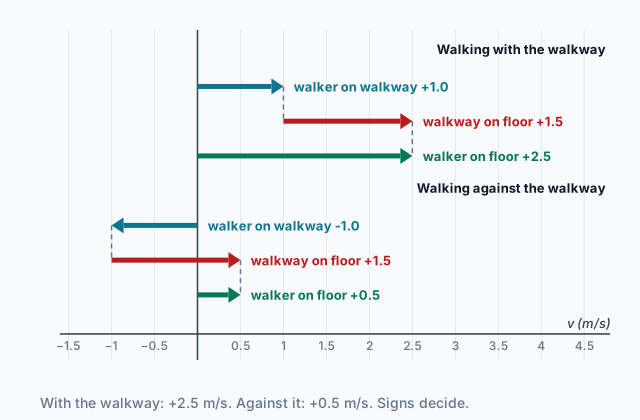
The diagram shows a moving walkway (W) in an airport, moving at +1.5 m/s relative to the floor (F), with its direction positive. A traveler (P) walks at 1.0 m/s relative to the walkway. Walking with it, m/s. Walking against it, m/s, so she still drifts forward, slowly.
The signs do the work. Adding the two speeds would give 2.5 m/s both times, which is wrong for the second walk. Choose a positive direction, give every velocity its sign, then add.
Swapping the frames flips the sign: . The walkway moves at +1.5 m/s relative to the floor, so the floor moves at m/s relative to someone standing on the walkway.
Quick check · Calculate
A bus drives east along a straight road at 12 m/s. A passenger walks toward the back of the bus at 1.5 m/s relative to the bus. Take east as positive. What is the passenger's velocity relative to the road? Include its sign.
2c. When the observer moves too
Often the observer is moving relative to the ground as well, and you want one moving object measured from another. Write both velocities relative to the ground (G), then put the ground in the middle:
On a highway, take north as positive. You are in car A, driving north at 30 m/s. Car B ahead of you drives north at 26 m/s. From your seat, m/s: you see it drift back toward you at 4 m/s, though both cars are heading north. A truck in the other lane drives south at 25 m/s, so m/s, and you measure m/s as it rushes past.
The tempting shortcuts are to add the two speeds every time, or to subtract the smaller from the larger every time. Each gets the size right for one of those two vehicles, and neither gives a direction. Only the signs give both.
This is vector addition and subtraction, kept to one line: every motion here points forward or backward along the same road, track or river.
Quick check · Multiple choice
A cyclist rides east at 8 m/s along a straight bike path. A jogger ahead of her runs east at 3 m/s on the same path. Take east as positive. What is the jogger's velocity measured by the cyclist?
2d. What every frame agrees on
Frames disagree about velocity, but not about acceleration. An inertial reference frame is one that is not accelerating: it is at rest or moves at a constant velocity. Unless a problem says otherwise, every frame is inertial.
Measured from any inertial frame, an object has the same acceleration. A runner speeds up from 4 m/s to 6 m/s in 2 s along a straight path, taking her direction as positive: . A cyclist rides beside her at a steady 5 m/s. In his frame her velocity goes from m/s to m/s, a change of 2 m/s in 2 s, the same . His 5 m/s comes off both velocities, so it cancels in the change.
That explains the ball on the train. The rider sees it fall straight down, and the platform sees it carry the train's forward velocity as it falls. The paths differ, but both measure the same downward acceleration of , because the train's steady velocity adds nothing to how fast the ball's velocity changes.
A faster observer does not see a bigger acceleration. Only a frame that is itself accelerating would measure a different one.
Quick check · Sort it
A rider on a train moving at a steady velocity along a straight track and a person on the platform watch the same events. Air resistance is negligible. Tap each measurement, then where it belongs.
Depends on the observer's frame
The same in every inertial frame
Part 3 Watch it done A tour boat up the river and back
Watch each step, then finish the problem yourself.
A tour boat moves at 5 m/s relative to the water. The river flows downstream at 2 m/s relative to the shore. The boat leaves its dock, travels 210 m straight upstream to a bridge, turns around and comes straight back. Take downstream as positive. How long does the round trip take?
Step 1 · Name the frames and their velocities
Call the boat B, the water W and the shore S. Along the river, . The current is the same on both legs, m/s. Only the boat's velocity through the water changes sign when it turns.
Step 2 · The upstream leg
Heading upstream, m/s, so m/s. The boat covers the 210 m to the bridge at 3 m/s, which takes s.
Why this step?
Why is the boat's velocity relative to the shore m/s on the way up, and not m/s?
Because the current points downstream, the opposite way to the boat's motion through the water. Every second the water carries the boat 2 m back toward the dock while the boat pushes 5 m forward through it. Adding 5 and 2 as speeds would treat the current as a help on the leg where it is a hindrance.
Step 3 · The downstream leg
Heading back, m/s, so m/s. Now the current helps, and the boat covers the same 210 m faster.
Your step · Calculate
Finish it. A tour boat moves at 5 m/s relative to the water on a river that flows downstream at 2 m/s relative to the shore. It travels 210 m straight upstream to a bridge and comes straight back to its dock. Take downstream as positive. How long does the whole round trip take?
s
Part 4 Try it A bolt in an elevator
A new situation, and this time the motion is vertical. A freight elevator rises at a steady 2 m/s. A bolt works loose from its ceiling and falls. Ria rides in the elevator, and Sam stands still in the lobby, watching through the glass doors. Before you calculate anything, decide whose frame makes the fall simplest to describe.
Try it · Decide and justify
A freight elevator rises at a steady 2 m/s. A bolt comes loose from its ceiling and falls. Air resistance is negligible, and up is positive. Ria rides in the elevator, and Sam stands still in the lobby. Who measures the bigger acceleration for the falling bolt?
Which reason supports your answer?
Try it · Calculate
A freight elevator rises at a steady 2 m/s. A bolt comes loose from its ceiling, 3.2 m above the elevator floor. Air resistance is negligible. Take up as positive. Ria, riding in the elevator, times the fall. How long does the bolt take to reach the floor? Give your answer to the nearest 0.01 s.
Part 5 Explain it A claim in words, then the numbers
Nothing you type leaves this page.
Free response is 50% of the exam score. This one is shaped like Question 4, Qualitative/Quantitative Translation.
Free-response practice · Question 4 style
A car on a straight road heads east and speeds up from to in a time , measured from the roadside. A train on a track beside the road moves east at a steady velocity , faster than the car the whole time. Take east as positive. A passenger on the train watches the car.
(a) The passenger says that, to her, the car seems to be moving backward and slowing down, so its acceleration must be smaller than the roadside value, or even point west. Make a claim about how the car's acceleration measured from the train compares with its acceleration measured from the roadside, in size and in direction. Explain your reasoning in words, without equations.
(b) Derive an expression for the car's acceleration measured from the train, in terms of , , and .
(c) Explain how your expression in (b) is consistent with your claim in (a).
(d) Suppose m/s, m/s, s and m/s. Explain how the passenger can see the car slowing down while the roadside sees it speeding up.
Model answer
(a) The acceleration is the same from the train as from the roadside, in size and in direction. The train moves at a constant velocity, so the passenger measures every velocity of the car lower than the roadside does by the same amount, the train's velocity. Acceleration depends only on how much the velocity changes, and taking the same amount off the starting and ending velocities leaves that change alone. (b) Relative to the train, , so the car starts at and ends at . Then . (c) is exactly the acceleration measured from the roadside, and has cancelled, so the result is the same whatever steady velocity the train has. That is the claim: same size, same direction. (d) Relative to the train the car starts at m/s and ends at m/s. It moves west, and its speed drops from 15 m/s to 3 m/s, so it is slowing down. Its acceleration is in both frames. In the train's frame that positive acceleration points opposite the negative velocity, which is what slowing down means. Speeding up or slowing down depends on the frame; the acceleration does not.
Score your own answer. This is a self-check, not a grade. Tick each point your answer makes.
Part 6 Check yourself Timing an airport walkway
Both case questions use the walkway timing table.
A physics class times one student along a straight moving walkway in an airport, 48 m from end to end. She walks at the same steady pace relative to whatever surface is under her feet. Every trip in the table goes from one end of the walkway to the other, in the walkway's direction.
| Trip | Time (s) |
|---|---|
| Stands still on the walkway | 60 |
| Walks on the floor beside the walkway | 40 |
| Walks along the walkway, in its direction | 24 |
Case question 1 · Calculate
Using the walkway timing table, how long would the student take to walk the full 48 m of the walkway against its direction, at her same pace, starting from the far end?
Case question 2 · Multiple choice
Using the walkway timing table, take the walkway's direction as positive. During the 24 s trip, a friend stands still on the floor beside the walkway. What velocity does the walking student measure for her friend?
The rest stand on their own and do not use the case.
Check yourself · Spot the error
Take east as positive. A car drives east at 24 m/s, and a truck on the same road drives west toward it at 20 m/s. A student works out the truck's velocity as measured by the car's driver. Tap the first line that goes wrong.
Check yourself · Match
A train moves east along a straight track at 25 m/s relative to the ground. Take east as positive. Tap an observer, then the velocity of the train that observer measures.
Part 7 Keep it Bring back earlier ideas
Pulling an older idea back up is what makes it last.
From 1.3 Representing Motion · Spot the error
A runner's position-time graph has three straight segments: from 0 m at 0 s up to 20 m at 4 s, level at 20 m until 6 s, then down to 0 m at 10 s. Position is measured from the starting line, positive away from it. A student describes the run. Tap the line with the mistake.
From 1.1 Scalars and Vectors in One Dimension · Multiple choice
Take right as positive. A cart rolls 3.0 m to the right, then 5.0 m to the left. What is the component of its total displacement?
In three lines
- A velocity is measured from a reference frame, and the frame decides its size and direction.
- Along one line, with signs, and swapping the frames flips the sign.
- Every inertial frame measures the same acceleration for an object, however fast the frame moves.
Vocabulary
- Reference frame
- The viewpoint a measurement is made from: an observer, an origin and a positive direction that all move with the observer.
- Inertial reference frame
- A reference frame that is not accelerating, so it is at rest or moves at a constant velocity; a frame is assumed inertial unless a problem says otherwise.
- Observed velocity
- The velocity of an object as measured from an observer's reference frame, which combines the object's velocity and the velocity of that frame.
- Relative velocity
- The velocity of one object measured in the reference frame of another, such as for B measured from A.
Course alignment, for teachers
AP Physics 1: Algebra-Based topic 1.4, Unit 1: Kinematics.
- Skill 1.C: Create qualitative sketches of graphs that represent features of a model or the behavior of a physical system.
- Skill 2.A: Derive a symbolic expression from known quantities by selecting and following a logical mathematical pathway.
- Skill 2.B: Calculate or estimate an unknown quantity with units from known quantities, by selecting and following a logical computational pathway.
- Skill 3.C: Justify or support a claim using evidence from experimental data, physical representations, or physical principles or laws.
This lesson maps all 5 essential knowledge statements of the topic to the part that teaches each one: 5 are checked by a scored question. The map is in the lesson file.