Unit 6 · Topic 6.1 · about 30 minutes · 7 parts · 12 scored checks, 1 of them multiple choice
AP Physics 1: Algebra-Based 6.1: Rotational Kinetic Energy
 Tap to open the picture full size
Part 1 Think first One hoop spins, one slides
Commit to a guess first. Being wrong now makes the right idea stick better.
Predict first
Two identical thin metal hoops have all their mass in the ring itself. Hoop 1 is mounted on light spokes and an axle through its center, and spun so that every bit of its rim moves at 4.0 m/s; its center stays where it is. Hoop 2 lies flat on smooth ice and slides across it at 4.0 m/s without turning. Which hoop has more kinetic energy?
In short. Rotational kinetic energy is the kinetic energy a rigid system has because it turns, , set by its rotational inertia and its angular velocity.
- A rigid system can have rotational kinetic energy while its center of mass is at rest, because the points within it are moving.
- It is a scalar: is squared, so a clockwise and a counterclockwise spin at the same rate store the same energy, and energies add as positive numbers.
- A system that moves and turns at once has a total kinetic energy of for its center of mass plus for its rotation about it.
Part 2 Learn it Three short ideas, each checked as you go
2a. Spinning in place is still moving
In 3.1 Translational Kinetic Energy an object had kinetic energy because it moved from place to place. A bicycle wheel spinning on a repair stand goes nowhere. Its center of mass, at the axle, stays at rest.
Now look at the rest of the wheel. The valve, the spokes and every bit of the tire move in circles, each at the linear speed from 5.2 Connecting Linear and Rotational Motion. Each of those moving bits has kinetic energy , so the wheel as a whole has kinetic energy, even though its center of mass is still.
You can show the energy is there. Hold a rag against the spinning tire and the wheel slows to a stop while the rubber and the rag warm up: friction has turned the wheel's energy of motion into thermal energy, as in 3.4 Conservation of Energy. A wheel with no kinetic energy would have nothing to give the rag.
The energy a rigid system has because it turns is its rotational kinetic energy. A system can have it while its center of mass stays exactly where it is.
Quick check · Decide and justify
A ceiling fan turns at a steady rate. Its center of mass, at the middle of the fan, stays at rest the whole time. A student says the turning fan has no kinetic energy, because its center of mass is not moving. Is the student right?
Which reason supports your answer?
2b. Add up the points:
Take a light rod with two 0.50 kg beads, each 0.30 m from an axis through the rod's middle, turning at 4.0 rad/s. Each bead moves at m/s and has J, so the pair has 0.72 J.
Do the same for any rigid object, one small piece at a time. A piece of mass a distance from the axis moves at , and every piece shares the same , so
The sum in brackets is the rotational inertia from 5.4 Rotational Inertia. For the beads, kg·m², and J, the same total. So for an object turning about a fixed axis, is the translational kinetic energy of all its points added up, and it is all the kinetic energy the object has. For an extended object such as a wheel or a door, a problem gives you ; for a few point masses you add up yourself, as you just did for the beads.
Like , it is a scalar. The angular velocity is squared, so a clockwise spin and a counterclockwise spin at the same rate store the same energy, and the energies of several spinning objects add as positive numbers.
Quick check · Sketch the graph
A lab flywheel has a rotational inertia of 0.50 kg·m² about its axle. Sketch its rotational kinetic energy against its angular speed, from 0 to 8.0 rad/s. The first point is fixed at 0.
One shape that fits
Drag a point up or down, or tap it and use the arrow keys. The shape is checked, and the graph must pass through the values the question gives.
2c. Moving and spinning at once
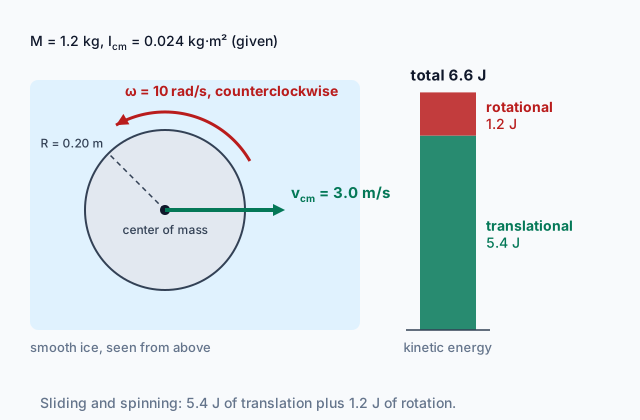
Plenty of objects travel and turn at the same time. The disk in the diagram at the top of the page slides across smooth ice at 3.0 m/s while it spins at 10 rad/s about its own center.
Its total kinetic energy has two parts. The translational part comes from the motion of its center of mass, J. The rotational part comes from its spin about its center of mass, , with the given kg·m²: J. The total is the sum, 6.6 J.
Each part takes its own speed. The translational part uses how fast the center of mass moves; the rotational part uses how fast the object turns about its center of mass. Leave out the spin and the disk is just sliding, with 5.4 J. Leave out the slide and it is spinning in place, with 1.2 J.
A ball rolling along the floor is the best known case of both at once. Rolling has its own rules, linking the two speeds, and those come in 6.5.
Quick check · Calculate
A 0.20 kg flying disc sails across a field. At one instant its center of mass moves at 9.0 m/s and it spins at 40 rad/s about its center of mass, where its rotational inertia is 0.0030 kg·m². What is its total kinetic energy at that instant? Give your answer to the nearest 0.1 J.
Part 3 Watch it done A child on a merry-go-round
Watch each step, then finish the problem yourself.
A playground merry-go-round has a rotational inertia of 250 kg·m² about its axle. A 40 kg child sits 1.5 m from the axle, and the two turn together at 1.2 rad/s. Treating the child as a point, what is the total kinetic energy of the merry-go-round and the child?
Step 1 · Treat the child as a point on the platform
The child turns with the merry-go-round, 1.5 m from the axle, so about the axle the child adds kg·m², as in 5.4 Rotational Inertia.
Step 2 · Make one rigid system
The child and the platform turn together with one angular velocity, so treat them as one rigid system: kg·m². Every bit of it turns about the fixed axle, so about that axle is all of the system's kinetic energy.
Why this step?
Why can the child's kinetic energy be counted inside instead of as ?
It is the same energy counted two ways. The child moves in a circle at m/s, so J. That is exactly J. Putting the child's into the rotational inertia just collects the child with every other moving piece of the system.
Your step · Calculate
Finish it. A playground merry-go-round has a rotational inertia of 250 kg·m² about its axle. A 40 kg child sits 1.5 m from the axle, and the two turn together at 1.2 rad/s. Treating the child as a point, what is the total kinetic energy of the merry-go-round and the child? Give your answer to the nearest joule.
J
Part 4 Try it Storing energy in a flywheel
A new situation, worked backward: you know how much energy a spinning object holds, and you want how fast it turns. Exercise bikes use a heavy flywheel, which keeps turning smoothly between pushes on the pedals because it stores rotational kinetic energy. Find a flywheel's angular speed from its energy, then practice with new numbers each time.
Try it · Calculate
A stationary exercise bike has a flywheel that turns on a fixed axle, with a rotational inertia of 0.30 kg·m² about it. A rider pedals until the flywheel has 60 J of rotational kinetic energy. What is the flywheel's angular speed then? Give your answer to the nearest 0.1 rad/s.
Part 5 Explain it Claim, derive, connect
Nothing you type leaves this page. Check your answer against the model and each scoring point.
Free response is 50% of the exam score. This one is shaped like Question 4, Qualitative/Quantitative Translation.
Free-response practice · Question 4 style
A thin hoop and a uniform solid disk have the same mass and the same radius . Each turns on a light axle through its center, perpendicular to its flat face. About that axle the hoop's rotational inertia is and the disk's is . Both are spun up to the same angular speed . A student says the two have the same kinetic energy, because they have the same mass and their rims move at the same speed.
(a) Make a claim about which one has the greater rotational kinetic energy, or whether they are equal. Explain your reasoning in words, without equations, using how fast the different parts of each object move.
(b) Starting from , derive expressions for and in terms of , and . Then derive the ratio , which says how many times greater one energy is than the other.
(c) Explain how your expressions in (b) are consistent with your claim in (a), and why matching rim speeds do not mean matching energies.
(d) The hoop keeps turning at , and the disk is spun faster until the two have the same rotational kinetic energy. Derive an expression for the disk's angular speed then, in terms of .
Model answer
(a) The hoop has the greater rotational kinetic energy. All of the hoop's mass is in its rim, so every bit of it moves at the rim speed. The disk has the same mass, but much of it is closer to the axle, where at the same angular speed it moves more slowly, and the kinetic energy of each bit goes with the square of its speed. The student is wrong, because only the rims match.
(b) and . Then , so the hoop has twice the disk's rotational kinetic energy.
(c) The ratio is 2, greater than 1, so the hoop has more, as claimed, and , and all cancel, so that holds for any such pair at any shared angular speed. The given rotational inertias carry the reasoning of (a): the hoop's is twice the disk's because its mass sits farther out, and at the same angular speed the energy is proportional to the rotational inertia. Both rims move at , so : exactly the kinetic energy the whole mass would have moving at the rim speed, because every bit of the hoop does. is half that, because only the disk's outer edge moves at and its inner parts move more slowly. The rim speed fixes the energy only when all the mass is at the rim.
(d) Setting the energies equal, , so and , about . Doubling the disk's angular speed would overshoot: it would give the disk four times its old energy, twice the hoop's.
Score your own answer. This is a self-check, not a grade. Tick each point your answer makes.
Part 6 Check yourself Wheels and flywheels on a test stand
Both case questions use the bike shop's table.
A bike shop that also services exercise bikes tests four wheels, some from bicycles and some heavier exercise-bike flywheels, by spinning each one on a stand, about its own fixed axle. The table gives each wheel's rotational inertia about its axle and its angular velocity at one moment. Seen from the side of the stand, counterclockwise is positive, so a negative angular velocity means the wheel turns clockwise.
| Wheel | Rotational inertia (kg·m²) | Angular velocity (rad/s) |
|---|---|---|
| W | 0.100 | +26.0 |
| X | 0.400 | -10.0 |
| Y | 0.080 | -35.0 |
| Z | 0.180 | +20.0 |
Case question 1 · Multiple choice
Using the bike shop's table, with counterclockwise positive: which wheel has the greatest rotational kinetic energy at that moment?
Case question 2 · Calculate
Using the bike shop's table, with counterclockwise positive: what is the total rotational kinetic energy of the four wheels together at that moment? Give your answer to the nearest 0.1 J.
The rest stand on their own and do not use the case.
Check yourself · Spot the error
Two 0.40 kg beads are fixed to a light rod, each 0.25 m from an axis through the rod's middle, perpendicular to the rod. The rod turns at 8.0 rad/s. A student works out the kinetic energy of the rod and beads. Tap the first line that goes wrong.
Check yourself · Sort it
Each card describes an object at one moment. Tap a card, then the kind of kinetic energy it has.
Translational only
Rotational only
Both
Check yourself · Fill the statement
A rigid object turns about a fixed axis with angular velocity . Tap a blank, then an answer.
A small piece of the object with mass , a distance from the axis, moves at speed , so a piece twice as far from the axis moves . Adding over every piece gives , and the sum in brackets is the object's .
Part 7 Keep it Bring back earlier ideas
Pulling an older idea back up is what makes it last.
A new situation, and this time the linear speed is the thing held fixed. A CD stores its music along one spiral track that starts near the center of the disc and winds outward. As the disc plays, the laser slowly moves out along the track, and the track has to pass under the laser at the same linear speed the whole time, about 1.2 m/s. So the motor keeps adjusting how fast the disc turns.
From 5.2 Connecting Linear and Rotational Motion · Calculate
A CD player reads a disc's track as it passes under the laser at a steady 1.2 m/s. At one moment the laser is reading the track 0.025 m from the center of the disc. What is the magnitude of the disc's angular velocity at that moment? Give your answer to the nearest 1 rad/s.
From 3.1 Translational Kinetic Energy · Decide and justify
A 0.50 kg ball is thrown straight down from a balcony at 6.0 m/s. Take up as positive, so the ball's velocity as it leaves the hand is m/s. A student writes the ball's translational kinetic energy at that moment as J. Is the student right?
Which reason supports your answer?
In three lines
- Rotational kinetic energy is , the kinetic energy of every point of a turning rigid system added up.
- A system can have it while its center of mass is at rest. It is a scalar, and because the angular velocity is squared it is never negative.
- An object that moves and spins has for its center of mass plus for its rotation about it.
Vocabulary
- Rotational kinetic energy
- The kinetic energy a rigid system has because it rotates, , set by its rotational inertia and the square of its angular velocity.
- Translational kinetic energy
- The kinetic energy due to the linear motion of a system's center of mass, .
- Rigid system
- A system that holds its shape as it rotates, so all of its points share the same angular velocity.
- Scalar quantity
- A quantity with a size and no direction, such as mass, energy or work, so it is never drawn as an arrow; work can be negative, but kinetic energy never is, because the speed in it is squared.
Course alignment, for teachers
AP Physics 1: Algebra-Based topic 6.1, Unit 6: Energy and Momentum of Rotating Systems.
- Skill 1.A: Create diagrams, tables, charts, or schematics to represent physical situations.
- Skill 2.B: Calculate or estimate an unknown quantity with units from known quantities, by selecting and following a logical computational pathway.
- Skill 2.C: Compare physical quantities between two or more scenarios or at different times and locations in a single scenario.
- Skill 3.B: Apply an appropriate law, definition, theoretical relationship, or model to make a claim.
This lesson maps all 5 essential knowledge statements of the topic to the part that teaches each one: 5 are checked by a scored question. The map is in the lesson file.